April 14, 2026
Why Military Vehicle Spare Parts Cost More Than the Vehicle Itself: A Defense Procurement Guide to Total Cost of Ownership
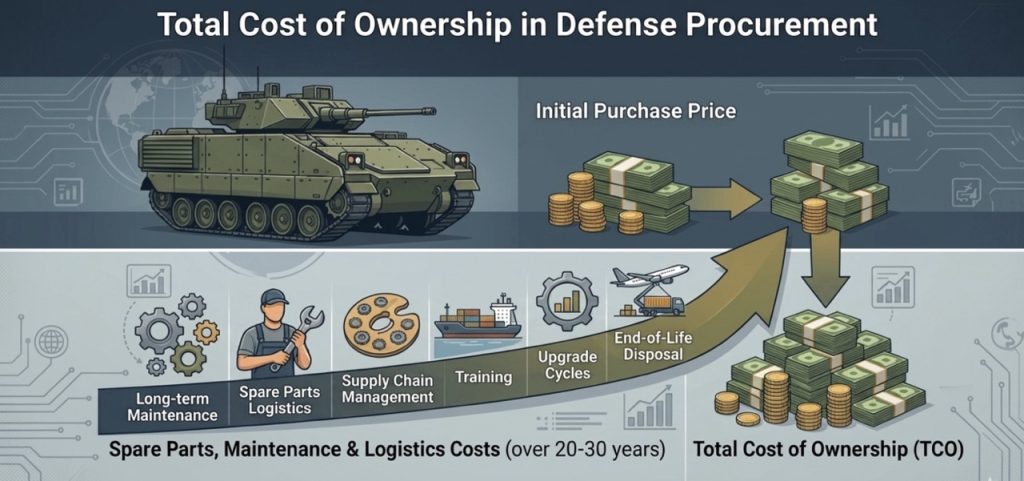
When defense procurement officers evaluate the acquisition of a military vehicle, the purchase price is rarely the most significant number on the table. What most defense planners learn over time, often at considerable operational cost, is that the initial contract value represents only a fraction of what a platform will ultimately require to remain mission-capable throughout its service life.
This concept, known as Total Cost of Ownership (TCO) or Life Cycle Cost (LCC), is one of the most consequential frameworks in defense logistics and procurement planning. Understanding it is not optional for acquisition professionals. It is the difference between a fleet that sustains operational readiness for decades and one that consumes defense budgets year after year without delivering the availability that commanders require.
The data behind this argument is no longer academic. It comes from government accountability offices, treaty-level defense expenditure bodies, and combat-tested sustainment organizations across multiple NATO members. This article examines that data in full.
The Global Context: Defense Spending Has Never Been Higher, but Readiness Is Not Keeping Pace
World military expenditure rose to 2,718 billion USD in 2024, meaning that spending has increased every year for a full decade, rising by 37 percent between 2015 and 2024. The 9.4 percent increase in 2024 was the steepest year-on-year rise since at least 1988. [SIPRI](https://www.sipri.org/publications/2025/sipri-fact-sheets/trends-world-military-expenditure-2024)
In 2024, military expenditure by the 32 NATO members totalled 1,506 billion USD, equal to 55 percent of world military spending. All NATO members increased their military spending in 2024. [SIPRI](https://www.sipri.org/sites/default/files/2025-04/2504_fs_milex_2024.pdf)
Despite this historic surge in investment, the readiness of ground vehicle fleets has deteriorated significantly in the same period. The US Government Accountability Office published its findings in September 2025 after reviewing 18 Army and Marine Corps ground vehicle types across a ten-year window. The results were unambiguous.
None of the Army vehicles reviewed met the Army’s goal of availability 90 percent of the time in FY 2024. Since FY 2015, mission capable rates declined for 16 of the 18 vehicles reviewed. According to Army and Marine Corps officials, two challenges affected all 18 ground vehicles: a lack of parts and materiel, and not having current technical data or drawings. [U.S. GAO](https://www.gao.gov/products/gao-25-108679)
This is not a funding problem in the traditional sense. Even as mission capable rates and depot overhauls declined, the cost of maintaining Army and Marine Corps vehicles went up for most selected ground vehicles. The Abrams experienced a fleet-wide increase in maintenance costs of 181.3 million USD when comparing FY 2015 to FY 2023, and per-vehicle maintenance costs nearly doubled. [U.S. GAO](https://www.gao.gov/products/gao-25-108679)
More money spent, lower availability achieved. The explanation lies in how defense organizations account for cost, and how long they wait to understand what sustainment truly requires.
What Total Cost of Ownership Actually Means in a Defense Context
Total Cost of Ownership in defense procurement refers to the full financial obligation of a military platform from initial acquisition through eventual decommissioning. It encompasses every expenditure across the complete lifespan of the system, not only what appears on the procurement contract.
In the United States and among NATO member states, this concept has become intrinsic to every defense acquisition, whether between industry and government or government-to-government. It is known by various names including Whole Life Cost, Cost of Ownership, or Total Ownership Cost, but Life Cycle Cost remains the most comprehensive term, capturing the processes, phases, and variables involved throughout a system’s lifetime. [ORF Online](https://www.orfonline.org/research/the-role-of-life-cycle-cost-in-defence-procurement)
The cost structure of a military vehicle breaks into three primary phases. First, the acquisition phase: design, development, production, testing, and initial procurement. Second, the operating and support phase: fuel, crew, maintenance, depot overhaul, and spare parts throughout service life. Third, the disposal phase: decommissioning, environmental remediation, and transfer or destruction.
Of these three phases, operating and support is consistently the largest by a significant margin, and within it, spare parts procurement is among the most persistent and least fully accounted for cost drivers.
The 70 to 80 Percent Reality: Where Defense Money Actually Goes
The figure that most surprises professionals outside the procurement world is this: over the lifespan of a system, sustainment costs can dwarf initial procurement. Over 70 percent of a weapon system’s lifecycle cost is incurred in sustainment. [Umbrex](https://umbrex.com/resources/how-industries-work/aerospace-defense/how-the-defense-contractors-manufacturing-industry-works/)
For some programs, depending on longevity, maintenance, operation, and support costs represent as much as 80 percent of total lifecycle costs. [Neo4j](https://neo4j.com/customer-stories/u-s-army/)
The GAO 2025 report confirmed this pattern at the fleet level: historically, the costs to sustain a weapon system from initial operations through the end of its life account for approximately 70 percent of a weapon system’s total life-cycle cost. [The National Interest](https://nationalinterest.org/blog/buzz/government-accountability-office-issues-scathing-report-on-army-readiness-ps-100825)
This means that a ground vehicle acquired for 2 million USD may require 10 to 14 million USD or more across its operational life when all sustainment expenditures are fully accounted for. The purchase price is not the beginning of cost. It is the smallest entry on a decades-long ledger.
Since sustainment costs represent two thirds of the entire weapon system LCC, the mindset that prioritizes acquisition over sustainment in defense procurement needs to change. LCC and performance-based contracting are the way to ensure that services, ministries of defense, and industry maintain visibility beyond the acquisition phase. [ORF Online](https://www.orfonline.org/research/the-role-of-life-cycle-cost-in-defence-procurement)
Why Spare Parts Drive Such a Disproportionate Share of Sustainment Cost
Several structural factors make spare parts procurement one of the most cost-intensive elements of military vehicle sustainment. Understanding them separately is necessary for any procurement team attempting to build a credible lifecycle cost model.
Platform longevity versus component lifespan
Military systems remain in service for decades. A fighter jet or tank may serve 30 or more years. [Umbrex](https://umbrex.com/resources/how-industries-work/aerospace-defense/how-the-defense-contractors-manufacturing-industry-works/) Ground vehicles often serve considerably longer. The M60 has undergone many updates over its service life, with its interior layout providing ample room for improvements and extending the vehicle’s service life for over four decades. [Wikipedia](https://en.wikipedia.org/wiki/M60_tank) As of 2026, the tank still appears in service with 17 foreign operators, including Egypt, Turkey, Taiwan, Saudi Arabia, Thailand, Tunisia, Bahrain, and others. [Modernengineeringmarvels](https://gallery.modernengineeringmarvels.com/2026/03/18/why-17-militaries-still-keep-the-m60-tank-ready/)
The challenge is that the components embedded in these platforms were designed and manufactured decades ago. Military platforms like the B-52 can last decades, while commercial components like semiconductors can have lifetimes as short as six months. The defense industry is at the mercy of commercial component life cycles. [Military Embedded Systems](https://militaryembedded.com/from-the-editor/supply-chain-management-and-obsolescence) A platform built for a 30-year service life will outlive multiple generations of its own components. Procurement teams that do not plan for this face both availability crises and inflated costs when they eventually arrive at the market unprepared.
Sole-source vendor concentration and pricing power
The underlying issue is that these parts are produced by sole-source vendors whose business models are optimized for large batch production, not small, urgent orders. When demand is low and quantities are small, the supply system struggles to respond quickly. [Breaking Defense](https://breakingdefense.com/2026/02/the-army-is-mispricing-readiness-and-additive-manufacturing-exposes-the-problem/)
The absence of up-to-date technical data or proprietary drawings from original equipment manufacturers has prevented technicians and skilled maintainers from conducting essential maintenance, making repairs, or sourcing parts from alternative suppliers. This has led to reliance on costly sole-source vendors whose own capacity is often strained. [Defense Security Monitor](https://dsm.forecastinternational.com/2025/10/28/the-u-s-armed-services-have-a-vehicle-serviceability-problem-on-their-hands/)
Sole-source reliance creates vulnerabilities along the supply chain, decreases innovation, and makes it difficult to determine the fair price for those goods. [The Heritage Foundation](https://www.heritage.org/defense/commentary/how-sole-sources-military-spare-parts-squander-defense-dollars-risk-national)
Obsolescence and the discontinuation problem
Parts obsolescence negatively impacts many warfighter programs and capabilities. When the overall system outlives the function or relevancy of its embedded components, the system is considered obsolete. Components are considered obsolete if they are no longer produced or they do not interface with newer parts. [ADS](https://www.adsinc.com/news/bridging-the-obsolescence-gap)
As a result of turbulence in the defense industrial base since the end of the Cold War, many former defense contractors are no longer in business. These defunct companies may own the intellectual property rights, including patents and technical data, necessary for production. [Strategicinstitute](https://strategicinstitute.org/other-transactions/solving-obsolete-spare-parts-problem-ot/)
When a manufacturer discontinues a part, procurement teams face three options: source from an alternative supplier that may require costly qualification testing, invest in reverse engineering under a new technical data package, or accept extended vehicle downtime. All three paths carry significant cost implications that were not accounted for at the time of initial acquisition.
The cannibalization response and what it reveals
When spare parts are unavailable through normal supply channels, military organizations frequently resort to stripping components from non-operational or decommissioned vehicles. This practice, known as cannibalization, temporarily addresses availability at the unit level while concealing the structural deficit at the fleet level.
In many cases, parts shortages prompted the Army to source parts from older vehicles that were no longer in use in order to make repairs. In some instances, those shortages come from a lack of production higher up in the logistics chain, with demand outpacing supply. [Task & Purpose](https://taskandpurpose.com/news/army-marines-vehicles-delays-maintenance/)
The number of overhauls performed by Army depots dropped from 1,278 in FY 2015 to 12 in FY 2024. A senior Army official stated that the Army accepted the risk from the decision to reduce funding for overhauls. Army officials also said reducing overhauls negatively affected the mission capable rates of most vehicles. The Army partially mitigated declining overhauls by harvesting parts from vehicles being phased out of service. [U.S. GAO](https://www.gao.gov/products/gao-25-108679)
Cannibalization reduces two fleets simultaneously while appearing to solve a problem in one. It is a symptom of a parts procurement system that has fallen behind demand, and it is one of the clearest indicators that total cost of ownership was not adequately modeled at the acquisition stage.
What This Looks Like at Scale: The Market Behind Military Vehicle Sustainment
In FY 2023, the Army and Marine Corps spent more than 2.3 billion USD combined on depot maintenance of their ground vehicles. [U.S. GAO](https://www.gao.gov/products/gao-25-108679) This figure covers only depot-level work and only two branches of one military. It excludes unit-level maintenance, logistics overhead, technical data management, and the cost of downtime itself.
At the global level, the market for sustaining military vehicles has reached significant scale. The global military vehicle sustainment market size was valued at 21.86 billion USD in 2024 and is projected to grow from 23.30 billion USD in 2025 to 38.80 billion USD by 2032, exhibiting a CAGR of 7.56 percent. [Kingsresearch](https://www.kingsresearch.com/report/military-vehicle-sustainment-market-2804)
The primary factors driving this growth include the need to extend the service life of aging vehicle fleets to optimize defense spending and the increased operational tempo in conflict zones, which requires rapid asset refurbishment to ensure combat effectiveness. [GlobeNewswire](https://www.globenewswire.com/news-release/2026/01/22/3224019/0/en/27-75-Military-Vehicle-Sustainment-Market-Global-Industry-Size-Share-Trends-Opportunity-and-Forecast-2021-2031.html)
This growth is not primarily driven by new platform procurement. It is driven by the accumulating cost of sustaining platforms that were acquired years or decades ago without sufficient lifecycle planning.
The Strategic Shift: Sustaining Existing Fleets Over Buying New Systems
One of the most significant structural changes in global defense procurement over the past decade is the deliberate shift away from acquiring new complete systems toward sustaining and extending the operational life of existing platforms.
Rather than buying new complete systems, there appears to be a stronger focus on maintaining, upgrading, and extending the life of existing platforms. Parts and components for existing systems are seeing much faster value growth than complete new systems. Defense organizations appear to be maximizing the value of their existing assets rather than making entirely new purchases. [Open Opportunities](https://openopps.com/defence-procurement-trends-global-analysis-2025/)
This shift is not only a response to budget pressure. It reflects a strategic reality that modern military platforms, particularly armored vehicles and heavy tactical trucks, are built with sufficient structural margin to accept multiple generations of systems upgrades while retaining their original hull architecture and automotive layout.
For some militaries, upgrading the M60 is a more practical option than purchasing expensive new tanks. New tanks also require new and improved maintenance facilities, and new, more expensive spare parts. [19FortyFive](https://www.19fortyfive.com/2025/12/the-m60-patton-tank-has-a-message-for-the-u-s-army/)
Once training pipelines, maintenance infrastructure, spare parts, and depot expertise are built around a platform, replacement becomes a long industrial and budgetary process rather than a simple procurement decision. [Modernengineeringmarvels](https://gallery.modernengineeringmarvels.com/2026/03/18/why-17-militaries-still-keep-the-m60-tank-ready/)
The implication for procurement teams is direct. A platform that was acquired 20 or 30 years ago is not simply an aging asset. It is a system around which an entire maintenance and logistics ecosystem has been built. The cost of replacing that ecosystem, including the supplier relationships, the technical documentation, the trained personnel, and the accumulated parts inventory, is rarely captured in new platform acquisition cost estimates.
Three Procurement Failures That Drive TCO Above Initial Estimates
Most lifecycle cost overruns in military vehicle sustainment trace back to one or more of three procurement failures that occur at the acquisition stage.
Failure one: Pricing at acquisition, not at ownership
Defense acquisition tends to reward the lowest unit price at point of purchase. The organizational and budget cycles within ministries of defense typically align around annual or biennial appropriations, which are structurally biased toward acquisition cost. This creates an incentive to underestimate or defer sustainment cost projections.
Acquisition tends to take precedence over sustainment in defense procurement. Since sustainment costs represent two thirds of the entire weapon system LCC, this mindset needs to change. [ORF Online](https://www.orfonline.org/research/the-role-of-life-cycle-cost-in-defence-procurement)
A procurement officer who selects a platform based primarily on acquisition price without a credible 20-year sustainment cost model is not minimizing expenditure. They are deferring it, at compound cost, to their successors.
Failure two: Inadequate parts and data rights negotiation
The second structural failure occurs when procurement contracts are finalized without securing sufficient technical data rights and parts sourcing flexibility. When original equipment manufacturers retain proprietary control over maintenance data, drawings, and specifications, procurement teams lose the ability to qualify alternative suppliers, reducing competition and inflating long-term parts costs.
The absence of up-to-date technical data or proprietary drawings from original equipment manufacturers prevented Army technicians and skilled maintainers from conducting essential maintenance, making repairs, or sourcing parts from alternative suppliers. [Defense Security Monitor](https://dsm.forecastinternational.com/2025/10/28/the-u-s-armed-services-have-a-vehicle-serviceability-problem-on-their-hands/)
Negotiating data rights at the acquisition stage is considerably less expensive than attempting to reverse-engineer or litigate access to technical packages after the platform has entered service and the original manufacturer has reduced support.
Failure three: Insufficient obsolescence planning
Platforms with service life targets of 20, 30, or 40 years will outlive the commercial production runs of many of their embedded components. Procurement teams that do not build obsolescence monitoring into their lifecycle management plans will face parts availability crises that force emergency procurements at premium prices.
Military systems are increasingly vulnerable to counterfeit parts as a result of schedule and obsolescence issues. Counterfeit parts typically enter the supply chain from sources other than the original component manufacturer’s authorized distribution networks. [Military Embedded Systems](https://militaryembedded.com/from-the-editor/supply-chain-management-and-obsolescence)
Counterfeit parts are not merely a quality concern. They are a direct consequence of inadequate sourcing infrastructure. When legitimate supply channels cannot meet demand, unauthorized suppliers fill the gap, often with components that fail inspection or, worse, enter service undetected.
What Effective TCO Management Looks Like in Practice
Defense procurement organizations that have institutionalized lifecycle cost thinking apply several practices that reduce total cost of ownership without compromising operational availability.
Performance-Based Logistics contracts align supplier compensation with platform availability rather than parts delivery volume. PBL contracting allows the user side to increase weapon system performance while simultaneously reducing cost compared to traditional product support strategies. [ORF Online](https://www.orfonline.org/research/the-role-of-life-cycle-cost-in-defence-procurement) Under PBL, the supplier assumes risk for availability outcomes, which creates commercial incentive to resolve supply chain vulnerabilities proactively.
Parts standardization and NSN alignment reduce per-unit procurement cost, simplify inventory management, and create competitive sourcing environments. Platforms whose components are fully catalogued within NATO stock number systems can be sourced from multiple qualified suppliers, eliminating sole-source pricing power.
Long-term parts agreements for high-consumption consumable components stabilize pricing, secure availability, and reduce administrative procurement burden. Contract durations in defense procurement show a clear upward trajectory, increasing from an average of 19.1 months in 2022 to 23.4 months in 2024, with early 2025 data suggesting averages approaching 38 months. [Open Opportunities](https://openopps.com/defence-procurement-trends-global-analysis-2025/) Defense organizations are structurally shifting toward longer-term supplier relationships precisely because transactional procurement has proven inadequate for managing the parts availability requirements of complex, long-lived fleets.
Predictive maintenance reduces unplanned downtime and allows procurement teams to position parts ahead of actual demand rather than reacting to failures. The adoption of AI-driven predictive maintenance models is fundamentally transforming sustainment strategies by shifting the focus from reactive repairs to proactive failure anticipation. Military organizations are embedding sensor-based algorithms into land platforms to analyze performance data in real time, reducing unplanned downtime and optimizing spare parts supply chains. [GlobeNewswire](https://www.globenewswire.com/news-release/2026/01/22/3224019/0/en/27-75-Military-Vehicle-Sustainment-Market-Global-Industry-Size-Share-Trends-Opportunity-and-Forecast-2021-2031.html)
Evaluating a Spare Parts Supplier Through a TCO Lens
For procurement officers applying lifecycle cost thinking to their sourcing decisions, the evaluation of a spare parts supplier involves criteria that go well beyond unit price.
Platform-specific documentation capability matters. A supplier who can provide full traceability records, NSN cross-references, and compatibility data for specific platform variants reduces the inspection overhead and procurement risk borne by the receiving military organization. A lower-priced component without documentation creates hidden costs in qualification, inspection, and liability.
Delivery reliability across order cycles is a lifecycle cost variable. A part that arrives consistently within quoted lead times, without quality exceptions, represents a lower total cost than a cheaper component that requires re-ordering, expedited logistics, or returns processing.
Inventory depth for legacy platform components addresses the obsolescence risk described above. A supplier with documented stockpiles of end-of-life components for legacy platforms can prevent the cannibalization cycles and emergency procurement premiums that inflate sustainment costs for aging fleets.
Geographic and regulatory positioning affects both delivery lead times and export compliance overhead. For NATO member procurement organizations, suppliers operating within or closely aligned to NATO regulatory frameworks can reduce the administrative burden associated with international parts transactions.
The Platforms That Make This Concrete
Abstract lifecycle cost arguments become operational realities when applied to specific platforms currently in service across NATO and allied forces.
The M60 series, introduced into US service in 1960 and now in its seventh decade of international operation, represents perhaps the clearest example of why procurement economics cannot be evaluated at the point of sale. As of 2026, the tank still appears in service with 17 foreign operators. [Modernengineeringmarvels](https://gallery.modernengineeringmarvels.com/2026/03/18/why-17-militaries-still-keep-the-m60-tank-ready/) The vehicles serving those operators today are not the same machines that left production facilities decades ago. They have received new guns, new powerplants, new fire control systems, and new armor packages. Each modernization cycle generates a new set of spare parts requirements against a supply chain that has contracted significantly since original production ended.
The M88 HERCULES recovery vehicle, the Leopard 1 and Leopard 2 series, the FNSS PARS armored personnel carriers, the ACV-300 and ACV-350 variants, the MAN F-series tactical trucks, and the Unimog military variants all represent platforms with decades of accumulated service history, well-established but often contracting spare parts supply chains, and procurement organizations that must balance current operational tempo against long-term availability planning.
For each of these platforms, the question is not whether spare parts will be needed. It is whether a qualified, documented, and reliable supply relationship has been established before the requirement becomes urgent.
Every broken tank represents more than a maintenance statistic. It represents a crew that cannot train, a gunnery iteration that cannot be executed, and a readiness window that does not reopen once the calendar moves on. Time, not money, becomes the binding constraint. [Breaking Defense](https://breakingdefense.com/2026/02/the-army-is-mispricing-readiness-and-additive-manufacturing-exposes-the-problem/)
How AB Defence Operates Within This Framework
AB Defence provides spare parts for military ground vehicle platforms including the M60T, Leopard 1 and Leopard 2, M88 HERCULES, ACV-300 and ACV-350, FNSS PARS variants, MAN F-series tactical trucks, Unimog military variants, and M107/M110 self-propelled artillery systems.
The operational value proposition is not transactional. It is structured around the TCO requirements described throughout this article: verified NSN traceability, platform-specific sourcing experience, documentation support for procurement and inspection processes, and the ability to address legacy platform requirements where OEM support has contracted or ceased.
For procurement organizations managing aging fleets under extended service life programs, and for defense contractors providing sustainment support to allied forces, the difference between a reliable, documented spare parts source and a transactional supplier is measurable in mission capable rates, maintenance cost per vehicle, and the absence of cannibalization events across the fleet.
Conclusion
The purchase price of a military vehicle is not the cost of that vehicle. It is the opening entry in a financial relationship that will run for decades and accumulate costs that dwarf the original acquisition figure.
World military expenditure has increased every year for a full decade, reaching 2,718 billion USD in 2024. [SIPRI](https://www.sipri.org/publications/2025/sipri-fact-sheets/trends-world-military-expenditure-2024) That investment is not producing proportional improvements in fleet readiness. The GAO found in its most recent ground vehicle analysis that none of the Army vehicles reviewed met availability targets, and that the two challenges affecting every vehicle in the study were a lack of spare parts and a lack of current technical data.
The conclusion is not that defense budgets are insufficient. It is that the framework for allocating those budgets underweights sustainment at the acquisition stage, and then pays compounding interest on that underestimation across the operational life of the platform.
Understanding total cost of ownership, applying it to procurement decisions, and building supplier relationships that support it over the long term is not a theoretical exercise. It is the practical foundation of military readiness for any force operating complex, long-lived ground vehicle fleets.
AB Defence specializes in spare parts supply and procurement support for military ground vehicle platforms operated by NATO members and allied forces. Our catalog covers components for armored vehicles, heavy recovery systems, tactical trucks, and self-propelled artillery systems, with full NSN traceability and documentation support for international procurement processes. Contact our procurement team through absdefence.com
Related Military Spare Parts Categories, Vehicle Platforms & Technical Guides
Explore AB Defence’s NATO-codified (NSN) and genuine OEM spare parts catalog, platform technical specifications, and sustainment engineering guides related to this article:
Stocked Spare Parts Categories (NSN & OEM Catalog)
- NATO Standard Defence Components & Military Hardware (12,993 stocked parts)
- M60 Tank Spare Parts (M60A1 / M60A3 / M60T) (497 stocked parts)
- M109 Self-Propelled Howitzer Spare Parts (585 stocked parts)
- BMC Kirpi MRAP Spare Parts (Kirpi I & Kirpi II) (597 stocked parts)
- Mercedes-Benz Unimog Military Spare Parts (562 stocked parts)
- Full NATO NSN & OEM Spare Parts Catalog (16,760+ Parts)
Compatible Vehicle Platforms & System Hubs
- Platforms
- Product Groups
- Quality
- Capabilities
- Tracked Armoured Vehicles
- Request a B2B Quotation (RFQ) & Technical Support