April 15, 2026
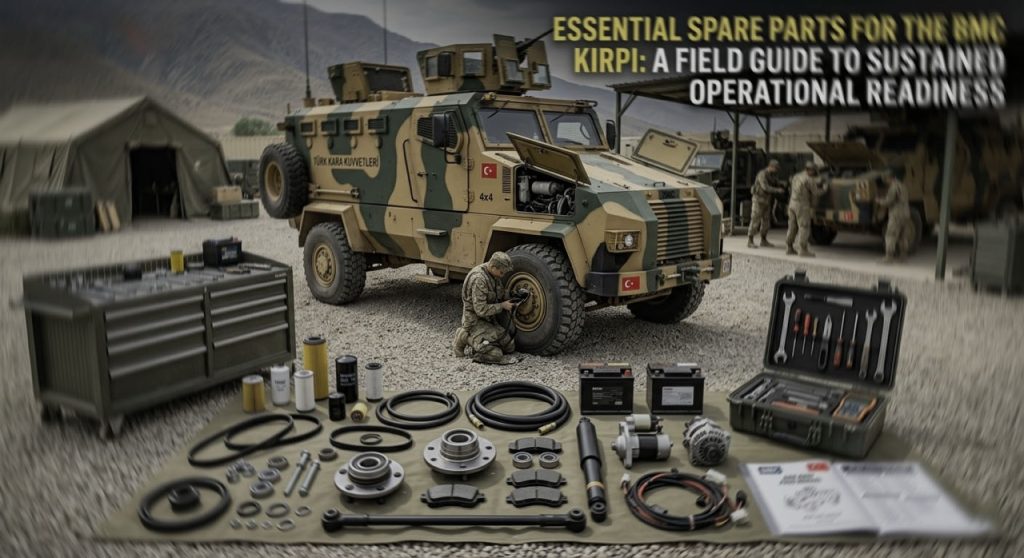
Essential Spare Parts for the BMC Kirpi: A Field Guide to Sustained Operational Readiness
Table of Contents
The BMC Kirpi — “Hedgehog” in Turkish — has earned its reputation the hard way. Since entering service with the Turkish Land Forces around 2010, it has survived IED strikes of extraordinary magnitude, including a May 2016 incident where a detonation believed to exceed one ton of buried explosive was triggered directly beneath a Kirpi. The V-shaped hull and armored capsule held, and the majority of the 13 soldiers aboard survived. Across counter-terrorism operations in southeastern Turkey and Syria, and more recently in the drone-contested battlespace of Ukraine, the platform has protected thousands of servicemen and women.
But battlefield survivability is only half the equation. The other half — the unglamorous, logistically demanding half — is sustained operational readiness. A Kirpi immobilized by a worn-out fuel injector or a failed run-flat insert is, for practical purposes, a mission failure. With over 2,000 vehicles in Turkish service alone and export fleets operating across Tunisia, Ukraine, Qatar, Kosovo, Turkmenistan, and Bosnia-Herzegovina, the spare parts supply chain for this platform has become a strategic concern in its own right.
This guide is written for maintenance officers, fleet managers, and procurement specialists who need a technically grounded, prioritized framework for Kirpi spare parts planning — not generic advice, but practical judgment built from wheeled MRAP fleet experience.
PLATFORM REFERENCE SPECIFICATIONS — BMC KIRPI FAMILY
Engine (Kirpi I / II): Cummins ISL9E3 375 / BMC TUNA 400 HP
Displacement: 8.9 L, 6-cylinder turbo-diesel
Max Torque: 1,550 Nm @ 1,100–1,400 rpm
Transmission: Allison 3000 series, 6F 1R automatic
Transfer Case: ZF VG 1600 (two-speed)
Axles: Axletech 3000 / 4000 / ISAS 4500 series
Axle Rating (each): 9,000–9,500 kg
Tires: 14.00-R20 / 16R20, run-flat, tubeless
Curb Weight (4×4): approx. 18,085 kg
GVW (4×4): approx. 19,710 kg
Max Speed: 105 km/h
Operational Range: 750–800 km
Electrical System: 24V (MIL-STD-1275), 2 × 12V / 210 Ah
Alternator: 155 A
Ballistic Protection: STANAG 4569 Level 3
Mine/IED Protection: STANAG Level 4a/4b
POWERTRAIN: THE HEART OF OPERATIONAL AVAILABILITY
The Kirpi’s propulsion system has always been built around proven commercial-off-the-shelf powerplants — a deliberate philosophy that prioritizes global parts availability and trained maintenance personnel over bespoke military solutions. The original Kirpi I and the majority of Kirpi II variants have been powered by the Cummins ISL9E3 375, an 8.9-liter, six-cylinder turbocharged and intercooled diesel producing 375 PS at 2,100 rpm and 1,550 Nm of torque across a wide rev band.
A significant development occurred in January 2025: BMC began delivering Kirpi II vehicles fitted with the BMC TUNA 400 HP engine — Turkey’s first domestically mass-produced military-grade diesel, developed by BMC Power at its Sakarya Arifiye facility. The TUNA engine underwent over 6,500 hours of laboratory testing and 140,000 kilometres of field trials before entering serial production. This transition has real implications for parts logistics: operators running the Cummins-powered fleet and those receiving newer TUNA-powered vehicles now face a bifurcated supply chain that requires deliberate management from the outset.
For fleets still running the Cummins ISL9E3 — which encompasses the vast majority of Kirpis currently in service worldwide — the highest-consumption and most mission-critical engine parts are the fuel injector assembly, high-pressure fuel pump, oil and fuel filter elements, air filter (primary and safety), coolant thermostat and housing, water pump assembly, turbocharger cartridge, intercooler core, EGR valve and cooler, engine oil cooler, valve cover and head gasket sets, connecting rod and main bearings, piston and ring kits, serpentine belt, tensioner and idler pulleys, and exhaust manifold gaskets.
One point worth flagging on the cooling system: the Kirpi is designed for an operating temperature range of minus 32°C to plus 55°C. In desert environments — such as those seen in Tunisian and Gulf operator fleets — coolant degradation occurs significantly faster than standard commercial maintenance schedules anticipate. Quality analysis should be conducted every 200 operating hours in temperatures exceeding 40°C, rather than at the standard 250-hour interval. This is a straightforward adjustment that prevents expensive engine damage.
For operators transitioning to the BMC TUNA engine, parts availability is necessarily more concentrated through BMC’s authorized channels. Operators in non-Turkish markets should negotiate minimum initial provisioning spare parts packages covering at least 24 months of expected operations at time of procurement — not after vehicles arrive in theater.
TRANSMISSION AND TRANSFER CASE
The Allison 3000 series fully automatic transmission is one of the most field-proven units in military wheeled vehicle applications globally. Its presence in the Kirpi is a significant logistical advantage: Allison parts and trained technicians are available across virtually every theater where the vehicle operates. The transmission is paired with the ZF VG 1600 two-speed transfer case, which enables highway 4×2 or off-road 4×4 selection via a pneumatically operated system. The Axletech cross-axle differential locks — also pneumatically actuated — are critical for low-traction traversal and require regular inspection of pneumatic control lines and solenoid valves.
Key spare parts in this area include the Allison 3000 filter kit, approved transmission fluid (TranSynd or equivalent), transmission oil cooler, torque converter seal kit, front and rear output shaft seals, ZF VG 1600 transfer case seal kit and mounting bushings, propshaft universal joint kits front and rear, propshaft center bearing, differential lock solenoid valve and actuator diaphragm, and a pneumatic control line repair kit.
In Ukrainian operations, Kirpi vehicles subjected to intense high-cycle urban maneuvering — frequent stops, direction changes, and heavy loads — showed accelerated wear on Allison transmission filter elements. Filter inspection intervals should be tied to operating hours rather than calendar time when operational tempo is high. A clogged transmission filter is one of the most common preventable causes of thermal shutdown, and it is entirely avoidable with disciplined maintenance scheduling.
AXLES AND SUSPENSION SYSTEMS
shock absorbers
The leaf spring and rigid axle setup is more robust under blast loading and simpler to field-repair. The independent suspension system provides superior ride quality and off-road articulation but introduces more components that can be damaged or worn. Neither architecture is inherently superior — the operational environment and mission profile should drive procurement decisions when both variants are available.
Suspension-related parts represent the single highest volume category of consumable replacement in MRAP operations across rough terrain. Essential stock should include parabolic leaf spring sets for Kirpi I variants, leaf spring shackle bolts and bushings, torsion bar units and A-arm bush kits for Kirpi II, front and rear telescopic shock absorbers, anti-roll bar links and bushings, Axletech hub assemblies with seals, wheel hub bearing sets, inner and outer axle shafts, axle differential seal and gasket sets, steering track rod ends and ball joints, steering box seal kit, power steering pump, and high-pressure hydraulic steering lines.
A critical point for post-blast assessments: in IED events where the vehicle survives the detonation, suspension components adjacent to the blast often absorb energy that would otherwise reach the hull. Leaf spring separation, shock absorber rod bending, and A-arm deformation in post-blast vehicles should be treated as expected damage, not abnormal wear. Post-blast inspection protocols must include full suspension disassembly and dimensional inspection of all load-bearing joints before the vehicle returns to service.
BRAKING SYSTEMS
The Kirpi uses a fully air-actuated braking system — a deliberate design choice for a roughly 20-ton vehicle that must perform reliably in mountain terrain, mud, and desert. The Kirpi I uses drum brakes with a full air dry-type service brake system, an air-operated spring parking brake, and a Jacobs compression brake for downhill speed control. The Kirpi II uses disc brakes with a dual-circuit air system and ABS as standard.
Key parts for this system include brake drums (Kirpi I) or rotors (Kirpi II), brake linings or pad sets per axle, service and spring brake chambers, automatic slack adjusters, air dryer cartridges and desiccant elements, brake system air reservoirs, foot control brake valve, ABS modulator valve and wheel speed sensors (Kirpi II), brake hardware kits, air line and fitting repair kits, and a field parking brake release tool.
RUN-FLAT TIRES AND CTIS
Tire management on the Kirpi involves two interconnected systems: run-flat inserts and the Central Tire Inflation System. The vehicle is fitted with tubeless 14.00-R20 or 16R20 tires incorporating military-specification run-flat inserts that allow continued mobility for a defined distance after complete air loss — an essential capability for extracting a vehicle from a kill zone.
The CTIS allows the driver to adjust tire pressure while moving, optimizing traction across different surfaces. The system uses a pneumatic circuit connected to the braking air supply via a dedicated valve manifold and rotary unions at each hub. CTIS failure is not immediately mission-critical in isolation, but it significantly degrades mobility in soft terrain — which is precisely where IED threats tend to be highest.
Essential parts include complete run-flat tires per wheel, run-flat inserts or bands, split-rim wheel assemblies with locking rings and O-rings, CTIS rotary unions per hub, CTIS control valves and solenoids, pressure sensors, display and control units, CTIS air line repair kits, wheel stud and nut sets, hub caps and seals, and field tire repair kits.
One operational discipline issue deserves emphasis: run-flat inserts have a defined service life measured in kilometers traveled after air loss, not calendar time. Many operators fail to log run-flat activations — a vehicle suffers a puncture, the crew inflates the tire and continues without documenting it. An insert that has reached end-of-life is functionally equivalent to having no run-flat capability at all. Establish a mandatory run-flat activation log in the vehicle record and enforce it.
ELECTRICAL AND MISSION SYSTEMS
The Kirpi operates on a 24-volt military electrical system compliant with MIL-STD-1275, using two 12V / 210 Ah batteries in series. The 155-amp alternator must support not only the baseline vehicle but also mission equipment loads — GPS, rear-view cameras, communications, intercom, and in later variants the Aselsan SARP Remote Controlled Weapon Station and electronic warfare systems.
The electrical system is one of the most neglected areas in armored vehicle maintenance until it causes a mission failure. Harsh thermal cycling, vibration, blast shock, and the constant addition of mission equipment by end users create a challenging environment for connectors, wiring harnesses, and battery terminals. Critical parts in this category include military-specification 24V batteries, battery terminal sets, the 155A alternator with drive belt and tensioner, voltage regulator, fuse box assembly, fuse assortment kits, relay sets, wiring harness repair kits with military connectors, Deutsch and Amphenol connector kits, starter motor, engine cold start components, and OEM-specification GPS and intercom equipment.
ARMOR AND STRUCTURAL PROTECTION
The Kirpi’s monocoque V-shaped hull is constructed from high-hardness ballistic steel and certified to STANAG 4569 Level 3 against 7.62×51mm NATO armor-piercing rounds and 155mm artillery fragments. The Kirpi II introduced composite add-on armor panels providing enhanced protection with reduced weight — a meaningful advantage when managing payload budgets on a vehicle already near its gross vehicle weight in operational configuration.
Structural armor repair following IED or ballistic engagement is a specialist task requiring ballistic steel welding certification. Where composite armor is involved, original manufacturer replacement panels are mandatory. Field improvisation with non-certified materials degrades the protection standard and may void procurement contract obligations regarding crew protection guarantees.
Parts to maintain in inventory include ballistic windshields and side window glass, window sealing and gasket kits, armored door hinge sets and latch mechanisms, emergency escape hatch mechanisms, firing port plugs and covers, spall liner panels, composite add-on armor panels for Kirpi II variants, underbelly skid plate hardware, cage armor brackets and RPG protection mesh, mine-blast seat shock absorber cartridges, seat mounting rails and energy absorbers, and self-recovery winch repair kits and cables.
One point that is consistently overlooked in post-incident assessments: mine-blast resistant seats contain energy-absorbing elements — typically polyurethane foam cores or hydraulic damper cartridges — that are consumed by blast loading. A seat that has been subjected to a mine blast must be inspected and the energy-absorbing element replaced before the vehicle returns to duty, even if the seat appears undamaged externally. This is not optional; it is a crew protection requirement.
FIRE SUPPRESSION AND CBRN SYSTEMS
The Kirpi is equipped with an automatic fire suppression system covering both the engine compartment and crew cabin, a critical survival feature given that post-blast fuel fires are a major cause of casualties in otherwise survivable IED events. The system uses sensor-triggered discharge that activates automatically upon detecting flame or heat threshold exceedance. CBRN protection — listed as standard on Turkish Armed Forces variants — uses overpressure filtration to maintain positive cab pressure and exclude contaminated external air.
Both systems require regular inspection and consumable replacement on defined schedules. Neither can be assumed to function in an emergency simply because it has not been previously activated. Parts to maintain include pressurized fire suppression agent cylinders, discharge nozzle sets, heat and flame sensors, AFSS control units, wiring harness connector kits, NBC-rated CBRN filter elements, overpressure fan motors, cabin seal kits for doors and hatches, smoke grenade launcher tubes and brackets, and electrical trigger harnesses.
SPARE PARTS STRATEGY AND SUPPLY CHAIN MANAGEMENT
Operating a Kirpi fleet effectively requires a structured approach to parts provisioning. Based on MRAP fleet sustainment experience, the following priority framework provides a practical starting point.
Critical priority items — those that cause immediate mobility or survivability loss if unavailable — are run-flat tires and inserts (recommend one full set per three vehicles), engine filters for oil, fuel, and air (three-month consumption stock), Cummins ISL9 fuel injectors (10% of fleet vehicle count), and 24V battery pairs (two pairs per five vehicles).
High priority items — those that cause significant capability degradation or safety risk — include front and rear shock absorbers (two pairs per five vehicles), Allison 3000 filters and fluid (six-month consumption stock), brake linings and pads (one full set per four vehicles), and AFSS agent cylinders (one per vehicle, inspected annually without exception).
Medium priority items — those that degrade specific capabilities when unavailable — include propshaft universal joints (one set per eight vehicles), CTIS rotary unions (two per five vehicles), armored window glass (one set per ten vehicles), and CBRN filter elements per manufacturer schedule.
On procurement channels: Cummins maintains an extensive global distributor network for the ISL9 engine line that serves commercial and military customers across virtually every country where Kirpis operate. Allison Transmission similarly maintains global 3000-series parts distribution. Axletech, now within the Meritor/Cummins group, distributes through authorized channels. For BMC-specific structural components — armor plates, hull fittings, door mechanisms, and BMC TUNA engine parts — procurement must flow through BMC Otomotiv or their designated regional representatives. Export customers should negotiate Initial Provisioning spare parts packages at time of contract, covering a minimum 24-month operating cycle. Establishing supply chains after vehicles arrive in an overseas theater is a common and costly mistake.
On maintenance philosophy: the most expensive spare part is the one that fails catastrophically because it was not replaced on schedule. MRAP fleets operating in high-tempo environments have demonstrated that shifting from reactive maintenance to condition-based and predictive maintenance can substantially reduce unscheduled downtime. At minimum, a functioning Kirpi fleet maintenance program requires a vehicle-level record tracking engine hours, operating kilometers, mission type, blast events, and CTIS and run-flat activations; a fleet-level consumption tracking system that generates procurement demand signals; scheduled major inspections at defined hour intervals with physical tear-down inspection of suspension joints, axle bearings, and brake components regardless of apparent external condition; and post-blast inspection checklists that are mandatory before any vehicle returns to operations, regardless of perceived severity.
CONCLUSION: MISSION READINESS IS A LOGISTICS ACHIEVEMENT
The BMC Kirpi has proven itself in some of the harshest operational environments in the world — surviving IED detonations that would have destroyed lesser vehicles, protecting crews across PKK counter-terrorism operations, Syrian deployments, and the grinding attritional warfare of Ukraine. Its V-shaped hull, monocoque structure, and carefully selected powertrain represent years of Turkish defense industry experience distilled into an exportable platform trusted by armed forces on three continents.
But the platform’s combat effectiveness is inseparable from the depth and quality of the logistics infrastructure behind it. A Kirpi with a failed turbocharger, depleted run-flat inserts, or a degraded fire suppression system is not a survivability asset — it is a liability. Every maintenance officer, fleet manager, and procurement official responsible for a Kirpi fleet carries a share of responsibility for the personnel riding inside those vehicles.
The transition to the BMC TUNA engine beginning in 2025 represents a meaningful step toward Turkish domestic defense industrial self-sufficiency, reducing dependency on foreign suppliers for a critical powertrain component. For existing operators, this creates a transition period requiring careful management of dual supply chains. For new procurement customers, it is an opportunity to negotiate comprehensive integrated logistics support packages that cover both the Cummins-powered legacy fleet and the newer TUNA-powered vehicles.
Invest in parts. Invest in training. Invest in maintenance records. The crews who ride in Kirpis depend on it.
Related Military Spare Parts Categories, Vehicle Platforms & Technical Guides
Explore AB Defence’s NATO-codified (NSN) and genuine OEM spare parts catalog, platform technical specifications, and sustainment engineering guides related to this article:
Stocked Spare Parts Categories (NSN & OEM Catalog)
- BMC Kirpi MRAP Spare Parts (Kirpi I & Kirpi II) (597 stocked parts)
- Military Brake Calipers, Master Cylinders & Hydraulic Systems (103 stocked parts)
- Military Portal Axles, Differentials & Drive Shafts (107 stocked parts)
- Military Engine Internal Components & Overhaul Parts (104 stocked parts)
- Electrical, Electronic & Vision Systems for Military Vehicles (250 stocked parts)
- Full NATO NSN & OEM Spare Parts Catalog (16,760+ Parts)
Compatible Vehicle Platforms & System Hubs
- Kirpi I (BMC)
- Cobra II
- Ejder Yalçın
- Tactical Wheeled Vehicles
- Brake & Suspension Systems
- Request a B2B Quotation (RFQ) & Technical Support