AB DEFENCE Platform support
Leopard 2 Series
Explore platform information, technical systems and spare parts support.
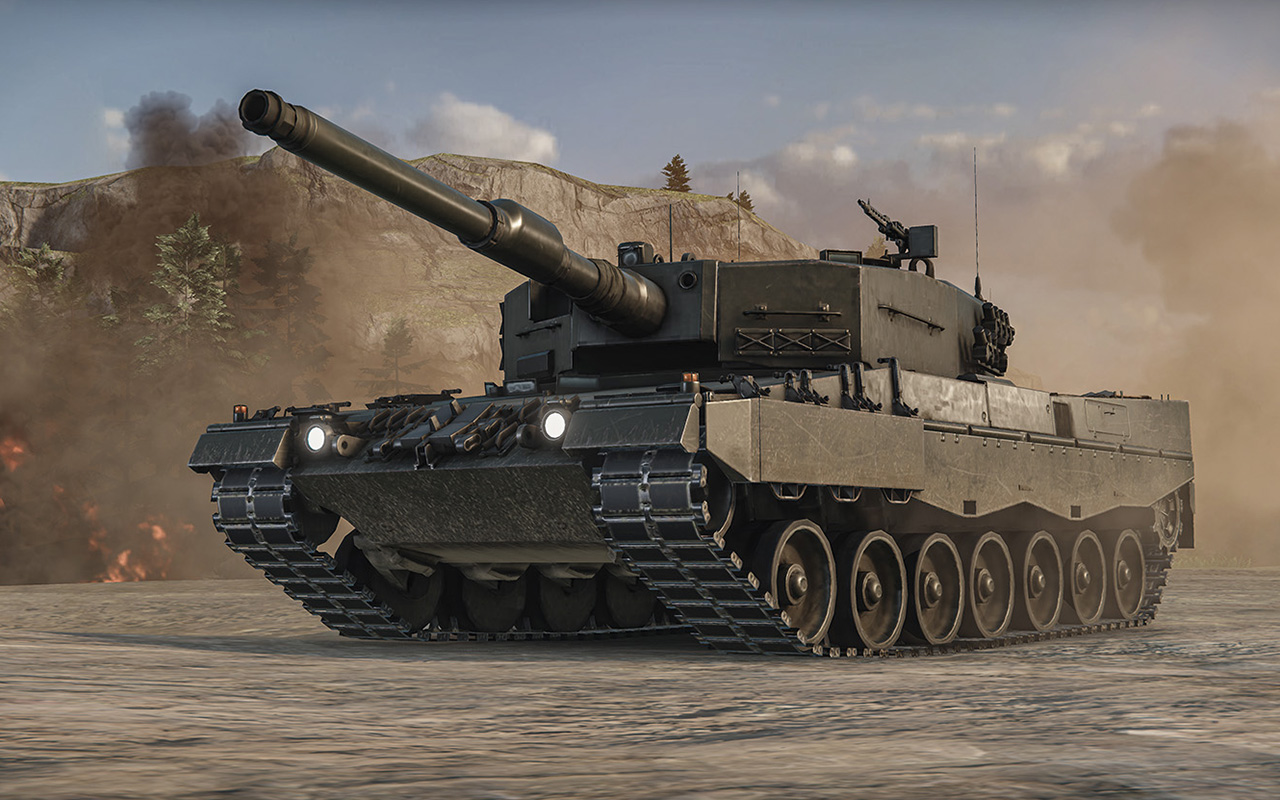
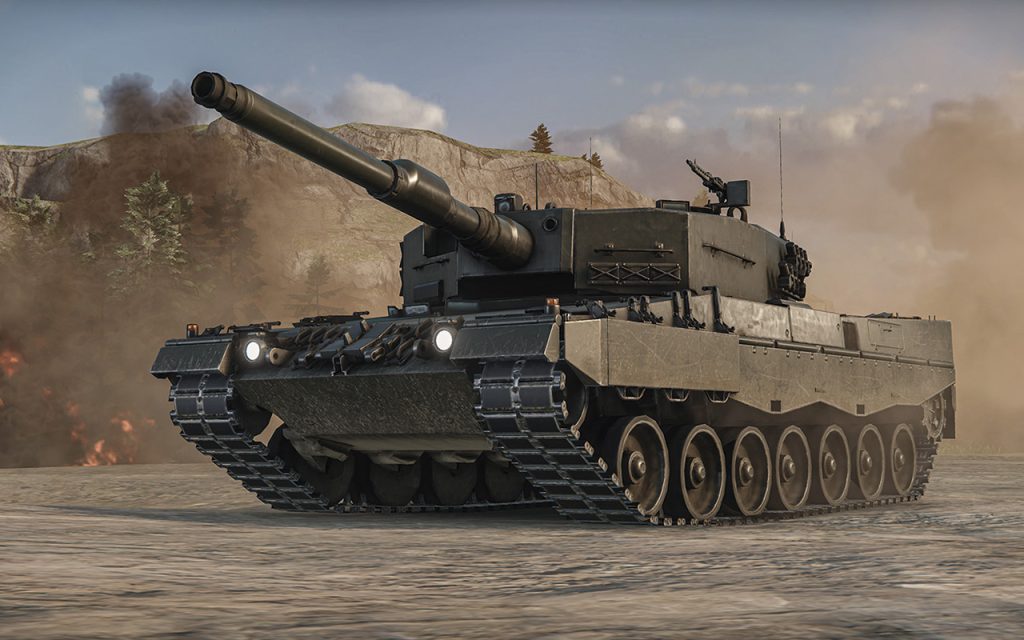
Leopard 2 is a main battle tank developed in Germany and widely used by NATO and allied armed forces. Known for its advanced firepower, protection, and mobility, it remains one of the most capable armored platforms in modern military operations.
Request a QuoteThe Leopard 2 as a Parts Supply Challenge: Why Platform Knowledge Cannot Be Improvised
The Leopard 2 is the most widely operated third-generation main battle tank in the world — a distinction that sounds straightforward until you examine what it actually means for the people responsible for keeping fleets operational. Across more than twenty operator nations, the platform exists in at least eight major production and conversion standards, multiple national sub-variants, and two architecturally distinct turret generations. A Bundeswehr 2A7V and a Turkish 2A4 share the same powerpack and running gear but differ in armour generation, fire control system, turret drive architecture, and protection specification in ways that make them effectively different vehicles at the sub-system level. When Germany announced in November 2025 the unveiling of the first Leopard 2A8 at KMW's Munich facility — the first wholly new-build Leopard 2 production since 1992 — it simultaneously confirmed that the platform's active procurement and parts supply requirement is not winding down. It is accelerating.
AB Defence approaches the Leopard 2 not as a single platform with a single parts list, but as a family of related vehicles whose common denominator is the MTU MB 873 Ka-501 powerpack and Renk HSWL 354 transmission, and whose divergence points — armour generation, FCS architecture, gun barrel length, turret drive type, hull protection level — determine which components are applicable to which vehicle in a given fleet. Our capability on this platform comes from sustained engagement with multiple operator contexts, not from catalogue depth alone. The distinction matters, because the Leopard 2's complexity rewards specialists and penalises generalists in equal measure.
Technical Specifications — Leopard 2 Series
| Parameter | Leopard 2A4 (Baseline) | Leopard 2A5 | Leopard 2A6 | Leopard 2A7 / 2A7V | Leopard 2A8 |
|---|---|---|---|---|---|
| Combat Weight | 55.15 t | 59.5 t | 59.7 t | 62+ t | 65+ t (est.) |
| Engine | MTU MB 873 Ka-501 | MTU MB 873 Ka-501 | MTU MB 873 Ka-501 | MTU MB 873 Ka-501 | MTU MB 873 Ka-501 |
| Engine Output | 1,100 kW / 1,500 hp | 1,100 kW / 1,500 hp | 1,100 kW / 1,500 hp | 1,100 kW / 1,500 hp | 1,100 kW / 1,500 hp |
| Transmission | Renk HSWL 354 | Renk HSWL 354 | Renk HSWL 354 | Renk HSWL 354 | Renk HSWL 354 |
| Max Road Speed | 68 km/h | 68 km/h | 68 km/h | 64 km/h | 60 km/h |
| Range | ~500 km | ~500 km | ~500 km | ~500 km | ~400 km |
| Main Gun | Rh 120 L/44 | Rh 120 L/44 | Rh 120 L/55 | Rh 120 L/55 | Rh 120 L/55A1 |
| Turret Drive | Electro-hydraulic WNA-H22 | All-electric E-WNA | All-electric E-WNA | All-electric E-WNA + RWS | All-electric + RWS |
| FCS | EMES-15 / PERI-R17 | EMES-15 raised / PERI-R17A2 TIM | EMES-18 (some variants) / PERI-R17A2 | Advanced digital FCS | Latest-gen digital FCS |
| Commander Sight | PERI-R17 (early: PZB-200) | PERI-R17A2 with TIM | PERI-R17A2 with TIM | PERI-R17A3 (2A7V) | Latest PERI generation |
| Turret Armour | Flat — titanium/tungsten composite | Wedge appliqué laminated armour | Wedge + improved frontal arc modules | Additional hull/turret modules | Advanced passive + Trophy APS |
| Suspension | Torsion bar + friction dampers (pos. 1,2,3,6,7) | As 2A4 | As 2A4 | Upgraded bump stops | As 2A7 |
| Tracks | Diehl 570F (early) / 570FT (Batch 6+) | Diehl 570FT | Diehl 570FT | Diehl DST | Diehl DST |
| Spall Liners | Not fitted | Fitted | Fitted | Fitted | Fitted |
| Mine Protection Kit | Not standard | Not standard | 2A6M: belly plate added | Standard (2A7) | Enhanced standard |
| APU | Not standard | Not standard | 2A6EX: fitted | Enhanced APU | Enhanced APU |
| APS | Not fitted | Not fitted | Not fitted | Trophy (17 test vehicles) | Trophy standard |
| Production Period | 1979 – 1992 | 1995 – 2002 (conversion) | 2001 – 2006 (conversion) | 2014 – present (upgrade) | 2025 – present (new build) |

Two Tranches, One Platform: The Architectural Divide That Parts Professionals Must Understand
Every Leopard 2 parts enquiry begins with one question: which side of 1995 is this vehicle on?
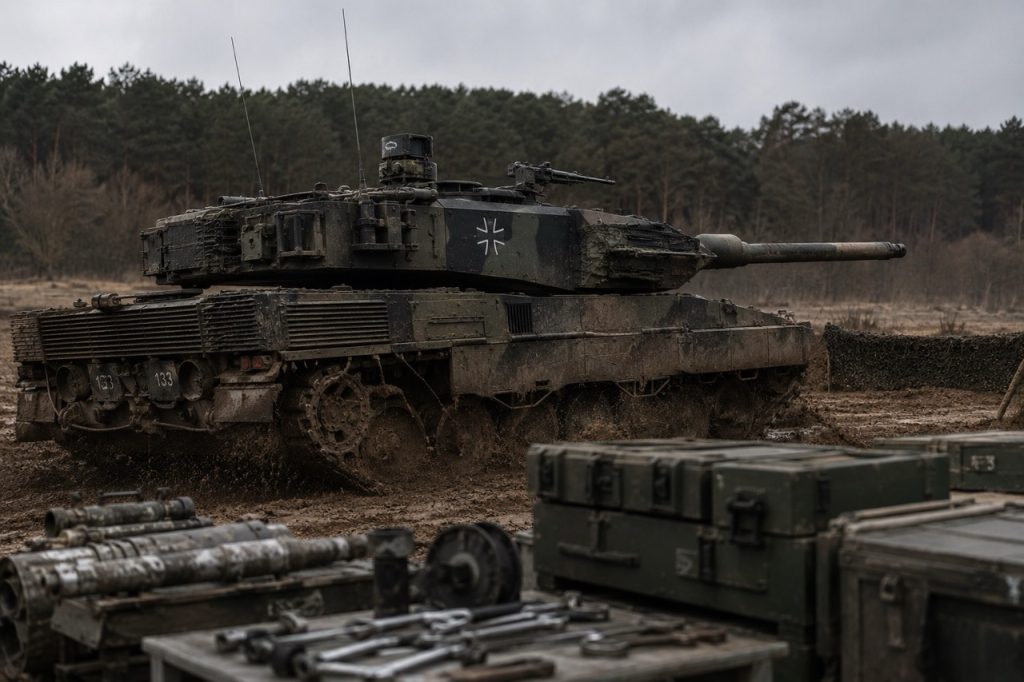
The Leopard 2's production and upgrade history divides cleanly into two architectural tranches defined by turret configuration. The first tranche encompasses all vehicles produced from Batch 1 (1979) through the final Batch 8 (1992) and standardised to the 2A4 level — characterised by vertically faced turret armour, the electro-hydraulic gun drive system WNA-H22, and the EMES-15 FCS with the gunner's primary sight housed in the turret front face. The second tranche begins with the 2A5 conversion programme of 1995 and continues through the 2A6, 2A7, 2A7V, and 2A8 — defined by the distinctive wedge-shaped laminated armour appliqué on the turret front, the all-electric gun drive system, relocated gunner's primary sight on the turret roof (eliminating the EMES-15 housing vulnerability), and the PERI-R17A2 commander's panoramic sight with its own independent thermal channel.
This architectural division has direct and specific consequences for parts procurement. The turret drive system — hydraulic on first-tranche vehicles, electric on second-tranche — uses entirely different components and requires different maintenance approaches. The gun mantlet is different between 2A4 and 2A5: the large cast mantlet of the 2A4 is replaced on the 2A5 by a significantly smaller and more armoured mantlet integrated with the wedge armour assembly. The spall liner introduced in the 2A5 interior is not present on 2A4-standard vehicles. And the FCS housing on the turret roof — fitted on 2A5 and later — has no equivalent on the 2A4, where the EMES-15 is positioned in the turret front.
AB Defence identifies which tranche a vehicle belongs to before supplying any turret-related component. For operators managing mixed fleets — Germany's current inventory contains 2A4, 2A6, 2A7V, and now 2A8 vehicles — this tranche discipline is not a procedural formality. It is the difference between a correctly specified part and an expensive procurement error.
The MTU MB 873 Ka-501: Forty-Five Years in the Field, Still Being Built
The engine at the heart of every Leopard 2 — from the first Batch 1 vehicle delivered to the Bundeswehr's Munster tank school in late 1979 to the 2A8s currently entering service with Panzerbrigade 45 in Lithuania — is the MTU MB 873 Ka-501. In December 2025, Rolls-Royce (which acquired MTU's defence powerplant business) received a KNDS contract for over 300 MB 873 Ka-501 engines to support new Leopard 2A8 production for Germany, Lithuania, Sweden, the Netherlands, and the Czech Republic — described as one of the largest contracts of its type in recent decades. This is not a legacy engine serving a declining fleet. It is an engine in active new production supporting the most significant European armour rearmament since the end of the Cold War.
Understanding the MB 873 Ka-501's engineering is not optional for a serious Leopard 2 parts supplier. The engine is a V12, 90-degree block, 47.6-litre displacement, twin-turbocharged and intercooled, four-stroke diesel. Its bore is 170 mm and stroke 175 mm — dimensions that reflect a design philosophy of maximising swept volume for torque rather than revving to peak power, which is precisely what a 60-plus-tonne vehicle needs when departing from a static start on a soft surface under load. Peak torque is approximately 4,700 Nm in the mid-rpm range. At 2,600 rpm the engine delivers its rated 1,100 kW, giving a 55-tonne 2A4 a power-to-weight ratio of 27.27 hp per tonne — a figure that remains competitive against current third-generation MBTs.
The dry sump lubrication system is not an incidental detail. It is operationally significant: dry sump designs maintain oil flow to the bearings at the steep inclinations encountered during cross-country movement, where a wet sump might uncover the pump pickup. The electronic control unit governs overspeed protection, manages emergency shutdowns on loss of coolant or oil pressure, and provides the emergency override capability that allows a commander to accept engine damage in order to extract the vehicle from an untenable position. These are design decisions that were made for operational reasons — and they define the maintenance and parts profile of the engine accordingly.
The engine's origin is the MBT-70 programme of the 1960s, where a V8 variant was developed for use in a joint US-German main battle tank. When MBT-70 was cancelled, the 12-cylinder version of the same engine family — with enlarged bore and stroke — was selected for the Leopard 2 programme. The lineage through MBT-70 explains why this engine has a 47.6-litre displacement in what is essentially an automotive configuration: it was designed for a vehicle class that requires not just high peak power but the sustained thermal and mechanical load-bearing capacity to maintain that power output for extended operational periods.
The Leopard 1 Chassis Family: Parts Scope Beyond the Combat Tank
The engine at the heart of every Leopard 2 — from the first Batch 1 vehicle delivered to the Bundeswehr's Munster tank school in late 1979 to the 2A8s currently entering service with Panzerbrigade 45 in Lithuania — is the MTU MB 873 Ka-501. In December 2025, Rolls-Royce (which acquired MTU's defence powerplant business) received a KNDS contract for over 300 MB 873 Ka-501 engines to support new Leopard 2A8 production for Germany, Lithuania, Sweden, the Netherlands, and the Czech Republic — described as one of the largest contracts of its type in recent decades. This is not a legacy engine serving a declining fleet. It is an engine in active new production supporting the most significant European armour rearmament since the end of the Cold War.
Understanding the MB 873 Ka-501's engineering is not optional for a serious Leopard 2 parts supplier. The engine is a V12, 90-degree block, 47.6-litre displacement, twin-turbocharged and intercooled, four-stroke diesel. Its bore is 170 mm and stroke 175 mm — dimensions that reflect a design philosophy of maximising swept volume for torque rather than revving to peak power, which is precisely what a 60-plus-tonne vehicle needs when departing from a static start on a soft surface under load. Peak torque is approximately 4,700 Nm in the mid-rpm range. At 2,600 rpm the engine delivers its rated 1,100 kW, giving a 55-tonne 2A4 a power-to-weight ratio of 27.27 hp per tonne — a figure that remains competitive against current third-generation MBTs.
The dry sump lubrication system is not an incidental detail. It is operationally significant: dry sump designs maintain oil flow to the bearings at the steep inclinations encountered during cross-country movement, where a wet sump might uncover the pump pickup. The electronic control unit governs overspeed protection, manages emergency shutdowns on loss of coolant or oil pressure, and provides the emergency override capability that allows a commander to accept engine damage in order to extract the vehicle from an untenable position. These are design decisions that were made for operational reasons — and they define the maintenance and parts profile of the engine accordingly.
The engine's origin is the MBT-70 programme of the 1960s, where a V8 variant was developed for use in a joint US-German main battle tank. When MBT-70 was cancelled, the 12-cylinder version of the same engine family — with enlarged bore and stroke — was selected for the Leopard 2 programme. The lineage through MBT-70 explains why this engine has a 47.6-litre displacement in what is essentially an automotive configuration: it was designed for a vehicle class that requires not just high peak power but the sustained thermal and mechanical load-bearing capacity to maintain that power output for extended operational periods.
The Renk HSWL 354: Series Production Since 1983, In Service in Eighteen Nations
The Renk HSWL 354 has been in continuous series production since 1983. By mid-1999 — long before the major export wave that followed Germany's post-Cold War surplus disposals — more than 3,000 had been completed. It is currently in service in 18 countries in the Leopard 2 platform and family vehicles, and Renk provides full in-service support throughout.
The HSWL 354 is a hydromechanical power-shift, reversing, and steering transmission providing four forward and two reverse gears. The torque path runs from the converter with lock-up clutch through planetary gear sets with multi-disc brakes and clutches for power shifting, to the differential steering mechanism — an infinitely variable hydrostatic-hydrodynamic superimposed steering system that provides smooth, continuous-rate turning without the stepped-radius limitations of clutch-and-brake steering. This means the Leopard 2 has no fixed turning radii: the driver selects direction through a steering wheel and the transmission manages the differential speed between the two tracks continuously, with no discrete pivot turn modes.
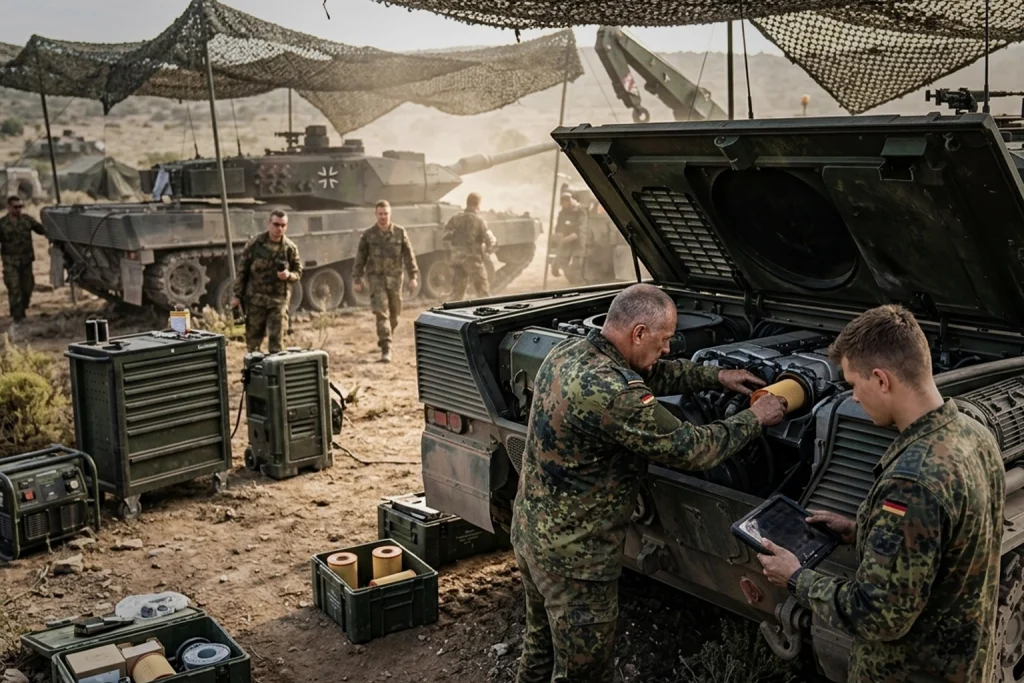
The combined hydrodynamic-mechanical brake system serves as service brake; separate parking and auxiliary brakes are not required. The transmission can be mounted directly to the engine or via a coupling component, which is why the Leopard 2 powerpack can be extracted as a single unit — engine, transmission, and associated cooling circuit hardware — in approximately 35 to 45 minutes in field conditions. That figure is not a theoretical design target. It has been demonstrated repeatedly in operational contexts, including by Canadian crews in Afghanistan and by Bundeswehr crews in training.
For parts procurement, the HSWL 354's maturity and global service infrastructure is advantageous: the transmission has been supported by Renk across 40-plus years of production and service, and its component standardisation across operator nations means that AB Defence's sourcing relationships for this transmission apply across the full Leopard 2 operator community.
Production Batches Through 2A4: What Was Built, When, and What Changed
The Leopard 2's production history for the German Army runs across eight batches between October 1979 and March 1992, all produced by Krauss-Maffei and MaK. The first six vehicles from Batch 1 were delivered to the Munster tank school in 1979; the remainder of the 380-vehicle Batch 1 was completed by March 1982, replacing M48A2G tanks in active units. Batch 2 through 4 brought the total to around 990 vehicles. Batch 5 — running from December 1985 to March 1987, 370 vehicles — marks the introduction of the Leopard 2A4 designation, with the digital fire control system and the Deugra explosion suppression system introduced as the primary changes. From Batch 5 onward the vehicle was the 2A4. All earlier-batch vehicles were subsequently upgraded to the 2A4 standard, making it the most universally applicable baseline across the German fleet before upgrades began.
Batches 6, 7, and 8 (1988–1992, 325 vehicles total) introduced Diehl 570FT tracks replacing the original 570F, maintenance-free batteries, and in Batch 8 the Muzzle Reference System mirror on the right side of the gun barrel — the device that allows the fire control system to continuously compensate for gun barrel droop caused by differential thermal expansion, without which ballistic accuracy degrades progressively with sustained firing.
The Netherlands was the first export customer, receiving 445 vehicles between July 1981 and July 1986 — equivalent to Batch 2 standard. Switzerland received 380 Leopard 2A4s, 35 built in Germany by Krauss-Maffei from June 1987 and 345 under licence by the Swiss firm EK Thun. Spain leased 109 and subsequently purchased them, with Santa Bárbara Sistemas licensed to produce 219 2A6-standard Leopard 2Es domestically. Sweden contracted 120 Stridsvagn 122s — Swedish 2A5 sub-variants with Swedish-developed appliqué armour, a new command system, and upgraded electronics — receiving the first in December 1996.
Turkey agreed to purchase 298 ex-German Army Leopard 2A4 tanks in November 2005, subsequently receiving a total fleet of 354 2A4s. These remain Turkey's primary Leopard 2 variant, a point of operational significance: the 2A4's flat-faced turret armour without wedge appliqué, and the absence of the 2A5-generation spall liners and improved frontal arc composite modules, was a documented factor in the performance of Turkish Leopard 2A4s in the Syrian theatre between 2016 and 2018, where three vehicles were confirmed destroyed or damaged by anti-tank guided missiles. Greece operates a more varied fleet: 183 ex-Bundeswehr 2A4s ordered in August 2005, plus 170 Leopard 2 HEL vehicles (equivalent to 2A6 standard) assembled by ELBO domestically from 2003, many of the latter already incorporating 2A5 and 2A6-generation features.
The 2A5 and 2A6: Two Steps That Changed the Threat Equation
Leopard 2A5 — The Wedge That Redefined Frontal Protection
The 2A5 conversion programme resulted from a December 1993 contract between Germany, Krauss-Maffei, and the Netherlands, converting the first 225 Leopard 2A4s from the sixth production batch — along with 330 Dutch vehicles — to what was called the Mannheim Configuration standard. The defining change is visible from a kilometre: the large, angled, arrow-shaped laminated armour appliqué covering the frontal arc of the turret and extending across the forward portion of the turret sides.
The wedge's protective mechanism is straightforward in principle and highly effective in practice. Most of the volume inside the wedge modules is empty space — the standoff distance this provides against HEAT warheads forces shaped charge jets to expend their energy before reaching the primary turret armour behind. Against kinetic penetrators, the angle and composition of the laminated armour stack disrupts the penetrator rod's structure on contact, reducing the effective penetration it achieves against the underlying composite armour. The result is that the 2A5's turret front provides substantially higher protection against both threat types than the 2A4's flat-faced composite armour, without requiring the primary turret armour itself to be replaced.
The 2A5 also relocated the gunner's primary sight from the turret front — where its housing created a geometry discontinuity in the armour protection — to the turret roof. In the 2A4, the EMES-15 housing on the turret front face is a documented weak point; in the 2A5, this vulnerability is eliminated. The gun drive was changed from the electro-hydraulic WNA-H22 to the all-electric E-WNA system, removing the hydraulic oil fire risk inherent in pressurised hydraulic systems in the fighting compartment. A 25 mm internal spall liner was added throughout, significantly reducing crew injury risk from secondary fragmentation in the event of armour penetration. The commander received the PERI-R17A2 panoramic sight with its own independent thermal imaging channel — the capability that enables the commander to observe and designate targets independently of the gunner, the foundational requirement for hunter-killer engagement methodology.
Weight increased from 55.15 to 59.5 tonnes, but the MB 873 Ka-501 was not uprated for the 2A5; power-to-weight ratio decreased accordingly and the 2A5 is modestly slower than the 2A4 in practice.
Leopard 2A6 — The L/55 and What an Extra 1.3 Metres of Barrel Does
The defining change between the 2A5 and 2A6 is the replacement of the Rheinmetall 120 mm L/44 smoothbore with the Rheinmetall 120 mm L/55 — a cannon 1.32 metres longer than its predecessor, with a corresponding increase in propellant gas work time on the projectile and thus muzzle velocity. The practical ballistic consequence is significant: firing the DM53 APFSDS round, the L/55 achieves a muzzle velocity of 1,750 m/s compared to 1,670 m/s from the L/44 — a 30% increase in muzzle energy that translates directly into increased penetration at range and against the most heavily armoured Soviet-era and current-generation targets. DM53 from the L/55 can engage targets at confirmed ranges of 5,000 metres; effective combat range against armoured vehicles is practically bounded by target acquisition and fire control rather than by the gun's ballistic envelope.
The L/55 is backward-compatible with all existing 120 mm NATO-standard ammunition, which is critical for mixed-fleet logistics: a 2A6 can fire the same DM12 HEAT and earlier DM series APFSDS rounds as a 2A4, with the higher muzzle velocity the L/55 provides as a bonus. The new L/55-specific ammunition — DM53 and its temperature-corrected successor DM63 — provides the full performance advantage and is the primary round for which the 2A6 was optimised.
The 2A6 entered Bundeswehr service in March 2001 with the first 225 conversions from the sixth production batch. The Netherlands converted 180 of its 2A5s to 2A6 standard, with the first vehicle entering service in February 2003. Canada borrowed 20 Leopard 2A6s from Germany for deployment to Afghanistan in August 2007 — the first confirmed combat deployment of the 2A6 — where they demonstrated both the gun's effectiveness and, in one documented IED strike, the hull mine protection package's ability to protect the crew without fatalities.

The L/44 and L/55: Parts Are Not Interchangeable
The Rheinmetall L/44 and L/55 are the same calibre, fire the same ammunition family, and are fitted to the same turret ring. They are not interchangeable at the gun barrel, bore evacuator, thermal sleeve, or breech component level.
The L/55's barrel is 1.32 metres longer than the L/44's — a difference that is not simply a matter of tube length. The longer tube changes the dynamics of propellant gas behaviour during firing, requires a different bore evacuator position and specification, alters the thermal sleeve geometry, and places different dynamic loads on the gun trunnion bearings during movement over rough terrain. AB Defence supplies L/44 and L/55 barrel assemblies, bore evacuator assemblies, thermal sleeve assemblies, and breech mechanism components separately, and confirms gun variant from the vehicle's FCS configuration and armament data plate before supplying any main armament component.
Operational Service: The Parts Lessons from Afghanistan, Syria, and Ukraine
The Leopard 2 has been tested in live combat in three distinct operational environments, and each theatre has generated specific parts supply and maintenance lessons that inform how AB Defence approaches fleet support.
Afghanistan (2006–2011): Danish and Canadian Leopard 2s — 2A5 and 2A6 variants respectively — faced mine, IED, and RPG threats in Helmand Province and Kandahar. One Danish 2A5 absorbed an IED blast that halted the vehicle but allowed most of the crew to escape. One Canadian 2A6 survived an IED strike with minor damage and no crew fatalities — a direct validation of the 2A6M mine protection belly plate that Germany had fitted to its own vehicles from 2004 and that the Canadians had specified for their leased vehicles. The operational learning from Afghanistan was clear: underbelly protection components, track mine blast resilience, and suspension blast response hardware are maintenance priority items on any fleet operating in mine and IED-threat environments.
Syria (2016–2018): Turkish Leopard 2A4s operated in northern Syria during Operation Euphrates Shield. Three vehicles were confirmed destroyed or captured, at least some by anti-tank guided missile strikes — ATGMs assessed as 9M113 Konkurs or similar Soviet-legacy systems obtained from Syrian or Iraqi Army captured stocks. The 2A4's flat-faced turret armour without wedge appliqué was assessed as a contributing factor to these losses. The Syria experience is now part of the institutional memory of every procurement authority evaluating whether to upgrade existing 2A4 fleets to 2A5-level protection before operational deployment.
Ukraine (2023–present): As of July 2025, at least 24 Ukrainian Leopard 2s of various models have been confirmed destroyed according to photographic analysis published by the Oryx blog — 13 Leopard 2A4/2A4V, 7 Leopard 2A6, plus Strv 122s and Bergepanzer-3 chassis. A further 31 have been confirmed damaged, abandoned, or captured. Ukraine operates both 2A4 and 2A6 variants donated by multiple NATO members. The operational losses in Ukraine have driven the demand that is fuelling the Leopard 2A8's accelerated production programme, with Germany's parliamentary approval in July 2024 for 105 additional 2A8s at a cost of approximately €2.9 billion and Defence Minister Pistorius indicating a further 75 vehicles in preparation.
For the parts supply community, Ukraine's Leopard 2 operations have a direct practical consequence: damaged vehicles require running gear, powerpack, and hull components that were not previously in high demand from Ukrainian sources, and the repair and recovery pipeline for battle-damaged vehicles creates a parts market that is both urgent and strategically sensitive.
Chassis Derivatives and Family Vehicles
The Leopard 2 hull and running gear support a set of specialist vehicles that are in service alongside the combat tank in multiple operator fleets. Understanding these derivatives is relevant because the MTU/Renk powerpack and Diehl running gear are common to all of them, and AB Defence's powerpack parts capability applies across the family.
Büffel Armoured Recovery Vehicle (ARV): The Büffel — "Buffalo" — uses the Leopard 2 hull modified for recovery operations, carrying a hydraulic crane capable of lifting complete Leopard 2 powerpacks, a 98-tonne main winch for vehicle recovery in soft or obstructed terrain, and a dozer blade for self-entrenchment. The MTU MB 873 Ka-501 in the Büffel is the same unit as in the combat tank; the crane, winch, and hydraulic circuit are specific to the ARV configuration. A standard Büffel procedure is to carry a spare complete Leopard 2 powerpack on the vehicle itself, enabling on-site powerpack exchange without requiring the recovery vehicle to transport the disabled tank to a workshop.
Pionierpanzer 3 Kodiak AEV: Based on the Leopard 2 hull, the Kodiak carries a 250 kN dozer blade, a telescoping crane arm, and an earth auger for obstacle clearance, trench construction, and combat engineering tasks. The powerpack is common with the combat tank. The hydraulic systems for mission equipment are Kodiak-specific.
Leguan AVLB: The Leguan bridge-layer carries a 26-metre scissors bridge on the Leopard 2 hull, capable of spanning an 18-metre gap at Military Load Class 70 — capable of carrying any current Western MBT. The bridge-laying sequence is completed hydraulically from within the vehicle. Leopard 2 running gear and powerpack are unchanged.
Dachs AEV (German Army): The original Leopard 2-chassis combat engineering vehicle, now largely replaced by the Kodiak in Bundeswehr service but still operated by some nations. Powerpack common with the combat tank.
All these chassis derivatives benefit from the same MTU engine and Renk transmission parts coverage that AB Defence provides for the Leopard 2 MBT.
Leopard 2 Spare Parts Coverage
MTU MB 873 Ka-501 Engine
AB Defence provides comprehensive parts coverage for the MB 873 Ka-501 across all production years. The engine's 12 individual cylinder heads are serviceable independently — a single cylinder can be attended to without disturbing the remaining eleven, which matters enormously in field-level maintenance where minimising vehicle downtime is the primary constraint. The dry sump lubrication system and its associated oil management components, the twin turbocharger units with their specific inter-cooling circuit, and the electronic control unit with its overspeed and emergency override functions are all within our supply scope.
AB Defence supplies: individual cylinder head assemblies and matched head gasket sets (12 positions), piston assemblies and cylinder liner kits (170 mm bore), piston ring sets, connecting rod assemblies and big-end bearing shells (standard and undersize), main bearing shell sets (all 12 positions), crankshaft assemblies and thrust washers, camshaft assemblies and drive components, complete valve train including rocker arms, pushrods, valve springs and guides, inlet and exhaust valve sets, twin turbocharger assemblies (left bank and right bank — the MB 873 Ka-501 uses twin turbochargers in parallel, not sequential configuration), intercooler assemblies and charge air circuit components, electronic control unit assemblies and sensor sets (coolant temperature, oil pressure, boost pressure, overspeed sensor), dry sump lubrication system components including scavenge pump assemblies and pressure pump assemblies, oil cooler assemblies, water pump assemblies, thermostat housing and engine thermostat, cooling system hose sets for the powerpack circuit, complete engine overhaul gasket and seal sets, all oil and coolant seals by position.
Renk HSWL 354 Transmission
AB Defence supplies: torque converter assemblies and lock-up clutch components, planetary gear set assemblies for all four forward and two reverse positions, multi-disc clutch pack assemblies with correct friction lining specification, brake assemblies, hydrostatic steering unit assemblies and components, hydrodynamic retarder assemblies, transmission oil filter kits, all external transmission oil lines and fittings, input shaft and output shaft seals, transmission housing gasket sets, electronic control unit components and wiring harness sets. Transmission variant confirmation is applied to all internal component orders.
Running Gear — Suspension, Track, and Drive System
The Leopard 2's suspension places friction dampers at road wheel positions 1, 2, 3, 6, and 7 on each side — the asymmetric distribution reflects the different dynamic loading at each position during cross-country movement, and it is important because it means that only specific positions carry friction dampers while positions 4 and 5 carry solid bump stops. Supplying friction dampers without position identification causes mis-installation.
AB Defence supplies: torsion bar assemblies for all 14 road wheel positions (7 per side), friction damper assemblies for positions 1, 2, 3, 6, 7 per side, solid bump stop assemblies for positions 4 and 5, road wheel assemblies (dual rubber-tyred — 7 per side), road wheel bearing kits and hub seals, road wheel arm assemblies and torsion bar anchor hardware, drive sprocket assemblies with ring gears (rear-mounted, with replaceable ring gears as wear items), front idler wheel assemblies and idler adjustment mechanism hardware, four track return roller assemblies per side with bearings, Diehl 570FT track link assemblies and rubber-bushed end connectors, rubber track pads (removable and replaceable by snow grousers), track pin assemblies and track tensioner hardware. Track type confirmation (570F vs 570FT vs DST) is applied to all track component orders.
Hull Systems and Protection Components
AB Defence supplies: driver's vision periscope assemblies (three front-mounted units), driver's hatch assembly and hatch seal (early electro-hydraulic type and later electric type confirmed by production standard), driver's rear-view camera assemblies (2A5 and later), hull fuel tank assemblies and internal fuel system components including fuel pumps and primary filters, engine bay automatic fire and explosion suppression system components including Deugra-type detector units, control modules, and suppression agent containers, NBC overpressure system components including compressor assemblies, particulate and carbon filter units, and distribution ducting, 120 mm ammunition stowage assembly components (hull positions), hull interior spall liner panels and mounting hardware (2A5 and later — confirm before supply), belly mine protection plate assemblies (2A6M, 2A7, 2A8 standard — confirm by variant before supply), track skirt assemblies and mounting hardware — heavy ballistic type (front third) and steel-reinforced rubber type (rear two-thirds), rear skirt assemblies in composite material (Batch 8 and later production).
Turret Systems — First Tranche (2A4 Standard)
AB Defence supplies for 2A4-standard vehicles: electro-hydraulic gun drive WNA-H22 components including hydraulic pump, control valve, and actuator assemblies, gun elevation and traverse hydraulic cylinder assemblies and seals, turret ring assembly and bearing hardware, gun mantlet assembly (large cast type — 2A4 specification), EMES-15 FCS housing mounting hardware and optical interface components (mechanical/structural elements — not electronic processing units), Rheinmetall 120 mm L/44 gun barrel assemblies, bore evacuator assemblies (L/44 position-specific), thermal sleeve assemblies for L/44 barrel, gun breech mechanism assemblies and breech ring seal kits, gun trunnion bearing assemblies, smoke grenade launcher assemblies and firing circuit hardware (2 × 4 configuration), commander's cupola assemblies and vision block sets, loader's hatch assembly and periscope, turret bustle stowage hardware.
Turret Systems — Second Tranche (2A5 and Later)
AB Defence supplies for 2A5-standard and later vehicles: all-electric gun drive E-WNA components including motor assemblies, control unit hardware, and drive interface components (confirming electric vs hydraulic before supply), wedge armour module mounting and structural interface hardware (mechanical fixings — not armour composites), EMES-15 raised housing mounting hardware (2A5 position on turret roof), PERI-R17A2 commander's sight housing and optical interface hardware, gun mantlet assembly (2A5-type smaller mantlet integrated with wedge armour), Rheinmetall 120 mm L/55 gun barrel assemblies (2A6 and later), bore evacuator assemblies (L/55 position-specific — not interchangeable with L/44 bore evacuator), thermal sleeve assemblies for L/55 barrel, muzzle reference system mirror assembly (Batch 8-onward and all 2A5+ vehicles), interior spall liner panels and mounting hardware, mine protection belly plate mounting hardware and fasteners (2A6M / 2A7 / 2A8 vehicles).
Electrical Systems
AB Defence supplies: 24-volt main electrical system alternators matched to MB 873 Ka-501 installation, 24-volt starter motor assemblies, vehicle main wiring harness assemblies, maintenance-free battery assemblies and isolator switches (Batch 6 standard onward), turret intercom and command system interface hardware, APU assemblies and associated fuel and cooling interface hardware (2A6EX, 2A7, 2A7V, 2A8 specification — confirm by variant), remote weapons station interface hardware and power supply components (2A7 and later), driver's rear-view camera power and interface assemblies.
Consumables and Scheduled Maintenance Items
AB Defence holds continuous stock of: MTU MB 873 Ka-501 engine oil filter elements, primary and secondary fuel filter elements, air filter elements and pre-cleaner assemblies, Renk HSWL 354 transmission oil filter kits, engine and transmission oil seals by position, cooling system maintenance items compatible with MB 873 coolant specification, torsion bar system seals and friction damper seal kits, track pad replacement sets (Diehl 570FT and DST compatible), Diehl track link end connector kits, bore evacuator seal and wiper sets (L/44 and L/55 specified separately), and all critical fasteners for scheduled powerpack and running gear maintenance tasks.
The Turkish Leopard 2 Fleet: A Parts Supply Context AB Defence Knows Directly
Turkey's 354 Leopard 2A4 tanks represent the largest single non-original-manufacturer Leopard 2 fleet in the region, and a fleet whose operational and maintenance history is directly relevant to AB Defence's parts supply orientation. Acquired from German Army stocks in 2005–2006, Turkey's 2A4s were received in the original flat-turret configuration — without 2A5-generation wedge appliqué, without spall liners, and without the mine protection belly plate that Germany introduced on its own vehicles from 2004.
The operational experience of Turkish Leopard 2A4s in Syria between 2016 and 2018, where three vehicles were confirmed destroyed or damaged, has informed ongoing discussions within Turkish defence planning circles about fleet upgrade options. Whether Turkey pursues a 2A5-equivalent turret upgrade, a domestic FCS modernisation similar to the Volkan programme applied to the Leopard 1T fleet, or a combination approach, the automotive and running gear parts requirement remains constant throughout: the MB 873 Ka-501 powerpack and HSWL 354 transmission require the same maintenance regardless of whether the vehicle carries original 2A4 armour or upgraded protection.
AB Defence's parts supply for the Turkish Leopard 2 fleet is oriented around this reality — providing the powerpack components, running gear hardware, and hull systems parts that sustain operational availability across a 354-vehicle fleet, with the variant accuracy that distinguishes correct 2A4-specification turret components from the 2A5-generation hardware that is not applicable to the Turkish fleet in its current configuration.
Frequently Asked Questions — Leopard 2 Series Spare Parts
What is the difference between L/44 and L/55 main gun components for parts purposes?
The Rheinmetall 120 mm L/44 and L/55 fire the same calibre ammunition but are not interchangeable at the barrel, bore evacuator, or thermal sleeve level. The L/55 is 1.32 metres longer, requiring a differently positioned bore evacuator and different thermal sleeve geometry. AB Defence confirms gun variant from vehicle data before supplying any main armament component.
Are the electro-hydraulic (WNA-H22) and all-electric (E-WNA) turret drive components interchangeable?
No. The WNA-H22 is a hydraulic system requiring hydraulic pump, cylinder, and valve components. The E-WNA is an electric drive system. They require completely different parts. AB Defence confirms turret drive type — which maps directly to the first/second tranche division — before supplying turret drive components.
Does AB Defence supply parts for all national sub-variants of the Leopard 2?
AB Defence supplies MTU MB 873 Ka-501 powerpack components, Renk HSWL 354 transmission components, Diehl running gear, and hull/turret automotive systems parts across all Leopard 2 variants. National-specific FCS electronics, national-specific armour composite inserts, and active protection system processing units (such as the Trophy APS on 2A8 vehicles) are outside our standard supply scope. All nationally-specific mechanical and structural interface hardware is covered with variant confirmation.
Are the MB 873 Ka-501 engine parts for the 2A8 the same as for earlier variants?
Yes. The 2A8 uses the same MTU MB 873 Ka-501 engine as all previous Leopard 2 variants. Rolls-Royce's December 2025 contract for 300+ engines for new 2A8 production confirms that the engine architecture is unchanged. AB Defence's engine parts coverage applies to 2A8 powerpacks.
What information is needed for a Leopard 2 parts enquiry?
Hull serial number or national inventory reference, production batch and variant designation (2A4, 2A5, 2A6, 2A7V, national designation), turret drive type (hydraulic 2A4 or electric 2A5-onward), gun type (L/44 or L/55), presence or absence of mine protection belly plate, track type (570F, 570FT, or DST), parts required by description, NATO stock number, or manufacturer's part number, quantities, delivery destination, and urgency. AB Defence responds with specification confirmation and a formal quotation within 24 hours.
 Request Technical Support
Get a response from our engineering team within 24 hours
Contact Us
AB DEFENCE / Platform support
Discuss this platform with our team.
Share your platform requirements, sourcing priorities or documentation needs.
For a specific part, use the request form on its product page.
Browse spare parts ↗AB DEFENCE
Platform support enquiry
Leopard 2 Series