May 8, 2026
Leopard 2 Readiness Depends on More Than Firepower: The Sustainment Perspective

When defence analysts and procurement officers evaluate the combat effectiveness of the Leopard 2 main battle tank, conversations typically gravitate toward armour protection, 120mm smoothbore firepower, and situational awareness systems. These are, without question, formidable capabilities. But experienced military logistics professionals and fleet sustainment managers understand a less glamorous truth: a tank that cannot move, cannot communicate, or cannot fire due to a failed component is tactically worthless regardless of its specifications on paper.
Leopard 2 operational readiness is not purely a function of design excellence. It is a daily outcome of supply chain resilience, maintenance planning discipline, trained technical personnel, spare parts availability, and long-term lifecycle sustainment strategy. For NATO aligned forces operating this platform across varied theatres and operational tempos, sustainment is not a secondary concern it is the primary determinant of battlefield contribution.
This article examines the sustainment realities behind the Leopard 2, the systemic challenges that affect fleet readiness, and the strategic approaches that defence organisations must adopt to ensure their armoured fleets remain operationally available when it matters most.
The Sustainment Complexity of Modern Main Battle Tanks
The Leopard 2 is a sophisticated platform. Its evolution from the original A4 variant through to the A7V has introduced significant enhancements in protection, electronics, and crew systems all of which add layers of sustainment complexity. Unlike earlier generation tanks that relied on simpler mechanical systems, modern Leopard 2 variants integrate advanced fire control electronics, thermal imaging subsystems, digital communications architecture, and composite armour solutions that each carry their own maintenance and supply chain requirements.
Hydraulic systems
For fleet sustainment managers, the Leopard 2 is not a single sustainment problem. It is a portfolio of interconnected systems, each with its own reliability profile, obsolescence timeline, and supply chain dependency. Managing that portfolio across potentially hundreds of vehicles in a national inventory demands structured lifecycle sustainment thinking rather than reactive maintenance.
torsion bar

Operational Tempo and Its Impact on Maintenance Cycles
Maintenance cycles for any armoured vehicle are calibrated around assumed operational tempo. Peacetime training schedules allow for planned intervals mileage based services, scheduled overhauls, and predictable component replacements. In high-intensity operational environments, that calculus changes dramatically.
Modern conflict environments, including the sustained armoured warfare observed in Eastern Europe in recent years, have demonstrated that main battle tanks operating at high intensity consume spare parts at rates that can outpace pre-war planning assumptions by significant margins. Track systems experience accelerated wear. Powertrain components particularly on platforms operating in extreme cold, dust, or mud require more frequent attention. Filter systems become critical maintenance chokepoints. Even seemingly minor consumable items, such as seals, gaskets, and electrical connectors, can become operational limiters when supply pipelines are disrupted or under-stocked.
For Leopard 2 operators, this translates directly into a readiness risk. Forces that entered recent conflicts with lean supply chains, minimal strategic spare parts stocks, and limited organic overhaul capability found themselves facing vehicle availability crises within weeks of sustained operations. The lesson reinforced not for the first time is that Leopard 2 sustainment planning must account for surge scenarios, not just steady-state maintenance requirements.
Powertrain and Suspension: The Heart of Readiness
The MTU MB 873 Ka-501 engine and Renk HSWL 354 transmission that power the Leopard 2A4 and early A5 variants represent one of the most capable powerpack combinations ever fitted to a main battle tank. They are also among the most maintenance-intensive. The 1,500 horsepower engine operates at high thermal loads and requires rigorous oil management, filter discipline, and cooling system attention. At operational tempo, powerpack removal and replacement executed by trained crews and field maintenance teams can mean the difference between a vehicle returning to action within hours or days rather than weeks.
Later variants and many modernised fleets have transitioned to improved powerpack configurations, but the core sustainment principle remains unchanged: engine and transmission health is the single greatest determinant of vehicle mobility, and mobility determines everything else. Strategic stocks of powerpack components including seals, fuel injection elements, oil coolers, and transmission service kits must be maintained at levels that reflect realistic operational risk, not peacetime optimism.
Armoured vehicle logistics teams supporting Leopard 2 fleets must maintain sufficient track component stocks to sustain operations through extended periods without resupply. The failure to do so is not a hypothetical risk: armoured vehicle overhaul facilities in multiple NATO nations have at various points struggled to source specific Leopard 2 track components at the volume and speed required for operational surges.
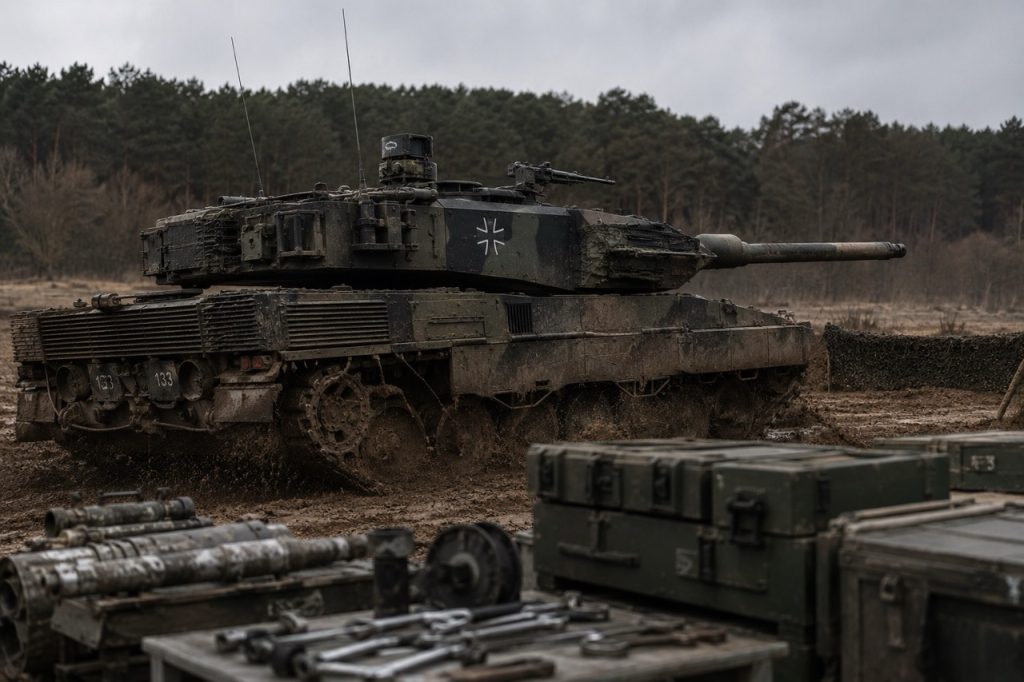
Electronics and Fire-Control System Sustainment Challenges
The fire-control and electronics systems that give the Leopard 2 its battlefield dominance are also among the most sustainment challenging aspects of the platform. The EMES 15 gunner’s primary sight, commander’s independent thermal viewer, ballistic computer, and associated electronics were state of the art at introduction but now represent a mature and in some respects ageing technology baseline across many national fleets.
Obsolescence management is a central sustainment challenge for Leopard 2 electronics. Components produced by suppliers who have since discontinued product lines require either long-term storage of original parts, redesign efforts, or technology refresh programmes that carry their own cost and schedule risk. Nations that have invested in A6 and A7 upgrades benefit from more modern electronics architectures, but even these systems require specialist support that is not always available through standard national logistics pipelines.
Military logistics operations supporting Leopard 2 electronics sustainment must therefore think beyond simple spare parts procurement. They must engage with original equipment manufacturers, authorised repair facilities, and specialist defence sustainment companies capable of sourcing, testing, and certifying components across the full electronics architecture of the vehicle. Without that capability, even a single failed electronics line replaceable unit can ground a vehicle indefinitely.
Obsolescence Management and Lifecycle Sustainment Strategy
The Leopard 2 has been in service since 1979. The oldest variants still in active inventories are approaching or exceeding forty years of operational life. Across that timeframe, component suppliers have changed, manufacturing processes have evolved, and original design documentation has in some cases become difficult to access. This creates a genuine obsolescence challenge that requires deliberate lifecycle sustainment strategy rather than adhoc procurement.
Effective Leopard 2 lifecycle support involves several interconnected disciplines. Parts cataloguing must be current and accurate, reflecting actual vehicle configurations rather than theoretical build standards that diverged from production reality decades ago. Supplier relationships must be maintained not just with prime contractors but with the subtier suppliers who manufacture critical components. And where original parts are genuinely unavailable, qualified substitute or remanufactured components must be identified, tested, and approved through appropriate technical authorities before they enter the fleet.
Nations that treat Leopard 2 sustainment as a procurement exercise buying parts reactively when vehicles break down consistently underperform on readiness metrics compared to those that treat it as a strategic programme with dedicated resources, forward planning, and supply chain investment. The difference in operational availability between these two approaches is measurable, and in a crisis scenario, potentially decisive.
Proactive Sustainment Strategies and Their Impact on Operational Availability
The concept of proactive sustainment is well established in defence industry doctrine but inconsistently applied across Leopard 2 operating nations. Proactive sustainment means identifying likely failure points before they occur, maintaining appropriate stock buffers at the right points in the logistics chain, and scheduling maintenance interventions based on usage data rather than waiting for breakdowns.
For main battle tank sustainment, this translates into several practical disciplines. Condition monitoring and usage tracking recording engine hours, mileage, and operational environments allows maintenance planners to predict component replacement requirements rather than react to failures. Prepositioned spare parts stocks, held either nationally or through NATO common support arrangements, reduce the lead time between a vehicle going unserviceable and returning to operational status. And investment in field repair capability trained maintainers with the right tools and technical data keeps minor faults from cascading into major unscheduled overhauls.
The operational availability improvements achievable through proactive sustainment are not marginal. Armoured fleets that implement structured maintenance programmes, adequate spare parts pipelines, and trained field maintenance teams routinely achieve significantly higher readiness rates than those relying on breakdown-driven maintenance. In a NATO context where interoperability and collective capability matter, these differences aggregate into measurable alliance-level readiness gaps or advantages.
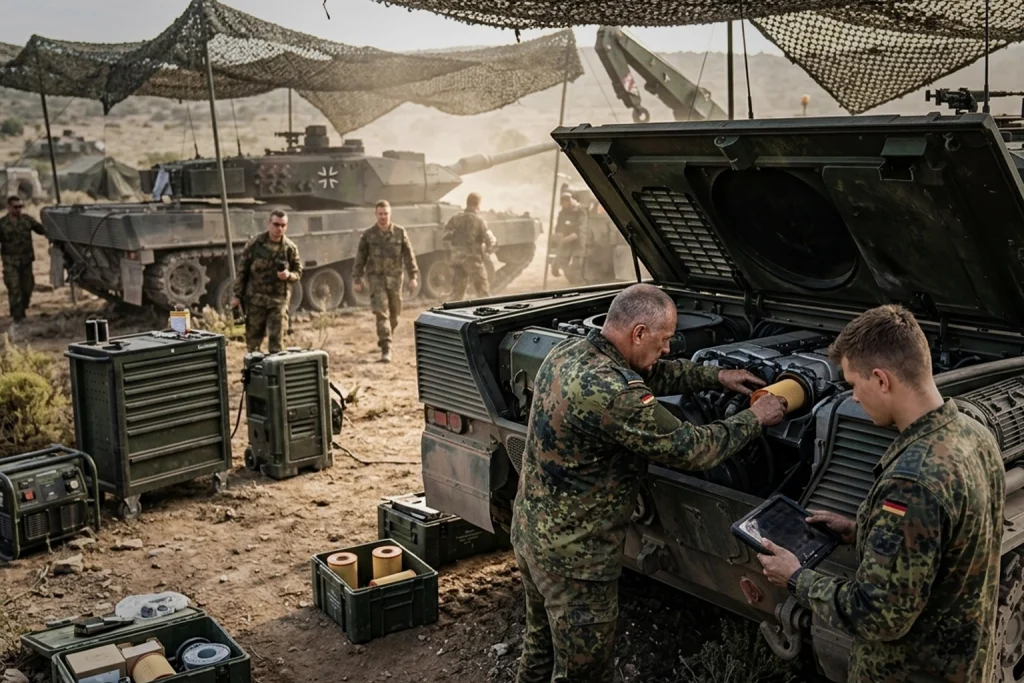
NATO Interoperability and Logistics Implications
The Leopard 2 is, in many respects, a NATO success story. It is operated by Germany, the Netherlands, Spain, Greece, Turkey, Poland, Norway, Finland, Denmark, Canada, Switzerland, and several other nations making it among the most widely operated main battle tanks in the Western world. This commonality creates genuine opportunities for shared logistics, cooperative spare parts pooling, and collective sustainment investment.
In practice, however, NATO tank logistics for the Leopard 2 remain fragmented. Different nations operate different variants from A4 to A7 with different national modifications, different approved suppliers, and different technical documentation standards. This fragmentation means that a spare part approved for use in one nation’s fleet may not be directly transferable to another without additional qualification. And while frameworks such as the NATO Support and Procurement Agency provide mechanisms for collaborative logistics, the practical reality of spare parts pooling remains more complex than the concept suggests.
For nations acquiring or expanding their Leopard 2 fleets as several have done in response to the changed European security environment since 2022 the sustainment challenge is compounded by the need to build logistics infrastructure, train maintenance personnel, and establish supply chains essentially from scratch. The tank itself can be delivered within a defined timeframe. The sustainment ecosystem required to keep it operational at scale takes considerably longer to establish.
The Importance of Reliable Defence Spare Parts Suppliers
In any major platform’s sustainment ecosystem, the availability of reliable, qualified spare parts suppliers is not optional — it is foundational. National defence logistics organisations cannot maintain direct relationships with every sub-tier component manufacturer across a complex platform like the Leopard 2. They depend on defence sustainment partners who can source, verify, and supply the right parts at the right time.
What distinguishes a genuinely capable military spare parts supplier from a simple parts broker is depth of platform knowledge, access to verified supply chains, and the ability to provide technical assurance that components meet the specifications required for military use. For a platform as complex and as widely operated as the Leopard 2, this means understanding not just part numbers but variant differences, national modifications, and the technical authorities responsible for component approval in each operating nation.
AB Defence operates within this space, providing Leopard 2 spare parts and broader armoured vehicle logistics support to defence organisations across multiple regions. The company’s approach is grounded in the understanding that sustainment is a long-term relationship rather than a transactional exchange — one that requires consistent reliability, technical credibility, and the organisational capacity to respond when operational timelines demand it.
Responsive logistics networks matter especially during surge requirements. When a national fleet faces an operational commitment that demands higher readiness rates than peacetime norms, the ability of sustainment partners to accelerate supply, identify alternative sources, and maintain quality standards under time pressure is what separates capable defence supply relationships from inadequate ones.
Lessons from Modern Conflict Environments
The conflict in Ukraine since 2022 has provided the most significant real-world data point on main battle tank sustainment in decades. While the Leopard 2 has not been the primary platform for either side, the conflict has illuminated maintenance and logistics realities that are directly relevant to Leopard 2 operators and their sustainment planning.
The pace at which armoured vehicles are consumed, damaged, and require repair in high-intensity warfare has exceeded many planning assumptions. The importance of battlefield maintenance the ability of crew and unit-level maintainers to conduct rapid field repairs and return vehicles to action has been reaffirmed as a decisive capability. And the vulnerability of extended, fragile supply chains to disruption has underscored the value of forward-positioned spare parts stocks and organic repair capability.
For Leopard 2 fleet managers and defence procurement officers assessing their own sustainment postures in light of these lessons, the conclusions are consistent: spare parts depth, field repair investment, and supply chain resilience are not peripheral considerations. They are core elements of armoured force capability that belong in capability planning and defence procurement budgets with the same prominence as platform acquisition itself.
Conclusion
The Leopard 2 is among the finest main battle tanks in the world. Its firepower, protection, and mobility represent decades of engineering development and operational refinement. But its effectiveness in any given operational scenario is bounded by the quality of the sustainment system that supports it.
Leopard 2 fleet readiness is achieved through spare parts availability, maintenance planning discipline, trained personnel, supply chain resilience, and lifecycle sustainment investment. It is sustained through proactive rather than reactive maintenance strategies, through reliable defence sustainment partnerships, and through the kind of long-term commitment to logistics capability that does not always attract the same attention as platform acquisition but is no less critical to national and alliance defence capability.
For defence organisations operating or acquiring the Leopard 2, the question is not simply whether the platform is capable it demonstrably is. The question is whether the sustainment infrastructure surrounding it is adequate to maintain that capability across the full range of operational scenarios it may face. That is the sustainment perspective, and it is one that no serious defence planner can afford to overlook.
Related Military Spare Parts Categories, Vehicle Platforms & Technical Guides
Explore AB Defence’s NATO-codified (NSN) and genuine OEM spare parts catalog, platform technical specifications, and sustainment engineering guides related to this article:
Stocked Spare Parts Categories (NSN & OEM Catalog)
- M60 Tank Spare Parts (M60A1 / M60A3 / M60T) (497 stocked parts)
- M109 Self-Propelled Howitzer Spare Parts (585 stocked parts)
- Allison XTG-411-2A Transmission Spare Parts (96 stocked parts)
- M48 Patton Main Battle Tank Spare Parts (M48A5T1 / M48A5T2) (11 stocked parts)
- M107 / M110 Self-Propelled Howitzer Spare Parts (83 stocked parts)
- Full NATO NSN & OEM Spare Parts Catalog (16,760+ Parts)
Compatible Vehicle Platforms & System Hubs
- M60 Series
- M88 Armoured Recovery Vehicle
- Leopard 2 Series
- Leopard 1 Series
- GIAT / DAF Turret Systems
- Request a B2B Quotation (RFQ) & Technical Support
Related Military Engineering & Sustainment Articles
- M60T and M88 HERCULES: Two Platforms That Define Modern Armored Force Readiness
- Tracked Armoured Vehicles with GIAT Turret Systems: Enhancing Battlefield Superiority
- Why Legacy Military Vehicles Still Matter in Modern Defense Operations
- 8 Components Most Frequently Replaced in Armored Military Vehicles