August 28, 2026
Operational Challenges in Maintaining Kirpi Armored Vehicles

A commercial delivery truck and a 20 tonne mine resistant vehicle are both diesel powered, wheeled, and built to move people and cargo. Past that, the comparison breaks down. Kirpi armored vehicle maintenance carries a mass penalty on every suspension component, an armored capsule that constrains access to routine service points, mission systems layered onto a base platform, and because the Kirpi is produced in multiple structurally different configurations a documentation burden a standard commercial fleet never faces. Readiness is not something a maintenance officer inherits once a vehicle is delivered; it is sustained through configuration discipline, preventive maintenance planning, trained personnel, accurate diagnostics and a spare parts supply chain that can be trusted under audit.
This article sets out the operational and sustainment challenges specific to keeping the BMC Kirpi family mission capable: why configuration diversity matters to procurement, what makes powertrain, suspension, braking, electrical, and protection system maintenance genuinely difficult on this platform, and a practical framework for reducing unplanned downtime. It is written for maintenance officers, fleet managers, MRO teams, logistics planners and defence procurement specialists accountable for keeping Kirpi fleets operational.
The Kirpi family and why configuration matters
BMC Otomotiv Sanayi ve Ticaret A.Ş. manufactures the Kirpi as a family of mine-resistant, ambush protected (MRAP) vehicles rather than a single fixed design. BMC’s current product line lists the Kirpi 4×4, Kirpi (4×4) Ambulance, Kirpi 6×6, Kirpi II 4×4, Kirpi II 4×4 with the BMC Power TUNA engine, Kirpi II 4×4 Ambulance, Kirpi II Carrier Vehicle and Kirpi II 4×4 METI (explosive ordnance disposal variant) as distinct configurations, each with its own published technical specification.
The differences are not cosmetic. The original Kirpi 4×4 and Kirpi 6×6 use rigid AxleTech axles on parabolic leaf springs, drum or disc brakes depending on variant, and a Cummins ISL9E3 375 diesel paired with an Allison 3000 series automatic transmission. The Kirpi II generation moves to fully independent front and rear suspension with differential locks, and in the variant BMC lists as “Kirpi II 4×4 (TUNA Engine)” some Kirpi II vehicles are powered by the BMC Power I4 TUNA engine rather than the Cummins unit, a domestically produced four cylinder diesel rated differently from the Cummins six cylinder it sits alongside in the product line. The Kirpi II Carrier Vehicle and Kirpi II METI variants step up again, to a larger Cummins ISLe-T / ISL9 450 engine, an Allison 3200 SP or 3000-series transmission, AxleTech ISAS 5000 axles, and 16.00 R20 tires in place of the 14.00 R20 fitted to the 4×4 baseline. A part, service interval or fluid specification that applies to one configuration cannot be assumed to apply to another simply because both vehicles are called “Kirpi.”
Why Kirpi configuration control matters
| Configuration variable | Maintenance / procurement implication | Verification required before ordering |
|---|---|---|
| Vehicle variant (Kirpi I vs. Kirpi II 4×4 / 6×6 / Ambulance / Carrier / METI) | Determines suspension type, brake system, dimensions, and mission equipment fitted | Confirm exact variant designation against the vehicle’s technical data plate |
| Engine family (Cummins ISL9E3 375, Cummins ISLe-T / ISL9 450, or BMC Power TUNA) | Governs fuel system, cooling capacity, engine control parameters, and which parts catalog applies | Confirm engine model and rating stamped on the engine data plate, not assumed from vehicle type alone |
| Suspension layout (rigid axle / leaf spring vs. independent double-wishbone) | Changes the wear part list entirely leaf spring hardware vs. control arm and torsion components | Confirm from the OEM technical specification for the specific variant |
| Axle and driveline arrangement (AxleTech 4000 series vs. ISAS 3000 / 5000 series) | Different load ratings and differential lock configurations affect axle and driveline parts compatibility | Confirm axle series and ratio against the vehicle’s build record |
| Braking system (drum, air actuated vs. disc, ABS-equipped) | Determines brake friction material, valve, and ABS sensor requirements | Confirm brake type from the technical data sheet for the exact variant |
| Electrical / mission equipment (base 24V system vs. added vision systems, robotic arm, or medical fit-out) | Adds load management, wiring, and diagnostic complexity beyond the base vehicle | Confirm installed mission equipment against the unit’s configuration record |
| Production or modification status | Field modifications and mid-life upgrades can move a vehicle away from its original build specification | Confirm current configuration through unit level maintenance and modification records, not the original order specification |
Not every listed system appears on every variant, and this table is not a substitute for the applicable OEM technical manual or fleet configuration record it is a starting checklist for the questions a maintenance or procurement team should be asking before ordering a part or scheduling a repair.
The major operational challenges in Kirpi armored vehicle maintenance
High mass, payload, terrain and duty cycle stress
A Kirpi 4×4 has a gross vehicle weight of roughly 19,710 kg, and the 6×6 variant rises to 26,000 kg. That mass, combined with a V-shaped monocoque hull and off road duty cycles, places sustained loading on suspension components, wheel end assemblies, steering linkages, and brakes that a commercial truck of similar footprint never experiences. Braking systems in particular must repeatedly arrest a heavier than average vehicle on grades and loose surfaces, which is why the Kirpi specification includes an engine (Jacobs) brake on several variants for controlled descent. None of this justifies assuming a specific failure rate or wear pattern without fleet level data; it does mean that inspection intervals, torque verification, and wheel end service should be planned around the vehicle’s actual operating mass and terrain exposure rather than a generic commercial truck schedule.
Dust, heat, cold, mud, water and contamination control
BMC’s published environmental ratings place the baseline Kirpi 4×4 and 6×6 between −32°C (mid-cold, “CO”) and +49°C (basic hot, “A2”), while the Kirpi II 4×4 with the Cummins engine is rated to +55°C a wider hot climate envelope than the Cummins-powered 4×4 and 6×6. Operators fielding Kirpi vehicles across this range should treat filtration (air, fuel and oil), cooling system integrity, seal condition, and connector corrosion as environment driven maintenance focus areas rather than fixed interval afterthoughts. Any specific temperature envelope cited for maintenance planning should be attributed to the exact variant it applies to; the Cummins-powered Kirpi II’s +55°C hot climate rating should not be assumed to extend to the TUNA powered Kirpi II, which BMC lists separately at +49°C.
Powertrain and cooling system complexity
Because the Kirpi family spans at least three engine specifications the Cummins ISL9E3 375 (375 PS, 1,550 Nm), the larger Cummins ISLe-T / ISL9 450 (450 PS, 1,627 Nm) fitted to the Carrier and METI variants, and the BMC Power TUNA (380 PS, 1,600 Nm) fitted to newer Kirpi II vehicles ordering by platform name alone is a documented risk. Cummins maintains a global dealer and parts network for the ISL9 engine family across North America, Africa, the Middle East, Latin America, Asia Pacific, and Europe, supporting Cummins powered Kirpi fleets in most operating theatres. The TUNA engine, as a domestically produced BMC Power unit, concentrates parts and technical support through BMC’s own channels a point fleet planners should account for separately when a fleet mixes Cummins and TUNA powered vehicles. Service procedures, coolant specifications, and diagnostic thresholds should be taken from the OEM manual for the specific engine fitted, not assumed from a sister variant.
Suspension, braking, tires, run flat systems and CTIS
The Kirpi’s two suspension architectures rigid axle with parabolic leaf springs on the original Kirpi 4×4 and 6×6, and fully independent suspension on the Kirpi II family are not interchangeable in parts or service procedure, and neither is inherently superior; the choice reflects a design trade off between structural simplicity and ride/off-road performance. All variants are fitted with run flat tires and a Central Tire Inflation System (CTIS) as standard equipment, which lets the driver adjust tire pressure on the move for changing terrain. Correct lifting points, torque specifications, and alignment procedures are configuration specific, and a mobility subsystem fault a CTIS failure, a degraded run flat insert, or a worn wheel end bearing can take a vehicle out of mission capable status even when the rest of the platform is sound. Tire and wheel service in particular should follow the OEM procedure for the specific rim and tire size fitted (14.00 R20 on the 4×4/6×6/Kirpi II baseline, 16.00 R20 on the Carrier and METI variants).

Electrical, electronic, and mission system integration
BMC’s published specification lists a 24V electrical system with two 12V batteries on the baseline Kirpi variants, rising to four 12V/120Ah batteries on the higher powered Kirpi II Carrier Vehicle to support its additional load carrying and mission equipment. eyond the base electrical architecture, individual variants add vision systems, driver information systems, and on the METI variant a robotic arm for explosive detection and disposal work. Each addition increases the number of connectors, sensors, and wiring runs exposed to vibration, thermal cycling, and field damage, and it increases the risk that an intermittent fault gets misdiagnosed if the technician is not working from the correct wiring diagram for that specific mission fit. This article does not address the operation of any weapon station or remote weapon interface; from a maintenance standpoint, the relevant point is diagnostic discipline verify the exact mission equipment installed before troubleshooting an electrical fault.
Protection related systems require controlled inspection
The Kirpi’s V-shaped, monocoque hull and its associated protection systems armored glazing, door and hatch hardware, mine protected seating, and the automatic fire suppression system covering engine and crew compartments are standard equipment across the family, with BMC’s public materials describing protection against ballistic, mine, and IED threats under STANAG 4569. BMC’s own public materials do not disclose the specific STANAG 4569 protection level achieved by each variant, and this article does not infer one; readers requiring that information should consult BMC directly or the applicable contract documentation. What matters operationally is that any vehicle exposed to blast, impact, rollover, fire, or significant water ingress requires inspection against OEM or fleet engineering criteria before it returns to service. This article does not set out post blast inspection checklists or repair limits those belong in the applicable technical manual or engineering authority’s documentation, and no maintenance program should substitute informal judgment for that authority.
Variant proliferation, modifications and documentation gaps
A Kirpi fleet accumulated over more than a decade of production, export sales, and in country modification programs is unlikely to be perfectly uniform. Serial number changes, superseded part numbers, and locally applied modifications all create fitment risk if a maintenance record does not track them. The practical safeguard is discipline at the point of identification: recording the vehicle identification or serial number, the exact variant designation, the specific assembly installed, the OEM reference number, and the current modification state before requesting a part supported by photographic or dimensional confirmation where the operator’s security policy permits it.
Parts availability, lead times, obsolescence and traceability
Long procurement cycles are a structural feature of armored vehicle sustainment, not a Kirpi specific flaw. GAO’s most recent public review of Army and Marine Corps ground vehicle sustainment 18 selected combat and support vehicles, including MRAP category platforms found that a shortage of parts and materiel and a lack of current technical data affected every vehicle reviewed, with a shortage of trained maintainers as a further recurring challenge. An earlier GAO report on the original multi vendor MRAP acquisition made a related point: procuring MRAPs from several manufacturers accelerated fielding but complicated long term maintenance because each vendor’s design requires its own procedures and parts. These are general MRAP category lessons, not documented findings about Kirpi specifically, and should be read as an informed basis for planning rather than evidence of a Kirpi failure pattern. The practical implication is the one GAO has raised for MRAP fleets generally: shelf life items, imported or controlled components, and repairable assemblies warrant a minimum stock model built from actual consumption data, supplier qualification, and traceable documentation certificates of conformity, material test reports, first article inspection records rather than reactive ordering after a vehicle goes non mission capable. Export control and customs requirements for any specific shipment should be confirmed against current regulatory guidance at the time of the transaction; this article does not offer legal advice on that point.
Skills, special tools, recovery and maintenance infrastructure
Sustaining a 19 to 26 tonne armored vehicle requires lifting and recovery capacity, diagnostic tooling matched to the specific engine and transmission control systems fitted, technicians trained on both the base commercial powertrain components and the vehicle’s armored specific systems, and current technical publications for the exact variant in service. A clear division between operator level checks, field level repair, and higher echelon overhaul work each with its own tooling and training requirements keeps minor faults from being deferred into major ones. This article does not describe specific recovery procedures; recovery operations should follow the operator’s own safety qualified procedures and equipment.
From reactive repairs to data driven fleet sustainment
GAO’s recent ground vehicle sustainment review also found that Army depot level overhaul volume fell sharply over the decade examined, with officials citing funding decisions as the driver a reminder that sustainment capacity is a resourcing choice as much as a technical one. Whatever the resourcing environment, an accurate maintenance record engine hours, kilometers, mission and environment profile, repeat fault history, and parts consumption by variant is what lets a fleet manager plan around failures rather than only react to them. This article does not promise specific predictive maintenance outcomes; the achievable claim is that accurate data collection is a precondition for any condition based approach, not a guarantee of one.
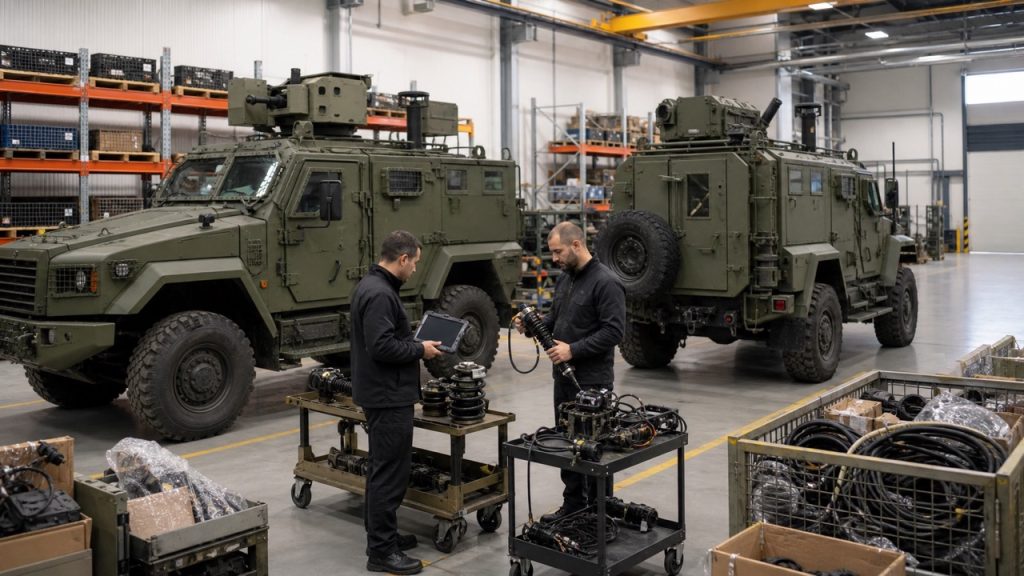
A seven part readiness framework
The following framework organizes the elements above into a practical sequence. It does not replace the applicable OEM technical manual, engineering authority, or unit safety procedures it is a planning structure for applying them consistently.
- Establish a configuration baseline for every vehicle. Record exact variant, engine, suspension type, and installed mission equipment against the vehicle’s serial number.
- Follow the applicable OEM or fleet authority maintenance documentation. Use the technical manual for the specific variant and engine fitted, not a sister configuration’s manual.
- Adapt inspection planning to duty cycle and environment through authorized engineering channels. Adjust inspection frequency for climate and terrain exposure only through a documented, authorized process not informal field judgment.
- Build a critical spares model from actual fleet consumption, lead time, criticality, shelf life, and repairability. Prioritize items whose absence causes immediate loss of mobility or survivability.
- Qualify suppliers and require traceable documentation. Certificates of conformity, material test reports, and first-article inspection records should accompany procurement, not follow it.
- Invest in technician, operator, diagnostic, and safety training. Match training to the specific systems fitted to the fleet in service, including any mixed Cummins/TUNA powertrain population.
- Use maintenance data and root cause analysis to improve availability. Track repeat faults by variant and component to distinguish genuine trends from isolated incidents.
Information to confirm before requesting a Kirpi part
Before submitting a parts request, maintenance and procurement teams should have the following information ready:
- Exact model and variant (e.g., Kirpi II 4×4, Kirpi II Carrier Vehicle, Kirpi II 4×4 METI)
- Vehicle identification or serial data, where releasable under the operator’s security policy
- Engine and transmission identification (Cummins ISL9E3 375, Cummins ISLe-T/ISL9 450, or BMC Power TUNA; Allison 3000 or 3200 SP)
- OEM part or reference number for the specific assembly
- Supersession status of the requested part number
- Current installed modification state of the vehicle
- Quantity required and whether the request is for stock or an immediate mission need
- Required supporting documentation (certificate of conformity, material test report, or equivalent)
- Packaging and preservation requirements for the shipping method and climate
- Destination and delivery priority
- Applicable end use or export documentation for the transaction
None of this information should be transmitted through an unsecured channel if it is operationally sensitive, classified or personally identifiable.
How AB Defence supports lifecycle continuity
AB Defence supports Kirpi I and Kirpi II sustainment through a platform first spare parts approach: verifying the exact vehicle variant and configuration before sourcing, working from OEM references and applicable technical documentation, and maintaining a catalogued Kirpi parts inventory spanning engine, transmission, suspension, braking, electrical, and structural components. AB Defence is not the Kirpi’s vehicle manufacturer and does not claim OEM authorization or manufacturer status for the platform; procurement teams should confirm any supplier’s role in a Kirpi supply chain directly with that supplier and, where relevant with BMC.
Readers looking for a component by component breakdown of Kirpi spare parts planning rather than the operational and configuration management focus of this article will find that covered in AB Defence’s field guide to Kirpi spare parts. AB Defence’s broader platform-specific tactical wheeled vehicle support covers Kirpi alongside other platforms in current service, and the catalogued Kirpi I and Kirpi II parts inventory lists components by system for teams building a sourcing requirement. Organizations with a documented Kirpi parts or sourcing need can submit a request through AB Defence’s contact page.
Kirpi armored vehicle maintenance is a system level challenge not a parts replacement task. Configuration control across the Kirpi I, Kirpi II, TUNA powered, and mission specific variants; disciplined preventive maintenance tuned to duty cycle and climate; trained technicians working from the correct technical documentation; accurate fault diagnosis; and a traceable, resilient spare parts supply chain all have to function together for a Kirpi fleet to stay mission capable. None of these elements substitutes for the others, and none of them is optional for an operator that depends on the platform’s protection in the field. Organizations managing a Kirpi fleet, and needing a properly documented parts or sourcing requirement fulfilled, are welcome to contact AB Defence with the vehicle’s configuration and requirement details.
Related Military Spare Parts Categories, Vehicle Platforms & Technical Guides
Explore AB Defence’s NATO-codified (NSN) and genuine OEM spare parts catalog, platform technical specifications, and sustainment engineering guides related to this article:
Stocked Spare Parts Categories (NSN & OEM Catalog)
- BMC Kirpi MRAP Spare Parts (Kirpi I & Kirpi II) (597 stocked parts)
- Military Brake Calipers, Master Cylinders & Hydraulic Systems (103 stocked parts)
- Military Portal Axles, Differentials & Drive Shafts (107 stocked parts)
- Military Engine Internal Components & Overhaul Parts (104 stocked parts)
- Electrical, Electronic & Vision Systems for Military Vehicles (250 stocked parts)
- Full NATO NSN & OEM Spare Parts Catalog (16,760+ Parts)
Compatible Vehicle Platforms & System Hubs
- Kirpi I (BMC)
- Cobra II
- Ejder Yalçın
- Tactical Wheeled Vehicles
- Brake & Suspension Systems
- Request a B2B Quotation (RFQ) & Technical Support