August 17, 2026
Kirpi MRAP Maintenance: Components with the Highest Wear Rates
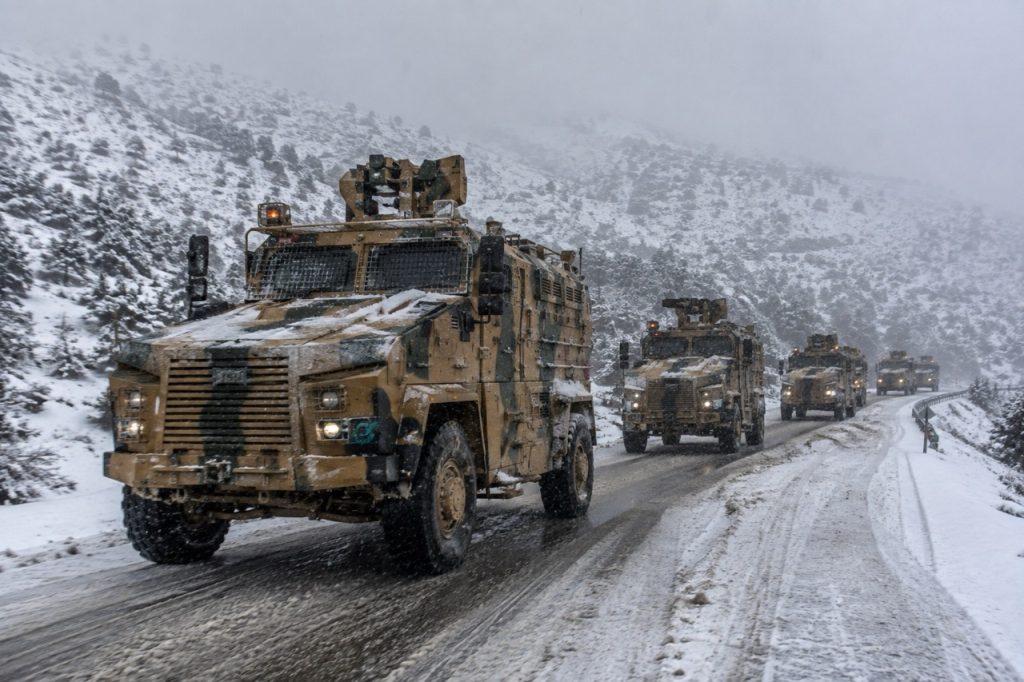
For fleet managers responsible for BMC Kirpi MRAP platforms, component wear is not an abstract engineering concern it is the variable that determines whether a vehicle is available for the next mission or sitting in a maintenance bay. Kirpi MRAP maintenance planning has to account for a demanding operating profile: high curb weight, armor driven payload, repeated off-road transitions, sustained braking under load, and long operating hours across the -32°C to +49/+55°C environmental range BMC specifies for the platform. These conditions place accelerated stress on the mechanical and supporting systems that keep the vehicle mobile and protected.
Effective Kirpi MRAP maintenance is not simply about repairing failures after they occur. It means identifying wear prone components early, monitoring their condition against known operational stressors, keeping lubrication and adjustment within specification, and ensuring critical spare parts are available before a minor component issue becomes a vehicle down event. This article outlines the systems that maintenance teams, fleet sustainment managers, and defense procurement professionals should treat as maintenance priorities, based on the mechanical loads those systems experience and BMC’s published technical architecture for the Kirpi family not on a public statistical wear ranking, because none exists for this platform.
1. Understanding Wear in Kirpi MRAP Operations
Component wear on a Kirpi MRAP is rarely the product of a single cause. Vehicle weight and payload set the baseline load every suspension, brake, and driveline component must carry; a Kirpi 4×4 with a gross vehicle weight of roughly 19.7 tonnes and a 6×6 configuration reaching 26 tonnes place meaningfully different demands on axles and brakes, even on related architecture. Terrain adds a second variable sustained off-road operation, articulation over uneven ground, and repeated transitions between paved and unimproved surfaces increase mechanical loading on suspension joints and bushings well beyond what road only operation produces.
Braking frequency and drivetrain loading compound the picture: vehicles operating in convoy or patrol conditions brake more often and more aggressively, accelerating wear on friction surfaces and air-system components. Dust, mud, water intrusion, and temperature extremes affect seals, lubricants, and electrical connections. Tire pressure and CTIS operation influence handling, traction, and suspension loading simultaneously. None of these factors acts alone maintenance quality, lubrication discipline, component quality, and mission profile all interact with the mechanical stresses above, which is why Kirpi MRAP maintenance is best approached as a systems discipline rather than a checklist of isolated parts.
2. Suspension Components: A Major Maintenance Priority
Suspension is one of the most consistently demanding maintenance areas on a tactical MRAP, and BMC’s own technical documentation shows that Kirpi suspension architecture is not uniform across the family a distinction that matters directly for spare parts planning.
Rigid Axle, Leaf Spring Variants
Independent Suspension Kirpi II Variants
Kirpi II 4×4 configurations the standard Cummins-powered version, the BMC Power I4 Tuna-engine version, and the Kirpi II Ambulance move to fully independent front and rear suspension. This is a structurally different wear chain from the leaf spring vehicles: instead of a smaller number of high load spring components, independent suspension distributes load across control arm joints, bushings, and mounting points at each wheel station individually, increasing the number of wear sensitive interfaces and raising the importance of alignment and bushing condition under payload.
Warning Signs of Suspension Wear
- Excessive vehicle movement over rough terrain
- Uneven tire wear patterns
- Abnormal vibration at speed
- Steering instability
- Unusual noises during articulation
- Fluid leakage from shock absorbers
- Changes in ride height or irregular handling under load
BMC does not publish component level replacement intervals for suspension parts, so inspection findings and fleet history not assumed calendar intervals should drive replacement decisions.
3. Brake System Components
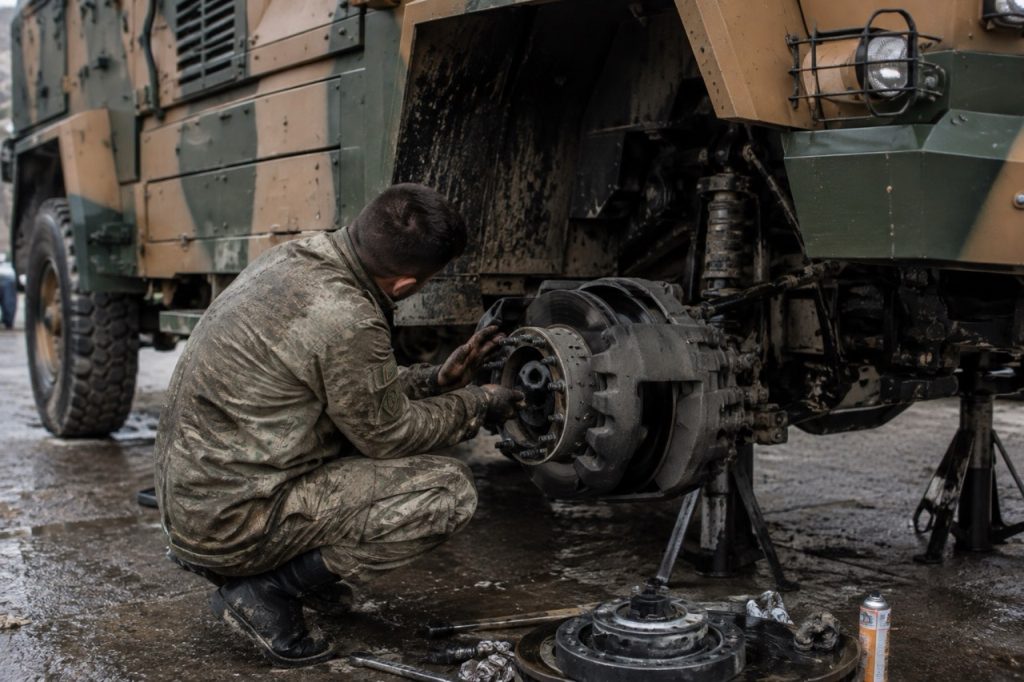
Brakes are a high priority wear area on any vehicle in the Kirpi’s weight class, and configuration differences here are significant enough that fleet operators should verify the exact brake architecture on each vehicle before planning spares. BMC’s published specifications show the Kirpi 4×4, Kirpi Ambulance, and Kirpi 6×6 fitted with a drum type, full air dry service brake system, an air operated spring parking brake, and a Jacobs (engine) brake, with ABS available as an option depending on configuration. The Kirpi II family the standard 4×4, the Tuna-engine 4×4, and the Kirpi II Ambulance specifies disc brakes with ABS as standard, alongside a dual-circuit air service brake system and a mechanically or spring actuated parking brake.
Because vehicle mass makes braking one of the most frequent high load events in normal operation, maintenance teams should monitor braking performance, uneven braking between wheel positions, abnormal heat at wheel ends after use, air system leakage, brake drag, unusual noise, and any ABS or air pressure warning indicators. On drum brake variants, lining and drum surface condition are the primary inspection points; on disc brake variants, pad wear and rotor condition take that role. Brake maintenance should follow the applicable BMC technical manual rather than intervals borrowed from other MRAP platforms, since brake hardware, actuation type, and ABS fitment are not identical across the Kirpi range.
4. Tires, Wheels, Run Flat Systems and CTIS
Tires and wheel-end air systems require continuous attention on a vehicle of this mass operating across mixed and often unimproved terrain. BMC specifies 14.00 R20 tires on 10×20-inch rims for the Kirpi 4×4, Ambulance, and 6×6, and 16.00 R20 tires for the higher capacity Kirpi II Carrier Vehicle and METI variants a distinction worth confirming before ordering replacement tires or rims, since sizes are not universal across the family. All current Kirpi variants are equipped with run flat inserts and a Central Tire Inflation System (CTIS) that lets the driver adjust pressure for different terrain without leaving the vehicle.
Maintenance priorities in this area include tread wear patterns, sidewall damage, cuts and punctures, uneven wear that can indicate a suspension or alignment issue elsewhere, wheel and rim damage, valve and CTIS air line condition, and seal integrity where CTIS lines interface with the hub. Incorrect tire pressure affects far more than the tire itself it changes handling, extends braking distances, accelerates uneven tread wear, increases fuel consumption, and alters the load path through the suspension. Because CTIS is a shared system across the fleet, air-line and seal inspection deserves the same discipline as the tires themselves; a slow CTIS leak is often the first visible sign of a wheel end sealing problem before it becomes a bearing issue.
5. Wheel End, Hub, Bearing and Seal Components
Wheel end assemblies sit at the intersection of several wear inducing conditions: they carry vehicle weight and cornering loads, they are directly exposed to water and mud thrown up from the road surface, and on Kirpi platforms they also carry the CTIS air line seals that must remain intact for the inflation system to function. Hub bearings, seals, axle end fasteners, and lubrication points in this area are worth tracking closely, since water intrusion, dust contamination, inadequate lubrication, and normal operational loading all contribute to progressive wear.
- Abnormal heat at the hub after operation
- Grinding or humming noises that change with speed
- Detectable play when the wheel is checked by hand
- Vibration that increases with speed
- Lubricant leakage at the seal
- Uneven or irregular wheel behavior during turns
Because wheel end failure can escalate quickly from a minor seal leak to a bearing replacement, and because bearing and seal availability is often a lead time bottleneck for deployed fleets, these are components worth stocking proactively rather than sourcing reactively.
6. Axles, Differentials and Driveline Components
Driveline architecture again differs meaningfully across the Kirpi family, and BMC’s technical documentation should be the reference point rather than assuming a single configuration applies fleet wide. The Kirpi 4×4 and Ambulance use AxleTech 4000 series rigid axles; the 6×6 uses AxleTech ISAS 3000 series axles across its axle positions; the Kirpi II 4×4 family uses AxleTech ISAS 5000-series axles paired with front and rear differential locks; and the higher-output Kirpi II Carrier Vehicle and METI variants also specify AxleTech ISAS 5000 axles, behind a GHM/Meritor RTC60 two speed transfer case rather than the ZF two speed unit used on the 4×4, Ambulance, and 6×6.
Off-road traction demands, torque transfer under load, steep gradient operation (all Kirpi variants are rated to 60 percent gradeability), and repeated changes in traction surface increase stress on driveline seals, universal joints, and differential components. Maintenance concerns to track include lubricant condition and contamination, leaks at pinion and axle seals, excessive backlash, abnormal noise or vibration under acceleration, damaged joint boots and seals, worn joints, and loose or fatigued fasteners at driveline connection points. Differential lock actuation pneumatic on the Kirpi variants that specify it is also worth including in routine inspection, since a lock that fails to engage or disengage cleanly affects both mobility and driveline stress distribution.
7. Steering and Front End Components
Steering components on a vehicle operating over rough and unpredictable terrain absorb repeated impact loading that road only vehicles rarely experience. Tie rods, steering linkages, joints, and steering related bushings are directly exposed to shock loading from potholes, rock strikes, and uneven ground, and that loading is transmitted through the same suspension architecture discussed above meaning steering and suspension wear should generally be assessed together rather than as separate maintenance tracks.
Warning signs that steering components require inspection include excessive play in the steering wheel before the front wheels respond, a tendency for the vehicle to wander or require constant correction, abnormal or uneven tire wear concentrated on the front axle, vibration through the steering column, unusually high steering effort even with power assistance functioning, and knocking or clunking sounds over rough ground. Wheel alignment should be checked whenever steering or suspension components are replaced, since misalignment accelerates tire wear and can mask or mimic other wear-related symptoms.
8. Engine and Cooling System Wear Points
The Kirpi engine itself is not a conventional high turnover wear part, but the systems that support it are legitimate maintenance priorities, particularly given the environmental range BMC specifies for the platform from -32°C mid-cold to +49°C or +55°C basic-hot conditions depending on variant. Engines across the family include the Cummins ISL9E3 375 (6-cylinder, 8.9-liter, 375 PS) fitted to the Kirpi 4×4, Ambulance, 6×6, and Kirpi II 4×4 and Ambulance; the BMC Power I4 Tuna (4-cylinder, 8.5-liter, 380 PS) fitted to the Kirpi II 4×4 Tuna-engine variant; and the higher output Cummins ISLe-T 450 and ISL9 450 (450 PS class) fitted to the Kirpi II Carrier Vehicle and METI variants.
Belts, hoses, filters, and the cooling package deserve routine attention, since dust ingestion, high ambient temperature, extended idle periods in convoy or checkpoint operations, and sustained heavy load running all increase thermal and filtration demands. Fluid leaks at hose connections and engine mounts, intake system contamination, and turbocharger related inspection should be part of routine service, following the applicable technical manual for the specific engine variant fitted rather than a generic diesel maintenance schedule.
9. Automatic Transmission and Transfer Case Maintenance
All current Kirpi variants use an Allison automatic transmission, though the specific series differs: Allison 3000 series units are specified across the 4×4, Ambulance, 6×6, and most Kirpi II variants, while the higher output Kirpi II Carrier Vehicle uses an Allison 3200 SP. Transfer cases also vary a ZF two speed unit on the 4×4, Ambulance, and 6×6, versus a GHM/Meritor RTC60 two-speed transfer case on the higher capacity Kirpi II Carrier Vehicle and METI variants.
Maintenance considerations for this driveline stage include transmission fluid condition and cleanliness, leaks at seals and cooler lines, overheating during sustained low-speed or off-road operation, shift quality and any hesitation or harsh engagement, abnormal noise from the transfer case, and driveline vibration that may originate at the transfer case rather than the axles. BMC does not publish generalized service intervals suitable for every operating environment, so transmission and transfer case service intervals should be drawn from the applicable technical documentation for the specific variant and adjusted for the fleet’s actual operating tempo.
10. Electrical and Auxiliary Systems
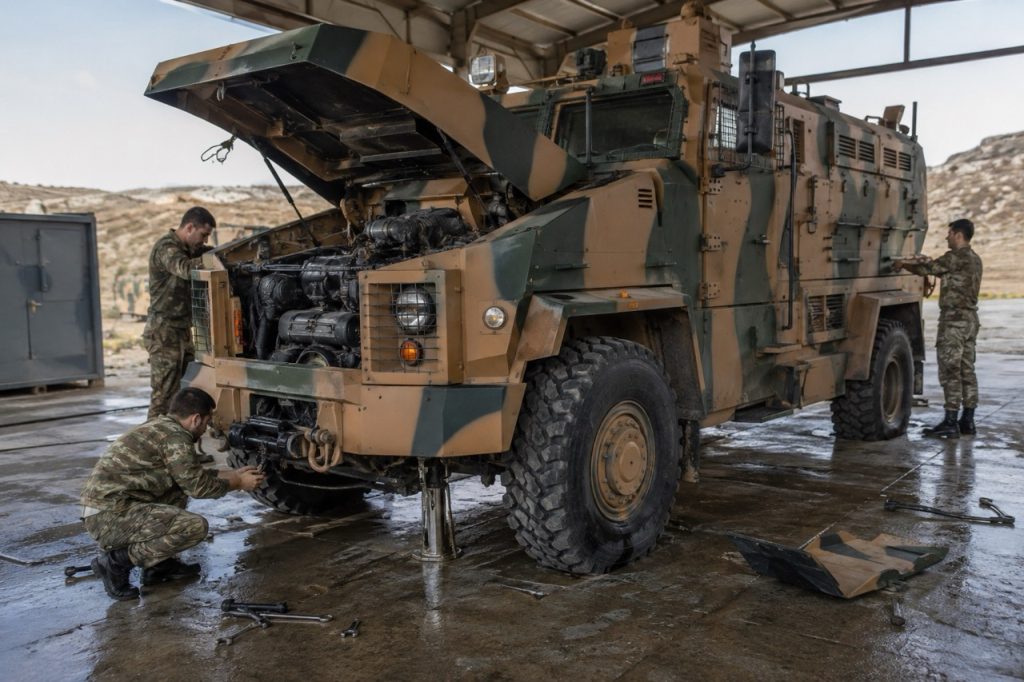
Electrical systems do not wear mechanically the way suspension or brake components do, but connector corrosion, wiring chafe, battery degradation, and sensor faults create readiness problems that are just as disruptive as a mechanical failure. Kirpi variants run a 24V electrical architecture with battery counts that scale with vehicle role two 12V batteries on the 4×4, Ambulance, and standard Kirpi II variants, and four 12V, 120Ah batteries on the higher-output Kirpi II Carrier Vehicle, reflecting its greater onboard electrical load.
Maintenance teams should include batteries, wiring harnesses, connectors, grounding points, lighting, and where fitted the vision system, driver information system, and CTIS control electronics in routine inspection. Air conditioning and independent heating, both standard equipment across the range, are also worth including in preventive checks, since crew compartment climate control is mission relevant across the extreme temperature range these vehicles are designed to operate in.
11. How Maintenance Teams Should Prioritize High Wear Components
With no published statistical wear ranking available for the Kirpi platform, maintenance planners are better served by a structured prioritization framework than by generic assumptions. A practical framework weighs:
- Safety criticality
- Consequence of failure mission abort versus inconvenience
- Wear visibility during routine inspection
- Failure probability based on the component’s operating environment
- Availability and lead time for replacement parts
- Mission importance of the specific vehicle
- The fleet’s actual operating environment
- Historical fleet data, where it exists
- Current inspection findings
- Manufacturer maintenance requirements
This framework also depends on distinguishing between maintenance approaches. Preventive maintenance replaces or services components on a schedule regardless of condition. Predictive maintenance uses trend data vibration, temperature, fluid analysis to anticipate failure before it occurs. Condition based maintenance acts on inspection findings rather than elapsed time. Corrective maintenance repairs a component after it has already failed. Most well run Kirpi fleets use a blend of these approaches, weighted toward preventive and condition based maintenance for safety critical systems like brakes and steering. Above all, actual fleet data failure history, inspection trends, and consumption patterns specific to a unit’s own vehicles and operating environment is more valuable than generic assumptions imported from another platform or theater.
12. Building a Kirpi MRAP Spare Parts Strategy
Identifying wear prone components is only useful if it translates into an actual spare parts strategy. Fleet operators should identify critical and high consumption spare parts before failures occur, rather than discovering a shortfall during an unscheduled repair. Depending on fleet configuration, mission profile, and operating environment, this can include suspension related parts specific to the leaf spring or independent-suspension architecture fitted, shock absorbers, brake components matched to the drum or disc system installed, filters, belts, hoses, seals, wheel-end bearings, driveline components, electrical connectors, and tire and CTIS-related parts.
Not every item on that list will be equally high consumption for every fleet a unit operating primarily on improved roads sees a different wear profile than one running sustained off-road patrols, and stocking decisions should reflect that difference rather than a one size fits all parts list. What matters is basing those decisions on fleet history, the exact vehicle configuration in service, mission profile, applicable technical documentation, and realistic lead times for each part category. Reliable spare parts sourcing, built around those variables, reduces vehicle downtime, maintenance delays, cannibalization of one vehicle to keep another running, emergency procurement at premium cost, and the broader logistics uncertainty that comes with reactive sourcing.
13. Why Component Level Monitoring Improves Fleet Readiness
Tracking component failures, replacement frequency, mileage and operating hours, inspection findings, recurring defects, environmental conditions, maintenance labor, and spare parts consumption over time gives fleet managers something a generic maintenance manual cannot: an accurate picture of how their own vehicles actually wear, in their own operating environment. This is where concepts like Mean Time Between Failures (MTBF) and Mean Time To Repair (MTTR) become useful not as fixed numbers imported from another platform, but as metrics a fleet builds from its own maintenance records.
Reliability-centered maintenance, condition based maintenance, and broader fleet health monitoring all depend on this kind of data discipline. A unit that tracks which components recur most often in its own maintenance logs, and correlates that against terrain, climate, and mission tempo, is in a far stronger position to plan spare parts inventory and preventive maintenance schedules than one relying on generalized assumptions about MRAP wear patterns.
14. Final Takeaway
Kirpi MRAP maintenance should focus on the systems most exposed to mechanical loading, friction, heat, vibration, and contamination suspension, brakes, tires and CTIS, wheel end components, steering, axles and driveline, and the supporting systems around the engine and transmission. Because BMC’s own technical specifications show meaningful differences in suspension type, brake architecture, axle series, engine, and tire size across the Kirpi 4×4, 6×6, and Kirpi II family, a sound maintenance and spare parts strategy has to start with confirming the exact configuration in service, not assuming uniformity across the fleet.
Early detection, qualified maintenance, and correct spare parts availability together produce improved fleet readiness. AB Defence supports military fleet managers, maintenance units, and procurement teams with Kirpi MRAP spare parts sourcing, replacement component supply, and broader defense logistics support for international military vehicle fleets. Organizations sustaining Kirpi platforms are welcome to contact AB Defence to discuss spare parts availability and fleet sustainment support for their specific configuration.
Work With AB Defence
Partner with AB DEFENCE for Reliable Combat Support Vehicle Sustainment. AB DEFENCE is a specialist international supplier of military spare parts and fleet sustainment solutions serving NATO and allied defense organisations. With deep inventory across a wide range of combat support vehicle platforms, rigorous quality assurance processes, export compliance expertise, and a commitment to long term supply chain partnership, AB DEFENCE helps defense buyers maintain fleet availability, reduce sustainment costs, and meet their operational readiness obligations. Contact the AB DEFENCE team to discuss your spare parts requirements, strategic inventory planning, and long-term sustainment programme needs.
Contact AB Defence to discuss your procurement requirements and learn how we can support your fleet readiness objectives.
Related Military Spare Parts Categories, Vehicle Platforms & Technical Guides
Explore AB Defence’s NATO-codified (NSN) and genuine OEM spare parts catalog, platform technical specifications, and sustainment engineering guides related to this article:
Stocked Spare Parts Categories (NSN & OEM Catalog)
- BMC Kirpi MRAP Spare Parts (Kirpi I & Kirpi II) (597 stocked parts)
- Military Brake Calipers, Master Cylinders & Hydraulic Systems (103 stocked parts)
- Military Portal Axles, Differentials & Drive Shafts (107 stocked parts)
- Military Engine Internal Components & Overhaul Parts (104 stocked parts)
- Electrical, Electronic & Vision Systems for Military Vehicles (250 stocked parts)
- Full NATO NSN & OEM Spare Parts Catalog (16,760+ Parts)
Compatible Vehicle Platforms & System Hubs
- Kirpi I (BMC)
- Cobra II
- Ejder Yalçın
- Tactical Wheeled Vehicles
- Brake & Suspension Systems
- Request a B2B Quotation (RFQ) & Technical Support