August 31, 2026
M113A1 vs M113A2 vs M113A3: Key Differences in Engine, Armor and Mobility

Why M113 Configuration Differences Matter
Three armored personnel carriers can sit side by side in a motor pool, wear the same boxy aluminum hull, and still require three different engines, three different transmissions, and three different maintenance procedures. That is the practical reality of the M113 family. The M113A1, M113A2, and M113A3 designations do not describe cosmetic revisions; they describe distinct powerpack generations, driver control layouts, and survivability packages layered onto a common chassis over roughly three decades of U.S. Army service life.
For fleet managers, maintenance officers, and spare parts buyers, the difference matters in very concrete ways. It affects which engine and transmission a depot needs to stock, how a mechanic diagnoses a cooling or steering fault, what training a crew requires, and critically which part number and National Stock Number (NSN) applies to a given component. Ordering against the wrong configuration can mean an incompatible engine mount, the wrong transmission control valve, or a fuel-system part built for a tank location the vehicle in front of the mechanic does not have.
This article compares the M113A1, M113A2, and M113A3 configurations across engine and powerpack, transmission and driver controls, cooling, suspension, braking and steering, weight and mobility, fuel system layout, armor and survivability, and the maintenance and procurement implications that follow. It also explains why a vehicle’s designation alone is not always sufficient to confirm its actual configuration, and what should be verified before a part is ordered.
Understanding the M113 Upgrade Sequence
The M113 entered U.S. Army service in the early 1960s as a gasoline powered, aluminum hulled armored personnel carrier. The M113A1 configuration was not a new vehicle; it was a dieselization program applied to existing hulls, replacing the original gasoline powerpack with a diesel engine for improved crew safety and range. The M113A2 that followed was, in turn, a package of automotive system improvements applied to the same basic diesel powertrain rather than a new engine family. The M113A3 represented a larger step: a new turbocharged engine, a redesigned transmission and steering system, relocated fuel storage, and provisions for additional armor.
It is important to treat these as configuration packages rather than as three cleanly separated production runs. Some vehicles were built new to a given standard; others were converted from an earlier configuration during depot overhaul programs that, in the case of the M113A2 to M113A3 conversion, ran for years and involved multiple contractors. National operators outside the United States have in some cases applied their own repower or armor packages on top of U.S. standard hulls, which means a vehicle carrying an “A2” or “A3” designation in a given country’s inventory does not automatically match the U.S. Army’s technical data package for that standard. This article focuses on the U.S. Army configuration sequence as the baseline, while noting where local modification is common.
M113A1 vs M113A2 vs M113A3 at a Glance
The table below summarizes verified configuration differences. Where a single universal figure could not be established from an authoritative source, the table notes that the value varies by configuration rather than presenting one number as definitive.
| Comparison area | M113A1 | M113A2 | M113A3 | Maintenance / procurement significance |
| Engine | Detroit Diesel 6V53, naturally aspirated, ~212 hp | Same 6V53 family as A1 — automotive refinements, not a new engine | Turbocharged Detroit Diesel 6V53T, ~275 hp | Naturally aspirated and turbocharged parts are not interchangeable |
| Transmission | Allison TX-100 series, 3 forward speeds | Allison TX-100 series (retained from A1) | Allison X200-4 / X200-4A hydrostatic-steer, 4 forward speeds | Confirm exact transmission model before ordering housings, valves, linkage |
| Steering / brake controls | Lateral steering levers | Lateral steering levers (unchanged) | Steering wheel and brake pedal, hydrostatic steering | Driver’s station parts are configuration specific |
| Cooling system | Original spec radiator/fan sized for N/A engine | Improved cooling capacity and personnel heating | Cooling sized for turbocharged output, part of RISE powerpack | Verify radiator/fan/shroud part number against installed powerpack |
| Suspension / running gear | Baseline torsion-bar suspension | Added shock absorbers (2nd road wheel), stronger torsion bars, raised rear idlers | A2 improvement package carried forward | A2/A3 suspension parts often shared confirm against build record |
| Approximate combat weight | Varies by mission equipment | Varies by mission equipment and kits | Increases with external tanks, liners, any armor kit | Varies by configuration check the specific vehicle, not a brochure figure |
| Road speed (combat-loaded) | ~40 mph class; varies by source/load | ~38 mph commonly cited | ~41 mph commonly cited | Treat published figures as approximate; loading and terrain affect results |
| Fuel-tank location | Internal | Internal (unchanged) | External, armored tanks replacing internal storage | Fuel-system fittings differ significantly between internal/external layouts |
| Base armor / survivability | Aluminum hull; no spall liner; no armor provision | Aluminum hull; no spall liner; no armor provision | Aluminum hull + internal spall-suppression liners + armor-mount provisions | Do not assume spall liners or mounts on earlier hulls |
| Appliqué / add-on armor | Not provisioned | Not provisioned | Mounting provisions included; kit itself is a separate item | Confirm provisions-only vs. installed kit before assuming protection level |
| Power-to-weight | Lower hp relative to later weight growth | Same output as A1, similar weight class | Higher hp intended to offset added tank/armor weight | Higher hp alone does not guarantee better mobility once weight is added |
| Primary ID points | 6V53 N/A engine, laterals, internal tank | Same drivetrain as A1; improved suspension/cooling, internal tank | 6V53T engine, steering wheel, external tanks, often no trim vane | External tanks and driver’s station are the most reliable visual cues |
Several figures above vary by source, installed equipment, and national modification. Any figure used for procurement or engineering purposes should be verified against the applicable technical manual for the specific vehicle serial number.
Engine and Powerpack Differences
M113A1 Engine and Powertrain
The M113A1 configuration replaced the original M113’s gasoline fueled Chrysler engine with a Detroit Diesel 6V53, a naturally aspirated, two stroke, six cylinder diesel rated in the low-200 horsepower range. The change to diesel fuel was operationally significant on its own terms: it reduced fire risk from fuel ignition compared with gasoline, and it improved operating range. The conversion package also replaced the transmission, transfer case, radiator, and alternator with components sized for the new engine, rather than simply swapping the engine into the original drivetrain. For comparison with the A2 and A3 configurations that followed, the key point is that the M113A1 powertrain engine, transmission, and cooling system as a matched set became the baseline that later packages built upon rather than replaced outright.
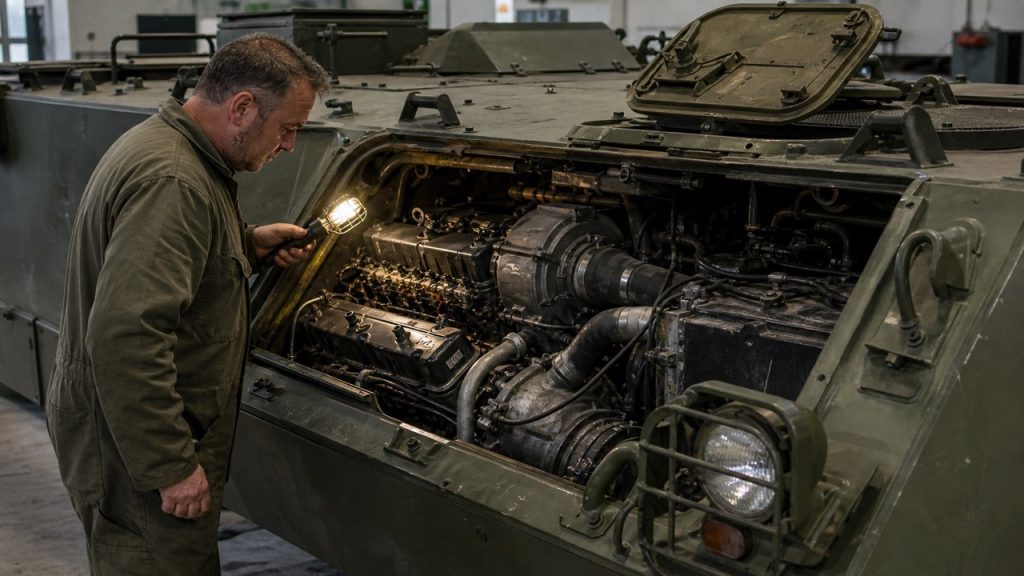
M113A2 Engine, Cooling, and Reliability Improvements
M113A3 Turbocharged Powerpack
The M113A3 represents the more substantial powerpack change in the family. The standard A3 upgrade package often referred to by its program name, RISE (Reliability Improvement of Selected Equipment) replaced the naturally aspirated 6V53 with a turbocharged Detroit Diesel 6V53T rated in the mid-200 to high-200 horsepower range, commonly cited near 275 hp, paired with a new Allison X200-4 (later X200-4A) transmission featuring four forward speeds and hydrostatic steering in place of the earlier mechanical steering levers. The package also introduced a 200 amp alternator with four batteries, an upgraded driver’s station with a steering wheel and brake pedal instead of laterals, and improved electrical diagnostic capability.
The rationale documented for this upgrade was mobility parity: as the M1 Abrams and M2/M3 Bradley entered service with substantially higher road speeds, the existing M113A2 fleet risked being unable to keep pace with the formations it was meant to support. Increased engine output improved acceleration and grade performance and helped offset the additional weight introduced by external fuel tanks and armor provisions. However, higher installed horsepower does not by itself guarantee improved mobility across every terrain condition; vehicle weight, gearing, track condition, and installed equipment all affect the net result, and a well maintained A2 can outperform a poorly maintained or overloaded A3 in specific conditions. Turbocharger, fuel-injection, and X200-series transmission components are specific to the A3 powerpack and are not interchangeable with A1/A2 parts.

Armor and Survivability Differences
The M113 family’s basic hull across all three configurations is constructed from welded aluminum armor plate. This fundamental hull material did not change between the A1, A2, and A3 standards; what changed at the A3 level were additions and provisions layered onto that same basic hull, not a replacement of the underlying armor material.
The A3 package added two specific survivability features. First, internal spall suppression liners sliding panels mounted inside the crew and troop compartment were incorporated to reduce the risk of spall fragmentation reaching occupants if the hull is penetrated. Second, the internal fuel tank used on the A1 and A2 was relocated to external, armored fuel tanks mounted outside the main crew compartment, reducing the risk of an internal fuel fire following a hit. Alongside these changes, the A3 package included mounting provisions for an add-on appliqué armor kit.
The distinction between “armor provisions” and an “installed armor kit” is not a minor technicality. A bolt on armor kit was developed and tested for the M113 family, reported in period sources as providing protection against a stated small caliber ballistic threat at a stated range, but available evidence indicates this kit was not incorporated into standard production; vehicles received the mounting provisions without necessarily receiving the kit itself. A vehicle bearing the A3 designation should therefore not be assumed to carry installed appliqué armor unless that has been separately confirmed for the specific hull in question. Some national operators have fitted their own locally sourced or nationally developed armor packages to M113 hulls, which further means protection level cannot be inferred from the U.S. designation alone.
Any added armor package changes the vehicle’s weight, and weight changes affect ground pressure, suspension loading, transportability by air and in vehicles that retain a swim capability freeboard and amphibious performance. Amphibious capability across the M113 family should be treated as configuration and load dependent rather than assumed as a constant feature; a vehicle fitted with substantial add on armor or additional mission equipment may no longer retain the freeboard margin of a baseline hull. This article does not detail specific protection levels, defeat mechanisms, or vulnerability data, consistent with standard practice for publicly available defense sustainment content.
Mobility and Automotive System Differences
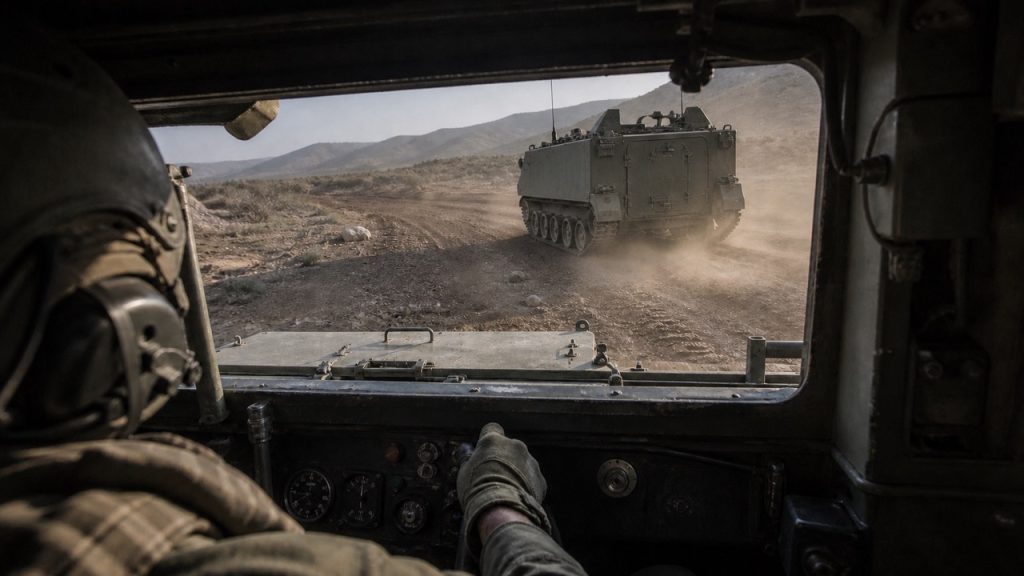
Road mobility improved measurably from the A1/A2 generation to the A3 generation, driven primarily by higher installed horsepower and the switch to a four speed transmission with hydrostatic steering. Sources commonly cite a combat loaded top road speed in the high-30s mph range for the M113A2 and low-40s mph for the M113A3, though exact figures vary by loading condition and source. Arguably more consequential for day to day operation is the steering system: hydrostatic steering with a wheel and brake pedal reduces driver fatigue and improves precision compared with the lateral lever system retained on the A1 and A2, and it reduces shock loading transmitted into the suspension during turns.
Cross-country mobility depends on more than top speed. The suspension improvements introduced at the A2 level additional shock absorption, stronger torsion bars, increased rear idler clearance improved ride quality and component durability over rough terrain regardless of engine, and carried forward into the A3. Cooling system capacity matters more under sustained heavy load, particularly for the turbocharged A3 powerpack in high ambient temperatures; a system adequate at idle can still be marginal at sustained high output, which is one reason cooling parts should be sourced to the applicable configuration’s specification rather than substituted from an earlier variant.
Brochure-level maximum speed should not be read as a direct indicator of tactical mobility. Obstacle-crossing, gradient, and amphibious performance are documented only for specific tested configurations and loads in the sources reviewed here, and this article does not state universal figures across all three configurations. Fleet managers should reference the applicable technical manual for the vehicle’s actual configuration and current mechanical condition rather than a general specification sheet.
Maintenance and Spare-Parts Implications
An M113 part should never be ordered using only the general platform name. Given the number of production years, conversion programs, and national modification paths involved in this vehicle family, “M113 parts” is not a sufficiently precise request for anything beyond the most universal fasteners and hardware. Before requesting a part, the following should be confirmed wherever releasable:
- Exact variant designation (M113A1, M113A2, M113A3, or a national/local designation)
- Vehicle serial number or identification data, where security classification permits
- Engine data plate information, including model and serial number
- Transmission model and serial number
- Any installed upgrade, repower, or conversion kit, and its source
- National modification status, if operated outside original U.S. Army configuration
- Relevant assembly and subassembly numbers
- OEM reference number
- National Stock Number (NSN), where available
- Supersession status of the part number
- Applicable technical manual reference for the specific configuration
- Photographs or dimensional confirmation where security and operational conditions permit
- Documentation and traceability requirements for the receiving organization
- Preservation and packaging requirements for shipment and storage
- Whether the component is repairable or consumable
Configuration differences affect sourcing across nearly every major system. Engine and fuel injection components differ between the naturally aspirated 6V53 used in the A1/A2 and the turbocharged 6V53T used in the A3; turbocharger components exist only on the A3 powerpack. Cooling parts differ between the original A1 package and the improved A2/A3 components. Transmission parts differ substantially between the three speed Allison TX-100 series on the A1/A2 and the four-speed hydrostatic-steer X200-4/X200-4A on the A3; steering and braking components follow the same split, since the A3 driver’s station uses a wheel and brake pedal rather than laterals. Electrical components differ because of the A3’s higher capacity alternator and additional battery. Fuel system components differ significantly because the A3 uses external armored tanks rather than the internal tank retained on the A1 and A2. Suspension and running gear parts are more often shared between the A2 and A3, since the A3 generally carried forward the A2 improvement package, but this should still be confirmed against the vehicle’s build record. Track assemblies and hull or fuel tank fittings should likewise be checked against the applicable configuration before ordering.
Interchangeability should never be assumed without configuration-level verification. Even where two configurations share a component family, dash numbers, mounting brackets, or connector types can differ in ways that are not obvious from a general parts description.
Which M113 Configuration Is “Better”?
There is no simple answer to which M113 configuration is best, because the right configuration depends on the mission and the operating context rather than on a single performance figure. A unit conducting rear-area logistics or command post duties in a permissive environment may have little operational need for the mobility improvements of the A3 powerpack, while a formation expected to keep pace with M1 and M2/M3 units in contested terrain has a clear operational reason to prioritize A3-standard mobility.
Fleet condition matters as much as configuration on paper. A well maintained M113A2 with intact suspension, a properly functioning cooling system, and no significant drivetrain wear can be more mission capable than a nominally more advanced M113A3 that has been poorly maintained or is missing critical components. Installed armor, available maintenance infrastructure, spare parts availability, crew and mechanic training, transportability requirements for the operating theater, modernization budget, and remaining service life objectives all factor into which configuration or which specific vehicles within a mixed fleet should be prioritized for retention, conversion, or replacement.
What can be said with reasonable confidence is that the M113A3 generally represents the broader U.S. Army upgrade standard for the family, incorporating the accumulated improvements of the A1 and A2 packages plus a materially more capable powerpack and additional survivability features. Whether that translates into better suitability for a given operator’s fleet depends on the actual condition and configuration of the specific vehicles involved, not on the designation alone. This is an informed assessment based on the documented upgrade rationale rather than a formally published Army finding and it should be weighed alongside an operator’s own fleet data.
Configuration Checklist for M113 Parts Procurement
Information to confirm before requesting an M113 part
- Exact vehicle designation (M113A1, M113A2, M113A3, or applicable national designation)
- National operator and known upgrade standard applied to the fleet
- Vehicle serial or identification data, where releasable
- Production or conversion information, including conversion contractor and date if known
- Engine model and serial number
- Transmission model and serial number
- Installed armor or survivability package, if any
- Relevant assembly number
- OEM part number
- NSN, if available
- Supersession status of the requested part
- Required quantity
- Required certificates and traceability documents (e.g., Certificate of Conformance, material test reports)
- Packaging and preservation requirements
- Destination and delivery priority
- Applicable end use and export documentation
Do not send classified, operationally sensitive, export-controlled, or personally identifiable information through unsecured channels when requesting parts or providing configuration details to a supplier.
How AB Defence Supports M113 Fleet Sustainment
AB Defence supports M113 spare parts sourcing across the A1, A2, and A3 configurations, working from documented component requirements rather than a single generic parts list. This includes engine and powertrain parts covering both the naturally aspirated and turbocharged 6V53 engine families, cooling and filtration components, transmission and driveline support spanning the Allison TX-100 and X200-4 transmission generations, and track, suspension, and running-gear components. AB Defence’s M113 Family of Vehicles platform overview (absdefence.com/platforms/tracked-armoured-vehicles/m113-series/) covers configuration-level sourcing considerations for the A1, A2, and A3 standards, along with related variants such as the M577 command post carrier, M548 cargo carrier, and M901 anti armor vehicle.
Part number and NSN verification is a recurring requirement in M113 sustainment given the platform’s long production and conversion history, and AB Defence’s engineering process cross references OEM part numbers against NSN codes as part of confirming component compatibility before a part ships. This is particularly relevant for obsolete or superseded components on legacy M113 fleets, where a current standard replacement may not carry the same part number as the original component listed in an older technical manual.
For engine and transmission components specifically, AB Defence’s engine and powertrain systems group (absdefence.com/product-groups/engine-powertrain-systems/) covers engine components, transmissions, differentials, and gear units relevant to the M113 family’s multiple powerpack generations. For suspension, track, and running-gear requirements, AB Defence’s brake and suspension systems group (absdefence.com/product-groups/brake-suspension-systems/) covers brakes, clutches, suspension components, and track assemblies. AB Defence does not manufacture the M113 platform, does not claim OEM engineering authority over the vehicle, and does not guarantee stock or delivery timelines without a documented, configuration verified requirement; procurement teams with a specific M113A1, M113A2, or M113A3 requirement are encouraged to contact AB Defence’s parts and sourcing team (absdefence.com/contact/) with as much configuration detail as can be releasably provided.
Contact AB Defence to discuss your procurement requirements and learn how we can support your fleet readiness objectives.
Conclusion
The differences among the M113A1, M113A2, and M113A3 extend well beyond engine horsepower. They touch cooling capacity, transmission design, driver controls, fuel tank location, survivability features, and as a direct consequence of all of the above maintenance procedures and spare parts identification. Treating the three configurations as interchangeable, or assuming that a vehicle’s designation alone confirms its actual build state, is a common and avoidable source of procurement error in M113 fleet sustainment.
For military fleet managers, maintenance officers, and procurement teams working with M113 family vehicles, the practical takeaway is straightforward: verify the specific configuration, engine model, transmission model, and any installed upgrade or armor package before requesting a part or planning a maintenance action. Organizations with a properly documented M113 parts or sourcing requirement are welcome to contact AB Defence to discuss configuration specific support.
Frequently Asked Questions
What is the main difference between the M113A1, M113A2, and M113A3?
The M113A1 introduced a naturally aspirated Detroit Diesel 6V53 engine in place of the original gasoline powerplant. The M113A2 kept that same basic engine family but improved cooling, suspension, and personnel heating. The M113A3 replaced the engine with a turbocharged 6V53T, added a new four speed hydrostatic steer transmission, relocated fuel storage to external armored tanks, and added spall suppression liners and provisions for appliqué armor. Each step changed different systems rather than repeating the previous upgrade.
Do the M113A1 and M113A2 use the same engine?
Yes. Available evidence indicates the M113A2 retained the same basic 6V53 naturally aspirated diesel engine family used in the M113A1. The A2 package focused on cooling, suspension, and reliability improvements around that engine rather than replacing it. This should still be confirmed against the specific vehicle’s data plate, since some nationally modified fleets have installed different engines outside the U.S. Army standard.
What engine is used in the M113A3?
The standard U.S. Army M113A3 configuration uses a turbocharged Detroit Diesel 6V53T engine, commonly cited at approximately 275 horsepower, paired with a new Allison X200-4 or X200-4A transmission. This is a materially different powerpack from the naturally aspirated engine used in the A1 and A2, and the two are not interchangeable at the component level.
Does the M113A3 have better armor than the M113A2?
The basic aluminum hull armor is broadly consistent across the family. The M113A3 package added internal spall suppression liners and mounting provisions for an add on armor kit that the A1 and A2 do not have. However, mounting provisions are not the same as an installed armor kit, and available evidence indicates the bolt on kit developed for the platform was not incorporated into standard production. Whether a specific A3 vehicle has enhanced ballistic protection beyond the baseline hull should be verified for that vehicle rather than assumed from its designation.
Are M113A1, M113A2, and M113A3 parts interchangeable?
Some parts are shared, particularly certain hull, hatch, and suspension components between the A2 and A3. Engine, fuel-injection, turbocharger, transmission, steering, and fuel system components generally are not interchangeable across the naturally aspirated and turbocharged powerpack generations. Interchangeability should always be confirmed against the applicable technical manual and part number rather than assumed from the platform name.
How can a buyer identify the correct M113 powertrain part?
Start with the engine and transmission data plates on the specific vehicle, then confirm the model and serial numbers against the applicable technical manual for that configuration. Cross reference the OEM part number against its NSN where available, and check for any supersession that may apply to older documentation. Where the vehicle has been nationally modified or converted, the conversion program’s documentation should be checked in addition to the original U.S. Army technical data.
Can an M113A2 be converted to an M113A3 configuration?
Yes. The U.S. Army ran overhaul and conversion programs that upgraded existing M113A2 vehicles to the M113A3 standard, including installation of a new engine and transmission, spall liners, and armored external fuel tanks, alongside armor mounting provisions and additional batteries. This was a substantial depot-level conversion rather than a simple parts swap, and the applicable installed configuration documentation should reflect the conversion once complete.
Related Military Spare Parts Categories, Vehicle Platforms & Technical Guides
Explore AB Defence’s NATO-codified (NSN) and genuine OEM spare parts catalog, platform technical specifications, and sustainment engineering guides related to this article:
Stocked Spare Parts Categories (NSN & OEM Catalog)
- M113 Armored Personnel Carrier (APC) Spare Parts (29 stocked parts)
- M113 Engine & Powerpack Spare Parts (Detroit Diesel 6V53) (20 stocked parts)
- Electrical, Electronic & Vision Systems for Military Vehicles (250 stocked parts)
- Military Engine Cooling Systems, Radiators & Water Pumps (57 stocked parts)
- NATO Standard Defence Components & Military Hardware (12,993 stocked parts)
- Full NATO NSN & OEM Spare Parts Catalog (16,760+ Parts)
Compatible Vehicle Platforms & System Hubs
- M113 Series
- M113 Modernization Program
- YPR-765 Infantry Fighting Vehicle Series
- ACV-300 / ACV-350 Tracked Armoured Vehicle Series
- Tracked Armoured Vehicles
- Request a B2B Quotation (RFQ) & Technical Support