November 4, 2026
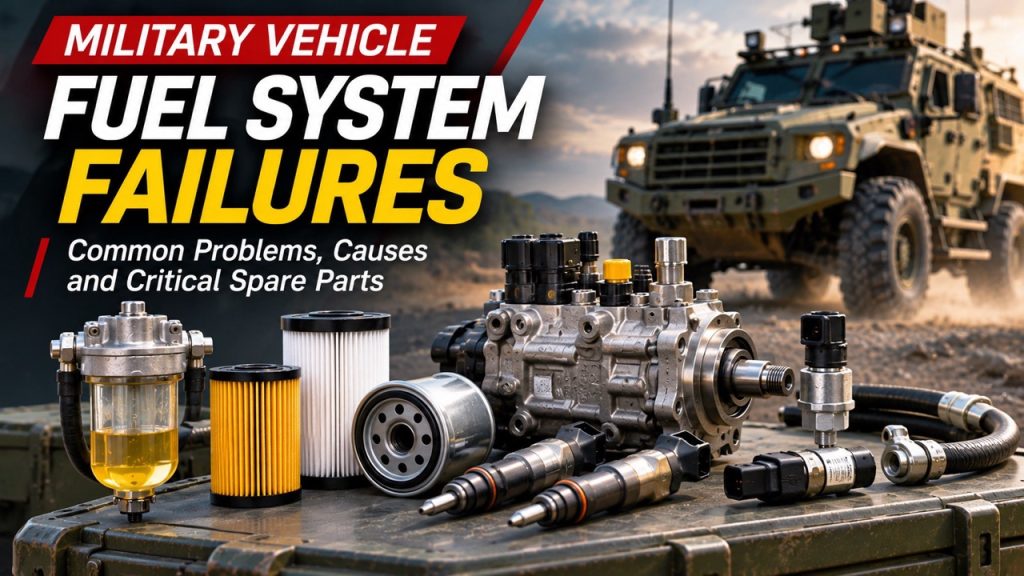
Military Vehicle Fuel System Failures: Common Problems, Causes and Critical Spare Parts
Why Fuel System Reliability Shapes Vehicle Readiness
A military vehicle can have a sound engine, intact armour and a trained crew and still be unavailable because fuel is not reaching the injectors in the right condition. Fuel arrives from tankers, bulk storage and cans of varying provenance, passes through pumps, filters and lines, and is finally metered by injection components built to very fine tolerances. When fuel quality or system condition drifts outside what those components were designed for, the first signs are usually blocked filters or hard starting; the later signs are accelerated component wear.
That chain links fuel contamination, component wear and downtime, although not in a way that can be reduced to a single statistic. Cummins’ fuel guidance states that excessive contamination can cause premature filter clogging and premature wear of critical injection parts. A vehicle with a recurring fuel complaint therefore deserves a diagnosis of the fuel and the supply system before an expensive component is ordered.
A note on scope. This article draws on general diesel fuel-system principles, engine-manufacturer bulletins and U.S. Army linked fuel research. These describe how diesel systems behave in general; they are not platform-specific procedures. For any vehicle, the applicable OEM documentation and military technical manual govern diagnosis, service intervals and approved parts, and take precedence over anything written here.
Understanding Military Vehicle Fuel Systems
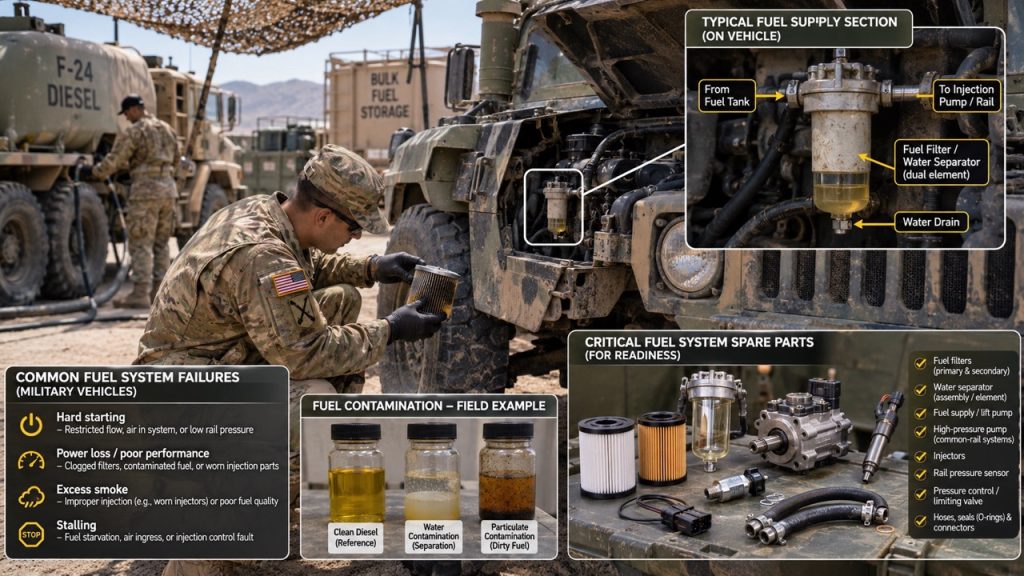
Fuel starts in the tank, which stores it and must be kept free of water and debris. Fuel lines and hoses carry it to a supply or transfer pump, which moves fuel through filtration toward the injection equipment. The filter and water separator is a critical protective stage: U.S. Army HMMWV training material describes it as a dual-element unit in which one element removes sediment while the other separates water, with a drain for periodically removing what has collected. Downstream, the injection pump or high-pressure pump raises fuel pressure, and the injectors meter it into the cylinders at the correct moment.
Conventional and Electronically Controlled Injection
In a conventional mechanical system, the injection pump meters and distributes fuel to the injectors. A common-rail system separates pressure generation from injection. The high-pressure pump feeds a rail that stores compressed fuel and supplies the injectors. A rail pressure sensor and a pressure control or pressure-limiting valve are fitted to that rail. The practical consequence is that electronically controlled systems add sensors, actuators, wiring and connectors, each a potential fault source, and the move to higher pressures has been achieved through tighter tolerances that make fine particulate contamination more consequential.
Most Common Military Vehicle Fuel System Failures
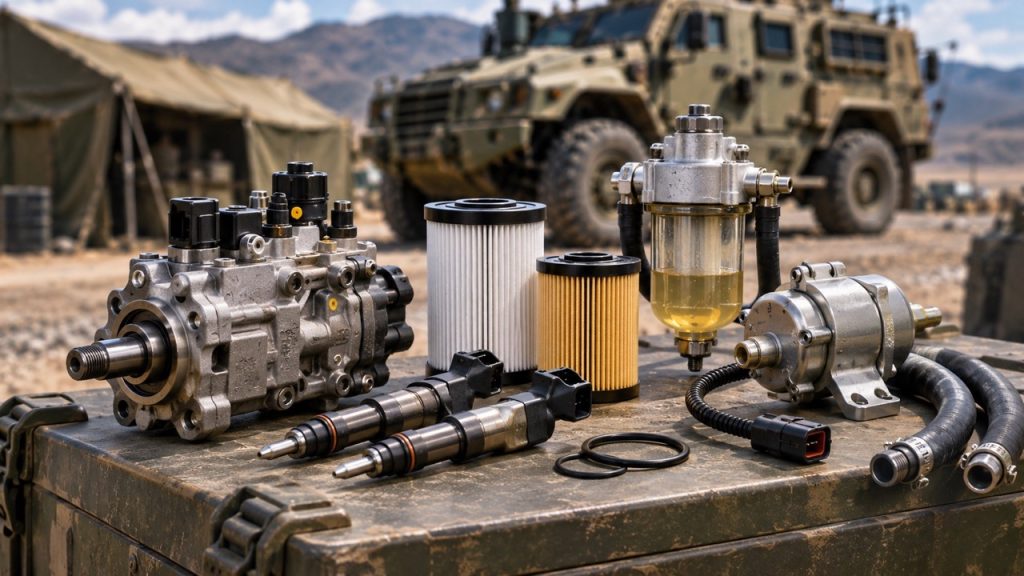
Hard starting, power loss, smoke and stalling are shared by many different faults. Each failure type below is therefore described in terms of what is observed, what is commonly found, and what still has to be confirmed before a part is condemned.
1. Fuel Contamination and Clogged Fuel Filters
Typical symptoms are loss of power under load, hesitation and filters that block earlier than expected. Common causes include dirt entering during refuelling, tank sediment and degraded fuel. Cummins Filtration has described abrasive particles in the 4 to 15 micron range as particularly damaging to injection components, and has noted that a stage 1 filter and water separator protects the stage 2 filter from being overwhelmed. Some engine manufacturers also specify fuel cleanliness targets as ISO cleanliness codes, with additional filtration required before fuel reaches the equipment tank if the supply does not meet them. Diagnosis should begin with the filter and a fuel sample from the tank bottom, not with the pump. Relevant parts are filter elements, housings and their seals; preventive practice means using the specified filters and keeping the supply chain clean.
2. Water Contamination and Inadequate Water Separation
Water shows up as collected water in the separator, rough running, and corrosion on fuel system components. Cummins has documented a diagnostic route based on a fuel sample, noting free standing water as a trigger for its water in fuel recovery procedure and distinguishing acceptable from unacceptable corrosion on injector connectors. Cummins Filtration engineers also point to reduced lubricity from water as a route to premature pump and injector wear.
This is a good place to separate symptom from root cause. A water-in-fuel indicator is a symptom. In one Cummins bulletin, a water in fuel fault code was traced to coolant leaking past a shrunken injector sleeve seal, not to water in the tank. Draining the separator would not have fixed that. Relevant parts include separator elements, drain valves, water in fuel sensors and seals.
3. Fuel Pump Deterioration and Failure
A failing transfer or lift pump typically presents as fuel starvation: hard starting, power loss, or unstable supply pressure. Supply pressure and flow should be checked against the manual before the injection pump is blamed. For injection pumps in military service, fuel lubricity has been a long running concern because many pump designs are lubricated by the fuel itself. The evidence is mixed. Testing has found JP-8 to have lower lubricity than DF-2 on both HFRR and BOCLE tests, and an Army laboratory programme recorded abnormal injection pump wear on a GM 6.2L engine in a dynamometer test, though later field tests did not show the same problem. A SAE field study concluded that most field failures could be attributed to causes other than poor lubricity, with failure modes ranging from normal wear to contamination to seizure, and an Army-linked examination of pumps from military ground equipment found the failures were not directly related to Jet A-1 or JP-8. The lesson is not that fuel type is irrelevant, but that wear findings need a root cause investigation rather than an assumption.
4. Fuel Injector Malfunction and Deposit Formation
Cummins Filtration has described hard starts and rough idling as early signs of injector wear, with higher fuel consumption, power loss and increased emissions appearing as wear advances. The same source notes that deposits forming on and inside injectors can cause delivery problems and wear. Sulfur content in JP-8 has also been associated with injector problems in commercial engines adapted for military use. Diagnosis follows the OEM procedure for leak off, balance or flow testing as applicable, and wiring and supply should be eliminated first. Relevant parts include injectors, nozzles, sealing washers and injector lines.
5. Air Entering the Fuel Supply System
Air causes hard starting, rough running and stalling. An engine manufacturer’s manual notes that the lift pump draws fuel from the tank, so air can accumulate in the system, and that a tiny leak at a fuel line fitting may admit air until symptoms appear. Common entry points include loose or cracked suction side lines, damaged seals, running a tank dry, and incomplete priming after filter service. Because suction side leaks can pull air in without showing external fuel, the absence of wetness does not clear the line. The root cause should be corrected before bleeding, or air will return. Relevant parts are hoses, clamps, seals and primer components.
6. Fuel Line Leakage, Deterioration and Restrictions
Visible wetness, fuel odour, fuel loss and starvation are the usual indicators. Lines and hoses are exposed to vibration, heat, abrasion and handling, so inspection should include routing, clamps and chafe points as well as the lines themselves. Leaks matter beyond fuel loss: on the supply side they can admit air, and on high pressure lines they are a personal injury hazard (see the safety section below). Relevant parts include hoses, rigid lines, clamps, sealing washers and connectors.
7. Fuel Pressure Regulation and Sensor Problems
On common rail engines, the rail carries a pressure sensor and a pressure control or limiting valve. A fault in either can produce hard starting, unstable rail pressure and diagnostic codes. But low or unstable pressure can equally originate upstream in a restricted filter, a weak supply pump or an air leak, so a stored code is a lead, not a conclusion. Confirm against the OEM’s expected values with the manufacturer’s diagnostic procedure. Relevant parts are rail pressure sensors, pressure control valves, limiting valves and regulators, each of which must be matched to the specific engine and fuel system.
8. Electrical Faults Affecting Fuel System Components
Intermittent stalling, misfire codes and no-start conditions can have electrical origins: connector corrosion, harness damage, relay faults or sensor and solenoid failures. Cummins’ water in fuel bulletin makes the link explicit by treating corrosion on injector connectors as an inspection item and distinguishing normal from abnormal corrosion. Check supply voltage, connector condition and harness integrity before replacing a costly injector or pump. Relevant parts include connectors, harness repair sections, relays, sensors and solenoid operated valves.
9. Cold Weather Fuel Flow and Operability Problems
Diesel contains wax that begins to crystallise at the cloud point, and those crystals can be caught by the fuel filter and cause serious operability problems in cold conditions. Summer grade fuel used in cold weather is one cause of filter plugging, but dirt and microbial growth can also plug filters, and those are housekeeping issues rather than fuel grade issues. A vehicle that stalls in cold weather therefore needs both the fuel grade and the filter inspected. Follow OEM and fuel supplier guidance on winter grade and cold flow treatment. Relevant parts are filter elements and, where fitted, fuel heating components.
10. Fuel Storage and Fuel Quality Issues
Microbial growth depends on water and occurs at the water and fuel interface; its effects include filter plugging and corrosion, and even after a biocide has stopped growth, accumulated biomass may still have to be physically removed. Periodic sampling and laboratory testing of stored fuel is recommended so that problems are caught early. Fuel supply stability is also an operational issue. U.S. Army policy has deployed vehicles refuelling with JP-8 and using diesel when JP-8 is not available, and a diesel engine running on JP-8 can show a known torque and fuel economy penalty. A performance change after a fuel switch is therefore not automatically a component fault.
Critical Military Vehicle Fuel System Spare Parts
The parts that matter most are those that protect or meter fuel. Filter elements and water-separation components protect everything downstream and are consumables that should be sourced to the manufacturer’s specification. Injection pumps, injectors and nozzles meter fuel with very fine tolerances, which is why they are sensitive to contamination and why mismatched replacements are costly. On common rail engines, rail pressure sensors, pressure control valves and limiting valves complete the pressure management loop. Seals, hoses, clamps and electrical connectors are inexpensive, but they are often the true root cause and are frequently overlooked.
Before ordering, a procurement specialist should confirm the vehicle model and configuration, the engine type and serial number, the fuel system manufacturer and its part number, any applicable NSN, and whether the number has been superseded. These details should be matched to the illustrated parts list or technical manual for that exact vehicle, not to a general description of the component.
How to Identify the Correct Fuel System Spare Parts
OEM Part Numbers, NSNs and NCAGE Codes
Within the NATO Codification System, each item of supply is identified by a unique 13-digit NATO Stock Number, made up of a four digit supply classification code, a two-digit nation code and a seven digit item identification number. Every part number listed on an NSN is accompanied by an NCAGE code identifying the manufacturer, and the NATO Master Catalogue of References for Logistics lists the parts and providers. In the United States, DLA Logistics Information Service serves as the national codification bureau. A part number alone is therefore incomplete; it should be read together with the manufacturer code, and an NSN can be associated with reference numbers from more than one manufacturer, as the NATO fact sheet illustrates.
Superseded Numbers and Interchangeability
Suppliers and manufacturers revise part numbers over a vehicle’s life. Superseded numbers should be confirmed through the current parts catalogue, the technical manual or the manufacturer’s written notice, never assumed. Interchangeability should only be accepted when the manufacturer or the applicable technical authority approves it. Similar dimensions, appearance or nominal specifications do not establish equivalence: calibration, flow characteristics, materials, sealing arrangements and connector details can differ between components that look alike. Documentation such as certificates of conformity and traceability records should be requested for parts used in critical systems.
Preventive Maintenance and Fuel System Reliability
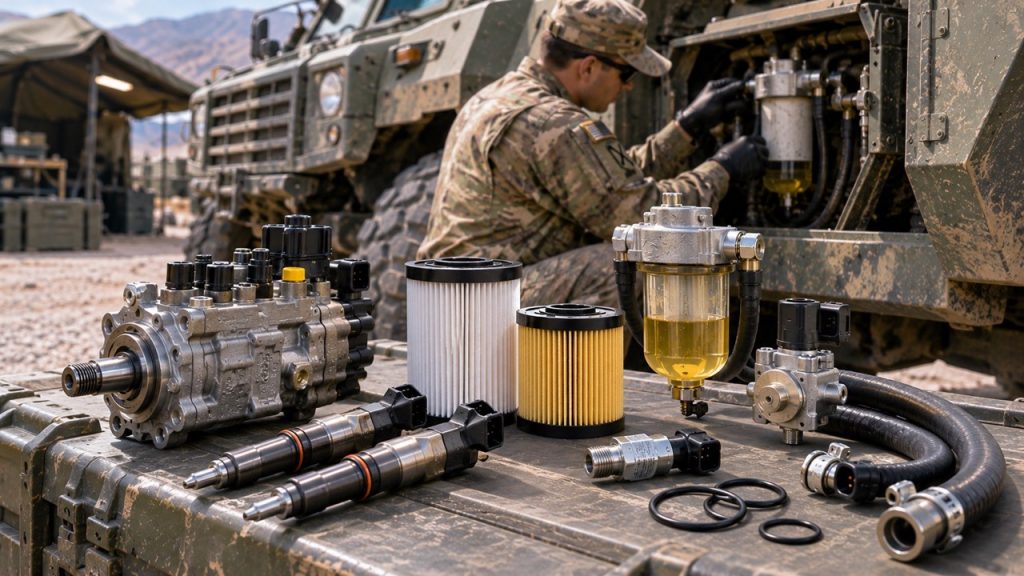
The most effective measures are practical and unglamorous. Keep fuel clean from the point of supply by sampling stored fuel and filtering bulk fuel where cleanliness targets require it. Manage water by draining separators according to the technical manual. Replace filters with the specified elements, then prime and bleed according to the manual to avoid leaving air in the system. Inspect lines, clamps and connectors for wetness, chafing and corrosion. Record fuel type, filter condition and fault history so that fuel related problems can be separated from component failures. No universal service interval is offered here, because intervals depend on the engine, the operating environment and the fuel; use those in the vehicle’s own maintenance documents.
Working Safely on High Pressure Fuel Systems
High pressure injection injuries are rare but serious. The entry wound is small and often underestimated, while the damage beneath it can be extensive, and prompt surgical assessment is needed. Fuel oil is among the substances reported in such injuries. Established prevention guidance is to stop the engine and safely relieve pressure before working on a line, never to search for leaks with the hands or other body parts, and to recognise that gloves and clothing may not protect against injection. Follow the manual’s depressurisation procedure, and anyone injected with fuel should seek immediate medical attention, even if the skin appears barely marked.
Military Vehicle Applications
Fuel history is a legitimate diagnostic input for military vehicles. As noted above, deployed U.S. vehicles may run on JP-8 or diesel depending on availability, and research on JP-8 in engines has examined its lubricity, sulfur content and effects on injection components.
Platform-specific conclusions require platform-specific evidence. The sources reviewed here do not support naming typical fuel system failure patterns for MRAP-class vehicles, Unimog platforms, BMC Kirpi, MAN or Mercedes-Benz military trucks, and this article does not claim any. Engines and fuel systems vary by model, variant and upgrade state, so fuel system parts for those vehicles should be identified from the OEM documentation or technical manual for the exact configuration.
Accurate Diagnosis and Correct Parts Keep Fleets Available
Fuel system failures rarely have a single visible cause. A blocked filter may be a fuel problem, a storage problem or a cold weather problem; a water in fuel code may point to coolant; a pump showing wear may reflect contamination more than lubricity. Careful diagnosis, replacement components that are genuine or technically approved, and parts identification built on part numbers, manufacturer codes and NSNs are what keep repair cost and downtime down.
If you are working from an OEM part number, an NSN or only a vehicle configuration, AB Defence can discuss the identification details needed and the options for sourcing military vehicle fuel system spare parts. Contact us at absdefence.com with the vehicle model, engine details and any numbers you hold.
Work With AB Defence
Partner with AB DEFENCE for Reliable Combat Support Vehicle Sustainment. AB DEFENCE is a specialist international supplier of military spare parts and fleet sustainment solutions serving NATO and allied defense organisations. With deep inventory across a wide range of combat support vehicle platforms, rigorous quality assurance processes, export compliance expertise, and a commitment to long term supply chain partnership, AB DEFENCE helps defense buyers maintain fleet availability, reduce sustainment costs, and meet their operational readiness obligations. Contact the AB DEFENCE team to discuss your spare parts requirements, strategic inventory planning, and long-term sustainment programme needs.
Contact AB Defence to discuss your procurement requirements and learn how we can support your fleet readiness objectives.
Related Military Spare Parts Categories, Vehicle Platforms & Technical Guides
Explore AB Defence’s NATO-codified (NSN) and genuine OEM spare parts catalog, platform technical specifications, and sustainment engineering guides related to this article:
Stocked Spare Parts Categories (NSN & OEM Catalog)
- NATO Standard Defence Components & Military Hardware (12,993 stocked parts)
- M60 Tank Spare Parts (M60A1 / M60A3 / M60T) (497 stocked parts)
- M109 Self-Propelled Howitzer Spare Parts (585 stocked parts)
- BMC Kirpi MRAP Spare Parts (Kirpi I & Kirpi II) (597 stocked parts)
- Mercedes-Benz Unimog Military Spare Parts (562 stocked parts)
- Full NATO NSN & OEM Spare Parts Catalog (16,760+ Parts)
Compatible Vehicle Platforms & System Hubs
- Platforms
- Product Groups
- Quality
- Capabilities
- Tracked Armoured Vehicles
- Request a B2B Quotation (RFQ) & Technical Support