November 2, 2026
How to Identify Superseded Military Vehicle Part Numbers Before Ordering
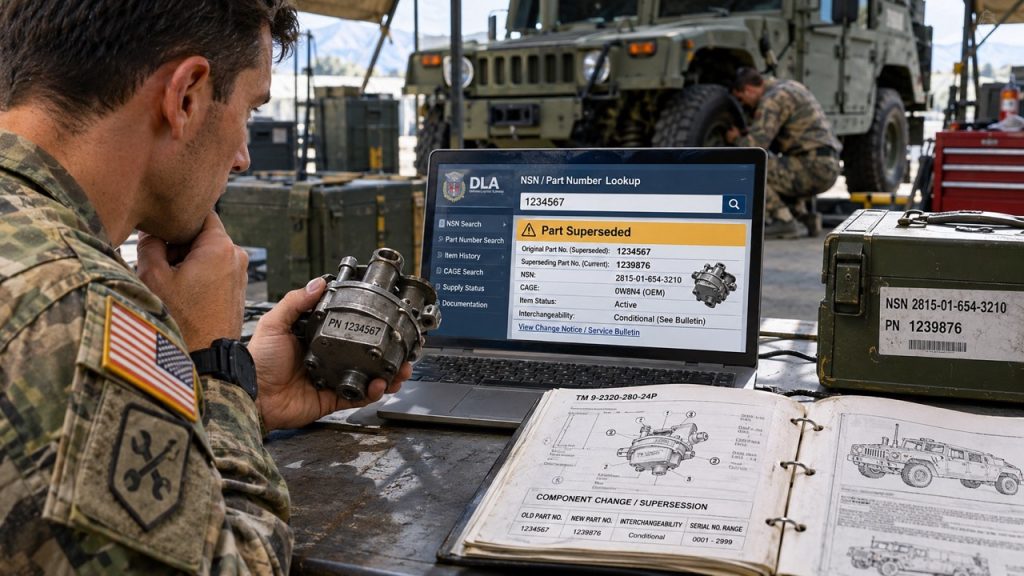
A part number stamped on a removed component, printed in an older manual or copied from a previous purchase order records what the part was called when that record was made. It does not confirm the correct orderable number today. Manufacturers revise designs, change sources and retire items. A number that was right at the last order may now be superseded, limited to certain serial ranges, cancelled, or replaced by a number that has itself since been replaced.
This article explains how buyers and maintainers can check superseded military vehicle part numbers before an order is placed. It goes deeper on a question that our guide to identifying the correct military vehicle spare part before ordering treats briefly: what has happened to this number since it was issued?
What Is a Superseded Part Number?
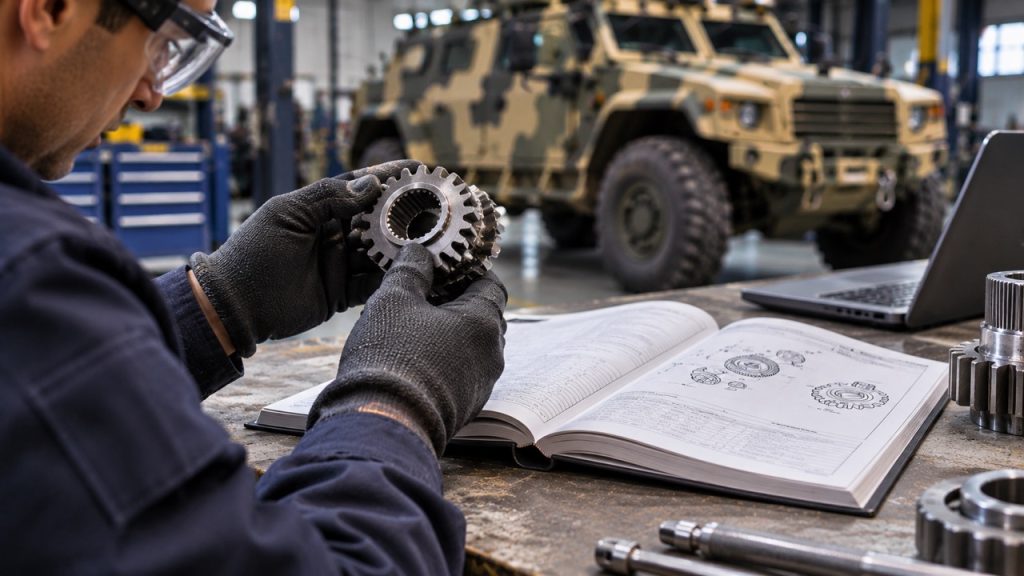
Supersession is a statement, normally by the manufacturer or the authority controlling the item, that one part number has been replaced by another. The old number is the superseded number; the new one is the superseding or replacement number. The term describes a relationship between two numbers, not whether the two parts look, fit or perform alike. Neighbouring terms are not synonyms:
- Original and current numbers. The number first assigned, and the number the manufacturer uses now.
- Alternate number. A number for an item with engineering approval for the same application; U.S. Navy instructions define it as engineering certified for identical application.
- Equivalent number or cross-reference. A claim that one part matches another; unless an authority has approved it, it is only as reliable as its maker.
- OEM and vendor numbers. The first belongs to the original manufacturer; the second is a seller’s own number, possibly under a different scheme.
- NSN. A government supply identifier for an item of supply, not a manufacturer’s part number.
Each term answers a different question; mixing them is where wrong orders begin.
Why Military Vehicle Part Numbers Change
Numbers change for several legitimate reasons, and the reason determines what the buyer must check. In DoD configuration management, a change affecting form, fit, function or interface characteristics is a Class I change. A transmission manufacturer’s 2024 service letter shows this: a new design, aligned with engine updates driven by regulatory change, produced new numbers for several parts, with a table recording which are backward compatible. Standardization also drives renumbering: one manufacturer’s parts history replaces many older hardware numbers with standard-series numbers.
Supply-side changes matter too. DoD cataloguing rules attribute superseded or discontinued reference numbers to a manufacturer’s change in numbering system, to a manufacturer that no longer produces the item or is no longer a technically approved source, or to a supplier going out of business. Obsolescence adds to this: DoD defines a DMSMS issue as the loss, or impending loss, of manufacturers or suppliers of items or raw materials.
A number change does not always mean a physical change: a numbering system change is one cited cause, and a remanufactured counterpart can be listed under its own number. Treat a change as a signal to investigate, not a conclusion.
Supersession Is Not the Same as Interchangeability
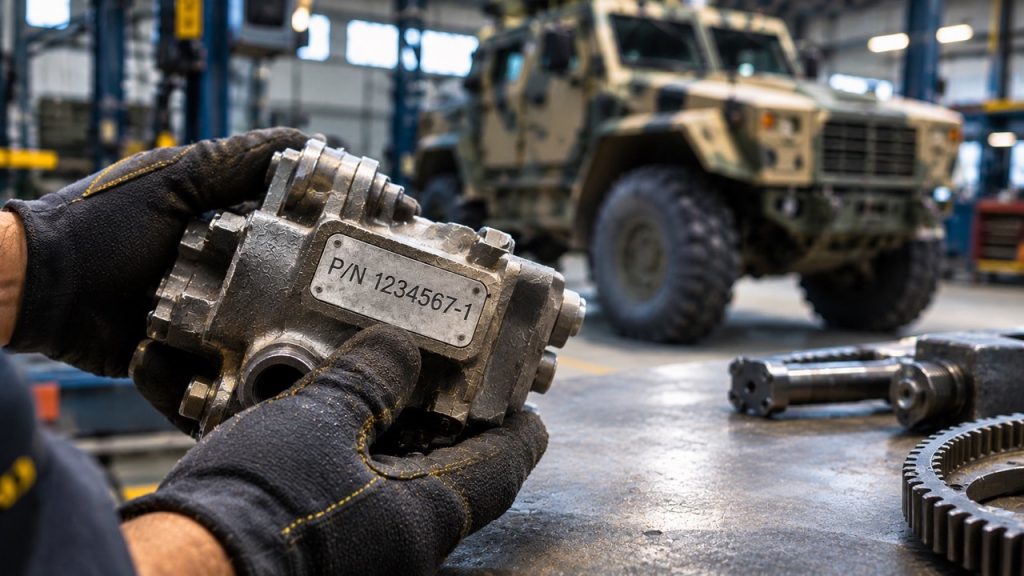
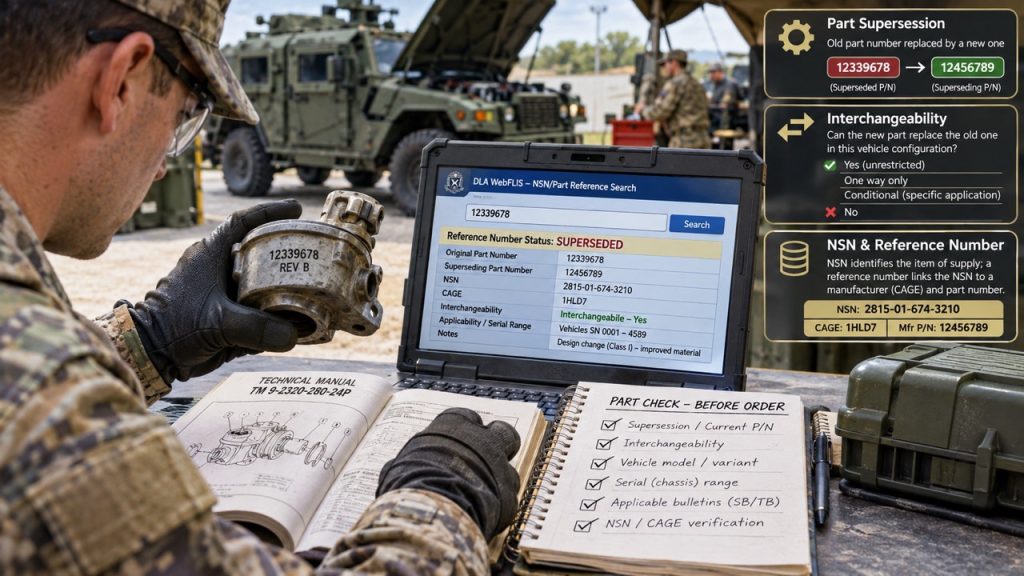
A supersession tells the buyer that two numbers have been linked. Whether the new part can replace the old one in a given vehicle is a separate engineering question. DoD policy draws the line explicitly. An interchangeable item is equivalent in performance, reliability and maintainability and can be exchanged without alteration of the items themselves or adjoining items, except for adjustment. A substitutable item can be exchanged only under specified conditions or for particular applications. Navy design change instructions record whether old and new parts are not interchangeable, interchangeable one way only, or both ways, and flag items limited to certain serial ranges. The same transmission letter gives each replaced part a yes or no backward compatibility answer and tells repairers to decide which of two gaskets suits the unit being repaired.
A supersession relationship therefore does not prove unrestricted physical or functional interchangeability in every vehicle configuration. Check the vehicle model, variant and serial or chassis range; production year; engine, transmission and axle models; voltage and connectors; mounting and dimensions; material; left or right hand application; modification status; and bulletin applicability. Where the vehicle specific manual, OEM catalogue, service bulletin or authorized engineering documentation disagrees with a supplier’s cross reference, the documentation takes precedence.
NSN Versus Manufacturer Part Number
The two identifiers serve different purposes. A NATO Stock Number is a 13-digit identifier for an item of supply, and one item of supply can comprise items of production from many manufacturers whose products share form, fit and function. A manufacturer’s part number follows that manufacturer’s own scheme; NATO notes there is no central controlling organisation and so no guarantee of uniqueness.
The link between them is the reference number. A CAGE code (NCAGE outside the United States) identifies a manufacturer or supplier at a specific location, and combined with the manufacturer’s part number it forms a reference held on the NSN record. The code says who makes the part, not what the part is. DLA’s data ties NSNs, reference numbers and CAGE codes together, and reference numbers are coded for their relationship to the item of supply, for example primary or secondary, item identifying or not, with some labelled pending validation until the source is approved.
Three cautions follow. An NSN identifies an item as recorded in its codification data; it does not by itself prove that every referenced commercial part suits every vehicle configuration, and DoD treats full interchangeability and conditional substitutability as separate relationships between NSNs. Not every part has an NSN; non managed consumables, for example, may never be codified. And records change: the NATO catalogue carries item status and cancellation data, and DLA’s WebFLIS offers an NSN history search.
How to Check Whether a Military Vehicle Part Number Has Been Superseded
1. Record the Original Identification Data
Capture the description, the number exactly as written (prefixes, suffixes, dash numbers), any NSN, the manufacturer and CAGE or NCAGE code, the vehicle platform, variant and serial, chassis or VIN data, engine and transmission data where relevant, physical markings and earlier purchase records.
2. Check Current OEM Documentation
Use the latest OEM catalogue or electronic parts system, not an old printed copy. Good systems start from the vehicle: Cummins’ parts finding training begins with the engine serial number and lists superseded numbers with the newest last, and Allison’s catalogue shows supersession for backward compatible parts being discontinued. Read the notes as well as the number, including whether a replacement is sold alone or only in a kit.
3. Review Official Supply System References
Where access is lawful, check the supply system record. DLA’s public PUB LOG data is described as unrestricted and includes cross reference and interchangeability and substitutability data, but excludes restricted data such as NATO data. WebFLIS, for registered users, searches by part number, CAGE code and NSN history, and DLA points to it for manuals that show an obsolete part number. NATO’s Master Catalogue of References for Logistics lists NSNs, part numbers and NCAGE-coded suppliers by subscription. Look for cancelled NSNs and reference numbers shown as history.
4. Trace the Full Supersession Chain
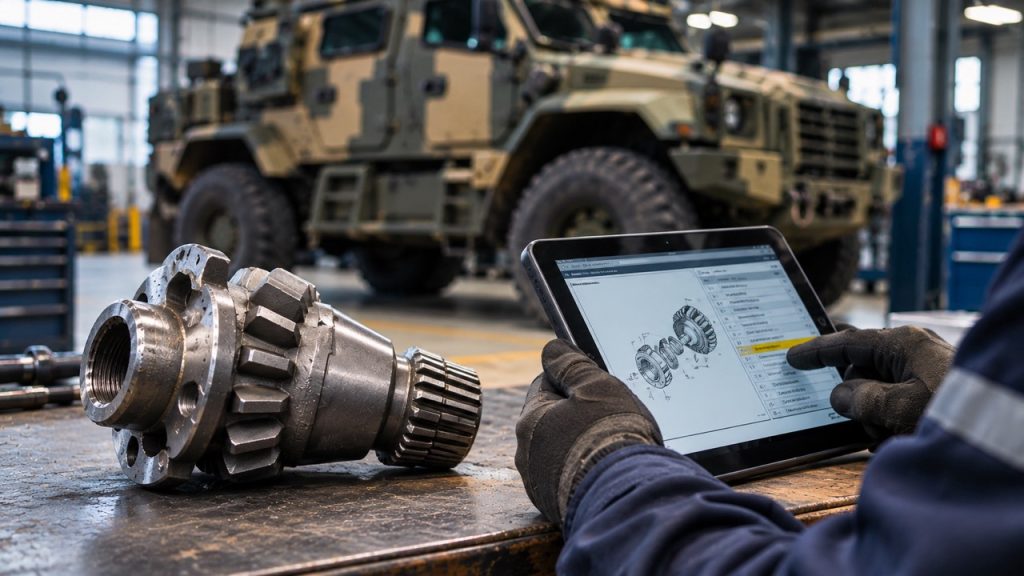
Look for wording that marks a replacement: replaced by, superseded by, supersedes, new part number, previous number, use instead, obsolete, no longer serviced. Then follow the chain to its end. The goal is the current orderable number, not the first replacement found.
5. Check Vehicle Configuration, Serial Range and Bulletins
Vehicle specific documents reveal restrictions a bare cross-reference hides. Army repair parts and special tools lists carry applicability in a usable on code column, and some are issued for a defined engine model and serial range; Navy design change notices likewise carry use-on codes and serial limits. Check service bulletins, which may change applicability after a catalogue was printed.
6. Verify Technical Compatibility
Physical checks confirm the documents; they do not replace them. Check what matters for the component, such as dimensions, threads, connectors, voltage, pressure rating, material, mounting, splines or gear ratio. DoD bases interchangeability determinations on a technical and engineering basis such as a standardization study, an approved engineering change proposal or a technical directive, so dimensional similarity alone does not settle the question.
7. Confirm Manufacturer Identity
A part number only has meaning with a manufacturer. Confirm the maker through the CAGE or NCAGE code, and check that the number belongs to that maker’s scheme: because manufacturer numbers are not guaranteed to be unique, the same characters can denote different parts for different makers.
8. Obtain Supplier Traceability
When a part is offered under a replacement number, ask for evidence. A 2013 Canadian defence solicitation for armoured vehicle spares shows what a customer may require: for a replaced (superseded or obsolete) number, an OEM Certificate of Conformity justifying the replacement and its equivalence in form, fit, function, quality and performance, or technical information demonstrating the same. DoD counterfeit prevention policy likewise directs components to suppliers that can map and identify authorized sources. A replacement claim that cannot be documented is unverified.
Why Multiple Supersession Levels Matter
A part may carry more than one historical number: A to B to C. Finding only A to B is not enough if B has since been replaced by C. Archived web pages, old PDF catalogues, past purchase records and distributor or marketplace listings may all predate the latest change. One OEM’s parts history lists superseding numbers that are themselves superseded, warns that its notes describe the situation at the time of the supersedure, and tells users to consult the latest revision of the referenced publication. It also shows that supersession is not always one to one: some numbers are replaced by two numbers, some only “in complete sets”, and some have no replacement. A 2016 DLA procurement note even requires contractors to tell the contracting officer immediately if a part number is superseded during the contract term, so supersession is a live contractual event, not a catalogue footnote.
Superseded, Obsolete, Discontinued: Not the Same Thing
These words are often used as if they meant the same thing:
- Superseded: replaced by another number. The old number may or may not remain available.
- Obsolete or cancelled: no longer available for service. One OEM letter cancels former numbers with backward compatible replacements once stock is depleted, yet keeps other former parts available because no direct replacement exists.
- Discontinued: the manufacturer has stopped supplying the item, possibly with no replacement; one parts history marks these “no longer available”.
- No longer manufactured or no longer serviced: claims about production or support to confirm with the manufacturer.
- Replaced, alternate, equivalent: relationships, not statuses; Navy instructions separately recognise deleted items, with or without a replacement.
Component Specific Examples
These generic examples illustrate questions a supersession can raise; they are not records of real parts.
Engine components. A superseding piston, bearing, gasket, water pump or fuel system part may reflect a design change at a serial break. Check the engine serial number and whether the replacement is sold alone or as a kit; Cummins’ training says a turbocharger, for example, should be bought as the whole kit, not a bare part.
Electrical components. For alternators, starters, relays, sensors, harnesses and control modules, confirm voltage, connector, pin configuration and mounting.
Brake and hydraulic components. For valves, cylinders, pumps, hoses and seals, confirm connection type, dimensions, pressure specification and seal material against the documentation.
Drivetrain components. For clutches, gearbox, propshaft, differential and axle parts, check splines, ratio, dimensions and configuration; Allison’s table shows some replaced transmission parts are backward compatible and others are not.
Common Procurement Mistakes
The mistakes that most often turn a supersession into a wrong order are:
- ordering from an old manual or catalogue;
- relying only on the number stamped on the removed part;
- assuming similar-looking parts are interchangeable;
- trusting an unvalidated online cross-reference;
- ignoring serial ranges and manufacturer identity;
- treating an NSN reference as proof of universal interchangeability;
- buying new old stock without checking revision status;
- stopping at the first superseding number; and
- accepting a “replacement” claim without documents.
The costs are a returned consignment, a second order and a vehicle that waits; for brake, steering or suspension parts, an undetected mismatch can create a hazard.
What About New Old Stock?
New old stock (NOS) is unused stock of an older part. It can be a legitimate, sometimes the only, source and is not inherently unsuitable. A genuine part with an old number should still be checked for current applicability and engineering revision status, storage history, packaging integrity and material ageing. DoD shelf life management exists for items with deteriorative characteristics and distinguishes Type I items, with a finite life, from Type II items whose life may be extended after inspection and testing. Seals, hoses and other elastomeric items are typical candidates for age checks. Finally, confirm that stock built to an older revision does not predate a change that now matters for the vehicle.
Reducing Counterfeit and Misidentification Risk
Superseded and obsolete numbers create openings for incorrect cross references, unverified substitutes, mislabelled products, counterfeit parts and parts from the wrong configuration. DoD policy aims to keep counterfeit materiel out of spares and repair parts, treats non conforming items that are unapproved or unauthorized substitutions as suspect counterfeit, and directs components to suppliers that can map and identify authorized sources. See also our article on the hidden risks of unverified military spare parts.
Keep five categories apart: genuine OEM parts; genuine surplus or NOS; verified aftermarket replacements with documented approval and traceability; unverified substitutes; and incorrectly cross-referenced items. Aftermarket parts are not automatically inferior, and OEM parts are not automatically correct for every configuration; what separates the categories is evidence: documents, markings, traceability and approval.
What Documentation Should Buyers Request?
Required documents depend on the contract, item and customer rules; none is mandatory for every purchase unless a contract says so. For an item offered under a replacement number, buyers commonly ask for:
- manufacturer identification, with CAGE or NCAGE code where relevant;
- the current manufacturer part number and the previous or superseded number;
- OEM cross-reference or supersession documentation;
- traceability documents and, where the contract requires it, a Certificate of Conformance;
- technical data and dimensional information;
- photographs of the part, its markings, packaging and labels;
- country of origin; and
- batch or lot information where applicable.
A Practical Pre Order Verification Checklist
- Identification data and vehicle configuration recorded.
- Current OEM documentation checked against the serial range.
- Supply system records checked for NSN history.
- Full chain traced to the current number, with conditions confirmed.
- Compatibility verified and manufacturer identity confirmed.
- Traceability documents obtained before the order is issued.
Final Assessment
Checking a superseded number is verification, not lookup. A replacement number is a claim made by someone; the question is whether it is documented, current and valid for this vehicle. Where documents disagree, vehicle specific OEM or authorized technical documentation outranks any cross reference.
AB Defence’s capabilities page describes an enquiry process that starts with the vehicle model, variant, system and any existing part reference, and says documentation needs are clarified for each item and procurement scope. To discuss a requirement, contact the AB Defence team.
Sources are numbered in the order they first appear; full details are listed in Part 4 of this document. Source numbers may be removed or converted to links before publication.
Related Military Spare Parts Categories, Vehicle Platforms & Technical Guides
Explore AB Defence’s NATO-codified (NSN) and genuine OEM spare parts catalog, platform technical specifications, and sustainment engineering guides related to this article:
Stocked Spare Parts Categories (NSN & OEM Catalog)
- NATO Standard Defence Components & Military Hardware (12,993 stocked parts)
- M60 Tank Spare Parts (M60A1 / M60A3 / M60T) (497 stocked parts)
- M109 Self-Propelled Howitzer Spare Parts (585 stocked parts)
- BMC Kirpi MRAP Spare Parts (Kirpi I & Kirpi II) (597 stocked parts)
- Mercedes-Benz Unimog Military Spare Parts (562 stocked parts)
- Full NATO NSN & OEM Spare Parts Catalog (16,760+ Parts)
Compatible Vehicle Platforms & System Hubs
- Platforms
- Product Groups
- Quality
- Capabilities
- Tracked Armoured Vehicles
- Request a B2B Quotation (RFQ) & Technical Support