May 13, 2026
7 Critical Factors Defense Buyers Evaluate Before Choosing a Military Spare Parts Supplier
In April 2023, the German Bundeswehr publicly acknowledged that fewer than 30% of its Leopard 2 main battle tanks were combat ready at any given time. The readiness crisis was attributed in significant part to chronic spare parts shortages and fragmented supply chain management. Germany was not alone. Across NATO member states, defense ministries have faced mounting pressure to address structural vulnerabilities in their military logistics and sustainment pipelines, particularly as defense budgets surge in response to the rapidly evolving European security environment.
The post 2022 acceleration in NATO and EU defense spending, with alliance members collectively pledging to exceed the 2% GDP target, has brought unprecedented investment into military acquisition and fleet modernization programs. Yet procurement velocity without supply chain integrity creates operational risks of its own. A fighter jet grounded because of a missing hydraulic seal, a tactical truck immobilized by an unavailable transmission component, or a naval vessel delayed due to missing sensor modules are not hypothetical situations. These scenarios reflect the operational consequences of poorly managed military spare parts procurement.
Choosing the right military spare parts supplier is therefore not a routine purchasing exercise. It is a strategic decision with direct implications for operational readiness, mission critical uptime, force projection capability, and ultimately national security. In an industry where operational timelines are measured in hours rather than weeks, the supplier selected becomes either a strategic operational asset or a serious liability.
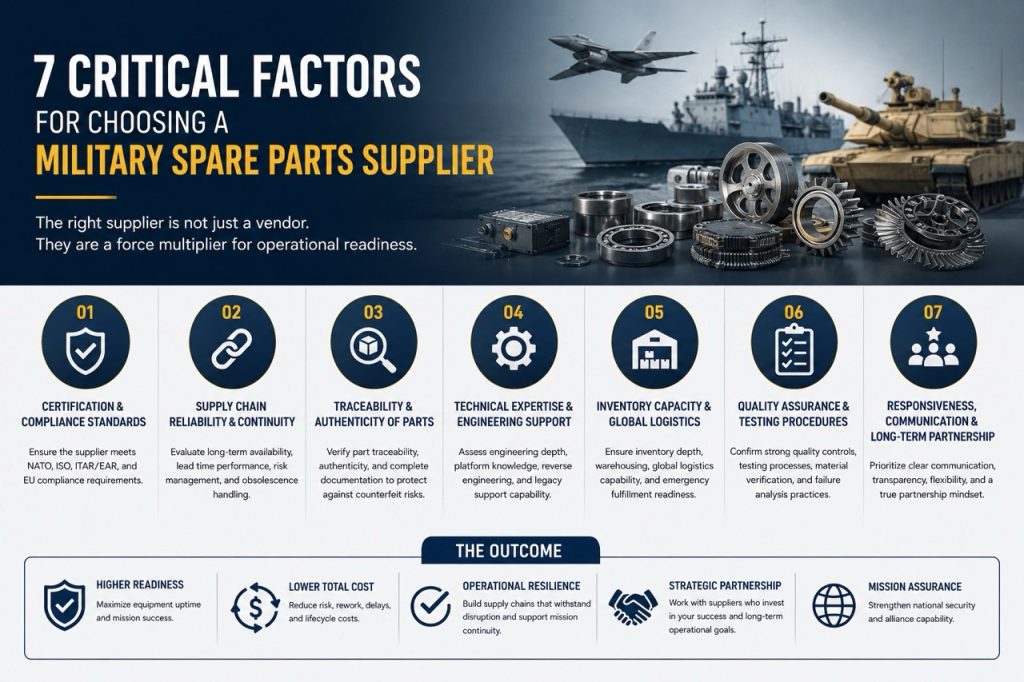
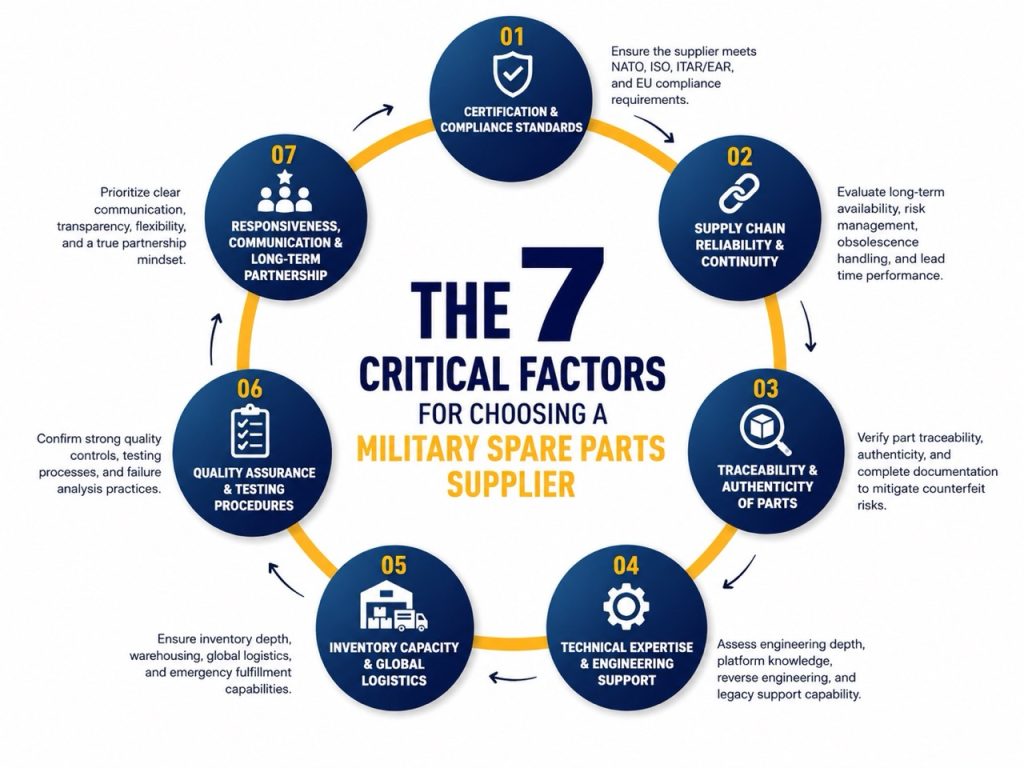
This guide outlines seven of the most critical factors that defense buyers, military logistics professionals, and fleet sustainment managers evaluate when selecting or qualifying a defense spare parts supplier. Each factor reflects current procurement realities, NATO standards, and practical lessons learned across military supply chains supporting armored vehicles, tactical transport systems, military aviation, and naval platforms.
Factor 1: Certification and Compliance Standards
Why Certification Is the Baseline Rather Than a Differentiator
In military procurement, certification is not a competitive advantage. It is the minimum threshold required to enter the defense supply chain. Before any procurement evaluation proceeds, defense buyers must verify that a prospective supplier operates within a fully auditable and compliant quality management framework. Failure to conduct this due diligence can result in substandard parts entering military systems, creating equipment failures, safety risks, and legal exposure.
NATO Standards and AQAP Compliance
The Allied Quality Assurance Publications, commonly known as AQAP, form the primary quality management framework for defense contractors operating within NATO environments. AQAP 2110 governs design, development, and production activities for defense hardware, while AQAP 2120 focuses on manufacturing quality requirements.
Suppliers certified under AQAP standards undergo independent audits confirming that their quality systems meet defense specific requirements including configuration management, design control, product verification, and management of nonconforming material. Within NATO procurement programs operating under STANAG frameworks, AQAP certification is frequently mandatory.
A supplier claiming AQAP compliance without a current and verifiable certificate from a recognized national quality assurance authority should immediately raise concern. Unverified claims in defense procurement carry operational and legal consequences.
ISO 9001 and Defense Specific Extensions
ISO 9001:2015 certification provides a general quality management baseline, but in defense procurement it is often insufficient on its own. AS9100, the aerospace and defense extension of ISO 9001, introduces additional controls around risk management, configuration control, and first article inspection that align more closely with military expectations. For aviation suppliers, AS9100 Revision D remains the benchmark standard.
ITAR and EAR Compliance
Defense suppliers operating internationally must also demonstrate compliance with the International Traffic in Arms Regulations and the Export Administration Regulations. These United States regulatory frameworks govern the export and re export of defense articles and dual use technologies.
European defense contractors sourcing US origin components must ensure suppliers maintain functioning ITAR and EAR compliance programs. Violations can result in export restrictions, substantial financial penalties, and loss of access to the US defense industrial base, creating major implications for NATO interoperability.
European Union Defense Procurement Regulations
Within the European Union, defense procurement is governed by Directive 2009/81/EC concerning defense and security contracts. Procurement authorities must ensure suppliers comply with national implementations of the directive, security of supply obligations, and increasingly the requirements associated with the European Defence Fund and collaborative capability development initiatives.
Factor 2: Supply Chain Reliability and Continuity
Sustained Availability as a Strategic Requirement
Operational readiness depends on two interconnected variables: equipment reliability and spare parts availability. Even the most advanced military platform becomes ineffective if critical parts cannot be sourced reliably, quickly, and at the required quality level. Military logistics is not simply a commercial supply chain challenge. It is a national security function.
Global defense supply chains have faced continuous disruption since 2020. The COVID 19 pandemic created factory shutdowns and semiconductor shortages, while the geopolitical consequences of Russia’s invasion of Ukraine exposed the fragility of just in time procurement models within defense environments.
Long Term Availability and Obsolescence Management
Military platforms often remain operational for decades. Tactical vehicles fielded in the 1990s may continue serving well into the 2030s, while naval platforms commissioned today may require support into the 2050s. Commercial supply chains evolve far more rapidly than military platform lifecycles, creating persistent obsolescence challenges.
Effective defense suppliers therefore require structured obsolescence management programs. These include monitoring end of life notifications, executing last time buy strategies, and developing technically compliant replacement solutions for discontinued components.
Multi Source Procurement and Wartime Resilience
Single source dependencies create critical vulnerabilities within defense logistics. Procurement professionals increasingly recognize that relying on one supplier for mission critical components is operationally dangerous.
Qualified suppliers should demonstrate either multi source procurement capability through diversified sub tier suppliers or sufficient safety stock strategies capable of buffering against disruptions.
During wartime or high intensity operational conditions, standard commercial logistics assumptions no longer apply. Defense buyers must evaluate whether suppliers possess the inventory depth, production flexibility, and logistics infrastructure necessary to sustain surge demand.
Lead Time Management
Lead time variability is one of the most underestimated risks in military procurement. A supplier capable of meeting standard delivery schedules may struggle during periods of simultaneous demand surge across multiple defense customers.
Procurement authorities should therefore require documented lead time performance data across normal, surge, and emergency fulfillment conditions.
Factor 3: Traceability and Authenticity of Parts
The Counterfeit Threat
Counterfeit components remain one of the most serious risks facing military supply chains. Investigations by defense authorities have identified thousands of counterfeit electronic parts entering military systems. These components frequently appear authentic but fail under operational stress.
The counterfeit problem extends far beyond electronics. Counterfeit fasteners, seals, bearings, and structural components have also been identified within military vehicle and naval supply chains.
Batch Traceability and Serial Number Control
A credible military spare parts supplier must maintain complete batch traceability. Every component should be traceable by serial number, lot number, or batch reference back to the original manufacturer with documented chain of custody records.
Modern defense procurement increasingly expects digital traceability systems integrated into enterprise resource planning platforms. Suppliers relying on fragmented or paper based systems introduce documentation risks and audit exposure.
OEM and Aftermarket Parts
The debate between OEM and aftermarket parts is more nuanced than often presented. OEM components provide assurance of compliance with original design specifications, particularly for mission critical systems.
However, qualified aftermarket components can provide cost effective and operationally viable alternatives, especially for legacy platforms affected by obsolescence. The critical factor is not whether a part is OEM or aftermarket, but whether the supplier can demonstrate robust qualification, technical justification, and quality assurance processes.
Documentation Standards
Complete documentation is non negotiable in military procurement. Required documentation may include Certificates of Conformance, Material Test Reports, inspection records, airworthiness release documentation, and declarations of compliance.
Suppliers unable to provide complete auditable documentation packages should not be considered suitable for defense supply roles.
Factor 4: Technical Expertise and Engineering Support
Why Engineering Capability Matters
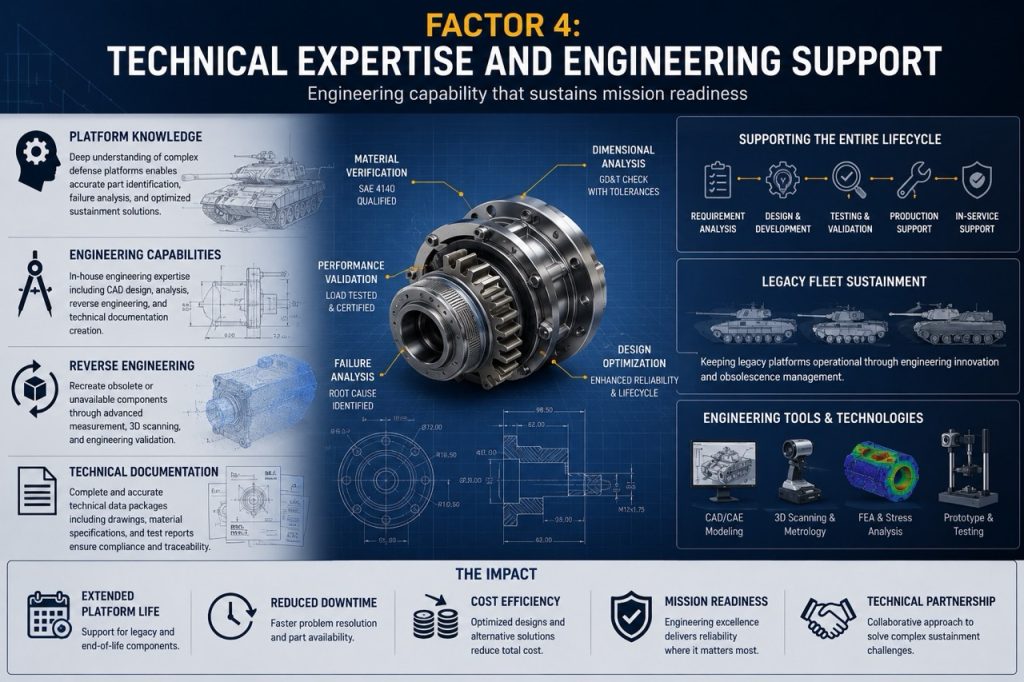
Military platforms are highly complex systems subject to continuous upgrades, modifications, and engineering changes. Suppliers without technical expertise often lack the ability to support these evolving requirements effectively.
Reverse Engineering Capability
For legacy platforms, reverse engineering capability may determine whether fleets remain operational or face retirement due to unavailable components.
Qualified reverse engineering programs require structured engineering controls, technical review procedures, and validation testing to confirm form fit function equivalence before operational use.
Platform Knowledge
Suppliers with deep platform experience provide operational value beyond parts availability. They can identify recurring failure modes, flag compatibility risks, and recommend preventative replacement strategies based on accumulated sustainment knowledge.
Military logistics officers consistently identify supplier technical expertise as one of the most important long term partnership factors.
Legacy Fleet Sustainment
European armed forces continue operating platforms spanning multiple generations of technology. Suppliers capable of supporting legacy systems through discontinued parts sourcing, condition based maintenance support, and sustainment engineering provide capabilities that commodity distributors cannot replicate.
Factor 5: Inventory Capacity and Global Logistics
Defense Logistics as an Operational Requirement
Military operations do not align with commercial shipping schedules. Supporting NATO exercises, expeditionary deployments, or maritime patrol operations requires suppliers capable of delivering critical parts rapidly across complex operational environments.
Warehousing and Inventory Depth
Inventory depth directly affects lead times and fulfillment reliability. Suppliers operating solely as intermediaries often introduce unacceptable delays for military operations.
Defense buyers should verify that suppliers maintain substantial on hand inventory and strategically positioned warehousing infrastructure.
Emergency Fulfillment Capability
Every sustainment manager eventually faces an Aircraft on Ground or mission critical equipment downtime scenario caused by a single unavailable component.
Suppliers should therefore demonstrate structured emergency fulfillment procedures including around the clock order management, priority freight arrangements, and real time shipment visibility.
International Shipping and Export Management
Cross border defense logistics involves complex regulatory obligations including ITAR licensing, dual use export controls, NATO transfer certificates, and end user documentation.
Suppliers lacking mature export compliance capability risk shipment delays and operational disruption.
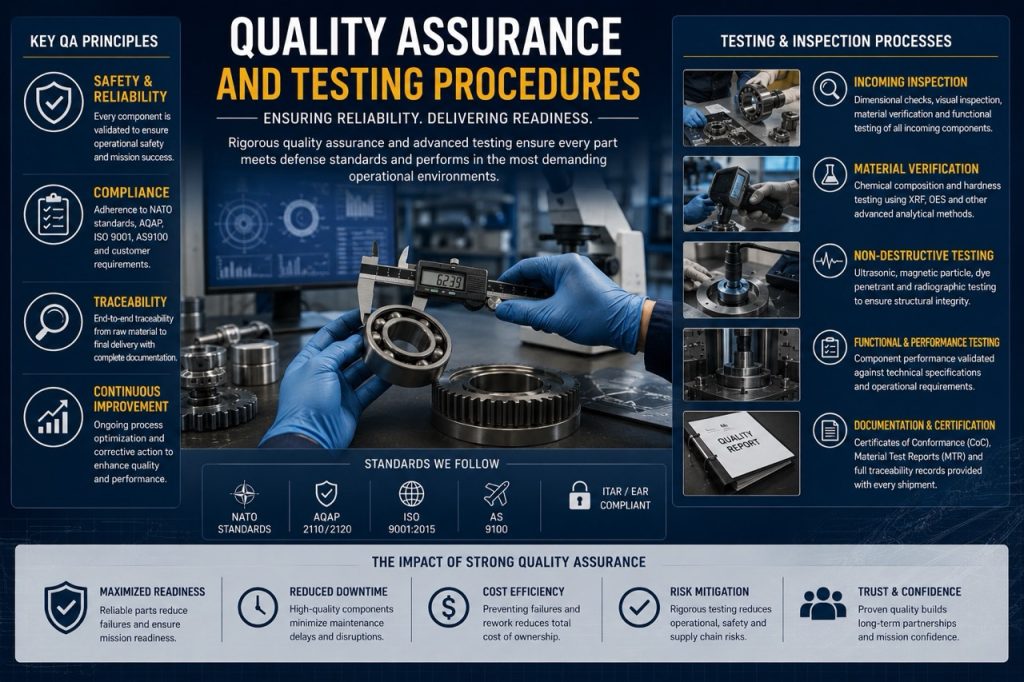
Factor 6: Quality Assurance and Testing Procedures
Quality Assurance as Operational Risk Management
Within defense MRO environments, quality assurance directly supports operational safety and readiness. A failed drivetrain bearing, defective fuel control unit, or out of specification hydraulic seal can escalate from a maintenance issue into a mission failure.
Incoming Inspection Processes
Leading defense suppliers implement rigorous incoming inspection processes covering dimensional verification, hardness testing, visual inspection, and electrical testing where applicable.
Incoming inspection serves as the primary barrier preventing counterfeit or substandard parts from entering operational supply chains.
Material Verification and Non Destructive Testing
Material verification processes such as X ray fluorescence analysis, optical emission spectroscopy, and hardness testing help confirm compliance with specified materials and alloys.
For structural and safety critical components, non destructive testing methods including ultrasonic inspection, magnetic particle inspection, and dye penetrant inspection provide additional assurance of component integrity.
Failure Analysis and Root Cause Investigation
Suppliers capable of conducting structured failure analysis provide direct operational value. Identifying whether a failure resulted from manufacturing defects, installation issues, design limitations, or operational misuse informs future procurement and maintenance decisions.
Transparent reporting of quality escapes and investigation findings demonstrates the operational maturity expected within defense procurement environments.
Factor 7: Responsiveness, Communication, and Long Term Partnership
Strategic Partnership Value
Defense sustainment programs often span decades. Suppliers who understand customer platforms, operational priorities, and institutional processes create long term value far beyond transactional purchasing relationships.
Communication and Transparency
Procurement authorities consistently identify communication quality as a decisive performance factor. Timely quotations, accurate lead time updates, and transparent technical communication reduce operational friction and support effective decision making.
Transparency regarding supply chain origin, non conformance history, and documentation availability is essential for building trust within defense procurement relationships.
Contract Flexibility and Emergency Response
Military demand patterns are inherently unpredictable. Operational surges, geopolitical crises, and clustered equipment failures can rapidly alter spare parts requirements.
Qualified defense suppliers must therefore support flexible contractual arrangements including framework agreements, surge provisions, and emergency stock programs.
After Sales Support
The procurement transaction marks the beginning rather than the end of the supplier relationship. Technical troubleshooting support, warranty handling, and proactive safety notifications all contribute directly to operational readiness.
Long Term Partnership Mindset
The most valuable defense suppliers operate as true strategic partners. They invest in understanding customer requirements, anticipate operational risks, and continuously improve their capability to support evolving defense sustainment challenges.
The Consequences of Poor Supplier Selection
Selecting an inadequate military spare parts supplier creates operational, financial, and reputational consequences that are often difficult to reverse.
Operationally, poor quality or counterfeit components generate unplanned maintenance events, reduce platform availability, and disrupt mission readiness.
Financially, the downstream costs associated with defective parts including incident investigations, corrective maintenance, logistics disruption, and contractual remediation frequently exceed any short term procurement savings.
Reputationally, repeated supply chain failures attract political scrutiny and media attention, particularly within increasingly transparent NATO and EU procurement environments.
The European Defense Context
NATO’s 2022 Strategic Concept and rising European defense spending have fundamentally reshaped the defense industrial landscape. According to the European Defence Agency, EU member defense expenditure reached approximately €270 billion in 2023, reflecting a major increase in real terms over recent years.
This surge in procurement demand has created both opportunity and risk. Procurement authorities now face an expanded supplier market with widely varying levels of genuine capability and compliance maturity.
The EU Strategic Compass further emphasizes supply chain resilience and diversification of defense industrial dependencies, reinforcing the need for rigorous supplier qualification and resilient European defense supply chains.
Summary
Selecting a military spare parts supplier is ultimately a strategic operational decision. Certification and compliance, supply chain resilience, traceability, technical expertise, logistics capability, quality assurance, and partnership quality collectively define whether a supplier can genuinely support military readiness.
For NATO and EU procurement professionals operating in today’s security environment, rigorous supplier evaluation has never been more important. Increased defense spending delivers operational value only when supported by resilient and trustworthy supply chains.
The procurement decisions made today will directly shape fleet readiness and operational capability for years to come. Supplier selection should therefore be approached with the same seriousness and rigor applied to platform acquisition itself.
You could contact us for defence spare parts
Related Military Spare Parts Categories, Vehicle Platforms & Technical Guides
Explore AB Defence’s NATO-codified (NSN) and genuine OEM spare parts catalog, platform technical specifications, and sustainment engineering guides related to this article:
Stocked Spare Parts Categories (NSN & OEM Catalog)
- NATO Standard Defence Components & Military Hardware (12,993 stocked parts)
- M60 Tank Spare Parts (M60A1 / M60A3 / M60T) (497 stocked parts)
- M109 Self-Propelled Howitzer Spare Parts (585 stocked parts)
- BMC Kirpi MRAP Spare Parts (Kirpi I & Kirpi II) (597 stocked parts)
- Mercedes-Benz Unimog Military Spare Parts (562 stocked parts)
- Full NATO NSN & OEM Spare Parts Catalog (16,760+ Parts)
Compatible Vehicle Platforms & System Hubs
- Platforms
- Product Groups
- Quality
- Capabilities
- Tracked Armoured Vehicles
- Request a B2B Quotation (RFQ) & Technical Support