July 28, 2026
Why Unimog Suspension Systems Require Specialized Military Maintenance
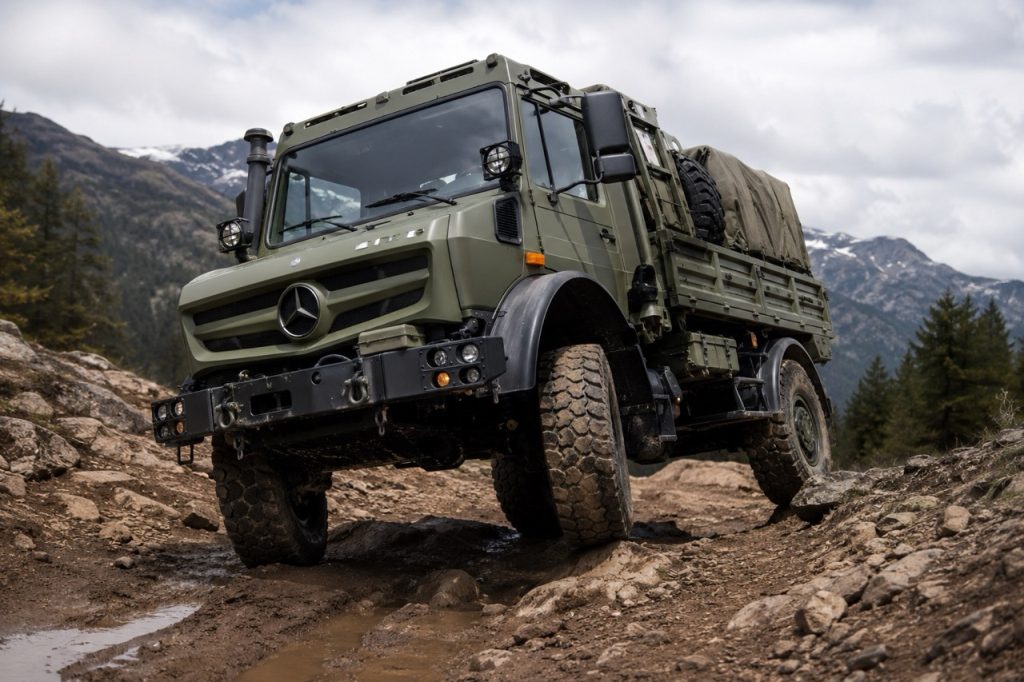
A Mercedes-Benz Unimog rolling across a rutted supply route in a mountain training area does not fail in the way a commercial delivery truck fails. Its suspension is asked to do something a highway chassis never has to do: keep all four wheels tracking ground contact while the frame twists beneath an armor kit, a weapons mount, or a fully loaded cargo bed. Why Unimog suspension systems require specialized military maintenance comes down to that single fact the platform’s off-road engineering is only as good as the maintenance discipline behind it.
Military fleet managers who treat Unimog suspension service like an oil change on a delivery van are setting themselves up for premature component failure, unplanned downtime, and in a deployed environment a vehicle that cannot get a crew, a casualty, or a resupply load where it needs to go. This article sets out why the suspension deserves a maintenance program of its own, what components carry the highest risk, and how procurement and sustainment teams can protect both readiness and lifecycle cost.
Overview of the Mercedes-Benz Unimog in Military Service
The Unimog short for Universal Motor Gerät has served military, engineering, and disaster response roles for more than seven decades. Mercedes-Benz built the platform from the outset around portal axles and permanent all wheel drive, and armed forces across Europe and NATO aligned states adopted it precisely because it could go where a conventional truck could not.
Successive U-series and later U4000/U5000 class Unimogs have been fielded as logistics trucks, engineering vehicles, recovery platforms, airfield support vehicles, and in variants such as the ATF Dingo protected patrol vehicles built on Unimog running gear. The mission profiles differ, but the demand placed on the suspension does not: it must deliver consistent wheel contact and load control across terrain that a civilian truck chassis was never designed to encounter.
That underlying design is also why the suspension cannot be maintained the way a commercial fleet manager would maintain a road going truck. The components are different, the failure modes are different, and the consequences of deferred maintenance are measured in mission capability rather than customer inconvenience.
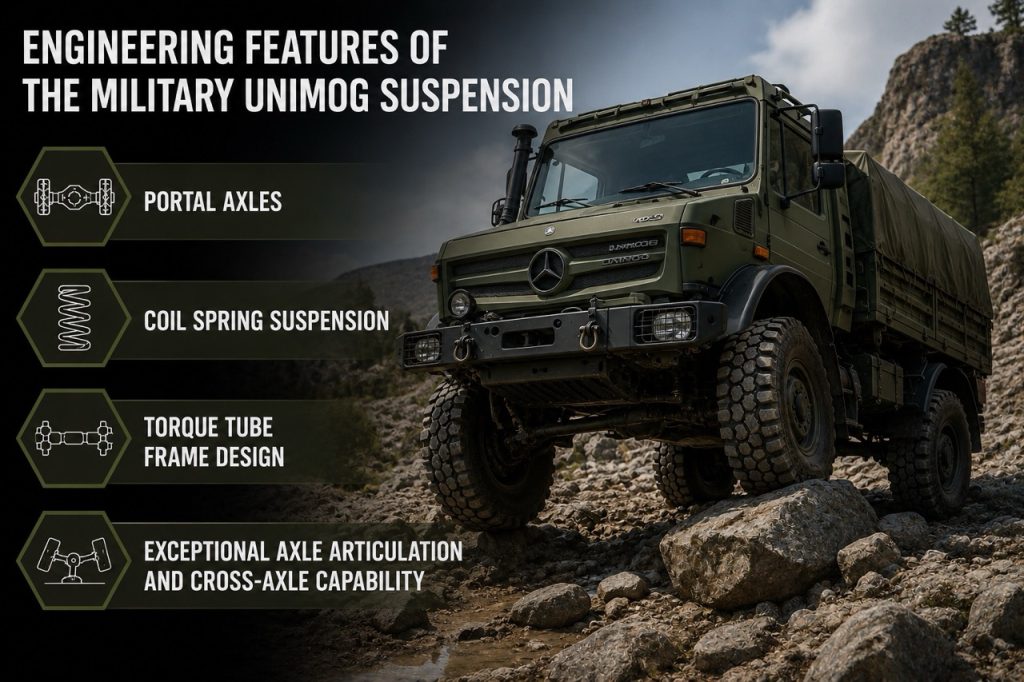
Engineering Features of the Military Unimog Suspension
Three design choices set the Unimog suspension apart from a conventional truck axle and explain why its upkeep sits in a different category.
Portal Axles
Portal axle housings position the differential above the centerline of the wheel hub, with the drive transmitted down through a reduction gear at the hub itself. The result is significantly greater ground clearance under the axle housing than a conventional beam or independent axle offers at the same ride height clearance that lets the vehicle pass over rocks, stumps, and berms that would otherwise strike the differential housing. That same gear in hub arrangement means each portal hub carries its own lubricant reservoir and wear surfaces that a standard truck axle simply does not have.
Coil Spring Suspension
Where many commercial trucks still rely on leaf springs tuned for carrying static loads on pavement, the Unimog’s coil springs are matched to long travel axle movement. Coil springs allow the axle to move through a greater range before the suspension reaches its limits, which is what gives the vehicle its wheel travel over broken ground but that same travel range means the springs, spring seats, and their locating components see continuous cyclic loading that a road biased leaf spring truck rarely experiences.
Torque Tube Frame Design
The Unimog’s frame uses a torque tube arrangement that permits a deliberate, controlled degree of torsional flex along its length. Rather than resisting every twisting force as a rigid ladder frame would, the frame flexes with the terrain, helping to keep all wheels loaded and in contact with the ground even when the vehicle is crossing a diagonal obstacle. This frame flexibility works together with the axle articulation and coil springs — it is not a separate system, and a maintenance program that only looks at springs and shocks while ignoring frame-mounted brackets and bushings is missing part of the picture.
Exceptional Axle Articulation and Cross-Axle Capability
The combined effect of portal axles, coil springs, and a flexible frame is axle articulation well beyond what a conventional 4×4 or 6×6 truck chassis provides. In practical terms, this is what allows a Unimog to keep one wheel in a ditch and the diagonally opposite wheel on a raised obstacle while maintaining traction on all four corners a capability collectively described as cross-axle mobility.
How Military Suspension Engineering Compares to a Conventional Truck
| Design Feature | Conventional Commercial Truck Suspension | Military Unimog Suspension |
| Axle type | Rigid or independent axles, low ground clearance | Portal axles, driveshaft mounted above axle centerline for elevated ground clearance |
| Spring medium | Leaf springs, tuned for pavement load carrying | Coil springs, tuned for wheel travel and shock absorption over broken terrain |
| Axle articulation | Limited, optimized for road stability | Exceptional, allowing individual wheels to follow uneven ground independently |
| Frame design | Rigid ladder frame for load stability | Torque tube frame permitting controlled torsional flex across obstacles |
| Primary duty cycle | Paved roads, predictable static loads | Cross country mobility, armor and mission kit payloads, shock loading |
| Maintenance driver | Scheduled service intervals under stable conditions | Condition based inspection driven by terrain severity and mission tempo |
Why Military Operations Create Different Maintenance Requirements
A civilian maintenance interval is built around a duty cycle of paved roads, predictable payloads, and moderate climates. Military use of the same platform changes nearly every one of those variables at once, and the suspension absorbs the difference.
- Heavy and variable payloads cargo beds, fuel bladders, shelters, or recovery equipment loaded well beyond a typical civilian configuration
- Armor kits and weapon stations added mass and a raised center of gravity that change how the suspension is loaded through turns and over obstacles
- Continuous vibration and shock loading sustained off-road operation subjects bushings, mounts, and fasteners to fatigue cycles that pavement driving does not produce
- Harsh and variable environments desert heat and abrasive sand, arctic cold and packed snow, jungle humidity, and mountain rock all place different stresses on seals, rubber components, and lubricants
- Long deployment cycles vehicles that stay forward deployed for extended periods accumulate wear between the kind of thorough inspections that a garrison based fleet receives routinely
- Repeated obstacle crossings and water fording every crossing is a fresh cycle of full suspension travel and, in fording, potential water and grit intrusion into axle and hub seals
None of these conditions is exotic on its own. What matters for maintenance planning is that they occur together, repeatedly, and often far from a depot level workshop which is exactly the environment the Unimog’s suspension was engineered to operate in, provided its upkeep matches the demand placed on it.
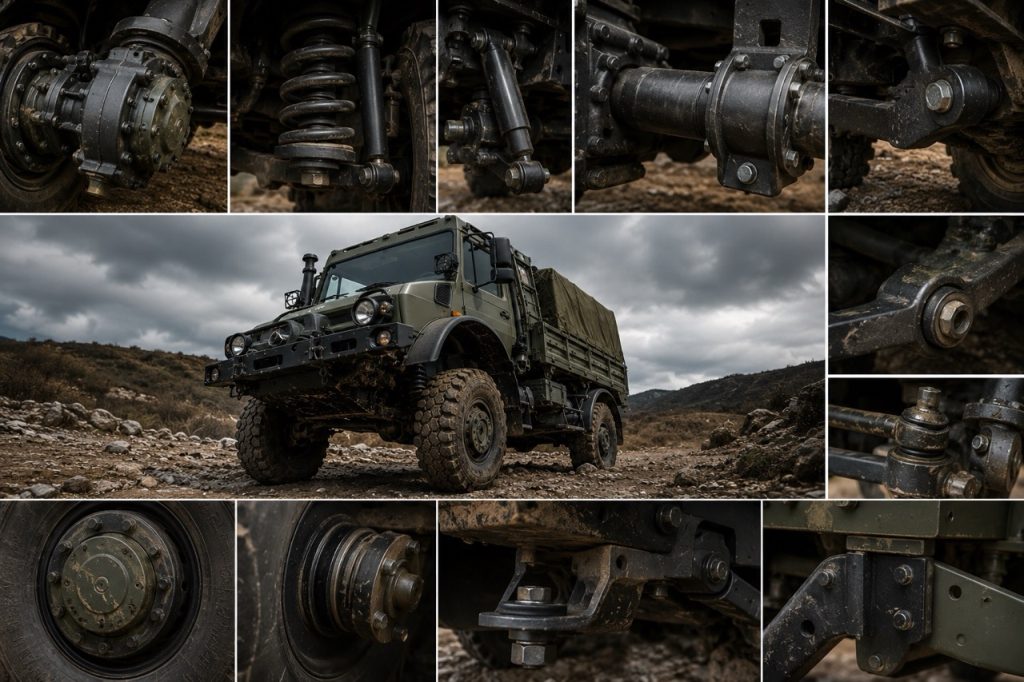
Critical Suspension Components That Require Regular Inspection
A disciplined inspection regime treats the suspension as a system of interdependent parts rather than a handful of isolated wear items. The components below are the ones maintenance crews consistently identify as the first to show the effects of sustained off-road military use.
- Portal axle housings and hub gear assemblies
- Coil springs and spring seats
- Shock absorbers and their mounting bushings
- Torque tubes and their frame mounting points
- Radius arms and radius arm bushings
- Control arm and stabilizer bar bushings
- Ball joints and steering linkage, including track rod and drag link
- Wheel hub assemblies and wheel bearings
- Axle and hub seals
- Mounting brackets and structural fasteners
Wear rarely appears in only one of these components at a time. A worn bushing changes how a radius arm loads its mounting bracket; a failing seal accelerates bearing wear; a fatigued spring changes the geometry the shock absorber has to control. That interdependence is the core technical reason a suspension inspection needs to be systematic rather than reactive.
Most Common Causes of Suspension Wear
Across fleet sustainment programs, a small number of root causes account for most premature suspension wear on military Unimog platforms.
- Overloading beyond rated payload, particularly with added armor or mission equipment not accounted for in load planning
- Inadequate or delayed lubrication of portal axle hub gears and chassis grease points
- Corrosion, especially in coastal, desert, or salted road operating environments
- Contamination of seals and bearings by sand, mud, or water intrusion during fording and obstacle crossings
- Impact damage from rocks, obstacles, or hard landings during cross country movement
- Metal fatigue in springs, torque tubes, and mounting brackets from sustained cyclic loading
- Aging and hardening of rubber bushings and seals, which lose their damping and sealing properties over time regardless of mileage
- Misalignment following component replacement or after a hard impact event
- Improper repairs using non specification parts or incorrect torque values
- Deferred preventive maintenance during high tempo deployment periods
Warning Signs Maintenance Teams Should Never Ignore
Suspension degradation is rarely sudden. It shows up first as small, easily dismissed symptoms and catching them early is what separates a scheduled component swap from an unplanned vehicle off road event.
- Uneven or accelerated tire wear across an axle
- A vehicle that leans or sits unevenly at rest
- Noticeably reduced axle articulation over familiar terrain
- Abnormal knocking, clunking, or squealing from the suspension under load
- Oil leaks at portal hub seals or shock absorber bodies
- Excessive vibration transmitted into the cab or cargo bed
- Vague or delayed steering response
- A general sense of instability at speed or during turns
- Reduced off-road capability compared to the vehicle’s known baseline performance
- Wheel alignment issues, including a pull to one side
Any one of these on its own may be minor. Reported together, or repeated across the same vehicle, they are a strong signal that a full suspension inspection not just the component showing the symptom is overdue.
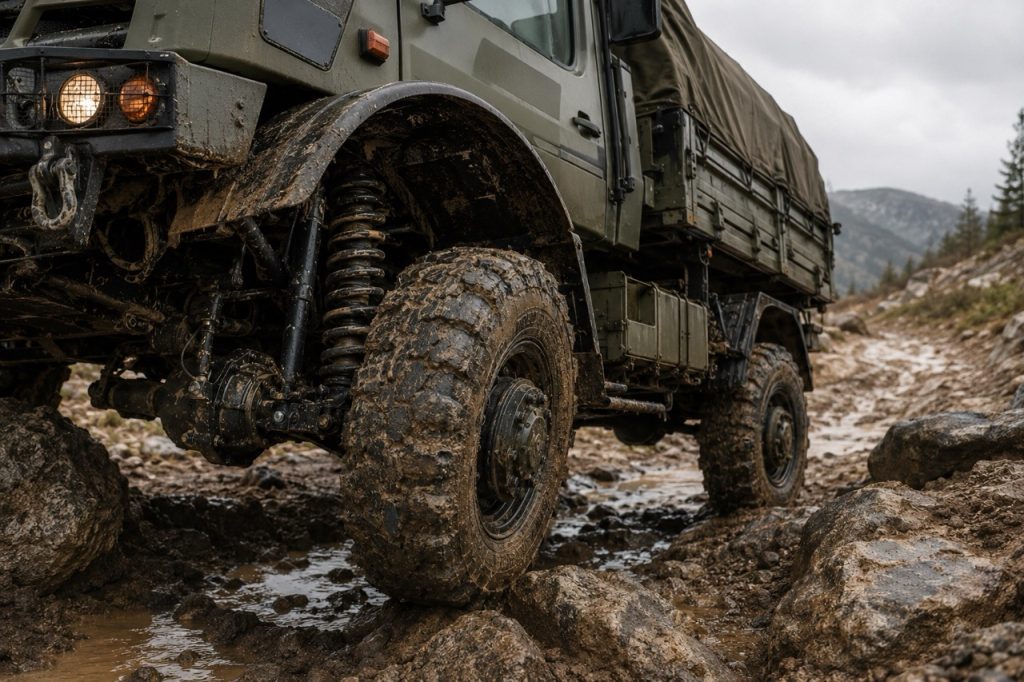
Preventive Maintenance Best Practices
Military maintenance doctrine generally organizes suspension upkeep around layered inspection tiers, and Unimog fleets fit that model well.
- Routine visual and functional inspections at the operator and organizational maintenance level
- Lubrication schedules for portal axle hub gears and all grease-point fittings, adjusted for operating environment
- Planned component replacement based on service life and observed condition rather than waiting for failure
- Torque verification on suspension and steering fasteners after off-road missions and following any component replacement
- Bushing inspection for cracking, hardening, or excessive play
- Functional shock absorber testing rather than relying on visual inspection alone
- Wheel alignment checks following suspension component replacement or a hard impact event
- Condition monitoring and documentation that tracks each vehicle’s suspension history over its service life
- Strict compliance with OEM specifications for parts, torque values, and lubricants
Condition based and predictive approaches using documented inspection history and observed wear trends rather than mileage or calendar intervals alone are increasingly how sustainment organizations manage suspension components on vehicles with highly variable duty cycles like the Unimog. A vehicle that spent six months on desert convoy duty and one that spent six months in garrison will not wear identically, even with the same odometer reading.
| Maintenance Planning Note This article describes general suspension maintenance principles for the Unimog platform. Specific service intervals, torque values, and lubrication specifications should always be taken from the applicable Mercedes-Benz Special Trucks technical documentation and the operating unit’s maintenance directives for the specific U-series variant in service. |
The Role of Genuine Spare Parts in Suspension Reliability
Suspension components operate under tightly engineered tolerances. A coil spring, bushing, or portal axle seal that is dimensionally close but not manufactured to OEM specification can alter ride height, wheel geometry, or seal performance in ways that are difficult to detect until the component or a neighboring one fails.
- OEM-quality materials and manufacturing tolerances preserve the geometry the suspension was designed around
- Consistent material durability reduces the risk of premature fatigue failure under military duty cycles
- Correct engineering tolerances keep articulation and alignment within design limits
- Verified reliability supports both operational safety and crew confidence in the vehicle
- Lower long-term lifecycle cost, since a correctly specified part fails less often and does less collateral damage to adjacent components when it does wear out
- Fleet availability depends on parts being in stock and correctly matched to the specific U-series variant and axle configuration in service
For a fleet sustainment program, supply chain reliability is as important as part quality. A technically correct component that arrives too late to prevent a vehicle from going off the availability list has already cost the fleet the readiness it was meant to protect.
Why Fleet Managers Prioritize Suspension Health
Suspension condition sits at the intersection of several priorities that fleet managers are measured against, which is why it tends to receive close attention in sustainment reviews.
- Mission readiness a vehicle with degraded articulation or a failed component cannot be tasked with confidence for cross country movement
- Reduced unplanned downtime catching wear early avoids the workshop time lost to secondary damage from a failed component
- Lower repair costs replacing a worn bushing is inexpensive; replacing a torque tube damaged by a bushing failure is not
- Longer vehicle service life a suspension maintained to specification protects the frame, axles, and drivetrain components it works alongside
- Crew safety steering response, stability, and braking performance are all connected to suspension condition
- Lower total ownership cost across the vehicle’s service life, which matters directly to procurement and sustainment budgeting
How AB Defence Supports Military Fleet Sustainment
Sustaining a Unimog fleet through its full service life depends on having the right components available at the right time, matched correctly to the vehicle variant and axle configuration in service. AB Defence supplies military vehicle spare parts including suspension, axle, and drivetrain components to NATO and allied defense organizations, fleet sustainment programs, and maintenance facilities operating Mercedes-Benz Unimog and other military platforms.
For procurement officers and maintenance planners, that support is most useful when it addresses the practical realities of fleet sustainment: correctly specified parts, responsive logistics across international customers, and technical familiarity with the platforms being maintained. Suspension components in particular reward that kind of specificity, since a part that is correct for one U-series axle configuration may not be correct for another.
A fleet sustainment plan that pairs disciplined preventive maintenance with a dependable spare parts supply chain is, in practical terms, the difference between a Unimog fleet that meets its readiness targets and one that does not.
The Unimog earned its reputation for off-road mobility through a suspension architecture portal axles, coil springs, a torsionally flexible frame, and exceptional axle articulation that has no direct equivalent in a conventional commercial truck. That same architecture is what makes generic, road oriented maintenance practices inadequate for the platform in military service.
Why Unimog suspension systems require specialized military maintenance ultimately comes down to matching the maintenance program to the demand the mission places on the vehicle: systematic component inspection, condition based preventive maintenance, and a dependable supply of correctly specified spare parts. Organizations that invest in that discipline preserve the mobility, reliability, and service life the platform was built to deliver and the mission capability that depends on it.
Work With AB Defence
Partner with AB DEFENCE for Reliable Combat Support Vehicle Sustainment. AB DEFENCE is a specialist international supplier of military spare parts and fleet sustainment solutions serving NATO and allied defense organisations. With deep inventory across a wide range of combat support vehicle platforms, rigorous quality assurance processes, export compliance expertise, and a commitment to long term supply chain partnership, AB DEFENCE helps defense buyers maintain fleet availability, reduce sustainment costs, and meet their operational readiness obligations. Contact the AB DEFENCE team to discuss your spare parts requirements, strategic inventory planning, and long-term sustainment programme needs.
Contact AB Defence to discuss your procurement requirements and learn how we can support your fleet readiness objectives.
Related Military Spare Parts Categories, Vehicle Platforms & Technical Guides
Explore AB Defence’s NATO-codified (NSN) and genuine OEM spare parts catalog, platform technical specifications, and sustainment engineering guides related to this article:
Stocked Spare Parts Categories (NSN & OEM Catalog)
- Mercedes-Benz Unimog Military Spare Parts (562 stocked parts)
- Military Portal Axles, Differentials & Drive Shafts (107 stocked parts)
- Military Gearbox, Transfer Case & PTO Assemblies (108 stocked parts)
- Military Brake Calipers, Master Cylinders & Hydraulic Systems (103 stocked parts)
- Military Engine Cooling Systems, Radiators & Water Pumps (57 stocked parts)
- Full NATO NSN & OEM Spare Parts Catalog (16,760+ Parts)
Compatible Vehicle Platforms & System Hubs
- Unimog U 1300 L (1.5 Ton – 2.5 Ton)
- Unimog U 1500 L
- Unimog U 1700 L
- Unimog U 2150 L
- Unimog U 2450 L
- Request a B2B Quotation (RFQ) & Technical Support
Related Military Engineering & Sustainment Articles
- Unimog Military Spare Parts: What Every Fleet Manager Needs to Know Before Placing an Order
- Unimog Spare Parts for Military Fleets: Why AB Defence Is Your Trusted Supply Partner
- 5 Unimog Components Most Commonly Replaced in Military Operations
- What Are the Most Common Failures in Military Unimog Vehicles?