July 7, 2026
5 Unimog Components Most Commonly Replaced in Military Operations
Few tactical vehicles have earned the operational trust that the Mercedes Benz Unimog has accumulated across six decades of continuous military service. Fielded by NATO members, non aligned defense forces, and United Nations logistics units alike, the Unimog’s portal axles, high ground clearance, and payload adaptable chassis have made it a standard platform for troop transport, engineering support, communications shelters, recovery work, and humanitarian logistics in terrain that would immobilize conventional trucks.
That reputation for durability does not mean the vehicle is immune to wear. Military duty cycles are fundamentally harsher than civilian or even commercial off road use: sustained overloading, extended idling, water fording, unimproved supply routes, and long dormancy periods between deployments all accelerate component fatigue in ways that standard maintenance intervals were never designed around. A fleet manager who treats the Unimog as maintenance-free because of its reputation is setting up for exactly the kind of unscheduled downtime that a sustainment program exists to prevent.
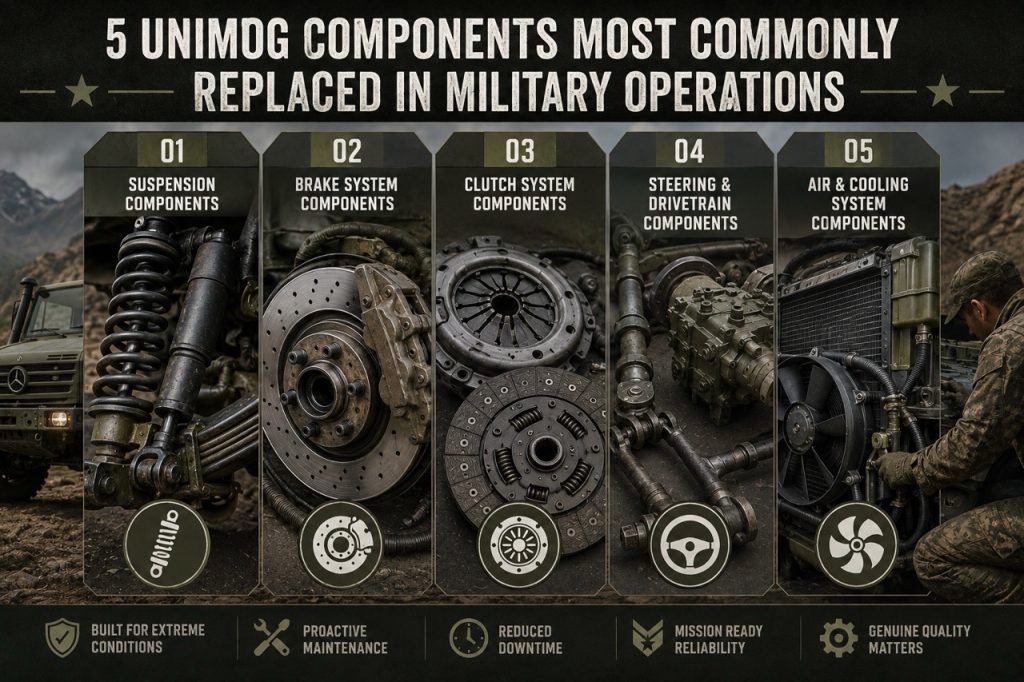
Proactive component replacement, built around inspection data rather than guesswork, is what actually delivers the reliability the platform is known for. The five component groups below account for the majority of unscheduled maintenance actions across military Unimog fleets. Understanding why each one wears the way it does, and what genuine quality replacement parts contribute to service life, is foundational to any serious fleet sustainment plan.
| Fleet Sustainment Note The component groups covered in this article are ranked by frequency of unscheduled replacement across military operated Unimog fleets, not by unit cost or complexity. Suspension, brakes, clutch, steering/drivetrain, and air/cooling systems consistently account for the majority of corrective maintenance actions in field conditions. |
1. Suspension Components
suspension system
Rough terrain fatigue is the primary driver of suspension wear in tactical use. Washboard tracks, rutted supply roads, and cross country movement subject shock absorber seals and springs to a far higher cycle count per mile than paved road driving. Off road articulation, the very characteristic that makes the Unimog valuable, also means suspension bushings see continuous torsional flex rather than the more limited motion typical of on road vehicles. Combine that with sustained overloading during resupply runs and the wear mechanism becomes straightforward: seal degradation in shocks leads to fluid loss and reduced damping, bushings harden or crack under repeated flex, and spring leaves develop fatigue cracking at stress points near the eyes and center bolt.
Inspection should focus on visible shock absorber leakage, uneven tire wear patterns that indicate a sagging spring or worn bushing, and any clunking or looseness detected during articulation tests on uneven ground. Units operating in consistently rough terrain benefit from shortening standard inspection intervals rather than waiting for a scheduled depot-level service, since suspension degradation is progressive and affects handling stability long before a component fails outright. Preventive replacement of shocks and bushings on a mileage and terrain adjusted schedule, rather than a strict calendar basis, keeps ride control and axle articulation within specification.
Selecting suspension components manufactured to correct metallurgical and dimensional tolerances matters more here than in almost any other system on the vehicle, because an undersized bushing or a shock absorber with inconsistent valving will fail faster under military loading than it would in commercial use, and a spring that does not match the original rate profile changes ride height and axle geometry in ways that cascade into steering and tire wear problems.
2. Brake System Components
Brake pads, discs, and, on older or specific variants, drums form the friction interface that has to perform consistently whether the vehicle is running empty on a paved road or fully loaded on a descending grade with a trailer behind it. Calipers clamp the friction material against the rotor, hydraulic components generate and transmit the clamping force, and flexible brake hoses accommodate suspension travel at each wheel without leaking or collapsing. Every part of that chain is exposed to conditions military maintenance planners have to account for explicitly.
Heat cycling is the dominant failure driver. Military routes frequently combine sustained loaded descents with stop-and-go convoy movement, which pushes friction material and rotors through repeated heat-and-cool cycles that civilian brake systems rarely see at the same frequency. This accelerates pad wear, promotes disc warping, and can degrade brake fluid through moisture absorption faster than the standard replacement interval assumes. Mud, water crossings, and dust contamination compound the problem: water fording introduces moisture into drum assemblies and can wash lubricant out of caliper slide pins, while fine dust acts as an abrasive at the pad to rotor interface, accelerating wear on both surfaces simultaneously.
Inspection priorities include pad thickness, disc surface condition and runout, caliper slide pin freedom of movement, and a visual check of flexible brake hoses for cracking, bulging, or chafing against suspension components, since a hose failure at the wheel end is a safety critical event with no warning. Brake fluid should be checked for moisture contamination on a schedule that accounts for water fording frequency, not just calendar time. The safety implications of deferred brake maintenance on a vehicle regularly operating loaded, on grades, and in convoy formation make this system a poor candidate for run to failure maintenance under any circumstances.
Because braking performance is a direct safety factor rather than simply a reliability one, sourcing pads, discs, and hydraulic components manufactured to correct friction coefficient and dimensional specifications is non negotiable. Aftermarket friction material that does not match OEM heat tolerance can fade precisely when a loaded descent demands the most from it, which is the scenario a military brake system is most likely to encounter.
| Safety Critical Reminder Brake system components are the one category on this list where deferred maintenance carries immediate safety consequences rather than a purely operational cost. Flexible hose and hydraulic condition checks should never be deferred to the next scheduled service interval. |
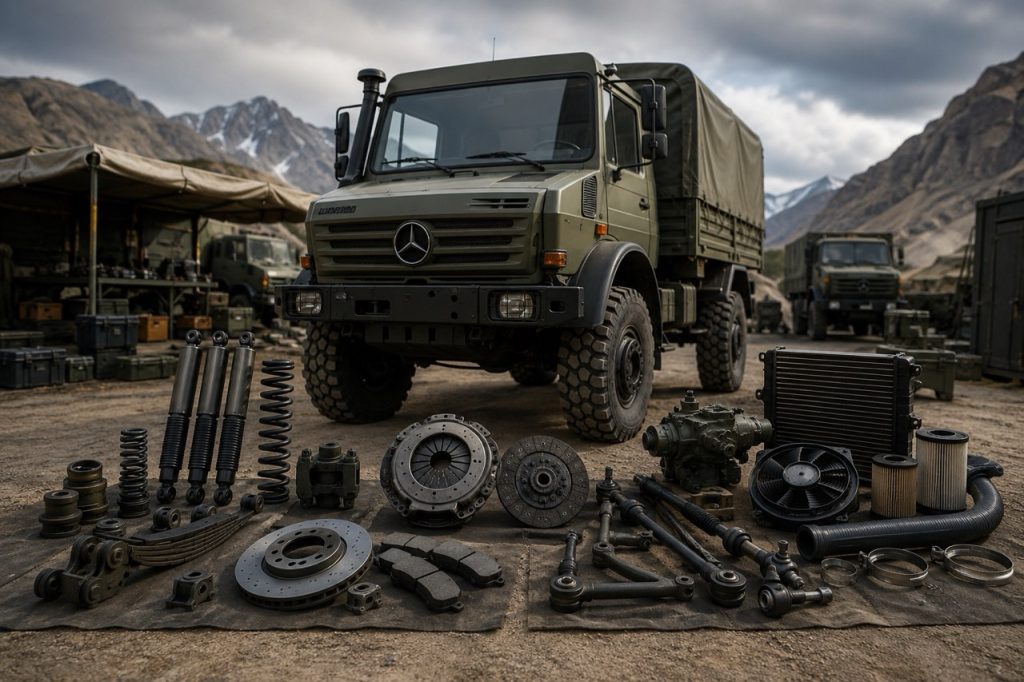
3. Clutch Assembly
The clutch disc, pressure plate, and release bearing together manage the transfer of engine torque into the drivetrain every time the vehicle moves from a stop, changes gear, or modulates power during low speed maneuvering. In military use, that transfer happens under conditions the component was not necessarily optimized for in isolation: heavy towing of trailers and equipment, off road maneuvering that demands frequent clutch slip for precise wheel speed control, and stop start operational patterns typical of checkpoint operations, convoy spacing, and loading and unloading cycles.
Each of these duty patterns accelerates a different wear mechanism. Heavy towing increases the torque and heat the friction disc must absorb during engagement, which shortens disc life relative to unladen operation. Off-road maneuvering, particularly low range work over obstacles, frequently requires deliberate clutch slip to control momentum, which is functionally similar to riding the clutch and generates disproportionate heat and wear at the friction surface. Stop start military operations simply multiply the number of engagement cycles per operating hour compared to sustained highway driving, and driver technique becomes a meaningful variable: operators who ride the clutch pedal or launch aggressively under load shorten service life measurably compared to those trained in smooth power transfer.
Early warning signs include a rising engagement point, a burning smell during or after low speed maneuvering, clutch chatter on takeoff, and any slippage under load that was not previously present. Because clutch wear is progressive and largely invisible until the disc is thin enough to slip, driver reported symptoms combined with periodic pedal free play checks are the most practical inspection method available outside of a full drivetrain teardown. Fleet maintenance planning should account for the fact that units with heavier towing profiles or more off road tasking will consume clutch assemblies faster than administrative or garrison based vehicles running the same total mileage.
Pressure plate clamping force and release bearing durability both depend on manufacturing precision that is difficult to verify visually, which is why sourcing clutch components from suppliers who can demonstrate consistent quality control matters as much as the disc friction material itself. A pressure plate that does not deliver rated clamping force will accelerate disc wear regardless of how well the disc itself was manufactured.
4. Steering and Drivetrain Components
Tie rod ends, ball joints, and steering linkage translate driver input into wheel angle at the portal axles, while universal joints and drive shafts carry torque from the transmission and transfer case out to those axles across a suspension travel range considerably greater than a standard highway truck. On variants equipped with independent front suspension geometry, CV joints perform a similar function while accommodating a different range of motion. Differentials at each axle then convert that driveline torque into wheel rotation, managing the speed differences between wheels during turns and, on portal axle designs, providing the additional gear reduction that gives the Unimog its distinctive ground clearance.
Terrain effects dominate wear patterns in this system. Off-road operation subjects steering linkage and ball joints to constant small-angle changes combined with impact loading from rocks, ruts, and uneven surfaces that a paved road vehicle’s steering components never experience. Universal joints and drive shafts operate at more extreme angles for more of their duty cycle in cross country use, which increases needle bearing wear inside the joint and accelerates the onset of vibration and eventual failure. Differential wear accelerates under the combination of sustained high torque loads, typical of low range crawling and heavy towing, and the contamination risk that comes with water fording, since moisture intrusion into a differential housing degrades lubricant protection quickly if seals are compromised.
Recommended inspection covers steering linkage and tie rod end play under load, visible grease seal condition at ball joints and universal joints, drive shaft runout and vibration at operating speed, and differential fluid condition and level, with particular attention after any deep water crossing. Torque loads transmitted through this system are cumulative and progressive in their effect on component life, so maintenance planning should treat steering and drivetrain wear as a function of terrain severity and towing frequency rather than mileage alone, adjusting inspection intervals accordingly for units with demanding operational profiles.
Because these components carry structural and safety loads simultaneously, dimensional accuracy in replacement tie rod ends, universal joints, and axle components is critical; a joint manufactured outside of correct tolerance will introduce play that accelerates wear in adjacent components and can compromise steering precision at exactly the moment precise handling matters most, such as during a water crossing or an obstacle traverse.
5. Air Filtration and Cooling System Components
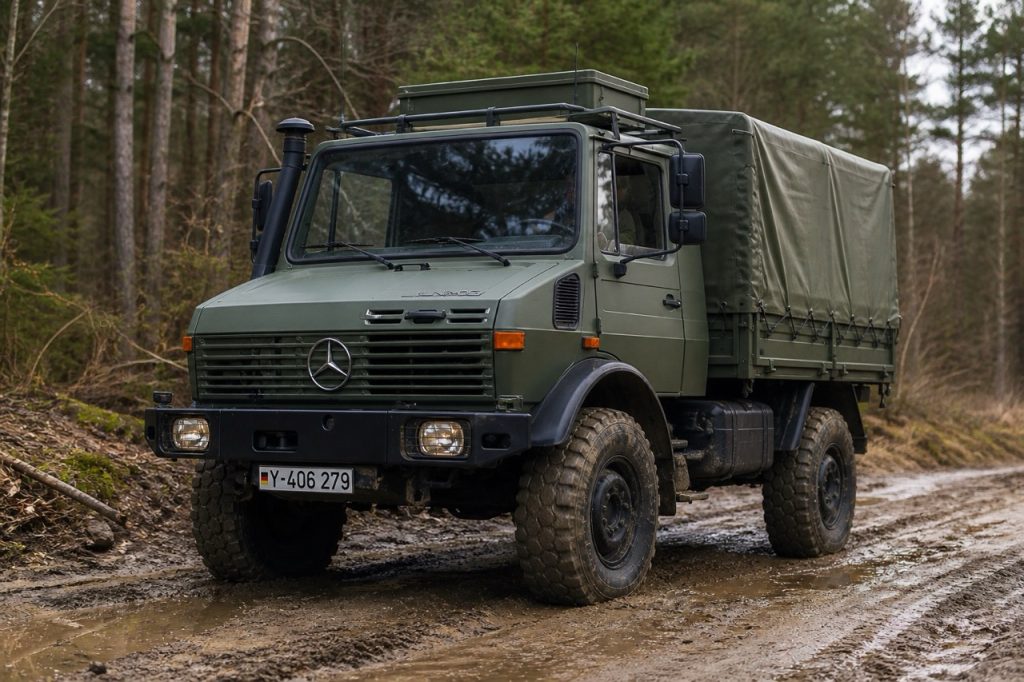
Air filters protect the engine’s internal components from the abrasive particulate that is unavoidable in most military operating environments, while the cooling system, comprising radiator hoses, cooling hoses, the water pump, and the thermostat, maintains engine operating temperature within the range the engine was designed around. Neither system is glamorous, but engine protection depends entirely on both functioning correctly, and failures here tend to cascade into far more expensive engine damage if left unaddressed.
Dust ingestion is the defining stress factor for air filtration in desert and arid operating environments, where fine particulate loads the filter media far faster than the standard replacement interval assumes and can, if the filter is neglected, begin passing abrasive material into the intake tract, accelerating cylinder and piston wear. Cooling system components face a different but related challenge: radiator and cooling hoses are subject to heat cycling and, in dusty environments, external abrasion against debris and vegetation, while the water pump’s shaft seal and bearing wear progressively under continuous operation, particularly during extended idling common to checkpoint duty, communications relay tasking, and static security operations where airflow across the radiator is reduced.
Thermostats can fail in either the open or closed position, and a closed failure produces overheating quickly enough to cause serious engine damage if not caught immediately, which makes temperature gauge monitoring during operation a frontline defense rather than a secondary check. Preventive inspection should include air filter condition checks scaled to dust exposure rather than fixed mileage, visual inspection of all cooling hoses for cracking, softening, or bulging, coolant level and condition verification, and water pump inspection for shaft play or weep hole leakage that indicates seal degradation before a complete failure occurs.
Because both systems exist specifically to protect the engine from environmental stress, replacement air filters, hoses, and water pumps manufactured to correct filtration efficiency and pressure ratings are not an area where cost driven substitution makes sense; a filter with inadequate media density or a hose rated for lower pressure than the system requires will fail exactly when the engine needs protection most, in sustained desert or high dust operations.
How Preventive Maintenance Extends Unimog Service Life
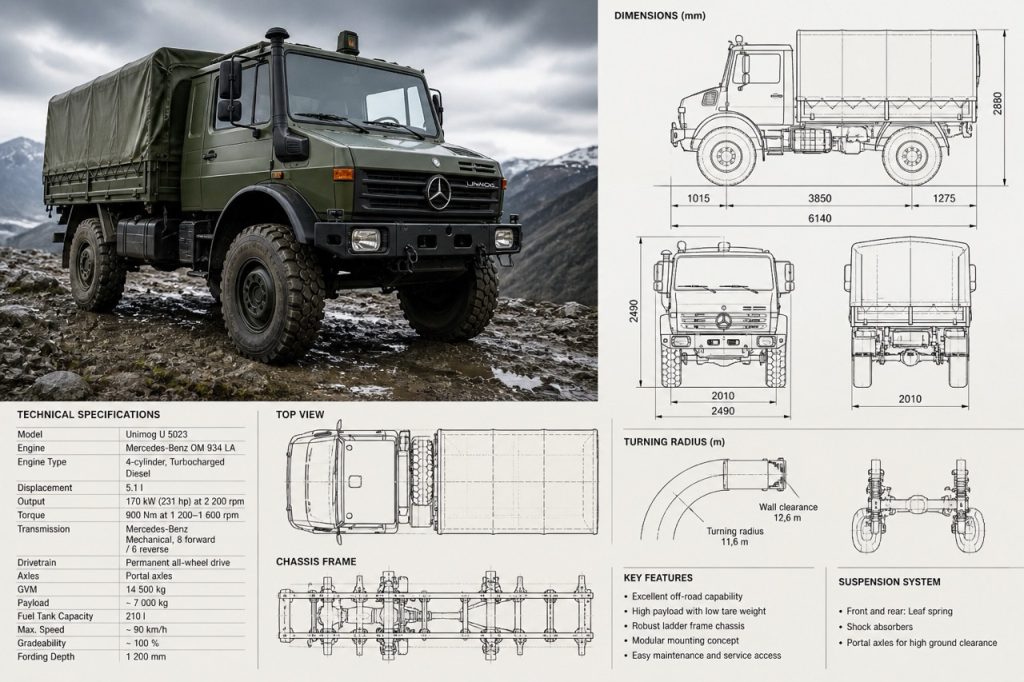
Every component discussed above shares a common thread: wear is progressive, detectable, and largely predictable when inspection data is collected consistently. Scheduled inspections built around the specific terrain, payload, and towing profile of a given unit, rather than a generic calendar interval, catch degradation while a component is still serviceable rather than after it has failed in the field. Predictive maintenance, using trend data from fluid analysis, vibration monitoring, and inspection findings across a fleet, allows a sustainment program to anticipate which vehicles are approaching a replacement threshold before symptoms become operationally significant.
Driver inspections remain one of the most underused tools available to a fleet maintenance program, since the operator is present for every operating hour and is the first to notice a new vibration, a change in brake pedal feel, or an unfamiliar smell. Formalizing driver reported observations into the maintenance record, rather than treating them as anecdotal, closes a gap that scheduled depot inspections alone cannot cover. Fleet maintenance planning that integrates driver input, terrain and towing profile data, and component specific wear patterns produces a sustainment schedule considerably more accurate than mileage alone.
None of this works without genuine quality replacement parts feeding into the maintenance cycle. A preventive maintenance program built on inconsistent or substandard components simply shifts the failure point rather than eliminating it, and the lifecycle cost calculation ends up worse, not better, because the vehicle experiences more frequent interventions rather than fewer. Reliability centered maintenance, which prioritizes attention on the components most likely to affect mission capability, depends on parts performing to specification between inspections. Done correctly, this approach measurably improves operational availability and mission readiness across the fleet rather than the individual vehicle.
Why Spare Parts Quality Matters in Military Operations
OEM quality manufacturing standards exist for a reason that becomes obvious the first time a substandard component fails in the field rather than on a test bench. Material durability, meaning correct alloy composition, heat treatment, and hardness for the application, determines whether a component survives the fatigue cycling that military use imposes or fails prematurely under loads the original design accounted for. Dimensional accuracy matters just as much: a bushing, bearing, or joint machined outside of tolerance introduces play or misalignment that accelerates wear in every adjacent component it touches, turning a single substandard part into a cascading maintenance problem.
Reliability and operational safety are inseparable in a military context, where a failed brake hose or a steering joint with excessive play does not simply cause inconvenience but creates a genuine risk to personnel and mission execution. This is precisely why defense procurement processes for spare parts place such weight on manufacturing provenance and quality documentation rather than price alone. Long term cost savings follow directly from getting this right: a component that performs to specification for its full expected service life costs less over a fleet’s operating lifetime than a cheaper part that requires earlier replacement, generates more labor hours, and risks consequential damage to adjacent systems.
Reduced downtime and improved fleet availability are the practical, measurable outcomes of a spare parts sourcing strategy built around verified quality rather than lowest unit cost. A vehicle sitting in a maintenance bay awaiting a part, or worse, awaiting a second repair because the first replacement part failed prematurely, is a vehicle unavailable for tasking. For any organization managing a Unimog fleet under operational demand, that availability metric is ultimately what spare parts quality is protecting.
Suspension components, brake system parts, the clutch assembly, steering and drivetrain hardware, and air filtration and cooling system components account for the majority of component replacements a military Unimog fleet will generate over its service life. Each wears through mechanisms that are well understood, terrain severity, payload variation, heat cycling, dust and moisture contamination, and driver technique, and each gives detectable warning signs before outright failure if inspection practices are consistent and driver observations are captured rather than dismissed.
Replacing high wear components proactively, on a schedule informed by actual operating conditions rather than a generic interval, is what converts the Unimog’s inherent design robustness into sustained fleet reliability. Pairing that preventive approach with spare parts manufactured to correct material, dimensional, and performance specifications closes the loop: the vehicle receives the maintenance attention it needs, and the components installed during that maintenance perform for their intended service life rather than becoming the next unscheduled repair. For maintenance units, procurement officers, and fleet managers responsible for keeping Unimog platforms mission ready, that combination of disciplined preventive maintenance and verified spare parts quality remains the most direct path to operational availability, vehicle reliability, and mission success.
Work With AB Defence
Partner with AB DEFENCE for Reliable Combat Support Vehicle Sustainment. AB DEFENCE is a specialist international supplier of military spare parts and fleet sustainment solutions serving NATO and allied defense organisations. With deep inventory across a wide range of combat support vehicle platforms, rigorous quality assurance processes, export compliance expertise, and a commitment to long term supply chain partnership, AB DEFENCE helps defense buyers maintain fleet availability, reduce sustainment costs, and meet their operational readiness obligations. Contact the AB DEFENCE team to discuss your spare parts requirements, strategic inventory planning, and long-term sustainment programme needs.
Contact AB Defence to discuss your procurement requirements and learn how we can support your fleet readiness objectives.
Related Military Spare Parts Categories, Vehicle Platforms & Technical Guides
Explore AB Defence’s NATO-codified (NSN) and genuine OEM spare parts catalog, platform technical specifications, and sustainment engineering guides related to this article:
Stocked Spare Parts Categories (NSN & OEM Catalog)
- Mercedes-Benz Unimog Military Spare Parts (562 stocked parts)
- Military Portal Axles, Differentials & Drive Shafts (107 stocked parts)
- Military Gearbox, Transfer Case & PTO Assemblies (108 stocked parts)
- Military Brake Calipers, Master Cylinders & Hydraulic Systems (103 stocked parts)
- Military Engine Cooling Systems, Radiators & Water Pumps (57 stocked parts)
- Full NATO NSN & OEM Spare Parts Catalog (16,760+ Parts)
Compatible Vehicle Platforms & System Hubs
- Unimog U 1300 L (1.5 Ton – 2.5 Ton)
- Unimog U 1500 L
- Unimog U 1700 L
- Unimog U 2150 L
- Unimog U 2450 L
- Request a B2B Quotation (RFQ) & Technical Support
Related Military Engineering & Sustainment Articles
- Unimog Military Spare Parts: What Every Fleet Manager Needs to Know Before Placing an Order
- Unimog Spare Parts for Military Fleets: Why AB Defence Is Your Trusted Supply Partner
- What Are the Most Common Failures in Military Unimog Vehicles?
- How Military Unimog Vehicles Perform in Desert and Off-Road Conditions