July 27, 2026
Critical Maintenance Intervals for Mercedes-Benz Unimog Tactical Vehicles
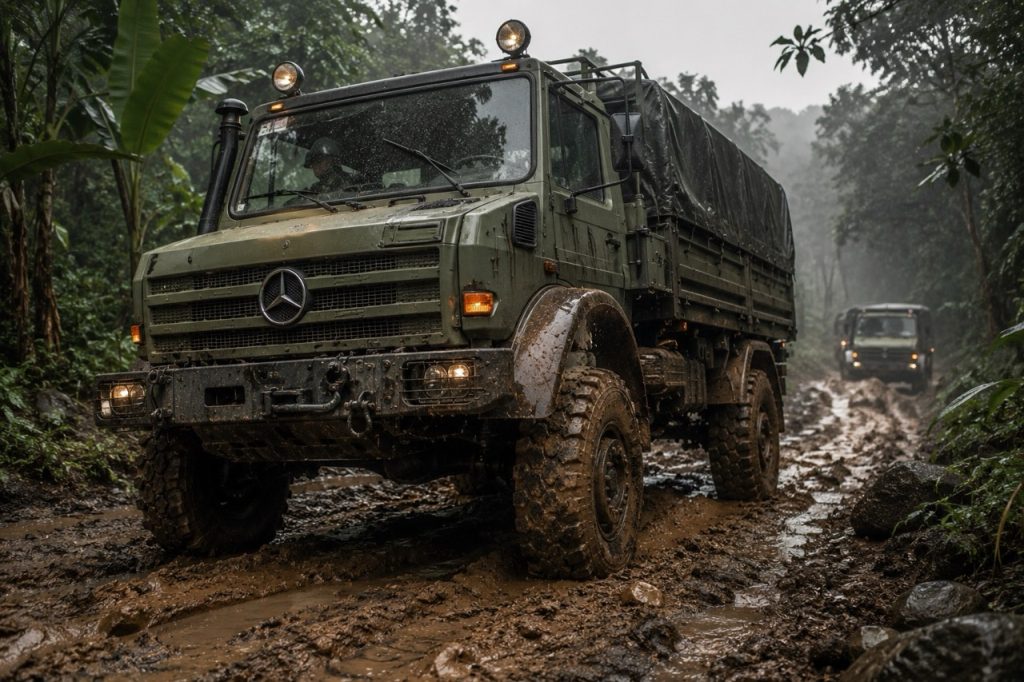
Ask any maintenance commander what separates a fleet that shows up for the mission from one that spends the war sitting in the motor pool, and the answer is rarely the vehicle itself. It is the discipline behind the maintenance calendar. Engines, axles, and transmissions are engineered to specification; the variable that actually determines whether a unit rolls out on schedule is whether the preceding service interval was respected, documented, and closed out properly.
For fleets built around the Mercedes-Benz Unimog, this distinction carries particular weight. The Unimog was never designed as a garrison vehicle. It was built as a load bearing, all terrain platform capable of carrying troops, towing equipment, and operating implements across terrain that would strand a conventional truck, and NATO and allied ground forces have relied on that capability for decades. That same versatility, however, means the vehicle absorbs stress from an unusually wide range of missions, climates, and duty cycles, which is exactly why the interval discipline behind it has to be equally rigorous.
This guide sets out the maintenance cadence that governs Unimog tactical vehicles in military and paramilitary service: daily checks, weekly and monthly tasks, periodic servicing, and the deeper, hour based work that keeps drivetrains and portal axles inside their design tolerances. It also addresses how mission profile and operating environment shift that cadence, and what fleet sustainment managers can do to keep availability high and lifecycle costs under control. Throughout, one point should stay in view: published intervals are a baseline, not a ceiling. The authoritative reference for any specific Unimog variant is always its official maintenance manual and the applicable military technical documentation, since intervals differ by model, engine variant, equipment fit, and operating mandate.
Why Maintenance Intervals Matter
Military vehicle maintenance philosophy generally rests on three complementary approaches, and a mature Unimog fleet program uses all three rather than picking one.
Preventive and Scheduled Maintenance
This is the calendar and mileage driven backbone: fixed interval inspections, fluid changes, and component replacements performed regardless of whether a fault has appeared. Its value is predictability. A maintenance commander can plan parts, labor, and vehicle downtime weeks in advance, which is exactly what fleet sustainment requires when vehicles need to be available for short-notice tasking.
Condition Based and Predictive Maintenance
Layered on top of the fixed schedule, condition based maintenance uses inspection findings, oil analysis, and component wear indicators to intervene before failure rather than strictly on a calendar. Predictive maintenance takes this further by tracking trends over time, so a slow rise in metal particulates in a gear oil sample, for instance, triggers action before a differential fails in the field rather than after.
Together, these approaches reduce lifecycle costs by catching wear early, when a bearing or seal is inexpensive to replace, rather than after it cascades into a transmission or axle rebuild. They also directly increase operational availability, since a vehicle serviced on schedule is far less likely to fail mid mission, and they extend the vehicle’s useful service life, which matters enormously for fleets expected to remain in service for two or three decades.
Daily Inspection Intervals
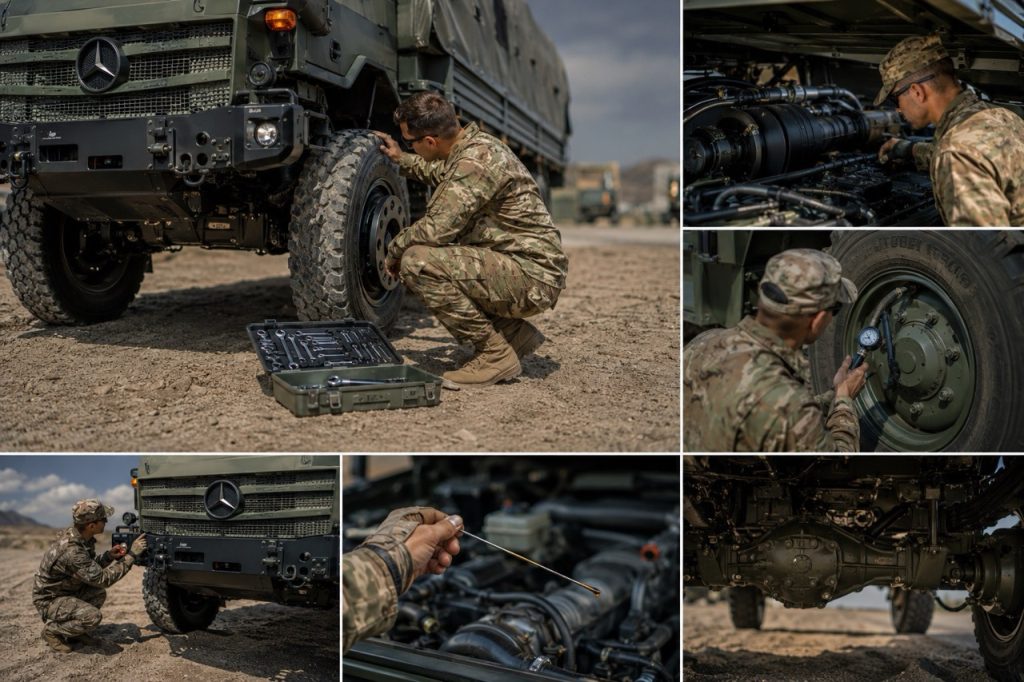
Daily checks are the first and most important layer of Unimog preventive maintenance because they are performed by the crew, not the workshop, and they catch the faults most likely to cause an in mission breakdown. Mercedes-Benz Special Trucks’ own care guidance for Unimog owners places departure control functions, correct operation of the lighting system, and tyre condition at the top of the daily list, alongside cleaning the radiator and cabin filter whenever operating conditions demand it, and rinsing off corrosive residue after any use in extreme conditions.
Military maintenance programs typically extend this baseline into a full pre mission inspection, consistent with the operator level checks used across NATO ground fleets. A thorough daily routine should cover:
- Engine oil level and visible signs of consumption or contamination
- Coolant level and condition, with attention to any discoloration suggesting a developing leak
- Brake system function, air pressure build up time, and pedal feel
- Tyre condition, tread wear, and inflation pressure, including CTIS function where fitted
- Lighting, indicators, and warning beacons
- Steering play and power assist function
- Air system integrity lines, fittings, and reservoir drain condition
- Fluid leaks under the vehicle, particularly around the portal axle hubs and transfer case
- Suspension components and visible spring or shock absorber condition
- Battery terminals, charge state, and mounting security
- Winch cable condition and recovery equipment stowage
- Cab controls, gauges, and dashboard warning indicators
None of these checks takes more than a few minutes individually, but skipped collectively they are the single largest predictor of unscheduled downtime. A crew that treats departure control as a formality is, in effect, deferring diagnosis to the point of failure usually at the worst possible moment in a mission timeline.
Weekly Maintenance Tasks
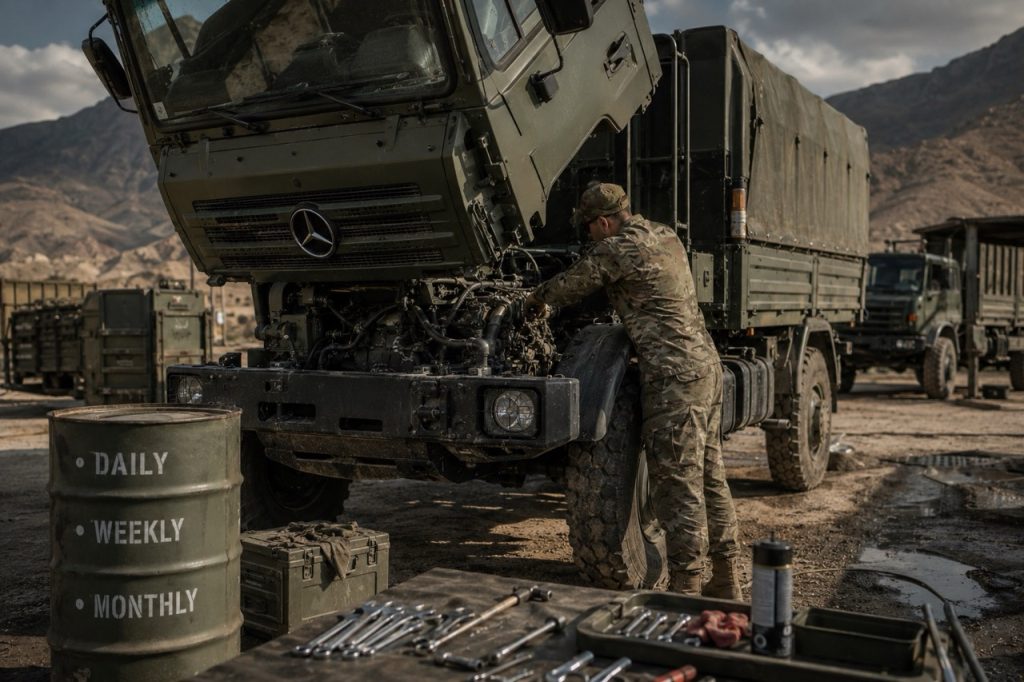
Weekly tasks build on the daily routine and are where accumulated environmental exposure starts to show. Official Unimog care guidance calls for checking the windscreen washer fluid level, inspecting wiper blades, and cleaning the radiator weekly, with additional ventilation filter housing cleaning on U 300/400/500 variants during winter operations.
For fleets operating in demanding conditions, this weekly layer is also the right point to work through lubrication points, a closer brake inspection, electrical connector checks for corrosion or loosening, chassis cleaning, recovery point condition, and a visual pass over the suspension. Dust, mud, sand, snow, and water crossings all accelerate the rate at which these items need attention a Unimog running weekly desert resupply routes will need radiator and air intake cleaning far more often than the same vehicle on paved road garrison duty, and the weekly interval should flex accordingly rather than being treated as fixed.
Monthly Maintenance
Monthly service is where the workshop, rather than the crew, typically takes the lead. Official guidance specifies a full vehicle clean especially important after winter road service exposure to salt and a check of the brake box for dust or moisture ingress on U 300 variants.
On top of this baseline, monthly inspection is the natural interval for a closer look at driveline components that don’t show obvious daily symptoms until they fail: universal joints, portal axle housings, differential lock engagement, the transfer case, gearbox linkage, the fuel system, and the air compressor. Because these components sit deeper in the drivetrain, a monthly rhythm catches developing wear a slightly notchy universal joint, a differential lock that engages sluggishly while it is still a minor repair rather than a recovery job.
Periodic and Operating Hour-Based Maintenance
Beyond the daily weekly monthly rhythm, Unimog maintenance programs include quarterly, annual, and multi year items, plus a separate layer of servicing tied to operating hours or distance rather than the calendar.
Quarterly and Annual Servicing
Official Unimog maintenance guidance calls for a quarterly check of compressed air dryer function and water ingress with a service workshop visit if water has entered the system and an annual review that includes the first-aid kit, flashing beacon function, antifreeze concentration ahead of the winter season, and, at the end of winter, applying acid protection grease to battery compartment earth points and starter connections, thoroughly cleaning the chassis and platform area with pH neutral cleaners, checking the corrosion protection treatment, and cleaning the service brake. Fire extinguisher function and condition should be verified every two years, and the vehicle’s protective agents renewed on a three year cycle.
Operating Hour and Distance Based Servicing
In addition to this calendar driven layer, deeper mechanical servicing engine oil and filter changes, fuel and hydraulic filters, gear and portal axle oil changes, transfer case and transmission service, coolant and brake fluid replacement, and air dryer cartridge replacement is governed by operating hours or distance thresholds set out in the official maintenance manual for each specific model and engine variant. These thresholds are not uniform across the Unimog range: they depend on the model (U 1300L, U 4000, U 4023, U 5000, U 5023, and others), the engine and transmission fitted, and the equipment configuration. Fleet sustainment managers should treat the official maintenance manual and the applicable military technical documentation for their specific variant as the only authoritative source for these figures, rather than relying on generic published numbers.
| Field Note • Severe duty military operation sustained off-road running, high ambient dust loads, repeated water fording, and extended idling for stationary tasking routinely justifies shortening operating hour service intervals below the manufacturer’s standard duty baseline. Where the operating manual offers a severe duty or arduous conditions schedule, fleet sustainment managers should default to it for any vehicle spending a meaningful share of its hours off-road. |
Maintenance in Harsh Military Environments
Because the Unimog’s operational value lies precisely in its ability to work where other vehicles cannot, its maintenance program has to account for environments that are punishing in very different ways.
Desert Operations
Fine dust is the dominant threat. It accelerates air filter loading, infiltrates electrical connectors, and abrades any component with relative motion CV joints, wiper mechanisms, door seals. Cooling system performance also degrades faster as radiator fins clog with fine particulate, raising the risk of engine overheating during sustained high load running. Air filter inspection frequency should increase sharply in desert tasking, and radiator cleaning already a daily or weekly item under standard Unimog guidance becomes a genuine daily necessity rather than a conditional one.
Arctic Operations
Cold weather operation shifts the maintenance burden toward starting reliability and lubricant behavior. Battery capacity drops sharply at low temperatures just as cold start current demand rises, making battery health checks and correct antifreeze concentration already flagged as a pre winter task in official Unimog guidance genuinely mission critical rather than routine. Cold weather rated lubricants and fuel treatment to prevent gelling are essential, and seals and hoses should be inspected more frequently, since cold makes rubber and elastomer components more prone to cracking.
Jungle and High Humidity Operations
Persistent moisture drives corrosion risk on any unprotected metal surface and creates ideal conditions for mold and mildew inside cab upholstery and insulation. Electrical systems are particularly vulnerable connectors that would be fine in a dry climate can develop intermittent faults from humidity ingress alone. Frequent water intrusion checks on electrical housings, more aggressive corrosion protection renewal, and drying out the cab interior whenever possible all become higher priority tasks than they would be in a temperate posture.
Mountain Operations
Sustained gradients put unusual load on the braking system and drivetrain, and descending grades in particular can push braking components toward thermal limits faster than flat terrain duty would suggest. Cooling efficiency also drops at lower engine speeds and steep, low gear climbs, and tyre wear accelerates on the abrasive, rocky surfaces typical of mountainous terrain. Brake system inspection frequency and cooling system checks both deserve tightening for units operating a substantial share of their mission profile in mountainous terrain.
Critical Components That Should Never Miss Scheduled Maintenance
Several Unimog systems are load bearing in the truest sense: their failure doesn’t just degrade performance, it can end a mission or endanger the crew. The portal axle and torque tube arrangement at the heart of the platform’s cross country mobility is a good example. By positioning the axle tube and differential above the wheel centerline, portal axles deliver the ground clearance the Unimog is known for, and on later U 4000/U 5000 generation and U 4023/U 5023 platforms this is paired with a flexible tubular frame design and torque tube suspension that allows axle articulation of up to roughly 30 degrees the mechanism behind the vehicle’s exceptional terrain following ability. None of that geometry matters if the portal hub oil isn’t changed on schedule or a differential lock is left unattended after a fault is reported.
The same logic applies across the rest of the drivetrain and safety critical systems, all of which belong on a schedule that is never allowed to slip:
- Engine oil, filtration, and cooling system integrity
- Transmission and transfer case fluid condition and shift quality
- Portal axles and differential locks hub oil, seal condition, engagement function
- Suspension coil springs, shock absorbers, and torque tube mounts
- Brake system dual circuit pneumatic system condition and air dryer function
- Steering linkage, power assist, and play tolerances
- Fuel injection system filtration and injector condition
- Electrical system battery, alternator, and connector integrity
- Air compressor and pneumatic braking circuit
- Central tyre inflation system (CTIS), where fitted a key enabler of the traction advantage Unimog variants gain when adjusting pressure on the move
- Winch systems and recovery equipment
Fording capability up to roughly 1200 mm of water on current generation off-road variants, combined with approach angles around 44 degrees, departure angles around 51 degrees, and slope climbing ability approaching 45 degrees is a genuine tactical advantage, but every one of those figures assumes the underlying seals, breathers, and driveline components are in the condition the manufacturer specified. Deferred maintenance erodes the platform’s actual capability long before it shows up as a breakdown.
The Cost of Delayed Maintenance
Deferred maintenance rarely announces itself. A missed filter change or a postponed brake inspection doesn’t cause an immediate failure it quietly narrows the margin the vehicle has left before a routine fault becomes a mission-stopping one. The consequences compound from there.
- Unexpected breakdowns during deployment, often at the least convenient point in a mission timeline
- Mission failure or delay when a vehicle cannot complete its tasking
- Reduced overall fleet readiness as more vehicles cycle through unscheduled repair
- Higher repair costs, since a failure caught late is almost always more expensive than the service that would have prevented it
- Accelerated wear on adjacent components a neglected wheel bearing, for instance, can damage the hub and axle around it
- Logistics delays while non stocked parts are sourced under time pressure
- Increased overall spare parts consumption across the fleet’s service life
- Lower fleet availability precisely when operational tempo is highest
- Elevated safety risk to crews, particularly where brake or steering systems are involved
None of this is unique to the Unimog it is true of any mechanical fleet but it is worth stating plainly because the discipline required to avoid it is entirely within a maintenance program’s control. Unlike combat losses or supply disruptions, deferred maintenance failures are the one category of readiness loss a fleet manager can largely eliminate through process alone.
Best Practices for Military Fleet Managers
Programs that sustain high Unimog availability over the long term tend to share a common set of habits, regardless of the specific mission set or operating theatre.
- Digital maintenance records a defensible, searchable service history for every hull number, not paper logs that can be lost or backdated
- Predictive maintenance technologies, including trend tracking on any telemetry the fleet’s vehicles support
- Routine oil analysis to catch developing wear before it becomes a failure
- Strict adherence to scheduled inspections, with no informal deferrals under operational pressure
- Structured driver and crew reporting procedures, so faults noticed during daily checks reach the workshop the same day
- Fleet management software that flags upcoming service intervals against hours, distance, and calendar time simultaneously
- Proactive spare parts planning tied to the fleet’s actual consumption pattern, not generic reorder points
- Ongoing technician training, particularly on portal axle, torque tube, and CTIS systems that differ meaningfully from conventional truck platforms
- Consistent use of OEM quality replacement parts to preserve the tolerances the platform was designed around
- Lifecycle planning that looks beyond the current budget cycle to the vehicle’s full service life
The common thread across all of these is that they convert maintenance from a reactive workshop function into a planned, data driven discipline which is exactly what operational readiness requires.
Spare Parts Strategy
A preventive maintenance schedule is only as reliable as the parts supply behind it. A perfectly planned quarterly air dryer check accomplishes nothing if the replacement cartridge isn’t in stock when the inspection finds one is needed. For Unimog tactical fleets, this means building a spare parts strategy around several pillars:
- Genuine and OEM equivalent components that meet the tolerances the platform was engineered around, particularly for portal axle, driveline, and braking system parts
- Reliable suppliers with a demonstrable track record in defense logistics, not just commercial automotive supply
- Inventory planning matched to the fleet’s actual duty cycle and environment, rather than a one size fits all reorder schedule
- Supply chain resilience multiple qualified sourcing paths for the parts most likely to be needed on short notice
- Fast spare parts availability for the consumable items filters, seals, brake components that drive the bulk of routine service work
This is the layer where a specialized logistics partner earns its place in the sustainment chain. AB Defence supports military fleet sustainment for Mercedes-Benz Unimog and other tactical vehicle platforms by supplying dependable spare parts and logistics support to procurement officers and maintenance commands across NATO and allied organizations helping keep the parts pipeline aligned with the maintenance calendar rather than a step behind it.
Maintenance intervals are not administrative overhead they are the mechanism by which a fleet converts engineering capability into operational readiness. Respecting daily, weekly, monthly, and periodic intervals, and layering hour based servicing on top of them according to the official maintenance manual for each variant, is what keeps Unimog tactical vehicles available when tasking arrives without warning.
Done consistently, this discipline delivers lower lifecycle costs, greater fleet reliability, stronger mission success rates, safer conditions for crews, and a longer service life from a platform that is already built to last decades. Done inconsistently, it erodes all of the above quietly, one deferred inspection at a time.
For procurement officers and maintenance commanders looking to strengthen the sustainment side of that equation genuine and OEM-equivalent spare parts, logistics support, and reliable supply for Unimog and other tactical vehicle platforms AB Defence works with defense organizations across NATO and allied nations to keep fleets mission ready. Contact AB Defence to discuss spare parts availability and fleet sustainment support for your Unimog fleet.
Work With AB Defence
Partner with AB DEFENCE for Reliable Combat Support Vehicle Sustainment. AB DEFENCE is a specialist international supplier of military spare parts and fleet sustainment solutions serving NATO and allied defense organisations. With deep inventory across a wide range of combat support vehicle platforms, rigorous quality assurance processes, export compliance expertise, and a commitment to long term supply chain partnership, AB DEFENCE helps defense buyers maintain fleet availability, reduce sustainment costs, and meet their operational readiness obligations. Contact the AB DEFENCE team to discuss your spare parts requirements, strategic inventory planning, and long-term sustainment programme needs.
Contact AB Defence to discuss your procurement requirements and learn how we can support your fleet readiness objectives.
Related Military Spare Parts Categories, Vehicle Platforms & Technical Guides
Explore AB Defence’s NATO-codified (NSN) and genuine OEM spare parts catalog, platform technical specifications, and sustainment engineering guides related to this article:
Stocked Spare Parts Categories (NSN & OEM Catalog)
- Mercedes-Benz Unimog Military Spare Parts (562 stocked parts)
- Military Portal Axles, Differentials & Drive Shafts (107 stocked parts)
- Military Gearbox, Transfer Case & PTO Assemblies (108 stocked parts)
- Military Brake Calipers, Master Cylinders & Hydraulic Systems (103 stocked parts)
- Military Engine Cooling Systems, Radiators & Water Pumps (57 stocked parts)
- Full NATO NSN & OEM Spare Parts Catalog (16,760+ Parts)
Compatible Vehicle Platforms & System Hubs
- Unimog U 1300 L (1.5 Ton – 2.5 Ton)
- Unimog U 1500 L
- Unimog U 1700 L
- Unimog U 2150 L
- Unimog U 2450 L
- Request a B2B Quotation (RFQ) & Technical Support
Related Military Engineering & Sustainment Articles
- Unimog Military Spare Parts: What Every Fleet Manager Needs to Know Before Placing an Order
- Unimog Spare Parts for Military Fleets: Why AB Defence Is Your Trusted Supply Partner
- 5 Unimog Components Most Commonly Replaced in Military Operations
- What Are the Most Common Failures in Military Unimog Vehicles?