September 3, 2026
The Most Failure Prone Components in Oshkosh Tactical Vehicles
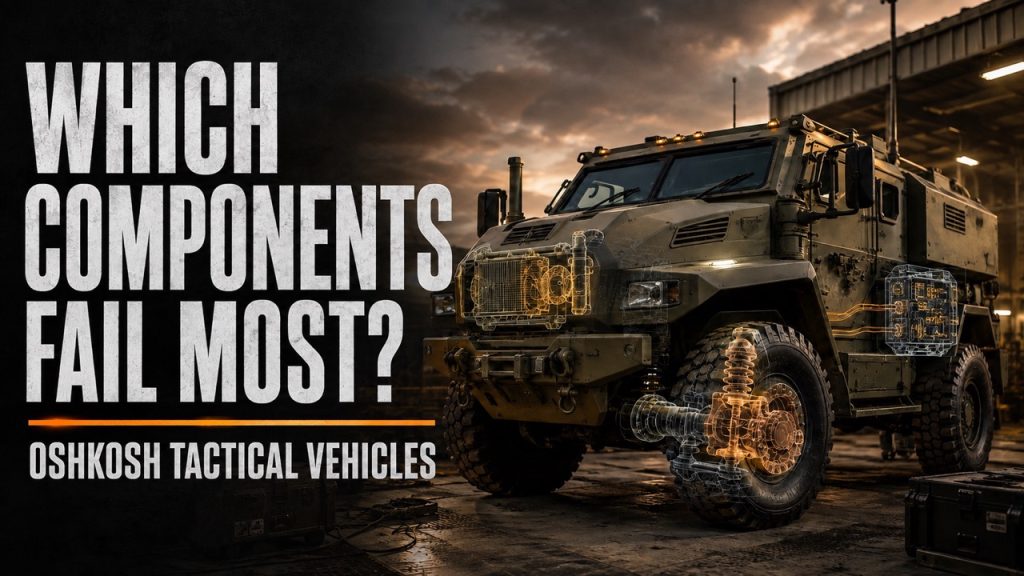
A Sustainment-Focused Review of Documented Reliability, Maintenance, and Parts-Availability Findings Across the JLTV, M-ATV, HEMTT, and MTVR Families
Oshkosh Defense builds several of the tactical wheeled vehicle families that carry the weight of U.S. and allied ground logistics, combat support, and light tactical missions: the Joint Light Tactical Vehicle (JLTV), the MRAP All-Terrain Vehicle (M-ATV), the Heavy Expanded Mobility Tactical Truck (HEMTT), the Palletized Load System (PLS), and the Medium Tactical Vehicle Replacement (MTVR). Fleet sustainment managers and spare parts planners who support these platforms ask a version of the same question every week: which components fail most often, and which ones simply demand closer, more frequent attention?
No single public dataset ranks component failure rates across every Oshkosh vehicle family on a common scale. The Department of Defense collects reliability and sustainment data program by program, using different test regimes, different metrics, including mission capable rates, mean miles between operational mission failure, and causes of not mission capable status, as well as different reporting periods. What does exist is a body of official operational test reports, government sustainment audits, and Army preventive maintenance bulletins that document specific, verifiable problems on specific vehicle families. This article works from that public evidence rather than from a single cross fleet ranking of most failure prone components in Oshkosh tactical vehicles, and it says so wherever the record does not support a direct comparison between vehicle types.
What “Failure-Prone” Means in a Tactical Vehicle Context
Not every component that shows up often in maintenance logs has failed in the strict sense, and not every documented reliability issue means a part breaks on every vehicle. This distinction matters for anyone planning spare parts inventory or writing a sustainment budget, so it is worth stating clearly before going further.
A common maintenance concern is a component that requires frequent inspection, adjustment, or servicing as part of normal preventive maintenance, not necessarily because it fails, but because its design calls for regular attention. A documented reliability issue is a problem identified in an official test report, audit, or technical bulletin, tied to a specific vehicle, variant, or operating condition. A high wear component is one that engineering literature and operational experience associate with accelerated wear under harsh duty conditions, even without a formal failure rate study. A confirmed failure mode is a specific, named way a part fails, documented well enough that maintainers can recognize and diagnose it.
This article uses those four categories deliberately, and it discusses a component only where at least one of them is backed by a citable public source: an official test or reliability report, a repeated maintenance requirement documented in Army technical guidance, a safety notice or technical bulletin, a Government Accountability Office (GAO) finding, or engineering literature describing wear mechanisms under military duty cycles. Where the evidence points to sourcing or supply chain difficulty rather than an in service breakdown, this article says so rather than blurring the two.

Documented Component Findings by Vehicle Family
Central Tire Inflation System and Tire/Wheel End Components: JLTV
The clearest documented tire and wheel related reliability finding on an Oshkosh platform concerns the JLTV. The Fiscal Year 2018 Annual Report from the Director, Operational Test and Evaluation (DOT&E), drawing on the Army and Marine Corps Multi Service Operational Test and Evaluation (MOT&E) conducted in early 2018, found that JLTVs demonstrated less reliability than required and identified flat and damaged tires as one of three primary drivers of operational mission failure, alongside engine wiring problems and brake system faults. The finding was reported at the time by multiple defense outlets covering the same DOT&E report.
The JLTV, like other Oshkosh tactical vehicles, uses a central tire inflation system (CTIS), which lets the driver adjust tire pressure from inside the cab to match the terrain, using lower pressure for sand or mud and higher pressure for hard surface roads, without leaving the vehicle. A CTIS depends on a chain of components that each represent a potential point of failure: wheel end valves at every tire, air hoses routed through the axles and frame, O ring seals, and a control unit that manages inflation and deflation. Because the hoses and wheel valves are exposed to dirt, mud, and debris on unimproved terrain, they require routine inspection as part of normal preventive maintenance, and a damaged hose, cracked valve, or clogged line can produce a flat or under-inflated tire independent of combat damage.
This finding applies specifically to the JLTV as tested in the 2018 MOT&E. It does not establish that CTIS or tire related problems affect the M-ATV, HEMTT, PLS, or MTVR at a comparable rate; those platforms were not part of the same test program, and no comparable public reliability study of their tire systems was identified for this article.

Braking System Components: HEMTT and JLTV
The same 2018 DOT&E finding cited brake system faults as one of the JLTV’s three primary drivers of operational mission failure. A separate, more specific brake system problem is documented for the HEMTT family. In a September 2022 technical note published by the Army Sustainment Command’s PS Magazine, the Army’s official preventive maintenance bulletin, a field maintainer reported that HEMTT parking brakes were failing to hold, releasing on their own once the vehicle’s air system reached roughly 90 psi. The root cause traced to a clogged exhaust port at the end of the parking brake valve exhaust hose, located under the vehicle between the third and fourth axles, where dirt and debris routinely accumulate because the port sits close to the ground and out of the operator’s direct line of sight.
The article noted that the problem was difficult to diagnose without knowing where to look, that it could consume four to eight hours of unnecessary troubleshooting per incident, and that it was not covered in the HEMTT technical manual at the time of publication. The fix itself is simple: routinely clearing the port of debris. Even so, the underlying pattern illustrates a recurring theme across Oshkosh’s heavier platforms: components mounted low on the chassis, close to the axles and exposed to the ground, accumulate dirt and moisture faster than components mounted higher on the vehicle, and that exposure can produce brake related mission capability problems that are easy to miss during a routine walk-around.
An inoperative parking brake is also a safety concern beyond mission readiness, since an unsecured vehicle can move on its own on a grade. Maintainers should treat any parking brake that fails to hold, or that releases as air pressure builds, as an immediate safety and mission-readiness issue, and should follow the applicable technical manual’s parking brake troubleshooting procedure rather than relying on this article alone.

Driveline, Axles, Differentials and Steering Gear: HEMTT
A September 2025 GAO report on ground vehicle sustainment, based on interviews with Army program and depot officials and a review of Army maintenance data through fiscal year 2024, found that the HEMTT fleet faces sustainment challenges tied to diminishing manufacturing sources for several driveline related parts, specifically steering gear, axles, and differentials, as well as transparent armor. This finding describes a parts availability and sourcing problem, not a documented in service failure rate: GAO’s review measured not mission capable status and its causes, and found that a lack of parts and materiel, rather than in service breakdowns as such, was the leading cause of non mission capable status for the HEMTT and for most of the other 17 ground vehicles GAO reviewed.
The same report found that HEMTT’s mission capable rate experienced the largest decrease among the Army support vehicles GAO reviewed between fiscal years 2015 and 2024, and that Army officials attributed part of the decline to an aging fleet and to delays obtaining parts and materiel, including for driveline components. For fleet and spare parts planners, the practical implication is less about any single part failing frequently in the field and more about lead times: when a HEMTT needs a steering gear, axle component, or differential part, sourcing it can take longer than it once did, and that lag itself contributes to vehicles sitting non mission capable.
Electrical Systems, Wiring and Connectors: JLTV
Engine wiring problems were the first of the three primary drivers of JLTV operational mission failure identified in DOT&E’s FY2018 MOT&E findings, alongside tire damage and brake faults. Separately, in describing the JLTV A2 program that succeeded the original Oshkosh-built JLTV in Army production, the vehicle’s program has stated that the redesigned vehicle incorporates enhanced corrosion protection for key automotive and electrical systems specifically to address corrosion problems identified in earlier JLTV vehicles, which had been linked to cracking and breakage in structural and electrical areas.
This is worth putting in context for readers whose spare-parts and sustainment planning centers on the currently fielded fleet. The Army awarded the JLTV A2 follow-on production contract to AM General in February 2023, ending Oshkosh Defense’s role as JLTV manufacturer, and the Army subsequently halted new JLTV procurement in 2025 as part of a broader force structure realignment. More than 22,000 Oshkosh built JLTVs, informally referred to as the A1 configuration, have been delivered. This fleet remains in service with the Army, the Marine Corps, and multiple foreign military sales customers, and will require sustainment support for years regardless of new production decisions. The corrosion and wiring findings described above pertain to that fielded, Oshkosh built fleet.
Transparent Armor, Cab and Door Hardware: HEMTT, JLTV and MTVR
GAO’s September 2025 sustainment review identified transparent armor, the ballistic resistant window material used in armored cabs, as a documented parts and materiel sustainment challenge affecting multiple Army and Marine Corps ground vehicles simultaneously, including the JLTV, HEMTT, HMMWV, and MRAP on the Army side, and the JLTV, MTVR, and Logistics Vehicle System Replacement (LVSR) on the Marine Corps side. Marine Corps officials told GAO that some MTVR trucks had been rated not mission capable for more than 18 months specifically because transparent armor could not be obtained.
As with the driveline findings above, this is a documented sourcing and lead time challenge rather than evidence that transparent armor panels themselves fail at a high rate in service. Multiple vehicle programs compete for the same limited transparent armor manufacturing capacity, and GAO’s report noted that competition between fleets for finite production capacity recurs across several Army and Marine Corps parts categories, not just transparent armor. For maintenance planners, the practical takeaway is that cab and door hardware requiring transparent armor replacement should be flagged early, since lead times can be long enough to keep a vehicle out of service well after a straightforward repair has been identified.

Environmental and Operational Factors That Accelerate Wear
suspension systems
High tempo, near continuous deployment cycles also reduce the windows available for scheduled preventive maintenance and depot level overhaul. GAO’s 2025 review found that Army depot overhauls across the reviewed ground vehicle fleets fell sharply between fiscal years 2015 and 2024, which Army officials linked to declining mission capable rates across most of the fleets reviewed, including the HEMTT and JLTV. Extreme heat and humidity accelerate corrosion in electrical harnesses and connectors, consistent with the corrosion protection improvements later incorporated into the JLTV program’s redesigned vehicles.
Preventive Maintenance and Parts Sourcing Considerations
None of the preventive approaches described in this article are a substitute for the applicable technical manual, and none should be treated as authorization to depart from the procedures a unit’s maintenance program requires. Scheduled preventive maintenance checks and services (PMCS), including OEM certified periodic maintenance kits available across the HEMTT, JLTV, MTVR, PLS, LVSR, and M-ATV platforms, remain the baseline for identifying wear before it produces a mission failure. With that said, several general practices are consistent with the documented findings above: routine, unhurried inspection of low mounted components, including CTIS hoses and valves, brake valve exhaust ports, and axle seals, during scheduled services rather than only when a fault appears; prompt reporting of any parking brake that fails to hold fully, given the safety implications; and early identification of parts likely to face long lead times, particularly transparent armor and driveline components on affected platforms, so replacement orders can be placed before a vehicle’s non mission capable status becomes prolonged.
Working with a supplier that can verify part authenticity and maintain consistent stock across these categories, including tire and CTIS components, brake system parts, driveline and steering gear, and transparent armor, can help fleet managers reduce the exposure created by the sourcing lead times GAO documented across multiple Oshkosh platforms.
Conclusion
The public record does not support a single ranked list of the most failure prone components in Oshkosh tactical vehicles across every family, and this article has been written to avoid implying one exists where the evidence does not. What the record does support is a set of specific, documented findings: DOT&E’s 2018 operational testing identified engine wiring, tire damage, and brake faults as the leading drivers of JLTV mission failure; Army maintenance guidance documents a specific, previously undocumented HEMTT parking brake failure mode tied to a clogged exhaust port; and GAO’s 2025 sustainment review documents parts availability challenges affecting HEMTT driveline components and transparent armor across the JLTV, HEMTT, MTVR, and other platforms. Each finding is tied to a specific vehicle, a specific evidence type, and a specific point in time, and fleet planners should treat them accordingly rather than generalizing from one platform to another.
AB Defence supplies spare parts and logistics support for Oshkosh and other tactical vehicle platforms to procurement officers, fleet sustainment managers, and maintenance engineers. Readers evaluating parts availability for the components discussed above are welcome to contact AB Defence to discuss current stock and sourcing lead times.
Related Military Spare Parts Categories, Vehicle Platforms & Technical Guides
Explore AB Defence’s NATO-codified (NSN) and genuine OEM spare parts catalog, platform technical specifications, and sustainment engineering guides related to this article:
Stocked Spare Parts Categories (NSN & OEM Catalog)
- Military Portal Axles, Differentials & Drive Shafts (107 stocked parts)
- Military Brake Calipers, Master Cylinders & Hydraulic Systems (103 stocked parts)
- Military Pneumatic Air Fittings, Brake Valves & Compressors (115 stocked parts)
- Military Vehicle Engines & Complete Power Assemblies (154 stocked parts)
- Electrical, Electronic & Vision Systems for Military Vehicles (250 stocked parts)
- Full NATO NSN & OEM Spare Parts Catalog (16,760+ Parts)
Compatible Vehicle Platforms & System Hubs
- OSHKOSH M984 A2
- Tactical Wheeled Vehicles
- Brake & Suspension Systems
- Engine & Powertrain Systems
- Hydraulics & Mechanical Components
- Request a B2B Quotation (RFQ) & Technical Support
Related Military Engineering & Sustainment Articles
- Oshkosh Defense Platforms: A Technical Guide to the HEMTT, FMTV, M-ATV and JLTV Fleet and What Keeps Them Running
- How Oshkosh Military Trucks Maintain Mobility in Extreme Terrain Conditions
- The 10 Most Widely Used Military Vehicles in the U.S. Armed Forces
- 7 Maintenance Critical Parts in Tactical Wheeled Vehicles