June 22, 2026
7 Maintenance Critical Parts in Tactical Wheeled Vehicles
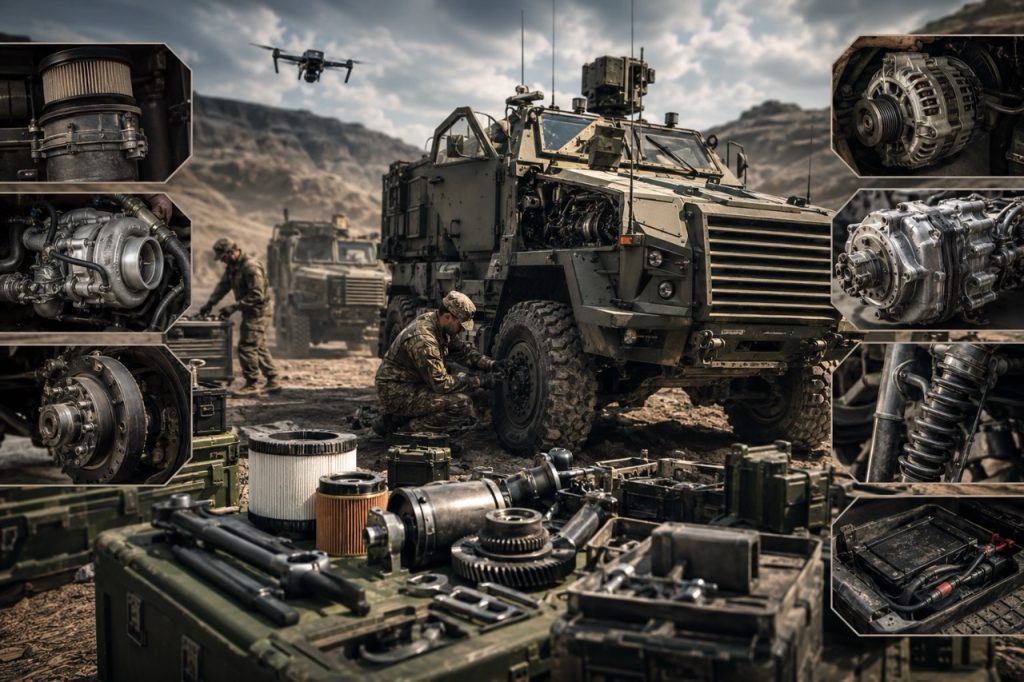
Why Maintenance Critical Components Matter in Tactical Wheeled Vehicles
Tactical wheeled vehicles operate under conditions that would dismantle most commercial fleet equipment within weeks. Whether crossing rocky desert plateaus in extreme heat, navigating waterlogged terrain under load, or sustaining multi thousand kilometre logistic convoys through alternating freezing and blistering climates, these platforms are expected to perform without failure and the cost of getting that wrong is not measured in downtime hours but in mission outcomes and lives.
Military vehicle maintenance is not simply a matter of keeping machines running. It is a structured discipline within defence logistics that determines whether a formation can manoeuvre, whether a supply chain stays open, and whether combat support assets are where they are needed when they are needed. Fleet readiness management in a defence context requires that every maintenance critical component be monitored, serviced, and replaced on a schedule dictated by technical data, not by convenience.
This article examines seven of the most maintenance critical component families found in tactical wheeled military vehicles from tactical trucks and armoured wheeled vehicles to MRAP platforms and logistics support vehicles. For each system, we explore why it fails, what warning signs appear before catastrophic breakdown, what the consequences of deferred maintenance look like in operational terms, and what best practices experienced maintenance teams apply in the field. Throughout, the thread connecting each component category is the same: reliable spare parts procurement and proactive replacement protocols are not optional they are strategic.
1. Suspension Components
Operational Role and Why They Are Critical
Suspension systems
The importance of military suspension systems becomes clearest during high payload operations and long distance deployments. When a logistics support vehicle carries a full cargo load across a rutted track at convoy pace, the suspension components absorb thousands of micro impacts per kilometre. Control arms manage wheel geometry under that load; bushings dampen vibration between rigid members; shock absorbers regulate oscillation speed so that rebound forces do not themselves become vehicle destabilising events.
hydraulic systems
Typical Causes of Failure and Environmental Factors
Off road terrain is the primary accelerant of suspension wear. Sand and grit infiltrate rubber bushings, accelerating wear at the contact surface. In desert environments, UV radiation embrittles rubber components far faster than temperate conditions, while extreme temperature differentials cold nights followed by midday heat above 50°C cause cyclic expansion and contraction that fatigues metal components and degrades bushing elasticity. In muddy or waterlogged terrain, leaf spring assemblies accumulate debris between leaves, promoting corrosion and reducing pack flexibility.
Overloading common during expeditionary operations where vehicles carry above their nominal payload compresses springs beyond their rated deflection range, inducing permanent set and reducing ground clearance. Once a spring has taken a set, it cannot be restored; replacement is the only corrective measure.
Warning Signs and Maintenance Intervals
Maintenance teams should monitor for visible cracking or separation in leaf spring leaves, uneven ride height across axles, clunking or creaking noises on articulation, excessive body roll during cornering, and steering pull that indicates geometry deviation caused by worn control arms or collapsed bushings. Shock absorbers that are leaking hydraulic fluid or that allow more than two full oscillations before damping represent a direct safety risk and must be replaced immediately.
For most tactical wheeled vehicle platforms, suspension inspection should occur every 5,000 to 8,000 kilometres under normal operational conditions, and every 2,000 to 3,000 kilometres in high-intensity off road or desert deployments. Shock absorbers typically have a service life of 80,000 to 120,000 kilometres but should be inspected at every scheduled service given the severity of operational use.
Consequences of Deferred Replacement
Neglecting suspension maintenance creates compounding failure cascades. A worn bushing increases play in a control arm, which alters wheel camber and accelerates tyre wear; a degraded shock absorber increases dynamic load transfer, overworking spring packs; a cracked leaf spring that fails in the field renders a vehicle immobile. In a convoy context, a single vehicle breakdown can halt an entire formation, exposing all assets in the column to extended dwell time in potentially hostile terrain.
2. Steering System Components
Operational Role and Why They Are Critical
The steering system is among the most safety critical assemblies in any wheeled vehicle, and in military vehicle maintenance operations it demands a level of scrutiny that reflects that criticality directly. Tie rods, drag links, steering gear assemblies, and ball joints form the mechanical chain that translates driver input into directional response. On a tactical truck operating at speed on an unpaved route, a failure anywhere in this chain is a loss of control event with immediate safety consequences.
Armoured wheeled vehicles place particular strain on steering components due to their weight. A fully loaded 8×8 armoured platform can apply several tonnes of force to the front axle steering knuckles during hard cornering or obstacle negotiation. Ball joints and tie rod ends are the most exposed points in this load path, and their wear rate under operational conditions is substantially higher than manufacturer estimates based on commercial use cycles.
Typical Causes of Failure and Environmental Factors
Dust and abrasive particulate are the primary enemies of steering component longevity in arid environments. Tie rod end boots, which seal the ball joint from contamination, degrade under UV and heat exposure; once a boot tears, grit infiltrates the joint and abrasion begins immediately. In cold weather operations, lubricant in ball joints and steering gear assemblies loses viscosity, increasing friction and wear rates during initial operation before the system reaches operating temperature.
Shock loading during obstacle crossing particularly when a front wheel drops into a rut or impacts a raised obstruction transmits impact force directly through the steering linkage. Tie rods can bend or develop pre fracture fatigue damage from single high energy events that show no immediate visible sign but create a latent failure risk.
Warning Signs and Maintenance Intervals
Maintenance teams should look for excessive play in the steering wheel before directional response, vibration through the steering column, audible clunking from the front axle area during slow speed manoeuvring, or uneven tyre wear patterns indicating toe misalignment from a bent tie rod. Any perceptible vertical or lateral play in a ball joint under manual test is cause for immediate replacement not next service interval, immediately.
Steering system components should be inspected at every scheduled maintenance interval, which for high intensity tactical use environments should not exceed 5,000 kilometres. Steering gear assemblies require periodic backlash adjustment and lubricant replenishment per the vehicle’s TM.
3. Brake System Components
Operational Role and Why They Are Critical
Brake systems in tactical wheeled vehicles operate under demands that civilian engineers rarely model. The combination of heavy gross vehicle weights, frequent stop and go movement in convoy operations, steep gradient operations in mountainous terrain, and the need to maintain vehicle control during emergency manoeuvres places the braking system under thermal and mechanical stress that rapidly depletes component service life.
Typical Causes of Failure and Environmental Factors
Brake fade is one of the most operationally dangerous conditions in military vehicle maintenance and one of the most preventable. It occurs when prolonged braking, especially on long downhill gradients, heats the brake disc and pad beyond the thermal threshold at which the pad friction material remains effective. Vehicles carrying maximum payload amplify this risk substantially. Military brake systems use higher specification friction materials than commercial equivalents, but they are not immune to fade if thermal management is ignored.
In sandy and dusty environments, abrasive particulate accelerates disc surface wear and can contaminate hydraulic system connections. Water ingress during river crossing or heavy rain operations can cause temporary brake effectiveness reduction and, in brake drum configurations, can promote corrosion. Hydraulic brake fluid absorbs moisture over time, lowering the boiling point of the fluid and increasing the risk of vapour lock under sustained braking loads.
Warning Signs and Maintenance Intervals
Warning signs include increased brake pedal travel, pedal pulsation or vibration during application, a pulling sensation indicating uneven caliper application, visible pad wear beyond the minimum thickness specification, scoring or heat discolouration on disc surfaces, and any sign of hydraulic fluid leakage at caliper connections or along brake lines. Military maintenance best practices require that brake fluid be tested for moisture content and replaced at intervals specified in the platform’s TM, regardless of apparent condition.
Brake pads in high intensity tactical use should be inspected every 5,000 kilometres and replaced when pad thickness reaches 3mm or the platform manufacturer’s specified minimum, whichever is more conservative. Brake discs should be measured for thickness and lateral runout at the same interval and replaced when either measurement approaches the rejection limit.
4. Driveline and Power Transmission Components
Operational Role and Why They Are Critical
The driveline is the mechanical bridge between engine power and ground traction. In tactical wheeled vehicles, this typically means a complex arrangement of drive shafts, universal joints, transfer case components, differentials, and axle assemblies all of which must function in concert to deliver power to each driven wheel across variable terrain gradients, traction conditions, and load states. Military driveline components carry the additional complexity of multi-range transfer cases and differential locks, which enable off-road performance but introduce additional component load paths and wear points.
Universal joints are the highest wear item in the driveline for most platforms. They operate at angular deflections that increase dramatically during full suspension articulation, and at the rotational speeds of a tactical truck at road march pace, they cycle millions of times per operational day. A universal joint that fails at speed produces a catastrophic loss of driveline integrity the shaft can drop, causing immediate and severe vehicle damage, or the imbalance can destroy adjacent components in milliseconds.
Typical Causes of Failure and Environmental Factors
Universal joint needle bearing wear is accelerated by contamination, inadequate lubrication, and sustained operation at high deflection angles all three of which are routine in tactical vehicle operations. Drive shaft balance can be disrupted by accumulated mud or physical impact damage, introducing vibration that accelerates bearing wear throughout the driveline. Transfer case components and differential gears are vulnerable to lubricant degradation; gear oil in operational vehicles becomes contaminated with metallic particles from normal wear, and if not changed at the correct interval, those particles become an abrasive that compounds wear geometrically.
Warning Signs and Maintenance Intervals
Vibration felt through the drivetrain at specific speed ranges, clunking on engagement or disengagement of drive, abnormal noise from differentials particularly during turning, and fluid leakage at axle seals or differential covers are the primary indicators of impending driveline component failure. Universal joints should be lubricated at every scheduled service or at a maximum of 5,000 kilometre intervals, and visually inspected for rust, bearing play, and seal condition. Drive shafts should be inspected for balance, straightness, and end yoke condition. Differential and transfer case oil should be sampled and analysed at major service intervals to detect abnormal metallic particle contamination before it produces bearing or gear failure.
Consequences of Deferred Replacement
A failed universal joint at speed is not merely a breakdown; it is a vehicle disabling event with safety implications for the crew and adjacent vehicles in a convoy. Military fleet readiness depends on driveline integrity being maintained across the fleet, not just in the vehicles selected for next departure. Deferred axle seal replacement leads to lubricant loss, which in turn leads to differential bearing failure a component whose replacement cost is orders of magnitude greater than the seal itself.
5. Engine Cooling System Components
Operational Role and Why They Are Critical
The engine cooling system in a tactical wheeled vehicle is responsible for maintaining the powertrain within its operational temperature envelope under conditions that consistently challenge that envelope’s upper boundary. Radiators, water pumps, cooling fans, hoses, and thermostats collectively manage the thermal balance of an engine that may be producing significant power output for extended periods in ambient temperatures exceeding 45°C while moving through terrain that limits airflow across the cooling surfaces.
Engine overheating in an operational context is rarely survivable for the powertrain. A cooling system failure during a desert convoy can result in engine seizure within minutes, destroying an asset that may take weeks to replace. Military cooling systems are engineered to higher specifications than commercial equivalents, but that engineering does not remove the requirement for meticulous maintenance.
Typical Causes of Failure and Environmental Factors
Hose degradation is the most common cause of coolant loss in the field. Hoses exposed to engine heat on their interior and ambient heat on their exterior develop internal cracking that is not visible during a cursory inspection but allows coolant to escape under system pressure. Silicone hoses, used in higher specification military platforms, resist heat degradation more effectively than EPDM equivalents but must still be inspected for swelling, cracking at connection points, and softening.
Water pump impeller failure, often caused by cavitation in systems where coolant concentration has drifted from specification, removes the primary circulation driver from the system. Radiators accumulate external debris in dusty and sandy environments; core blockage reduces cooling efficiency and can produce localised hot spots. In cold weather operations, incorrect antifreeze concentration can cause freezing in the radiator or block passages, with catastrophic results.
Warning Signs and Maintenance Intervals
Rising coolant temperature gauge readings that were previously stable, visible coolant loss without an apparent external leak, white exhaust smoke indicating coolant entering the combustion chamber, coolant that appears discoloured, foamy, or that has an oil sheen indicating cross contamination, or a cooling fan that is audibly labouring abnormally are all indicators that require immediate investigation. Coolant condition should be tested with a refractometer at every service interval to verify both antifreeze concentration and inhibitor condition. Hoses should be physically squeezed and inspected at every service they should feel firm but not hard, and show no cracking, swelling, or weeping at clamp interfaces. Thermostat function should be verified annually or at major service intervals.
6. Electrical and Power Distribution Components
Operational Role and Why They Are Critical
Modern tactical wheeled vehicles are substantially more electrically complex than their predecessors. Wiring harnesses, connectors, alternators, batteries, and control modules now govern not only basic vehicle functions such as starting and lighting, but also communications systems, electronic warfare equipment, central tyre inflation systems (CTIS), vehicle health monitoring systems, and in many cases fire suppression and crew protection electronics. This proliferation of electrical load on military platforms has made electrical and power distribution components among the most maintenance critical systems in the fleet.
Military electrical systems are designed to MIL SPEC standards for vibration resistance, temperature tolerance, and connector sealing, but the operational environment consistently challenges those specifications at their limits. A wiring harness that fails in the field does not simply disable a convenience feature it can disable communications, render vehicle health monitoring inoperative, or prevent the vehicle from starting entirely.
Typical Causes of Failure and Environmental Factors
Vibration is the primary cause of wiring harness failure in tactical vehicles. At the points where harnesses are clamped or routed through grommets, chafing and fatigue cracking develop over time, eventually producing intermittent or permanent open circuits. Connector corrosion, particularly in vehicles operating in high humidity, coastal, or wet terrain environments, degrades contact resistance and produces unreliable signal transmission. In cold climates, insulation becomes brittle and can crack during articulation or when technicians handle it below its minimum handling temperature.
Battery performance in extreme temperatures is a persistent challenge in military maintenance operations. Lead acid batteries lose substantial capacity below 0°C and can be permanently damaged by deep discharge, which is common in vehicles that sit unused for extended periods with parasitic loads from electronic systems. Alternator failure, often preceded by abnormal bearing noise or voltage output that drifts from specification, can go undetected until a vehicle fails to restart after an operational period during which the alternator was providing insufficient charge.
Warning Signs and Maintenance Intervals
Intermittent electrical faults, unexpected system resets, warning lights that appear and disappear without apparent cause, battery voltage that reads low after a normal overnight rest period, alternator output that falls outside the specification range during a voltage check, or corrosion visible at connector interfaces are all signs requiring systematic electrical investigation. Military vehicle electrical systems should be inspected for harness integrity, connector condition, and battery state of health at every scheduled service. Batteries in cold weather environments should be load tested before the onset of winter conditions, and replaced prophylactically if capacity has declined to below 80% of rated capacity.
7. Wheel End Components
Operational Role and Why They Are Critical
Wheel-end components wheel hubs, bearings, seals, and lug assemblies are the final interface between the vehicle’s mechanical systems and the terrain. They bear the full weight of the platform, absorb lateral and longitudinal forces from braking and cornering, and must maintain their integrity across the entire operational life of the vehicle between service intervals. In military convoy operations, where vehicles may cover hundreds of kilometres without stopping, wheel end condition is one of the most consequential maintenance variables.
Hub bearing failure is among the most dangerous mechanical failures a wheeled military vehicle can experience while mobile. A bearing that collapses while a vehicle is at speed on a road march produces immediate loss of directional control and can cause the wheel assembly to separate. Unlike many other component failures that provide advance warning, hub bearing failure under sustained load can progress from initial symptoms to catastrophic collapse over a very short period.
Typical Causes of Failure and Environmental Factors
Seal failure is the primary precursor to wheel bearing failure. The hub seal prevents lubricant from escaping the bearing cavity and prevents external contaminants water, mud, sand, and abrasive grit from entering it. In vehicles operating in stream crossings, deep mud, or fine desert sand, seal integrity is challenged continuously. A compromised seal allows bearing lubricant to be washed out and contamination to enter; without adequate lubrication, bearing temperatures rise, surface fatigue accelerates, and failure follows.
Lug assembly integrity the wheel studs and nuts that secure the wheel to the hub is a separately critical concern. In vehicles that experience high vibration loads, particularly on rough terrain at sustained speed, lug nuts can loosen if not torqued correctly or if thread condition has degraded. Wheel separation events trace almost universally to lug nut loosening or stud failure resulting from inadequate maintenance of the lug assembly.
Warning Signs and Maintenance Intervals
Rumbling or growling noise from the wheel area that changes in character or volume during cornering, heat perceptible at the hub face after moderate operation, lateral or axial play detectable at the wheel rim when the vehicle is lifted, or visible lubricant leakage or contamination streaking around the hub seal are all indicators requiring immediate investigation. Wheel hub bearings should be inspected, repacked or replaced according to the platform TM typically at major service intervals or at a defined mileage that reflects the severity of operating conditions. Lug nut torque must be verified at every pre mission inspection and rechecked after the first 50 to 100 kilometres following any wheel removal.
How Preventive Maintenance Improves Military Fleet Readiness
The relationship between preventive maintenance and fleet readiness management is not theoretical it is empirical and well documented across every major defence organisation that has operated tactical wheeled vehicle fleets at scale. A vehicle that receives consistent, scheduled maintenance according to its technical manual degrades at a predictable, manageable rate. A vehicle that receives reactive maintenance serviced only when something breaks operates at an elevated failure risk continuously, consumes more spare parts over its lifecycle because deferred wear cascades into adjacent system damage, and imposes unpredictable availability losses at the worst possible operational moments.
Military maintenance best practices establish a hierarchy of maintenance activity that spans operator level daily checks through to depot level overhaul. At the operator level, daily inspection of fluid levels, tyre pressures, lug nut condition, visible leaks, and basic electrical function catches the early indicators of emerging failures before they become mission stopping events. At the unit level, scheduled mileage based or calendar based service events provide the opportunity for systematic inspection of wear components across all seven critical categories addressed in this article. At the field workshop level, component testing, measurement against rejection limits, and replacement of items approaching end of service life maintain the vehicle’s readiness to standards the operator level inspection cannot fully assess.
The investment required to maintain a consistent preventive maintenance programme for tactical wheeled vehicles is substantially lower than the cost of the breakdowns, secondary damage, and operational disruptions that deferred maintenance generates. For defence procurement officers managing lifecycle costs across large fleets, this is not a marginal efficiency argument it is a fundamental cost driver that separates well maintained fleets with high availability rates from poorly maintained fleets that consume disproportionate maintenance budgets on emergency repairs.
The Role of Reliable Spare Parts Supply in Defence Operations
Preventive maintenance requires parts. This seems obvious, but the supply chain dimension of military fleet maintenance is one of the most frequently underestimated aspects of readiness management. A maintenance programme designed to replace suspension bushings at 40,000 kilometres means nothing if the correct NSN referenced bushings are not in stock when 40,000 kilometres arrives. A scheduled brake service interval becomes a mission risk if brake pads meeting the platform’s friction specification cannot be sourced within the lead time available.
Defence spare parts supply chains are complex and, for many platforms, face genuine scarcity challenges. Tactical wheeled vehicles operated by NATO and allied defence organisations often include ageing platforms with limited OEM support, platforms whose original manufacturers no longer exist in their original form, and specialist vehicles for which aftermarket parts availability is limited. This environment places significant demands on defence logistics organisations and their spare parts procurement partners to maintain both immediate stock of high turnover consumables and sourcing relationships for less common items.
The criteria applied by experienced defence procurement officers when evaluating spare parts suppliers are increasingly sophisticated. Traceability documentation the ability to provide material test reports (MTR), certificates of conformance (CoC), and first article inspection (FAI) reports is now a baseline expectation, not a premium offering. Suppliers who can demonstrate alignment with AQAP-2110 or equivalent quality management standards, who can provide NSN cross-references and CAGE codes for their products, and who have established fulfilment track records with defence organisations carry substantially lower supply chain risk than those who cannot. The cost differential between a traceable, quality assured spare part and an unverified substitute is trivial compared to the risk of installing a non conforming component in a safety critical application and discovering the consequences in the field.
Tactical vehicle reliability across a deployment is therefore a function of three interdependent elements: the quality of the maintenance programme, the competence of the maintenance personnel executing it, and the reliability of the spare parts supply chain supporting it. A weakness in any one of these elements degrades the output of the other two. A well trained maintenance team executing a sound programme with inadequate or non conforming parts will produce worse outcomes than a modestly resourced team working with high quality, traceable components on a rigorous schedule.
Tactical wheeled vehicles sustain military operations across terrain, climate, and mission profiles that test every component they carry. The seven maintenance critical categories examined in this article suspension systems, steering components, brake assemblies, driveline and power transmission, engine cooling, electrical and power distribution, and wheel end components collectively determine whether a vehicle remains operational or becomes a logistics burden.
For defence procurement officers, fleet sustainment managers, military maintenance teams, and defence contractors responsible for the readiness of tactical vehicle fleets, the key takeaways from this analysis are consistent: establish and enforce inspection intervals appropriate to the operational environment, replace wear components before they fail rather than after, and source spare parts from suppliers whose documentation and quality management standards meet the requirements of military application. Military vehicle downtime reduction is not achieved by reacting faster to breakdowns it is achieved by preventing them through disciplined, intelligence led preventive maintenance supported by a reliable defence spare parts supply chain.
AB Savunma specialises in the supply of high quality, traceable tactical vehicle spare parts to NATO and allied defence organisations worldwide. From military suspension systems and driveline components to brake assemblies, cooling system parts, and wheel end components, our product range is supported by full traceability documentation and quality assurance processes aligned with defence procurement requirements. Contact our technical team to discuss your platform requirements and spare parts sourcing needs.
Work With AB Defence
Partner with AB DEFENCE for Reliable Combat Support Vehicle Sustainment. AB DEFENCE is a specialist international supplier of military spare parts and fleet sustainment solutions serving NATO and allied defense organisations. With deep inventory across a wide range of combat support vehicle platforms, rigorous quality assurance processes, export compliance expertise, and a commitment to long term supply chain partnership, AB DEFENCE helps defense buyers maintain fleet availability, reduce sustainment costs, and meet their operational readiness obligations. Contact the AB DEFENCE team to discuss your spare parts requirements, strategic inventory planning, and long-term sustainment programme needs.
Contact AB Defence to discuss your procurement requirements and learn how we can support your fleet readiness objectives.
Related Military Spare Parts Categories, Vehicle Platforms & Technical Guides
Explore AB Defence’s NATO-codified (NSN) and genuine OEM spare parts catalog, platform technical specifications, and sustainment engineering guides related to this article:
Stocked Spare Parts Categories (NSN & OEM Catalog)
- NATO Standard Defence Components & Military Hardware (12,993 stocked parts)
- M60 Tank Spare Parts (M60A1 / M60A3 / M60T) (497 stocked parts)
- M109 Self-Propelled Howitzer Spare Parts (585 stocked parts)
- BMC Kirpi MRAP Spare Parts (Kirpi I & Kirpi II) (597 stocked parts)
- Mercedes-Benz Unimog Military Spare Parts (562 stocked parts)
- Full NATO NSN & OEM Spare Parts Catalog (16,760+ Parts)
Compatible Vehicle Platforms & System Hubs
- Platforms
- Product Groups
- Quality
- Capabilities
- Tracked Armoured Vehicles
- Request a B2B Quotation (RFQ) & Technical Support