July 6, 2026
The Most Common Engine Related Failures in Heavy Military Vehicles
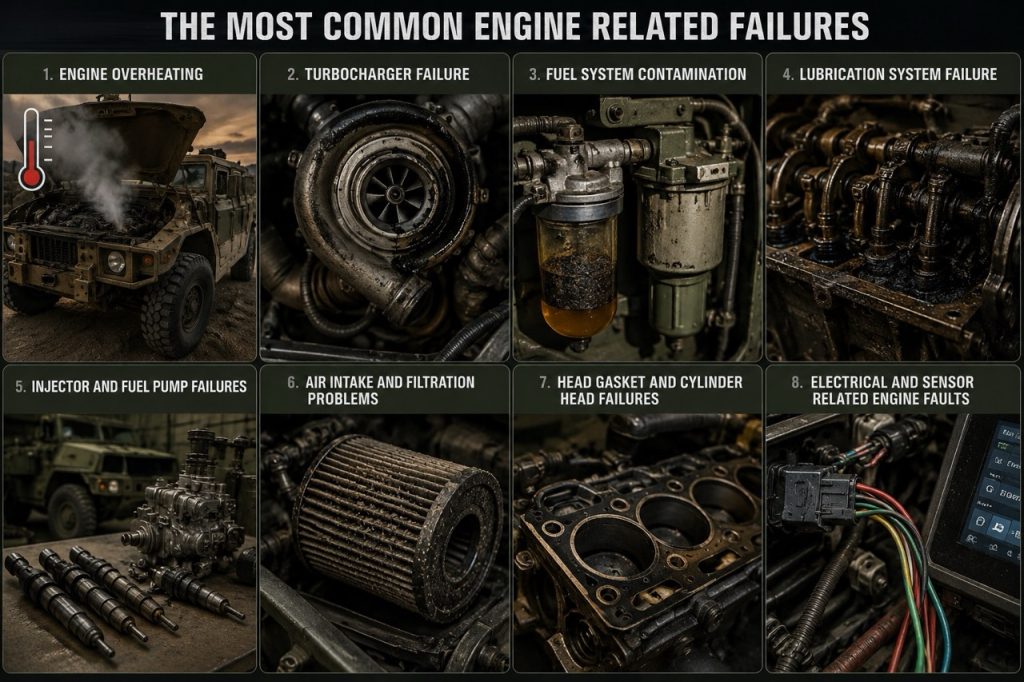
A heavy military vehicle can be protected by composite armor, fitted with advanced sensors, and armed with the latest weapon systems and still be rendered combat ineffective by a single engine failure. Engine reliability is not a secondary maintenance concern in defense operations; it is a direct determinant of battlefield readiness, logistics throughput, and mission success.
Unlike commercial trucking or civilian fleets, military vehicles operate in conditions engineers describe as duty cycles far outside standard design assumptions: sustained high loads, abrasive environments, extreme temperature swings, and long idle periods interspersed with abrupt high demand maneuvers. Engine related failures remain one of the leading causes of unscheduled maintenance and vehicle downtime across tactical wheeled vehicle and armored vehicle fleets.
For procurement officers, fleet sustainment managers, and maintenance engineers, understanding the most common engine related failures in heavy military vehicles and the preventive and predictive maintenance strategies that mitigate them is essential to sustaining mission readiness. This article examines the operating conditions that stress military diesel engines, the specific failure modes maintenance teams encounter most often, and the fleet management practices that modern defense organizations use to reduce unplanned downtime.
Why Heavy Military Vehicle Engines Operate Under Extreme Conditions
Heavy duty military diesel engines are engineered to tolerate abuse that would rapidly degrade a comparable commercial engine. Even so, the operating envelope of combat and combat support vehicles introduces stress factors that accelerate wear, corrosion, and component fatigue.
- High and variable loads: armored vehicles frequently operate at or near gross vehicle weight, and engines must deliver high torque at low speeds for off road maneuvering, hill climbs, and towing or recovery tasks.
- Harsh and unpredictable terrain: cross-country operation subjects the engine, drivetrain, and mounts to constant vibration, shock loading, and mechanical stress that on road commercial engines rarely experience.
- Dust, sand, and particulate exposure: operations in arid and desert theaters expose air intake and filtration systems to extremely high particulate loads, accelerating filter saturation and abrasive wear on internal components.
- Extreme temperature ranges: military fleets are deployed from arctic to desert climates, and engines must start reliably and maintain stable operating temperatures across an unusually wide thermal band.
- Long idle periods: vehicles are often kept idling for extended periods to maintain onboard electronics, communications, or environmental control, which promotes carbon buildup, incomplete combustion, and lubrication breakdown.
- Frequent stop and go operation: convoy and patrol operations involve constant acceleration and deceleration cycles that place repeated thermal and mechanical stress on turbochargers, injectors, and cooling systems.
- Added armor weight: up armoring programs increase vehicle mass substantially, and engines originally designed for a lighter platform are frequently required to work harder without a corresponding increase in cooling or lubrication capacity.
Together, these factors explain why diesel engine failures in military vehicles tend to cluster around a recognizable set of subsystems: cooling, turbocharging, fuel delivery, lubrication, and the sensors that monitor them. The sections below examine each failure mode in operational detail.
The Most Common Engine Related Failures
The following failure modes account for the majority of engine related downtime reported across heavy tactical and armored vehicle fleets. Each is presented with its typical causes, field recognizable warning signs, operational consequences, and the preventive maintenance actions that reduce recurrence.
1. Engine Overheating
Engine overheating in military vehicles is one of the most frequent and most damaging failure modes, particularly in desert and high load operations. Once coolant temperature exceeds design limits, the risk of warped cylinder heads, blown gaskets, and seized components rises sharply.
Typical Causes
- Radiator and heat exchanger fouling from dust, mud, or debris.
- Coolant leaks from hoses, clamps, or the water pump.
- Thermostat failure in the closed position.
- Extended high load operation combined with added armor weight.
- Degraded or contaminated coolant that has lost its heat transfer properties.
Warning Signs
- Rising temperature gauge readings or repeated high temperature warning alerts.
- Coolant loss without a visible external leak.
- Steam or coolant odor from the engine bay.
- Reduced power output under load, often described by crews as the engine feeling sluggish.
Operational Consequences
- Forced mission abort to prevent catastrophic engine damage.
- Risk of warped cylinder heads or cracked blocks if the vehicle continues to operate hot.
- Extended recovery and repair timelines, since cooling system failure in armored vehicles often requires removal of armor panels for access.
Preventive Maintenance Actions
- Scheduled inspection and cleaning of radiator fins and heat exchangers, especially after desert or off road operations.
- Routine coolant sampling to verify additive concentration and contamination levels.
- Pressure testing cooling systems during scheduled services to catch small leaks early.
- Replacing thermostats and hoses on a condition or age based interval rather than waiting for failure.
2. Turbocharger Failure
Turbocharger failure is a recurring issue in military vehicles because turbochargers operate at extremely high rotational speeds and temperatures, and are highly sensitive to oil quality and intake air cleanliness. A turbocharger failure can quickly cascade into broader engine damage if debris enters the intake or exhaust tract.
Typical Causes
- Oil starvation or delayed lubrication at startup, especially after long idle periods.
- Contaminated or degraded engine oil reaching the turbo bearings.
- Ingested dust or sand bypassing a saturated or damaged air filter.
- Exhaust leaks upstream of the turbine housing.
- Repeated shutdown immediately after high load operation without a cool down period.
Warning Signs
- Visible blue or gray exhaust smoke.
- Whining, whistling, or grinding noise from the turbo unit.
- Noticeable loss of power or boost pressure.
- Oil consumption increasing without a corresponding external leak.
Operational Consequences
- Immediate loss of engine power output, directly affecting tactical mobility.
- Secondary engine damage if turbo bearing debris migrates into the intake or exhaust system.
- Vehicle downtime for turbocharger replacement, which is typically a higher cost repair with longer parts lead times.
Preventive Maintenance Actions
- Enforcing post operation cool down idle periods before shutdown.
- Strict adherence to oil change intervals using specification correct lubricants.
- Regular air filter inspection and replacement, particularly in dusty environments.
- Prompt investigation of any unusual exhaust smoke or turbo noise rather than deferring to the next scheduled service.
3. Fuel System Contamination
Fuel system contamination military engines experience is most often traced to water, dirt, or microbial growth introduced during fuel handling, storage, or transport in the field. Modern high pressure common rail diesel systems have extremely tight tolerances, making them especially vulnerable to contaminated fuel.
Typical Causes
- Water intrusion from field fuel storage, refueling equipment, or condensation in partially filled tanks.
- Particulate contamination from improvised or non standard fuel sources.
- Microbial (bacterial or fungal) growth at the fuel water interface in long stored fuel.
- Degraded fuel filters that are overdue for replacement.
Warning Signs
- Rough idling, hesitation, or stalling.
- Difficulty starting, particularly in cold conditions.
- Visible water or sediment in fuel filter sight bowls or during filter changes.
- Reduced fuel economy and inconsistent power delivery.
Operational Consequences
- Injector and fuel pump damage from abrasive particulate or corrosion, often requiring costly component replacement.
- Mission delays caused by field troubleshooting of intermittent stalling or starting problems.
- Increased maintenance burden on forward deployed maintenance teams with limited diagnostic equipment.
Preventive Maintenance Actions
- Fuel quality testing and water detection checks at the point of refueling wherever feasible.
- Regular draining of fuel water separators and prompt replacement of primary and secondary fuel filters.
- Proper fuel tank management during storage to minimize condensation and water accumulation.
- Use of approved fuel additives or biocides when long term fuel storage is unavoidable.
4. Lubrication System Failure
Lubrication system failure in military engines is a leading cause of catastrophic, non repairable engine damage. Because lubrication protects nearly every moving component in the engine, a loss of oil pressure or oil quality can escalate from a minor warning to total engine seizure within minutes.
Typical Causes
- Oil pump wear or failure reducing system pressure.
- Oil dilution from fuel or coolant intrusion.
- Extended oil change intervals under severe operating conditions.
- Clogged oil filters restricting flow to critical bearings.
- Oil viscosity breakdown from sustained high operating temperatures.
Warning Signs
- Low oil pressure warning lights or gauge readings trending downward.
- Increased engine noise, particularly knocking or tapping sounds.
- Dark, gritty, or diluted oil observed during dipstick checks.
- Excessive oil consumption between scheduled services.
Operational Consequences
- Risk of complete engine seizure if operation continues after a low pressure warning.
- Total loss of vehicle mobility, often requiring engine replacement rather than repair.
- Significant recovery and logistics burden, since a seized engine cannot be restarted for self recovery.
Preventive Maintenance Actions
- Adherence to severe duty oil change intervals rather than standard commercial schedules.
- Routine oil analysis to detect metal particulate, fuel dilution, or coolant intrusion before failure occurs.
- Immediate shutdown procedures whenever a low oil pressure warning is triggered.
- Use of specification correct lubricants suited to the engine’s operating temperature range.
5. Injector and Fuel Pump Failures
High pressure injectors and fuel pumps in modern heavy duty military diesel engines operate at pressures far higher than earlier generation systems, making them precise but also more sensitive to fuel quality, wear, and calibration drift.
Typical Causes
- Contaminated or low lubricity fuel accelerating wear on precision components.
- Normal wear related calibration drift over extended service life.
- Air ingestion into the fuel system from loose fittings or low fuel levels.
- Overheating of injectors during extended high load operation.
Warning Signs
- Misfiring, rough running, or noticeable power loss.
- Increased fuel consumption without a matching increase in performance.
- Hard starting or extended cranking time.
- Diagnostic trouble codes related to fuel rail pressure or injector balance.
Operational Consequences
- Reduced engine performance affecting acceleration and towing capability during combat support vehicle maintenance tasks.
- Higher fuel consumption, straining logistics resupply schedules.
- Costly component replacement if contamination is not addressed at the root cause.
Preventive Maintenance Actions
- Consistent use of clean, specification compliant fuel and functioning water separators.
- Scheduled injector performance testing during major services.
- Prompt filter replacement to protect precision fuel system components.
- Calibration checks aligned with manufacturer recommended service intervals.
6. Air Intake and Filtration Problems
Air intake and filtration problems are especially significant for fleets operating in desert, sandy, or dusty environments, where particulate ingestion is one of the single largest contributors to accelerated engine wear in tactical vehicles.
Typical Causes
- Filter media saturation or damage allowing unfiltered air to bypass into the intake tract.
- Improperly seated or damaged intake ducting after field repairs.
- Extended operation without filter servicing during high tempo missions.
- Pre cleaner or cyclonic separator maintenance being deferred under operational pressure.
Warning Signs
- Noticeable loss of power, particularly at higher engine loads.
- Increased engine oil consumption from abrasive particulate entering the crankcase.
- Visible dust accumulation around intake seals or ducting.
- Shortened intervals between required filter changes.
Operational Consequences
- Accelerated wear on pistons, rings, and cylinder walls, shortening overall engine life.
- Increased frequency of turbocharger failure due to particulate ingestion.
- Higher long term maintenance costs from cumulative internal engine wear.
Preventive Maintenance Actions
- Frequent filter inspection and replacement schedules calibrated to the operating environment rather than a fixed calendar interval.
- Use of pre cleaners or cyclonic separators in high dust theaters.
- Inspecting intake ducting and seals for damage after off road or field repair activity.
- Training operators and crews to recognize early signs of intake restriction.
7. Head Gasket and Cylinder Head Failures
Head gasket and cylinder head failures often follow repeated overheating events, and are among the more expensive engine related repairs because they typically require significant teardown and can indicate underlying cooling or combustion problems.
Typical Causes
- Repeated or prolonged engine overheating events.
- Detonation or pre ignition caused by fuel quality issues or incorrect timing.
- Age and cycle related fatigue of gasket materials under repeated thermal cycling.
- Overtightened or unevenly torqued cylinder head fasteners during prior repairs.
Warning Signs
- White or gray exhaust smoke suggesting coolant entering the combustion chamber.
- Coolant loss with no visible external leak, and a corresponding rise in oil level or milky oil appearance.
- Combustion gases bubbling into the coolant expansion tank.
- Persistent overheating despite a functioning cooling system.
Operational Consequences
- Extended vehicle downtime, since repair requires engine disassembly.
- Risk of secondary engine damage if the failure is not caught early.
- Higher repair costs and reliance on specialized maintenance facilities rather than forward field support.
Preventive Maintenance Actions
- Prompt investigation and repair of any overheating event, however brief.
- Correct torque procedures and gasket selection during any cylinder head service.
- Routine coolant and oil condition checks to detect early cross contamination.
- Root cause analysis after any cooling system failure to prevent recurrence.
8. Electrical and Sensor Related Engine Faults
Modern heavy duty military diesel engines rely on an extensive network of sensors and electronic control modules to manage fuel delivery, turbo boost, emissions, and cooling. Electrical and sensor faults are increasingly common as fleets adopt more electronically controlled powertrains.
Typical Causes
- Corrosion or moisture intrusion at connectors and wiring harnesses.
- Vibration induced wear on wiring and connector pins during off road operation.
- Sensor drift or failure from extreme heat, cold, or contamination.
- Battery and charging system issues affecting stable sensor and control module power supply.
Warning Signs
- Illuminated check engine or fault indicator lights.
- Inconsistent engine performance not explained by mechanical inspection.
- Intermittent stalling, derating, or failure to reach full power.
- Diagnostic trouble codes that do not correspond to an obvious mechanical cause.
Operational Consequences
- Difficulty diagnosing intermittent faults in the field without proper diagnostic equipment.
- Engines entering protective derate modes, reducing available power during missions.
- Extended troubleshooting time that delays return to service.
Preventive Maintenance Actions
- Regular inspection of wiring harnesses and connectors for corrosion or chafing damage.
- Use of onboard diagnostics and telematics to capture fault codes before they become mission affecting.
- Maintaining trained technicians proficient in electronic engine control systems.
- Protecting connectors and control modules with appropriate sealing and routing during vehicle upgrades.
Operational Impact of Engine Failures
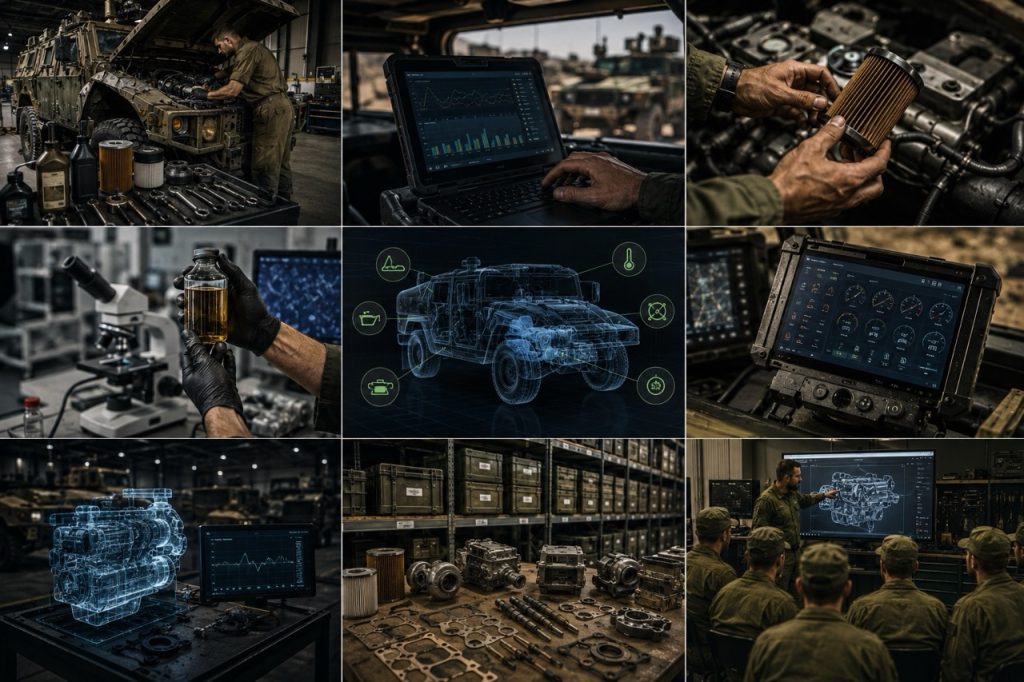
Engine related failures extend well beyond the cost of the repair itself. Their operational impact ripples through logistics, readiness reporting, and mission planning.
- Mission delays: a single engine failure can force a convoy to halt, a patrol to abort, or a combat support vehicle to fall out of formation, directly affecting mission timelines.
- Recovery operations: an immobilized armored or tactical vehicle often requires a dedicated recovery asset and crew, diverting resources away from other tasks and introducing additional risk in contested environments.
- Increased maintenance costs: failures caught late particularly turbocharger, lubrication, or cylinder head failures are substantially more expensive to repair than issues addressed through preventive maintenance.
- Reduced fleet availability: every vehicle in unscheduled maintenance is a vehicle unavailable for tasking, directly reducing overall military fleet readiness and complicating unit level planning.
- Risks during combat and logistics missions: an engine failure at the wrong moment can leave a crew exposed, disrupt a resupply convoy, or compromise a broader operational timeline.
For these reasons, engine reliability is properly understood as a readiness multiplier rather than a purely technical or budgetary matter. Fleet sustainment managers and procurement officers who treat engine maintenance as a strategic priority not an afterthought consistently see stronger mission readiness and maintenance outcomes.
How Modern Defense Fleets Reduce Engine Failures
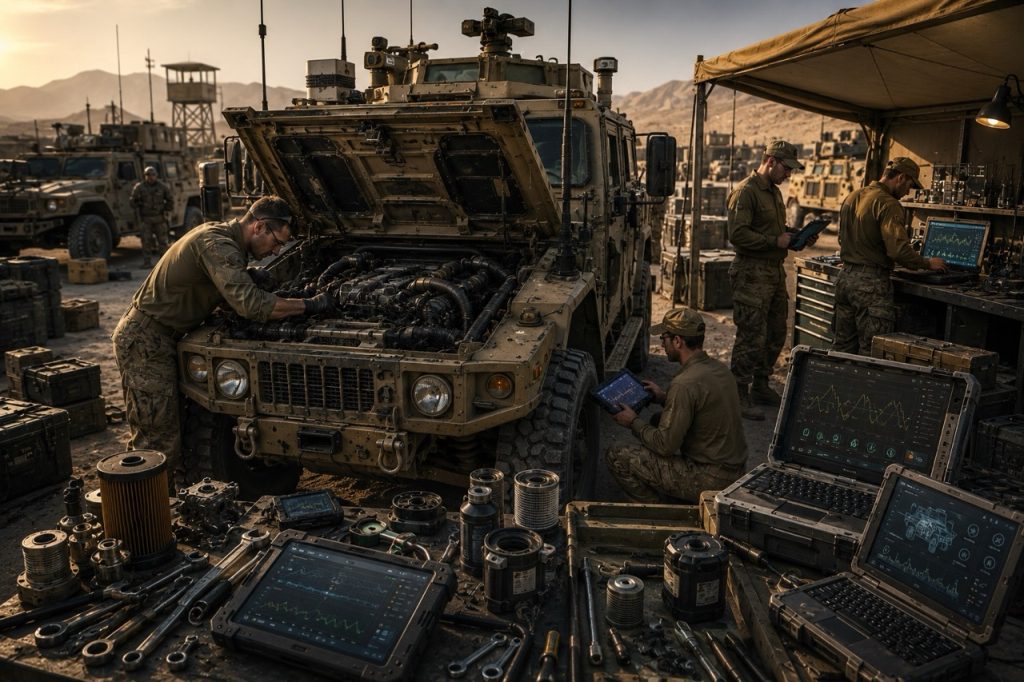
Leading defense organizations have shifted away from purely reactive, run to failure maintenance toward layered strategies that combine preventive schedules, condition monitoring, and data driven planning.
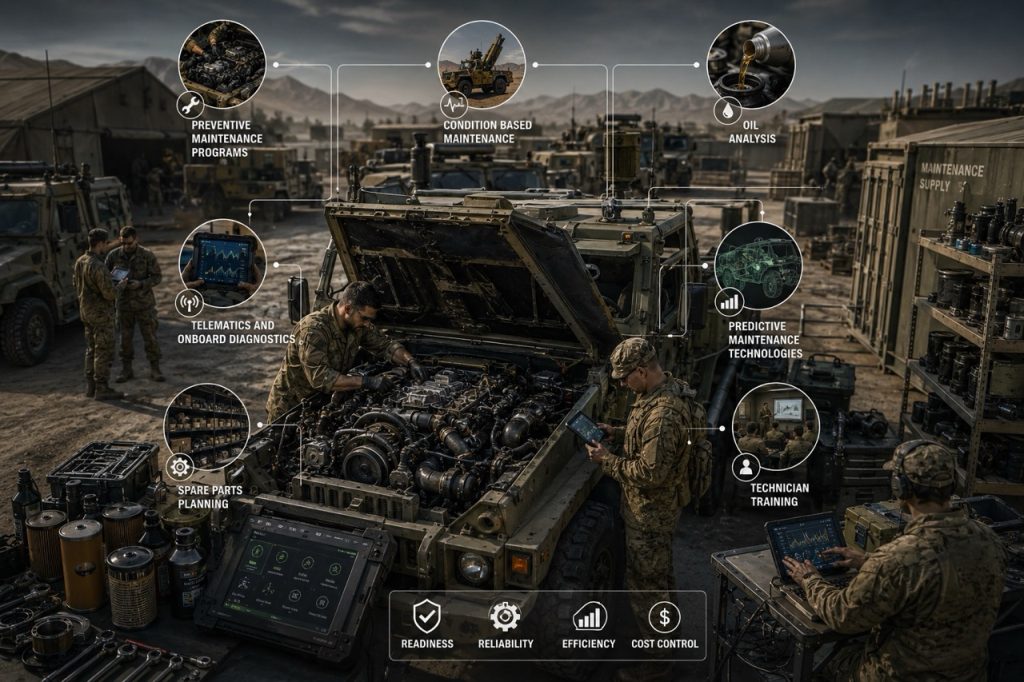
Preventive Maintenance Programs
Preventive maintenance military vehicles rely on structured, interval based servicing filter changes, fluid replacement, inspections calibrated to the specific operational tempo and environment of each unit, rather than a single generic schedule applied fleet-wide.
Condition Based Maintenance
Rather than servicing components on a fixed calendar alone, condition-based approaches use actual vehicle usage data, operating hours, and environmental exposure to determine when maintenance is genuinely needed, reducing both unnecessary servicing and missed early-warning signs.
Oil Analysis
Routine oil sampling and laboratory analysis can detect metal particulate, coolant intrusion, or fuel dilution well before a failure becomes catastrophic, making it one of the most cost effective predictive maintenance tools available to defense fleets.
Telematics and Onboard Diagnostics
Modern tactical and combat vehicles increasingly incorporate onboard diagnostic systems and telematics that continuously monitor engine temperature, oil pressure, boost pressure, and fault codes, giving maintenance teams early visibility into developing problems.
Predictive Maintenance Technologies
Predictive maintenance defense fleets increasingly draw on trend analysis of sensor and diagnostic data to anticipate component failure before it occurs, allowing maintenance to be scheduled proactively rather than reactively a critical capability for sustaining tactical vehicle engine reliability at scale.
Spare Parts Planning
Military spare parts management is central to engine reliability: even a well diagnosed failure causes extended downtime if the correct filter, injector, turbocharger, or gasket is not available when needed. Robust military logistics and maintenance planning ensures that engine critical components are stocked, tracked, and positioned where fleets actually operate.
Technician Training
As engines incorporate more electronic controls and precision fuel systems, maintenance personnel require ongoing training to correctly diagnose and repair increasingly sophisticated powertrains a factor that directly affects how quickly a fleet can return a vehicle to service.
| Field Insight Fleets that combine oil analysis, telematics based diagnostics, and disciplined spare parts planning consistently report fewer catastrophic engine failures and shorter average repair timelines than fleets relying on calendar based maintenance alone. |
Engine reliability in heavy military vehicles is not simply a maintenance line item it is a strategic readiness issue. Overheating, turbocharger failure, fuel system contamination, lubrication system failure, injector and fuel pump wear, air intake restriction, head gasket damage, and electrical faults each represent a distinct pathway to the same outcome: a vehicle that cannot complete its mission.
The armor and armament that define a combat vehicle’s capability are only relevant if the vehicle can move, fight, and return. Sustaining that capability requires proactive maintenance, disciplined diagnostics, well trained technicians, and dependable access to quality spare parts. Defense organizations that invest in these areas consistently achieve stronger military fleet readiness and reduce the operational and financial cost of unplanned engine failures.
For procurement officers, fleet sustainment managers, and maintenance engineers, the path forward is clear: treat engine reliability as inseparable from mission readiness, and build maintenance, diagnostic, and logistics programs accordingly.
Work With AB Defence
Partner with AB DEFENCE for Reliable Combat Support Vehicle Sustainment. AB DEFENCE is a specialist international supplier of military spare parts and fleet sustainment solutions serving NATO and allied defense organisations. With deep inventory across a wide range of combat support vehicle platforms, rigorous quality assurance processes, export compliance expertise, and a commitment to long term supply chain partnership, AB DEFENCE helps defense buyers maintain fleet availability, reduce sustainment costs, and meet their operational readiness obligations. Contact the AB DEFENCE team to discuss your spare parts requirements, strategic inventory planning, and long-term sustainment programme needs.
Contact AB Defence to discuss your procurement requirements and learn how we can support your fleet readiness objectives.
Related Military Spare Parts Categories, Vehicle Platforms & Technical Guides
Explore AB Defence’s NATO-codified (NSN) and genuine OEM spare parts catalog, platform technical specifications, and sustainment engineering guides related to this article:
Stocked Spare Parts Categories (NSN & OEM Catalog)
- Military Engine Cooling Systems, Radiators & Water Pumps (57 stocked parts)
- Military Vehicle Engines & Complete Power Assemblies (154 stocked parts)
- Military Engine Internal Components & Overhaul Parts (104 stocked parts)
- Military Air, Oil, Fuel & Hydraulic Filters (34 stocked parts)
- Military Fuel Injection Pumps, Injectors & Fuel Control (64 stocked parts)
- Full NATO NSN & OEM Spare Parts Catalog (16,760+ Parts)
Compatible Vehicle Platforms & System Hubs
- Engine & Powertrain Systems
- Filtration & Fluid Systems
- MTU Engine Series
- ALCO Diesel Engines
- Railway & Industrial Engines
- Request a B2B Quotation (RFQ) & Technical Support