July 2, 2026
Military Brake System Failures: Causes, Risks and Maintenance Priorities
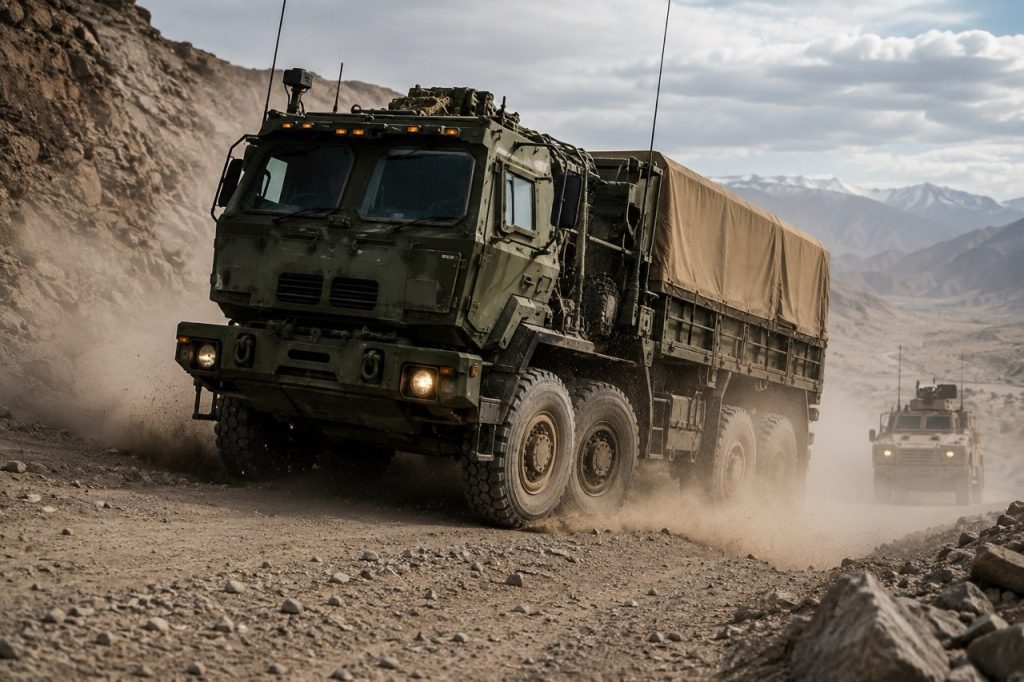
In military operations, the margin between mission success and catastrophic failure is often measured in meters and milliseconds. Few vehicle systems carry greater life safety and mission criticality than the braking system. Whether a fully loaded HEMTT is descending a steep mountain pass, an MRAP is navigating a combat zone convoy, or a FMTV is manoeuvring through a logistics staging area, the ability to stop reliably and precisely is non negotiable. A brake system failure is never merely a maintenance problem it is a force readiness emergency with direct consequences for crew safety, vehicle availability, and mission outcomes.
Military vehicle braking systems operate under conditions that far exceed the demands placed on commercial heavy duty platforms. They must function reliably across extreme temperature ranges, through mud, sand, snow, salt water, and high altitude environments, while managing the unique stress profiles of off road terrain, armour added weight, and the unpredictable intensity of combat or humanitarian operations. For this reason, brake system maintenance is one of the most consequential responsibilities assigned to military fleet maintenance teams.
This article examines the primary causes of military brake system failures, the operational risks they generate, and the maintenance priorities that defence fleet managers, military maintenance officers, and vehicle sustainment engineers should incorporate into their preventive and predictive maintenance programmes.
Brake system integrity is a direct determinant of operational readiness. A single brake failure during a tactical mission can halt an entire convoy, endanger crew lives, and compromise time sensitive objectives.
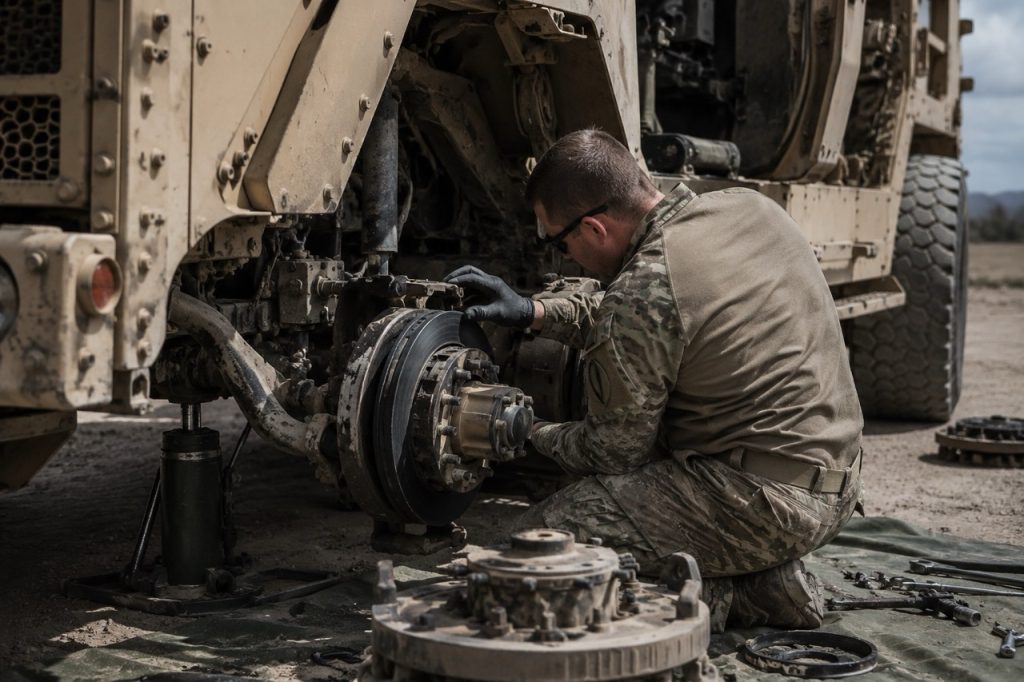
Why Braking Systems Are Mission Critical in Military Vehicles
Military vehicles are not simply heavy duty commercial trucks painted in camouflage. They are complex, multi mission platforms designed to sustain operational effectiveness in environments where no commercial vehicle would be expected to perform. Tactical wheeled vehicles including the JLTV, FMTV, HEMTT, and Stryker can weigh anywhere from 6,000 kg to over 30,000 kg fully loaded. Armoured platforms like the Bradley Fighting Vehicle and the M113 impose additional static and dynamic loads that place severe demands on brake components with every operational cycle.
At those weights, stopping distances become operationally significant. The kinetic energy that must be absorbed by the braking system during an emergency stop scales with the square of velocity and directly with vehicle mass. A brake system that is degraded by 20 percent does not merely add a small amount of distance to a stop it can fundamentally change the vehicle’s ability to avoid an obstacle, hold position on a grade, or protect a convoy during a rapid halt.
Beyond the physics of stopping, braking systems affect convoy spacing, vehicle platooning protocols, mission timing, and crew confidence. Fleet managers and maintenance planners who treat brake maintenance as a secondary priority do so at the expense of overall defence fleet readiness.
How Military Braking Systems Differ from Commercial Vehicle Brakes
The fundamental engineering principles governing braking systems friction, heat dissipation, hydraulic pressure, and pneumatic actuation are the same in military and commercial contexts. However, military vehicle braking systems are engineered to different performance envelopes, qualification standards, and logistical constraints than their commercial counterparts.
Military vehicles must meet stringent NATO standardisation agreements (STANAG) and OEM qualification requirements that govern brake system design, component specification, and maintenance intervals. Many platforms incorporate Central Tire Inflation Systems (CTIS), run-flat tyre capabilities, and specialised suspension geometries that interact directly with brake dynamics in ways that have no direct commercial equivalent. Additionally, military brake components must be able to withstand prolonged storage under adverse conditions, function after periods of operational inactivity, and perform immediately upon call up without the pre operational warmup cycles that commercial fleet operators often take for granted.
Perhaps most importantly, military brake systems must perform under combat conditions that introduce unique stressors: rapid acceleration followed by emergency braking, the weight of appliqué armour kits that may not have been part of the original platform specification, and the stress of high frequency off road movement over surfaces that accelerate rotor and pad wear at rates rarely encountered in commercial transport operations.
Types of Braking Systems Used in Military Vehicles
Hydraulic Braking Systems
Hydraulic braking systems are common across lighter tactical wheeled vehicles, including the JLTV and early generations of the HMMWV. In these systems, brake fluid transmits force from the master cylinder to the wheel cylinders or brake calipers when the driver depresses the brake pedal. The system’s effectiveness depends critically on the integrity of all hydraulic components including brake hoses, master cylinders, and wheel cylinders as well as the quality and condition of the brake fluid itself.
Air Brake Systems
Heavy tactical wheeled vehicles including the HEMTT, FMTV series, and large logistics platforms typically use pneumatic (air) brake systems. These systems use compressed air generated by an engine driven air compressor to actuate brake chambers, which in turn apply mechanical force to the brake shoes or disc pads. Air brake systems are preferred for heavy platforms because they generate higher actuation forces, are self-adjusting in some configurations, and do not rely on hydraulic fluid lines that can rupture under mechanical load.
However, air brake systems introduce their own set of failure modes, including air compressor degradation, moisture accumulation in air lines, brake chamber diaphragm failures, and the critical risk of air pressure loss during operation. Air system integrity checks are therefore a mandatory element of pre operational vehicle inspections on any heavy tactical platform.
Electronic Braking Systems and ABS
Modern military vehicles, including current production JLTV variants and many MRAPs, incorporate electronic braking systems (EBS) and anti lock braking system (ABS) technologies derived from advanced commercial vehicle platforms. ABS prevents wheel lock up during emergency braking, maintaining vehicle steer ability on variable terrain and wet or loose surfaces a critical capability in the type of unpredictable environments where military vehicles operate.
Electronic braking systems add diagnostic visibility that supports condition based maintenance strategies. ABS wheel speed sensors, electronic control units (ECUs), and integrated vehicle health monitoring systems can alert maintenance teams to developing brake system anomalies before they produce operational failures. However, they also introduce electronic components that require qualified maintenance personnel and supply chains capable of supporting specialised replacement parts.
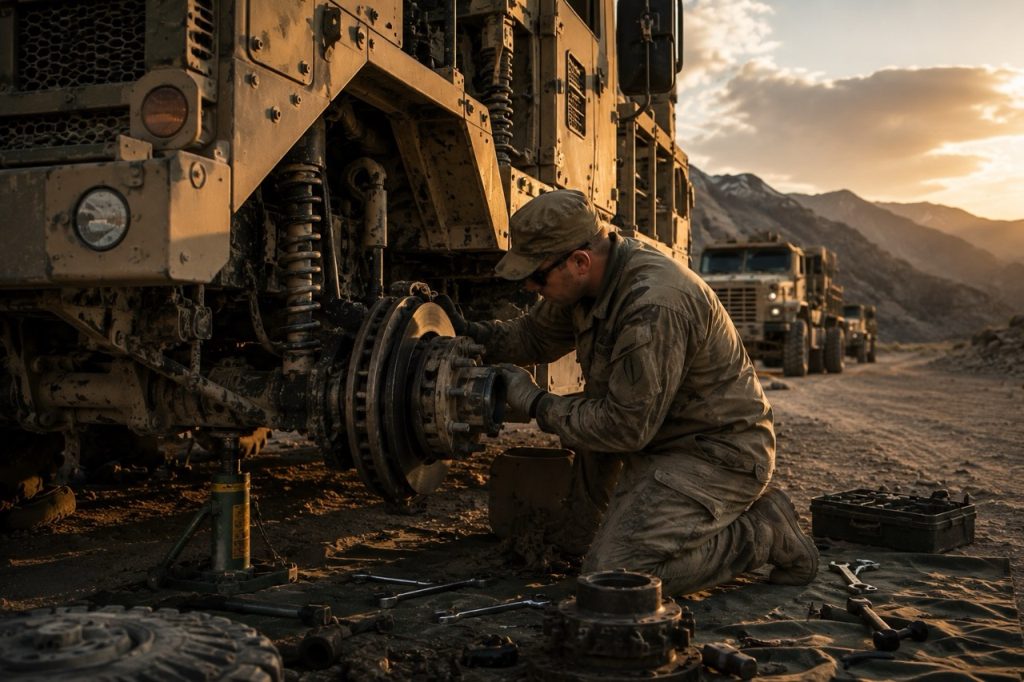
The Most Common Causes of Military Brake System Failures
Brake Overheating and Brake Fade
Brake overheating is one of the most prevalent and dangerous failure mechanisms in military vehicle operations. When brake systems are subjected to sustained or repeated heavy applications descending long grades, conducting repeated high-speed stops, or navigating convoy brake and go situations the thermal energy absorbed by the brake pads, rotors, and drums can exceed the system’s heat dissipation capacity. The result is brake fade: a progressive reduction in braking effectiveness as friction materials reach temperatures at which their friction coefficient drops sharply.
Brake fade is particularly dangerous because it develops gradually. Drivers may not recognise the deterioration until braking distances have extended to unsafe levels. In military operations, where the consequences of extended stopping distances can be immediately life threatening, brake fade is a condition that maintenance programmes must actively work to prevent through proper component selection, regular inspection, and driver education.
Hydraulic System Failures
Hydraulic brake failures in military vehicles most commonly originate from three sources: master cylinder degradation, brake hose deterioration, and brake fluid contamination. The master cylinder is the hydraulic heart of the system when its internal seals wear, fluid can bypass internally, reducing or eliminating braking pressure. Brake hoses, especially those routed near hot engine or exhaust components or through areas exposed to terrain abrasion, are subject to internal degradation that may not be visible externally until the hose fails completely.
Brake fluid is hygroscopic, meaning it absorbs moisture from the environment over time. As moisture content increases, the boiling point of the fluid drops, increasing the risk of vapour lock a condition in which fluid boils within the brake line and generates compressible gas bubbles that cause the brake pedal to feel soft or spongy and dramatically reduce braking efficiency. Military vehicles operating in high humidity environments or after prolonged storage are particularly susceptible to this failure mode.
Air System Degradation
In pneumatic brake systems, the air compressor is the source of all braking energy. A compressor that is worn, contaminated with oil, or operating with degraded output pressure compromises the entire brake system. Moisture accumulation in air lines especially in cold-weather operations where condensation is pronounced can lead to ice formation in brake valves and chambers, causing delayed or asymmetric brake application. Brake chamber diaphragm failures are another common failure mode, producing reduced actuation force or complete loss of braking on the affected axle.
Worn Friction Materials: Pads, Shoes, and Drums
Brake pads and brake shoes are consumable components with predictable wear characteristics under normal operating conditions. However, military operational tempos and terrain profiles can dramatically accelerate wear rates. Heavily loaded logistics vehicles operating in mountainous terrain may consume brake pads at two to three times the rate of the same vehicles operating on paved roads. When friction materials wear beyond their minimum thickness limits, metal to metal contact between the pad backing plate and the rotor or drum accelerates rotor wear and dramatically reduces braking effectiveness. In military vehicles, where rotor or drum replacement can be a complex, time consuming logistics exercise, allowing brake pads to wear excessively is a costly and avoidable maintenance failure.
Environmental Contamination
Military vehicles operate in environments that are inherently hostile to precision mechanical systems. Mud, sand, water, salt, and chemical contamination are routine operational conditions rather than exceptional events. Each of these contaminants creates specific risks for brake system components. Sand and fine grit act as abrasives that accelerate rotor and pad wear. Salt particularly in maritime or winter road environments drives corrosion in brake callipers, wheel cylinders, and brake lines. Mud and debris can pack into brake assemblies, causing uneven pad contact or preventing full brake release, which generates heat and accelerates component wear even when the brakes are nominally not applied.
Component Aging, Long Term Storage, and Poor Quality Parts
Military vehicles often undergo extended periods of storage between operational deployments. Rubber seals, brake hoses, and diaphragms are particularly vulnerable to degradation during storage, as they dry out, crack, and lose their elasticity even in the absence of operational stress. Vehicles that are reactivated after extended storage must undergo comprehensive brake system inspections before being returned to service a step that is sometimes abbreviated under operational time pressure with serious consequences.
The use of non OEM or counterfeit brake components is another significant contributor to premature brake system failures in military fleets. Brake pads manufactured with incorrect friction compounds, brake hoses that do not meet the pressure and temperature specifications of the original platform, or master cylinders with substandard internal seals may appear visually identical to qualified OEM components while offering dramatically inferior performance. The procurement of genuine, verified spare parts from qualified suppliers is not an administrative formality it is a direct contributor to operational safety.
Counterfeit or non OEM brake components are a documented risk in defence supply chains. Components that fail qualification testing may still enter the supply chain through unverified distributors. Defence procurement officers must verify CAGE codes, NSN compliance, and supplier quality certifications for all brake system components.
Operational Risks Generated by Brake System Failures
The operational consequences of a brake system failure are immediate and severe. At the most direct level, brake failure results in loss of vehicle control a catastrophic outcome for the crew, bystanders, and any cargo or weapon systems the vehicle carries. At the convoy level, a single vehicle that cannot stop reliably disrupts spacing protocols, creates collision risks, and can halt an entire formation.
At the fleet sustainment level, brake failures that are not caught by preventive maintenance generate unplanned maintenance events that consume spare parts inventory, maintenance man hours, and recovery assets. The cost of an emergency brake repair in a forward operating environment is substantially higher than the cost of a scheduled maintenance action at a depot or garrison facility. Equipment availability rates a primary metric for measuring defence fleet readiness drop when vehicles are taken out of service for unscheduled brake repairs.
The most serious operational risk is mission failure. Military operations are time sensitive by nature. A convoy that is halted by a brake failure may miss a resupply window, allow an adversary to react to the delay, or leave a supported unit without the materiel it needs to sustain operations. In these scenarios, the financial cost of the brake failure is the least significant consequence.
Brake Inspection Priorities for Military Maintenance Teams
Effective brake system inspection in a military maintenance context requires a structured approach that covers all system components at appropriate intervals. Pre operational checks conducted before every mission should confirm that brake pedal travel and feel are within normal parameters, that air system pressure (on pneumatic platforms) builds to operating pressure within the expected timeframe, and that there are no visible leaks or fluid contamination around brake components.
Periodic scheduled inspections, conducted at defined mileage or operating hour intervals, must include measurement of brake pad and shoe thickness against minimum specification limits, inspection of rotor and drum surfaces for scoring, heat cracking, or excessive thickness variation, pressure testing of hydraulic circuits and air lines, inspection of all brake hoses and hard lines for external damage or deterioration, functional testing of ABS systems where equipped, and verification of brake fluid condition including moisture content where test equipment is available.
Brake callipers should be inspected for seized sliding pins, damaged boots, and uneven pad wear asymmetric wear is a reliable indicator of a sticking calliper piston or pin that will worsen if not addressed. Wheel cylinders on drum brake systems should be inspected for fluid seeping past the dust boots, which indicates internal seal failure. On air brake systems, brake chamber push rod travel should be measured to confirm proper automatic adjuster function and identify chambers that are approaching the replacement threshold.
A brake inspection is only as valuable as the documentation it generates. Maintenance records that capture measured component dimensions, fluid condition assessments, and corrective actions taken are essential for trend analysis, predictive maintenance planning, and lifecycle cost management.
Preventive and Predictive Maintenance Strategies
Preventive maintenance for military brake systems follows established doctrine: inspect at defined intervals, replace consumables before they reach their failure threshold, and verify system function after every corrective maintenance action. The discipline of preventive maintenance is well understood in military maintenance organisations, but its consistent execution is frequently challenged by operational tempo, parts availability, and the competing demands on maintenance resources.
Condition based maintenance (CBM) and predictive maintenance strategies offer the opportunity to improve on time based maintenance intervals by incorporating actual wear data into maintenance scheduling decisions. Modern military vehicles equipped with vehicle health monitoring systems can transmit brake system data pad wear sensor signals, ABS fault codes, brake pressure anomalies to maintenance management systems that can trigger maintenance actions based on actual component condition rather than elapsed time.
For older platforms without integrated vehicle health monitoring, portable diagnostic tools and structured data collection during scheduled inspections can support informal condition based maintenance practices. Tracking brake pad thickness measurements over successive inspection cycles, for example, allows maintenance planners to project remaining pad life and schedule replacements during planned maintenance windows rather than in response to failures.
Predictive maintenance reduces fleet downtime, improves parts inventory planning, and ensures that vehicles are available for operational tasking when required. In defence fleet management, where vehicle availability is a direct measure of readiness, predictive maintenance is a force multiplier.
The Critical Role of OEM Quality Spare Parts
No maintenance programme regardless of its sophistication can compensate for the use of substandard brake system components. Military vehicle brake systems are precision engineered assemblies in which every component is specified to precise material, dimensional, and performance tolerances. The friction compounds used in brake pads and shoes determine not only the stopping performance of the vehicle but also the heat generation and rotor wear characteristics that affect the entire system’s longevity.
OEM specification replacement parts are manufactured to the same standards as the original components and are validated against the vehicle platform’s brake system performance requirements. Aftermarket or non qualified parts may meet visual inspection criteria while failing to meet the thermal stability, compressibility, or sealing performance requirements that the original specification demands.
In defence procurement contexts, the importance of parts quality is reinforced by regulatory frameworks including NATO’s Allied Quality Assurance Publications (AQAP), Certificate of Conformance (CoC) requirements, and traceability documentation standards that form part of the material technical review (MTR) process. Defence maintenance officers and logistics specialists who source brake system components should verify supplier qualifications, demand full documentation, and work with suppliers who understand the military supply chain’s compliance requirements.
The lifecycle cost implications of parts quality are substantial. A brake rotor that wears prematurely due to an incompatible friction compound may require replacement at half its expected service life, doubling the parts consumption rate and the maintenance labour burden. Conversely, a verified OEM quality rotor installed with the correct OEM specification pads will deliver predictable service life that supports accurate maintenance planning and lifecycle cost management.
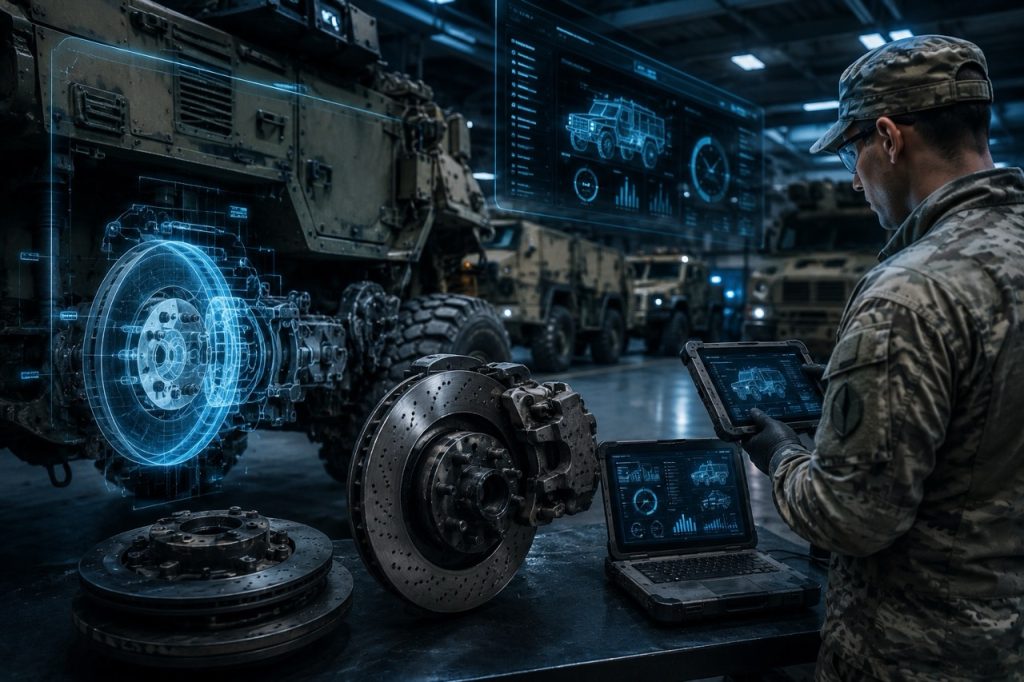
Future Trends in Military Brake Technology
Military vehicle braking technology is evolving in parallel with broader trends in vehicle electrification, digital fleet management, and integrated vehicle health monitoring. Electro mechanical braking systems (EMB), which replace hydraulic circuits with direct electric actuation of brake calipers, are being evaluated for military applications where their diagnostic transparency and reduced fluid maintenance requirements offer operational advantages. Brake by wire architectures, already present in some advanced civilian autonomous vehicle development programmes, may eventually find their way into military vehicle platforms where the elimination of physical hydraulic connections reduces vulnerability to combat damage.
Digital fleet management platforms are increasingly capable of aggregating vehicle health data from multiple systems including brake system sensors into unified maintenance management dashboards that support both predictive maintenance decisions and supply chain planning. For defence fleet managers, these platforms offer the potential to shift maintenance from a reactive discipline to a proactive, data driven function that maximises vehicle availability and minimises unplanned downtime.
In the near term, the most impactful developments for military brake system maintenance will likely come not from new brake technology but from improved integration of existing diagnostic systems with maintenance management software, better training of maintenance personnel in condition based maintenance methodologies, and more rigorous enforcement of OEM parts quality standards throughout the defence supply chain.
Military brake system failures are preventable. They are the product of deferred maintenance, environmental exposure, substandard parts, operational stress, and the cumulative effect of factors that a disciplined, well resourced maintenance programme can identify and address before they produce failures in the field. For defence fleet managers, military maintenance officers, and vehicle sustainment engineers, brake system maintenance is not a routine administrative function it is a direct investment in the operational safety of military crews, the availability of the vehicle fleet, and the probability of mission success.
The framework for effective brake system maintenance is clear: implement structured inspection protocols at appropriate intervals, use verified OEM quality replacement components, train maintenance personnel to recognise early indicators of brake system degradation, and leverage condition based maintenance data to optimise maintenance scheduling. Where predictive maintenance tools are available, use them. Where they are not, rigorous manual data collection and trend analysis can serve the same function.
Operational readiness begins with mechanical reliability. And mechanical reliability, in the context of military wheeled and armoured vehicles, begins with the confidence that the vehicle will stop when its crew commands it to. That confidence is built, maintained, and preserved by the quality of brake system maintenance and by the quality of the components that maintenance teams install.
Work With AB Defence
Partner with AB DEFENCE for Reliable Combat Support Vehicle Sustainment. AB DEFENCE is a specialist international supplier of military spare parts and fleet sustainment solutions serving NATO and allied defense organisations. With deep inventory across a wide range of combat support vehicle platforms, rigorous quality assurance processes, export compliance expertise, and a commitment to long term supply chain partnership, AB DEFENCE helps defense buyers maintain fleet availability, reduce sustainment costs, and meet their operational readiness obligations. Contact the AB DEFENCE team to discuss your spare parts requirements, strategic inventory planning, and long-term sustainment programme needs.
Contact AB Defence to discuss your procurement requirements and learn how we can support your fleet readiness objectives.
Related Military Spare Parts Categories, Vehicle Platforms & Technical Guides
Explore AB Defence’s NATO-codified (NSN) and genuine OEM spare parts catalog, platform technical specifications, and sustainment engineering guides related to this article:
Stocked Spare Parts Categories (NSN & OEM Catalog)
- Military Brake Calipers, Master Cylinders & Hydraulic Systems (103 stocked parts)
- Electrical, Electronic & Vision Systems for Military Vehicles (250 stocked parts)
- Military Pneumatic Air Fittings, Brake Valves & Compressors (115 stocked parts)
- Military Portal Axles, Differentials & Drive Shafts (107 stocked parts)
- Military Cab, Armor Body Panels, Mirrors & Structural Hardware (130 stocked parts)
- Full NATO NSN & OEM Spare Parts Catalog (16,760+ Parts)
Compatible Vehicle Platforms & System Hubs
- Brake & Suspension Systems
- Hydraulics & Mechanical Components
- Electrical, Electronic & Vision Systems
- Body, Panel & Gasket Solutions
- Tactical Wheeled Vehicles
- Request a B2B Quotation (RFQ) & Technical Support
Related Military Engineering & Sustainment Articles
- Military Vehicle Hydraulic System Failures: Causes, Maintenance and Critical Spare Parts
- Armored Vehicle Suspension Failures: 6 Warning Signs Maintenance Teams Should Never Ignore
- Why Military Vehicle Electrical Systems Fail: Common Problems and Spare Parts
- 8 Components Most Frequently Replaced in Armored Military Vehicles