January 23, 2026
The HMMWV (HUMVEE) Parts That Fail Most Often in Service: Verified Maintenance Hotspots
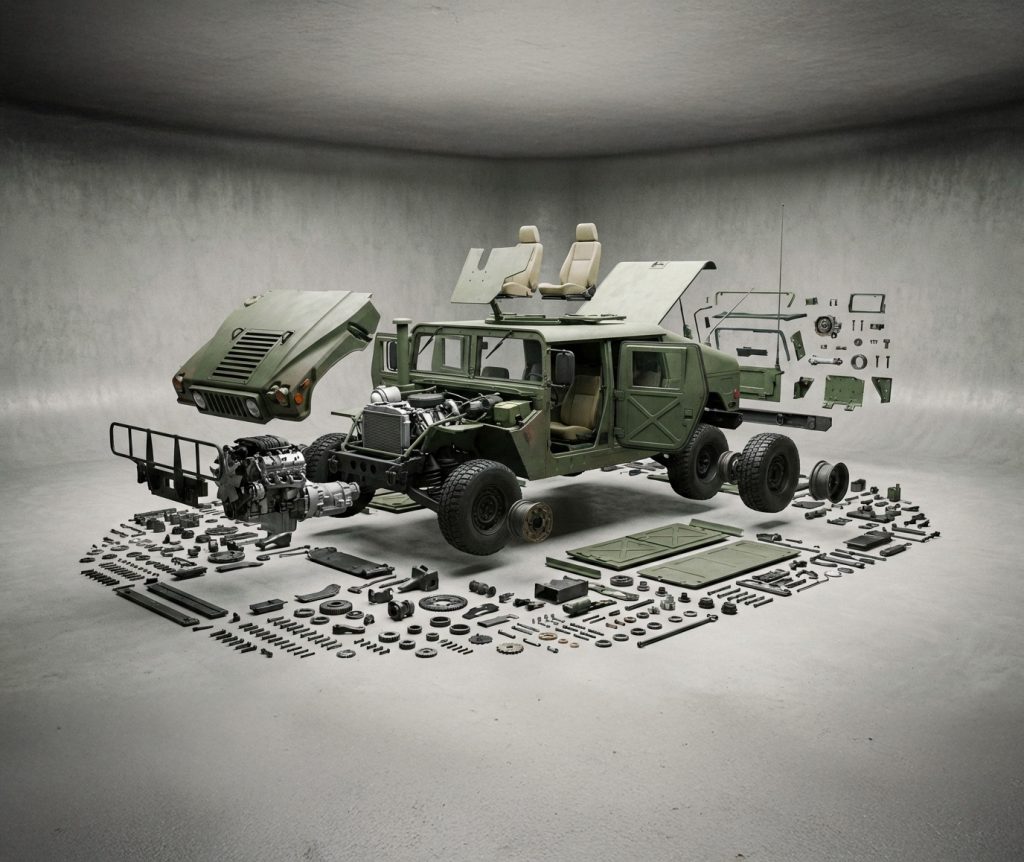
The HMMWV is built to survive abuse, but it’s still a machine operating under heat, dust, vibration, heavy load, and aggressive terrain. When units talk about “most common failures,” what they’re really describing (in a defensible, technical sense) are the components that repeatedly show up in official PMCS and unit maintenance tasks because they are high-wear, high-exposure, or mission-impacting when neglected.
At AB Defence, we support HMMWV fleets by focusing on these platform-specific high-turn items—so maintenance teams can reduce downtime, prevent repeat faults, and keep readiness predictable.
What “Most Common Failures” Means Here (So We Stay 100% Accurate)
Public sources rarely provide fleet-wide failure-rate statistics. So this list is built from official operator PMCS requirements, troubleshooting tables, and unit-maintenance procedures—the places where the Army/DoD tells maintainers where problems repeatedly emerge and what must be inspected, serviced, or replaced.
1) Halfshafts and CV Boots (Plus Ball Joint Boots)
If you want one “silent killer” of HMMWV reliability, it’s torn boots that let contaminants in. The operator PMCS explicitly calls for checking halfshaft CV boots and ball joint boots for rips/tears/cuts—because once a boot fails, joint wear accelerates fast.
Unit maintenance also contains dedicated halfshaft maintenance procedures (boots, joints, grease), underlining how often driveline wear must be addressed in real service conditions.
Typical field symptoms
- Clicking/knocking under load, vibration on acceleration
- Grease sling around the hub/inner fender
- Rapid wear after water crossings or sand/mud exposure
What to stock / plan
- Boot kits, clamps, grease, and (depending on variant) halfshaft assemblies or joint components
2) Geared Hub Seals and Lubrication Contamination
Geared hubs are a signature HMMWV design choice—and they demand respect. Unit-level guidance warns to change geared hub lubricants when contaminated (water/foreign material) or overheated by smell/feel/visual indicators, and even specifies fill quantities—this is not “rare maintenance.”
There are also detailed procedures for geared hub seal replacement (e.g., spindle seal), which is exactly the kind of task that exists because leaks/contamination happen in the field.
Typical field symptoms
- Drips at the hub, oily residue, odor of overheated gear oil
- Noise that changes with speed, heat buildup at the hub
What to stock / plan
- Seal kits, correct lubricants, and hardware often replaced during resealing
3) Drive Belts (and Related Pulleys/Tensioners)
Belts are explicitly treated as mission-relevant wear items in PMCS: the TM calls out broken/cracked/frayed belts and even notes belt behavior at idle so maintainers don’t misdiagnose normal flutter.
When belt integrity slips, multiple systems get hit (charging, cooling, steering assist), so this becomes a “single point of cascading failure.”
Typical field symptoms
- Squeal, loss of charging indication, rising coolant temperature, reduced steering assist
What to stock / plan
- Correct belt type for the variant, plus inspection discipline around routing and pulley alignment
4) Cooling System: Coolant Level, Leaks, Hoses, Oil Cooler Lines, Fan Shroud
Operator PMCS emphasizes coolant level and overheating risk, and the PMCS table repeatedly targets cooling-system integrity (radiator mounts/brackets/weldments, fan shroud condition, and oil-cooler hoses/leaks).
This is where a small leak becomes a mission kill—fast.
Typical field symptoms
- Temperature gauge trending high, steam smell, coolant loss
- Visible leaks at hoses/lines, damaged shroud affecting airflow
What to stock / plan
- Hoses, clamps, caps, and (as applicable) oil cooler lines and related seals
5) Power Steering System: Fluid Level, Belts, Cooler Airflow
The troubleshooting table for hard steering points straight to repeat offenders: low fluid, missing/broken steering belts, and blocked/damaged power steering cooler fins.
The servicing section also warns about contamination—because contamination-driven wear is a real-world cause of failures.
Typical field symptoms
- Heavy steering, intermittent assist, noise under steering load
- Cooler fins clogged with debris or bent restricting airflow
What to stock / plan
- Correct fluid, belt(s), and cooler inspection/cleaning discipline
6) Brakes and Parking Brake Function (Including Low Fluid Indicators)
Before-mission checks include brake pedal travel and a functional parking brake hold test—basic, but it’s in PMCS because it matters and because issues recur.
Troubleshooting also flags low brake fluid as a check when brake warning indicators appear.
Typical field symptoms
- Excess pedal travel, inconsistent stopping, warning lamp behavior
- Parking brake not holding on incline
What to stock / plan
- Wear items (pads/rotors as applicable), fluid, and leak-detection discipline
7) Steering Linkage Wear: Tie Rods, Center Link, Idler Arm (and Related Hardware)
The steering system reference explicitly identifies the tie rod assembly, center link, and idler arm as key mechanical transmitters/support for steering motion—exactly the components that wear under shock loads and rough terrain.
Unit maintenance includes dedicated tie rod maintenance/replacement procedures, reinforcing that linkage wear is expected and serviceable.
Typical field symptoms
- Excess steering play, wander, shimmy, abnormal tire wear
- Clunks over bumps, inconsistent alignment feel
What to stock / plan
- Tie rod ends, clamps/hardware, and alignment follow-up after replacement
8) Suspension Wear Items: Control Arms, Bushings, Shocks, Ball Joints
Unit PMCS explicitly calls for inspection of control arms, bushings, springs, shock absorbers, and brackets for damage—again, because these are realistic wear/failure points in service.
Ball joints have dedicated replacement procedures in the unit maintenance manual, underscoring their service reality.
Typical field symptoms
- Clunking, uneven tire wear, instability under braking or over bumps
- Visible boot damage, looseness, shock leakage
What to stock / plan
- Ball joints, bushings, shocks, and related fasteners/hardware
9) Electrical “No-Start / No-Charge” Repeat Offenders: Batteries, Cables, Alternator, Protective Control Box
The HMMWV electrical troubleshooting documentation repeatedly routes diagnosis through battery condition and connections, starter circuit checks, alternator checks, and the protective control box—because these are common fault domains in the 24V architecture.
Typical field symptoms
- No crank, intermittent crank, weak crank, low voltage indications
- Recurrent electrical faults after moisture/connector contamination
What to stock / plan
- Batteries and cables/connectors, alternator support, and (where applicable) protective control box availability
Why This List Is “Safe” to Publish for Military Readers
Everything above is anchored in publicly available operator PMCS items, troubleshooting tables, and unit maintenance procedures—not internet hearsay or “forum wisdom.” It’s the difference between:
- “These parts fail most in the world” (unprovable without fleet stats)
- “These parts are repeatedly targeted by official PMCS/troubleshooting and have dedicated service tasks” (defensible and verifiable)
AB Defence note: turning maintenance reality into readiness
AB Defence supports HMMWV sustainment by focusing on these high-impact, high-turnover maintenance categories—helping procurement teams source the right spares faster, and helping maintainers avoid repeat faults that keep vehicles NMC.
Related Military Spare Parts Categories, Vehicle Platforms & Technical Guides
Explore AB Defence’s NATO-codified (NSN) and genuine OEM spare parts catalog, platform technical specifications, and sustainment engineering guides related to this article:
Stocked Spare Parts Categories (NSN & OEM Catalog)
- HMMWV (Humvee / Hummer M998) Spare Parts (203 stocked parts)
- Electrical, Electronic & Vision Systems for Military Vehicles (250 stocked parts)
- Military Brake Calipers, Master Cylinders & Hydraulic Systems (103 stocked parts)
- Military Portal Axles, Differentials & Drive Shafts (107 stocked parts)
- Military Engine Cooling Systems, Radiators & Water Pumps (57 stocked parts)
- Full NATO NSN & OEM Spare Parts Catalog (16,760+ Parts)
Compatible Vehicle Platforms & System Hubs
- HMMWV M998
- Tactical Wheeled Vehicles
- Electrical, Electronic & Vision Systems
- Brake & Suspension Systems
- Engine & Powertrain Systems
- Request a B2B Quotation (RFQ) & Technical Support