AB DEFENCE Platform support
PARS III 6×6
Explore platform information, technical systems and spare parts support.
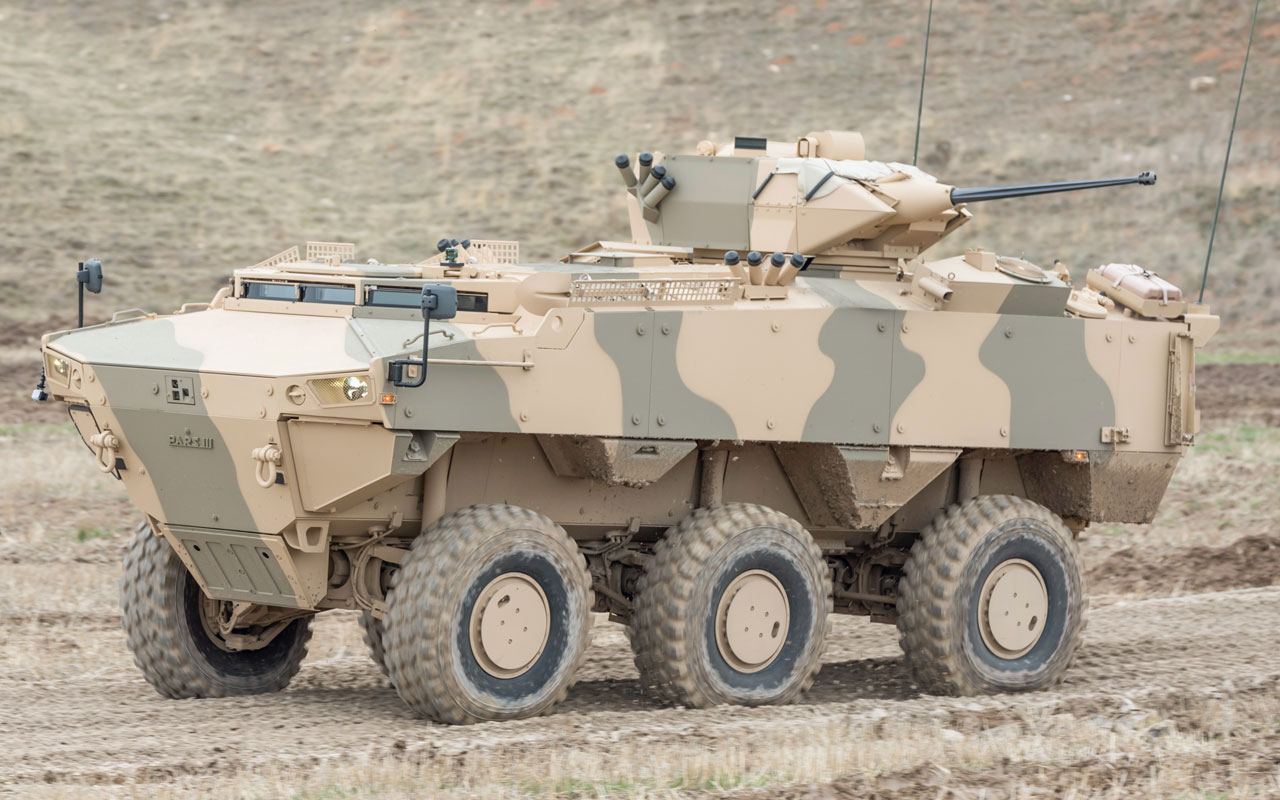
The FNSS PARS III 6x6 is a high-performance Wheeled Armoured Vehicle (WAV) engineered for superior tactical mobility and advanced ballistic and mine protection in modern combat environments. This sophisticated platform utilizes a state-of-the-art independent hydropneumatic suspension system and a high-torque power pack to ensure mission success across the most challenging off-road terrains. We provide a comprehensive range of FNSS PARS III 6x6 spare parts, specializing in drivetrain components, electronic architecture, and mission-critical engine systems to guarantee maximum fleet uptime. Through our precision-engineered lifecycle sustainment solutions and genuine OEM parts supply, we ensure the operational readiness of the PARS III 6x6 for strategic defense operations worldwide.
Request a QuoteThe FNSS PARS III 6×6: A New-Generation Wheeled Armoured Combat Vehicle in International Service
The FNSS PARS III 6×6 is the six-wheeled member of FNSS Defence Systems' third-generation PARS wheeled armoured combat vehicle family — a platform developed with deliberate emphasis on four interconnected design objectives: mobility, protection, payload capacity, and growth potential. It represents a substantial evolution from the earlier PARS generations, introducing a fully independent hydro-pneumatic suspension system, steer-by-wire all-axle steering, a 60-minute field-replaceable power pack, and a modular armour architecture that allows protection levels to be tailored to customer requirements — including MRAP-comparable mine and ballistic protection without sacrificing the tactical mobility expected of a wheeled armoured combat vehicle.
Understanding the PARS III 6×6 within the broader PARS family is essential context for any operator or procurement authority managing this platform. FNSS's PARS vehicle family began development in 2002 as a private venture in cooperation with US company General Purpose Vehicles (GPV), initially producing the 8×8 variant that was first publicly displayed at IDEX 2005 in Abu Dhabi. Since then, the family has expanded to encompass 4×4, 6×6, and 8×8 configurations, with continuous development producing progressively refined generations. The "PARS III" designation specifically marks the third-generation standard — rolled out publicly at IDEF 2017 in Ankara — which introduced the significant advances in suspension, electronics, and protection architecture that define the platform in its current production form.
The PARS III 6×6 occupies a distinct niche within the family. It is smaller and lighter than the 8×8, with a combat weight of 25,000 kg against the 8×8's 30,000 kg, and with the capacity to carry up to nine personnel compared to the 8×8's larger complement. This weight and size advantage translates into superior strategic deployability — the PARS III 6×6 is air-transportable by C-130H, A400M Atlas, C-17, and C-5 Galaxy aircraft — while still offering protection levels that FNSS positions as comparable to MRAP vehicles in the mine and IED threat categories.
The PARS III 6×6 has secured export contracts with two armed forces: the Royal Army of Oman, which ordered 27 PARS III 6×6 vehicles in five configurations as part of a total 172-vehicle PARS III contract worth approximately US$500 million signed in November 2015 — FNSS's largest export contract to that date — with deliveries completed by August 2020; and Kosovo, whose Ministry of Defence signed a Letter of Request worth €70 million with FNSS for 60 PARS III 6×6 Infantry Fighting Vehicles fitted with the Saber 25mm turret and FNSS SANCAK RCWS. Additionally, on 29 March 2022, FNSS and Malaysian partner Deftech formally proposed the PARS III 6×6 for Malaysian military service.
Understanding the Platform Architecture
Before examining individual systems and parts, it is worth understanding several architectural decisions that define the PARS III 6×6 and directly influence its maintenance and parts requirements.
Power Pack Location: Mid-Ship, Between Axles 1 and 2
Unlike the PARS 4×4, which positions the power pack at the rear of the vehicle, the PARS III 6×6 locates the power pack between the first and second axles — to the left side of the hull, leaving an aisle on the right side that connects the driver-commander cockpit to the rear troop compartment. This mid-ship location places the engine weight in a position that contributes to near-equal axle load distribution across all three axles — a design decision that FNSS explicitly identifies as fundamental to the vehicle's ability to maintain mobility on soft and loose terrain where unequal axle loading causes wheelspin and loss of direction.
The practical consequence of this layout for maintenance and field support is the PARS III 6×6's most cited logistical advantage: the power pack can be removed and reinstalled in the field in less than 60 minutes. This capability, verified by FNSS, directly reduces the mission downtime associated with power pack failures — a vehicle grounded by an engine problem can have its power pack replaced at company level without requiring the vehicle to be evacuated to a workshop. AB Defence's parts support strategy is calibrated to this capability: rapid power pack exchange requires rapid parts availability, and our supply chain is structured accordingly.
Steer-by-Wire All-Axle Steering
The PARS III 6×6 steers on its first and third axles — the front axle and the rear axle — through a steer-by-wire system that provides the lowest turning radius in the 6×6 wheeled armoured vehicle class. Critically, the steer-by-wire system is electronically managed: at higher road speeds, the rear axle steering angle is progressively reduced and ultimately locked, preventing the instability that full rear-axle steering would cause at speed. This graduated rear-axle lock function, combined with the ABS system and engine braking, defines the vehicle's high-speed handling characteristics.
For parts procurement, this architecture means that the steering system encompasses both the conventional hydraulic components of the front axle steering circuit and the electronic control components of the steer-by-wire system — both of which must be maintained to correct specification. AB Defence supplies components for both elements.
Hydro-Pneumatic Independent Suspension with Ride Height Control
The fully independent hydro-pneumatic suspension system provides each of the six wheels with individual, unrestricted travel — the highest wheel travel in the 6×6 wheeled armoured vehicle class according to FNSS documentation. Hydro-pneumatic units replace conventional coil or leaf springs, using fluid and gas pressure to manage wheel movement with progressively increasing resistance as travel increases. This system also enables active ride height adjustment, allowing the vehicle to be raised or lowered from the driver's position to suit terrain or tactical requirements.
This suspension architecture requires parts support that differs fundamentally from the conventional leaf spring and shock absorber systems found on earlier-generation military vehicles. The hydro-pneumatic strut assemblies, ride height control valves, and associated hydraulic circuit components are purpose-designed for the PARS III platform and cannot be substituted with generic components. AB Defence maintains dedicated sourcing for these assemblies.
PARS III 6x6 Technical Specifications
| Parameter | Specification |
|---|---|
| Manufacturer | FNSS Defence Systems, Ankara, Turkey |
| Generation | PARS III (Third Generation) |
| Configuration | 6×6, Full All-Wheel Drive |
| Combat Weight | 25,000 kg |
| Personnel Capacity | Up to 9 (driver, commander + troops, variant-dependent) |
| Length | Under 7 metres |
| Width | 2.9 metres |
| Hull Height | 2.4 metres |
| Maximum Road Speed | 100 km/h |
| Operational Range | Over 800 km |
| Grade Climbing | 60% |
| Side Slope | 30% |
| Vertical Obstacle | 0.7 metres |
| Trench Crossing | 1.75 metres |
| Suspension | Fully independent hydro-pneumatic, with ride height control |
| Steering | Steer-by-wire, axles 1 and 3; rear axle progressively locks at speed |
| Turning Radius | Lowest in class (under 7 metres) |
| Braking | ABS (Anti-lock Braking System) + engine brake |
| Tyre System | CTIS (Central Tyre Inflation System); run-flat solid disc inserts |
| Amphibious Capability | Optional (trim vane, bilge pumps, water jets — not standard on all customer orders) |
| Power Pack | Water-cooled diesel engine + fully automatic transmission |
| Power Pack Removal | Under 60 minutes field replacement |
| Fuel Tanks | Explosion- and puncture-protected main tank + under-armour reserve tank |
| Hull Structure | Ballistic steel |
| Armour System | Modular design — tailorable ballistic and mine protection levels |
| Mine Protection | STANAG 4569; hull form, underbelly structure, base plates |
| Mine-Protected Seats | Standard fitment, all crew and troop positions |
| Seatbelts | Five-point harnesses, all positions |
| Crew Hatches | Commander and driver: individual single-piece roof hatches opening to the side |
| Rear Exit | Powered rear ramp |
| Air Conditioning | Integrated system maintaining +25°C in desert conditions |
| CBRN Protection | Available |
| Smoke Grenade Launchers | 8 units |
| Fire Suppression | Automatic fire suppression system |
| Driver Visibility | 180°+ horizontal field of view, large glass periscopes |
| Cameras | Front and rear thermal cameras + day cameras (driver and commander) |
| Displays | Flat-panel displays, driver and commander positions |
| Electronics | SAE CAN-bus distributed computing architecture; solid-state over-current protection (fuse-free) |
| Auxiliary Power Unit | Integrated APU |
| Air Transportability | C-130H, A400M, C-17, C-5 Galaxy |
| Production Rollout | IDEF 2017 (first public display as PARS III generation) |
| Primary Operators | Royal Army of Oman (27 vehicles, 5 configurations); Kosovo (60 IFV) |
Platform Variants and Mission Configurations
The PARS III 6×6's modular architecture is fundamental to its value proposition: the base hull, power pack, drivetrain, and protection system are common across all variants, with mission-specific equipment — turrets, weapon stations, mortar systems, communications suites, medical equipment — integrated onto the common platform. This commonality dramatically reduces the parts and training burden of operating a mixed-mission fleet: a PARS III 6×6 fleet comprising IFVs, reconnaissance vehicles, and mortar carriers shares the vast majority of its automotive components across all three variants.
Infantry Fighting Vehicle (IFV)
The IFV configuration arms the PARS III 6×6 with a weapon station or turret for direct fire support of dismounted infantry. Kosovo's procurement is the most documented current example: 60 vehicles configured as IFVs with the Saber 25mm turret and FNSS SANCAK RCWS. The SABER turret — a one-man, stabilized turret — mounts an M242 25mm dual-feed automatic cannon capable of firing a range of 25mm ammunition types, with a coaxial 7.62mm machine gun (M240 or FN MAG 58) mounted alongside. The SANCAK RCWS provides an independent weapon station — typically armed with a 12.7mm M2 HMG, 7.62mm machine gun, or 40mm Mk19 automatic grenade launcher — giving the vehicle a secondary weapon capability operated independently from within the hull without crew exposure. For export configurations, the TEBER-II 30/40 Remote Controlled Turret is actively marketed as an alternative, mounting a 30mm dual-feed automatic cannon (upgradeable to 40mm) with a 7.62mm coaxial machine gun, integrated anti-tank missile capability for targets at ranges exceeding 4 km, and an independent RCWS on the turret for engagement of elevated and drone threats.
Armoured Reconnaissance Vehicle (ARV)
The reconnaissance configuration was among the five variants delivered to the Royal Army of Oman, with 12 of the 27 Omani PARS III 6×6 vehicles in this role. The reconnaissance variant leverages the PARS III 6×6's core mobility advantages — its 100 km/h road speed, all-axle steer-by-wire manoeuvrability, and potential amphibious capability — to operate ahead of the main force, gathering intelligence and designating targets while maintaining the ability to disengage rapidly. The vehicle's thermal cameras and all-round situational awareness systems are the primary reconnaissance tools, supplemented by the flat-panel displays available to both driver and commander.
Command Post Vehicle (CP)
The command post variant removes the primary weapon system and installs enhanced communications equipment, additional display surfaces, and map boards to support command and staff functions at battalion and brigade level. Four Omani PARS III 6×6 vehicles were delivered in the Armoured Specialised Command Vehicle configuration. In this role, the vehicle's range — over 800 km on internal fuel — and road speed allow command elements to reposition rapidly in response to the tempo of operations, maintaining connectivity with subordinate units through the vehicle's communications suite.
Mortar Fire Controller Vehicle
Six of the Omani PARS III 6×6 vehicles were delivered as Mortar Fire Controller (MFC) variants. The MFC operates in direct coordination with mortar units — either the 81mm or 120mm self-propelled mortar variants of the PARS III 8×8 — providing forward observation, target acquisition, and fire mission direction capability in an armoured, mobile platform.
Armoured Training Vehicle (ATV)
One Omani PARS III 6×6 was delivered in an Armoured Training Vehicle configuration, providing a platform for driver and systems training on the PARS III automotive architecture without the full mission equipment fit of operational variants.
Fire Support Vehicle (FSV) — Export Variant
At DSA 2024 in Kuala Lumpur, FNSS unveiled the PARS III 6×6 Fire Support Vehicle equipped with the TEBER-II 30/40 RCT — a two-axis stabilised remote-controlled turret mounting a 30mm dual-feed automatic cannon, 7.62mm coaxial machine gun, two ready-to-fire anti-tank missiles, and an independent RCWS for elevation engagement of UAV and rooftop threats. This variant extends the PARS III 6×6's capability into the direct fire support role, providing organic anti-armour and fire support capability at company level without requiring dedicated tank or artillery support.
PARS III 6×6 Spare Parts Coverage
AB Defence provides spare parts coverage for all major systems and sub-assemblies of the PARS III 6×6. The modular architecture of the platform, combined with the CAN-bus distributed electronics system and the standardised automotive components shared across the PARS III family, creates a structured parts environment that AB Defence's procurement team navigates with platform-specific expertise.
Power Pack — Engine & Transmission Components
The power pack — comprising the water-cooled diesel engine and fully automatic transmission as a single integrated assembly — is the most operationally critical component on the PARS III 6×6. FNSS's design intent is explicit: the power pack is a field-replaceable unit, removable and installable in under 60 minutes. This requires that replacement power packs and their component parts be available at forward logistics nodes — not exclusively at base workshops. AB Defence's supply approach for power pack components reflects this operational requirement.
AB Defence supplies the following power pack components: engine assemblies and sub-assemblies compatible with PARS III 6×6 installation, engine cooling system components including water pump, thermostat, radiator, intercooler (where fitted), coolant hoses and all associated hardware, air filtration system including primary and safety filter elements, housing assemblies and intake ducting, engine lubrication system components including oil pump, oil filter, oil cooler and all associated seals and gaskets, fuel system components including primary and secondary fuel filters, fuel delivery pump, fuel system seals and all under-armour reserve tank components, engine mount assemblies and vibration isolators, exhaust system components, complete engine gasket sets and seal kits, automatic transmission assemblies and service components, transmission filter and seal kits, transmission control module and interface components, all associated wiring harness assemblies for engine and transmission systems.
Drivetrain — Axles, Driveshafts & Differential Systems
The PARS III 6×6's full 6×6 all-wheel drive system — with the ability to lock all axles when required — distributes torque across all three axles and six wheels. The axle lock capability is operationally valuable on soft terrain but places cyclical mechanical loads on the differential and driveshaft components that must be managed through correct parts replacement at scheduled intervals.
AB Defence supplies: front axle assembly and differential, centre axle assembly and differential, rear axle assembly and differential, axle lock actuator assemblies and control components for all three axles, inter-axle differential assemblies where fitted, front and rear driveshaft assemblies, propshaft universal joint cross-kits (all positions), centre bearing support assemblies, wheel hub assemblies and hub bearing kits (all six positions), drive flange assemblies and associated fasteners, axle shaft assemblies and inner and outer oil seals, axle breather valves and filler plugs, differential oil seals and gasket sets.
Steer-by-Wire Steering System Components
The steer-by-wire steering system on the PARS III 6×6 — managing both front (axle 1) and rear (axle 3) steering inputs — is a more electronically complex system than the conventional hydraulic steering found on earlier-generation wheeled armoured vehicles. Its correct functioning is essential to the vehicle's core handling characteristics, particularly the progressive rear axle lock at speed that prevents high-speed instability. AB Defence supplies steering system components including: steer-by-wire electronic control unit (ECU/SCU), steering actuator assemblies (front and rear axles), steering position sensors and feedback sensors, hydraulic power steering pump (where hydraulic assist is integrated with the steer-by-wire system), steering gear assemblies (front and rear axle positions), track rod assemblies and track rod ends (front and rear), steering knuckle assemblies and kingpin sets, steering column and intermediate shaft assemblies, hydraulic steering hose sets and fittings, steer-by-wire system wiring harness and connector repair kits.
Hydro-Pneumatic Suspension Components
The fully independent hydro-pneumatic suspension system — with its active ride height control capability — is one of the PARS III 6×6's defining performance characteristics. It is also a system with no direct equivalent in commercial vehicles and no aftermarket supply chain. Parts for the PARS III's hydro-pneumatic suspension require procurement through the defence industry supply chain that AB Defence maintains access to.
AB Defence supplies: hydro-pneumatic strut assemblies (all six wheel positions), strut internal seal and rebuild kits, ride height control valve assemblies, hydraulic accumulator assemblies and gas charges, hydraulic fluid reservoir for suspension circuit, suspension hydraulic pump assembly, suspension hydraulic hoses and fittings, upper and lower suspension arm assemblies (all six positions), suspension arm bushing sets, ball joint assemblies (upper and lower, all corners), stabiliser bar assemblies and link rod sets, all suspension fasteners and torque-critical hardware.
Braking System Components
The ABS braking system and engine brake work in combination on the PARS III 6×6 to manage deceleration on the terrain types and at the road speeds this vehicle operates at — including emergency stops on high-speed road runs at 100 km/h and controlled descents on 60% grades in off-road conditions. Both capabilities depend on correctly maintained components throughout the braking system.
AB Defence supplies: brake disc assemblies (all six wheel positions), brake caliper assemblies and caliper repair kits (all positions), brake pad sets for all axle positions, ABS wheel speed sensor assemblies (all six wheels), ABS exciter rings and tone wheels, ABS electronic control unit, brake master cylinder assembly and reservoir, brake booster assembly, all hydraulic brake lines and fittings, brake fluid seals and O-ring kits, engine brake control components and actuators.
Central Tyre Inflation System (CTIS) & Run-Flat Components
The Central Tyre Inflation System is an active mobility management tool, not a passive safety feature — the driver uses it while moving to actively manage tyre contact patch for current terrain conditions. Its correct functioning is a direct determinant of the vehicle's cross-country performance. The run-flat solid disc inserts allow continued mobility following tyre damage or pressure loss — a mission-critical capability when operating in environments where tyre damage is a routine threat.
AB Defence supplies: CTIS rotary union assemblies (wheel end, all six positions), CTIS control valve assemblies, CTIS pressure sensors and monitoring components, CTIS electronic control unit, CTIS air supply lines and fittings, valve stem assemblies (CTIS-compatible), run-flat solid disc insert assemblies (all six tyre positions), wheel rim assemblies and wheel fasteners.
Electronic Architecture — CAN-Bus Distributed Computing Components
The PARS III 6×6 uses a SAE-standardised CAN-bus distributed computing architecture connecting all vehicle electronic control modules — engine, transmission, suspension, steering, braking, weapon station interface, and vehicle management systems — into an integrated network. The system uses solid-state over-current protection throughout, eliminating conventional fuses and replacing them with electronically managed protection. This architecture provides excellent fault isolation and diagnostic capability but requires correct component-level parts identification for electronic replacements.
AB Defence supplies: vehicle main control module assemblies, engine control module (ECM) for PARS III 6×6 installation, transmission control module, ABS/braking system control module, CTIS control module, suspension ride height control module, steer-by-wire control unit, weapon station interface modules, CAN-bus gateway modules, flat-panel display units (driver and commander positions), thermal camera assemblies (front and rear), day camera assemblies (front and rear), glass periscope units (driver's forward vision array), driver and commander roof hatch assemblies and seal kits, vehicle electrical wiring harness assemblies (engine bay, cab, and chassis), solid-state power distribution assemblies, relay assemblies, battery assemblies and isolator switches, connector and terminal repair kits.
Crew Protection & Mine-Resistant Seating
The mine-protected crew seats fitted to all positions in the PARS III 6×6 are safety-critical components subject to service life limitations and mandatory replacement intervals. In a mine or IED event, the energy-absorbing mechanism within each seat — designed to limit the vertical acceleration transmitted to the occupant's spine during a mine detonation — is the primary engineering control between the event and spinal injury. These components are not interchangeable with commercial seating and cannot be replaced with unqualified alternatives without voiding the vehicle's protection standard.
AB Defence supplies: mine-protected seat assemblies for all crew and troop positions, seat energy-absorber mechanisms and rebuild kits, five-point crew harness assemblies, harness buckle and adjustment fittings, seat mounting frame assemblies and attachment hardware, anti-blast floor mat assemblies, interior trim panels and crew compartment fittings.
Rear Ramp & Access Systems
The powered rear ramp is the primary embarkation and debarkation route for dismounted troops and the exit route in an emergency. Ramp actuator failures in operational conditions are a mission-critical maintenance event. AB Defence supplies: rear ramp actuator assemblies (hydraulic or electric, per vehicle specification), ramp hinge assemblies and pivot pins, ramp seal profiles and weatherstrip sets, ramp locking mechanism assemblies, emergency manual release components.
Amphibious System Components (Optional Configuration)
For PARS III 6×6 vehicles ordered with amphibious capability — noting that the Royal Army of Oman's vehicles were delivered without swimming capability in favour of enhanced ballistic and mine protection — AB Defence supplies: water jet pump assemblies (port and starboard), water jet impeller assemblies and wear rings, water jet inlet grille assemblies, water jet deflector nozzle and reverse deflector assemblies, water jet drive shaft and coupling assemblies, water jet seal and bearing kits, bilge pump assemblies and motor units, trim vane assemblies and actuator components, bilge pump inlet strainers and non-return valves.
Weapon Station Interface & Ancillary Systems
AB Defence supplies the following ancillary and survivability system components: smoke grenade launcher assemblies (8 positions), smoke grenade launcher wiring and firing control components, automatic fire suppression system components including detector units, control module, suppression agent containers and distribution nozzles, CBRN protection system components including overpressure unit, filter assemblies and detector interfaces, Auxiliary Power Unit (APU) assemblies and service components, APU fuel and cooling connections, antenna mounting assemblies and radome hardware, external stowage bracket assemblies, tow hook and recovery point assemblies, self-recovery winch assemblies and cable/rope sets (where fitted), winch control valve and solenoid assemblies.
Filters, Seals & Service Consumables
AB Defence maintains continuous stock of all consumable service items for the PARS III 6×6: engine oil filter elements, primary and secondary fuel filter elements, primary and safety air filter elements, automatic transmission oil filter elements, suspension hydraulic system filter elements, complete engine gasket sets and overhaul seal kits, shaft oil seals by assembly and position, O-ring and seal kits organised by system, CTIS seal kits and valve service kits, suspension hydro-pneumatic strut seal kits, all associated fasteners for scheduled maintenance tasks.
Operational Deployment: PARS III 6×6 in International Service
Royal Army of Oman — 27 Vehicles, 5 Configurations
The Omani PARS III 6×6 fleet, delivered between 2017 and 2020 under the approximately US$500 million contract, encompasses five configurations: Armoured Reconnaissance Vehicle (12 vehicles), Armoured Specialised Command Vehicle (4 vehicles), Mortar Fire Controller Vehicle (6 vehicles), Armoured Training Vehicle (1 vehicle), and one additional configuration detailed in contract documentation. The Omani contract was the first major export order for the PARS III generation and the second overall export contract for any PARS family vehicle following Malaysia. It validated the platform's capability in the demanding environmental conditions of the Arabian Peninsula, where desert heat, fine sand, and significant temperature cycles place severe demands on seals, filtration systems, and cooling components.
Critically, the Omani contract vehicles were delivered without the amphibious capability present in the base PARS III design — a customer decision driven by the preference for the higher ballistic and mine protection levels achievable when the hull is not configured for water entry. This illustrates the genuine modularity of the platform's protection and systems architecture, and it means that Omani PARS III 6×6 vehicles do not require amphibious system parts while requiring the full range of automotive, suspension, steering, and protection system components.
Kosovo — 60 IFV, Saber 25mm & SANCAK RCWS
The Kosovo Ministry of Defence's €70 million procurement of 60 PARS III 6×6 Infantry Fighting Vehicles represents the largest single PARS III 6×6 order to date and the first order for this configuration in an IFV role. The vehicles are fitted with the Saber 25mm turret — housing the M242 25mm dual-feed automatic cannon — and the FNSS SANCAK RCWS as a secondary weapon station. This combination gives Kosovo's armoured infantry units a vehicle capable of engaging light armoured targets and infantry with the 25mm cannon while the SANCAK provides independent overwatch capability. The Kosovo order significantly raises the PARS III 6×6's profile in the European defence market, where multiple NATO members are evaluating wheeled IFV platforms.
Why AB Defence for PARS III 6×6 Spare Parts
Current Generation, Defence Industry Supply Chain
The PARS III 6×6 is an active production programme with live export contracts and ongoing delivery obligations. Its parts supply chain is embedded in the Turkish defence industry and its international sub-contractor network — it is not a commercial automotive supply chain that general truck parts distributors can access. AB Defence operates within this environment as a defence industry specialist, maintaining procurement relationships aligned with FNSS's supply chain and the vehicle's sub-system suppliers. We are positioned to source parts that standard commercial channels cannot access.
Platform-Level Technical Knowledge
Correct parts procurement for the PARS III 6×6 requires understanding the vehicle's architecture at a level of detail that distinguishes, for example, between the steer-by-wire electronic control components of the front and rear steering axles, the variant-specific weapon station interface modules across IFV and reconnaissance configurations, and the different protection system component sets between amphibious and non-amphibious customer specifications. AB Defence's technical team maintains this platform-level knowledge and applies it to every parts enquiry to eliminate the risk of incorrect components being supplied.
Modular Architecture — Maximising Fleet Commonality
The PARS III 6×6's modular design, with a high proportion of common automotive components across all mission variants, creates the opportunity to maintain a rationalised parts inventory that supports an entire multi-role fleet from a single consolidated stock. AB Defence can work with fleet operators to identify and maintain the optimal common-parts inventory — reducing total stockholding cost while ensuring availability across all configured variants. This fleet-level approach to parts planning is a capability that general parts suppliers cannot offer for this platform.
Safety-Critical Component Certification
The mine-protected seats, five-point harness systems, automatic fire suppression system, and ballistic glazing assemblies fitted to the PARS III 6×6 are safety-critical components with defined service lives and replacement requirements. AB Defence sources all such components with full certification and traceability documentation, ensuring that the protection standard designed into the vehicle is maintained throughout its operational life and that the documentation record required for fleet safety compliance is complete.
Documentation for Defence Procurement
All spare parts supplied by AB Defence for the PARS III 6×6 are provided with supply chain traceability records, certificates of conformity for critical components, and technical data packages as required by the customer's procurement authority. Our documentation standards are aligned with Turkish defence procurement regulations, NATO logistics standards, and the government audit requirements applicable to Oman and Kosovo as operator nations.
PARS Platform Expertise
FNSS's PARS family represents one of the most significant wheeled armoured vehicle development programmes in the Turkish defence industry. AB Defence has developed specific procurement knowledge and supplier relationships aligned with the PARS platform family — knowledge that general parts distributors do not possess. We understand the parts identification requirements specific to PARS III 6x6 sub-systems, the documentation that Turkish defence procurement regulations and NATO logistics standards require, and the urgency that applies when an operationally-deployed vehicle requires a part.
Frequently Asked Questions FNSS PARS III 6x6 Spare Parts
How does the PARS III 6×6 differ from the original PARS 6×6? The PARS III designation marks the third-generation standard, publicly introduced at IDEF 2017. The key advances over earlier generations include the fully independent hydro-pneumatic suspension with ride height control, the steer-by-wire all-axle steering system with progressive rear-axle lock, the 60-minute field-replaceable power pack, and the modular armour system capable of MRAP-comparable mine protection levels. The electronics architecture also reflects CAN-bus advances over earlier generations.
Which armed forces currently operate the PARS III 6×6? The Royal Army of Oman operates 27 PARS III 6×6 vehicles in five configurations, delivered between 2017 and 2020. Kosovo has signed a €70 million contract for 60 IFV-configured PARS III 6×6 vehicles. Malaysia and Spain are among nations in active evaluation or proposal processes.
Do the Omani PARS III 6×6 vehicles have amphibious capability? No. The Royal Army of Oman's vehicles were delivered without the amphibious system in order to achieve higher ballistic and mine protection levels. Amphibious capability is an optional configuration on the PARS III 6×6, not a standard fitment across all customer orders.
Are automotive components shared between the PARS III 6×6 and PARS III 8×8? A high proportion of automotive components are common across the PARS III 6×6 and 8×8. The power pack, suspension strut type, steering architecture, braking system, CTIS, and electronics platform are derived from the same design. Specific component dimensions and capacities may differ to reflect the weight and performance differences between the configurations, and AB Defence confirms applicability from vehicle documentation before supply.
What is the significance of the steer-by-wire system for parts maintenance? The steer-by-wire system manages both front and rear axle steering — and its progressive rear-axle lock function at speed is a safety-critical characteristic. Electronic control components in this system must be sourced to correct specification and cannot be substituted with generic alternatives. AB Defence supplies all steer-by-wire system components with platform-specific identification.
What documentation does AB Defence provide with PARS III 6×6 spare parts? AB Defence provides supply chain traceability records, certificates of conformity for safety-critical and protection-rated components, part number verification against manufacturer documentation, and technical data packages for inclusion in end-user maintenance records. Our documentation is aligned with NATO logistics standards and the procurement regulations applicable to current operator nations.
 Request Technical Support
Get a response from our engineering team within 24 hours
Contact Us
AB DEFENCE / Platform support
Discuss this platform with our team.
Share your platform requirements, sourcing priorities or documentation needs.
For a specific part, use the request form on its product page.
Browse spare parts ↗AB DEFENCE
Platform support enquiry
PARS III 6×6