September 17, 2026
BMC Kirpi I vs Kirpi II: Key Differences in Engine, Suspension, Mobility and Maintenance
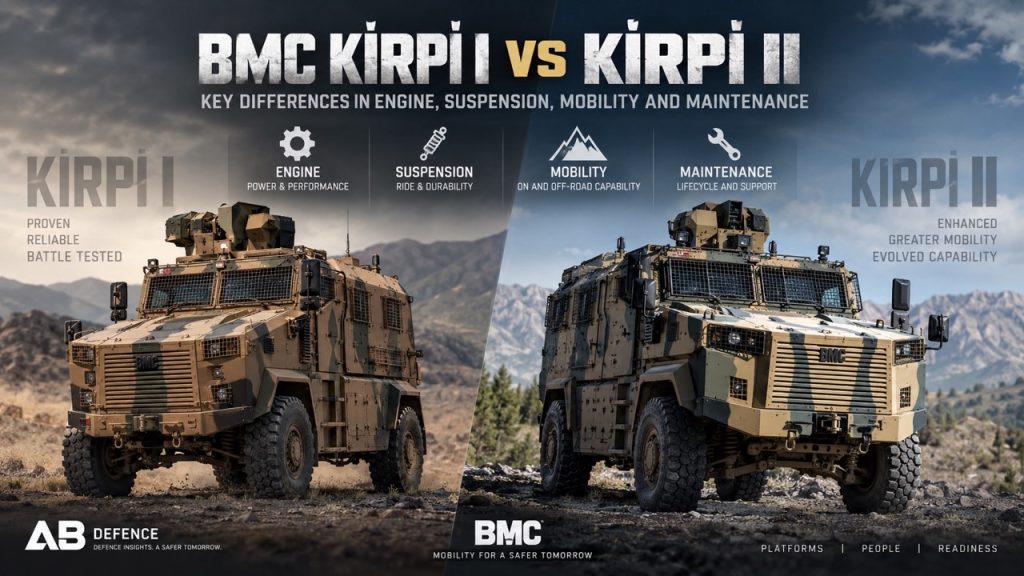
BMC’s Kirpi has carried Turkish soldiers, gendarmerie personnel and export customers through more than a decade of mine and IED contested operations, and its evolution from Kirpi I to Kirpi II follows a pattern familiar to every MRAP program: protection alone does not keep a fleet mission capable, sustainment does. For the procurement officers, fleet sustainment managers and maintenance engineers who plan around this platform, knowing exactly what changed between the two generations, and what did not is more useful than the marketing shorthand of “next generation.”
Some assumptions common in defense trade commentary do not survive contact with BMC’s own published technical specifications. The baseline engine, for example, carried over almost unchanged between the standard Kirpi I and Kirpi II troop carriers. Other changes, chiefly the move to independent suspension, rewrote the vehicle’s wear pattern and maintenance profile more thoroughly than any single spec sheet line suggests. This article works through the verified differences in engine, suspension, mobility and maintenance between Kirpi I and Kirpi II, configuration by configuration and flags where public information is incomplete or where sources disagree.
From Kirpi I to Kirpi II: Evolution of the Platform
Design work on the Kirpi began in 2008, with a first prototype following in 2009, the same year BMC won a Presidency of Defence Industry (then SSB) tender covering 614 MRAP vehicles. That contract’s preliminary and critical design work matured into what the market now calls Kirpi I. Fielding to the Turkish Land Forces and Gendarmerie General Command followed through the early 2010s, and the platform went on to accumulate sales of more than 1,500 units, including over 200 for export customers such as Tunisia, Turkmenistan and Qatar, with additional vehicles later transferred to Ukraine.
After roughly seven years of operational feedback, BMC and Turkey’s Presidency of Defence Industry signed the Tactical Wheeled Vehicles-2 (TTA-2) contract in August 2017 for 529 vehicles of an improved design, publicly referred to as Kirpi II. Deliveries began the following year, with the Gendarmerie General Command accepting its first units, reportedly including ASELSAN SARP remote controlled weapon stations, in 2018. BMC has continued to develop the Kirpi II line since, adding a Carrier Vehicle variant, a mine and IED detection/disposal (METI) variant with a robotic arm and from January 2025, an indigenous BMC Power engine option branded TUNA alongside the original Cummins power pack.
The result is not one Kirpi II but a family of configurations, each with its own baseline specification, which is precisely why blanket comparisons between “Kirpi I” and “Kirpi II” need to specify which build is being discussed.
Engine and Powertrain: What Actually Changed?
This is the section where the most common assumption about Kirpi II breaks down. BMC’s published technical specifications show that the standard Kirpi II 4×4 troop carrier retains the same Cummins ISL9E3 engine family as Kirpi I: a turbocharged, intercooled, six cylinder, 8.9 liter diesel rated at 375 PS (275 kW) at 2,100 rpm and 1,550 Nm between 1,100 and 1,400 rpm, driving through the same Allison 3000 series six speed automatic transmission and a two speed transfer case. At this baseline configuration, there is no power increase between generations.
Two things did change on the powertrain side. First, since January 2025 BMC has offered the Kirpi II 4×4 with an indigenous alternative: the BMC Power I4 TUNA, a four cylinder, 8.5 liter turbo diesel rated at 380 PS (280 kW) at 2,100 rpm and 1,600 Nm, a modest gain over the Cummins baseline, paired with the same Allison transmission and transfer case. Moving from six cylinders to four, on a similar displacement, changes the accessory drive layout, the charge air path and the parts basket a workshop needs to stock, even though torque and power are close to the outgoing engine’s.
Second, BMC’s higher payload Kirpi II configurations, the Carrier Vehicle and the 4×4 METI mine disposal variant, use a materially larger power pack: the Cummins ISL9 450 (listed in Carrier Vehicle documentation as the ISLe-T 450), the same 8.9 liter block rated for higher output at 450 PS (336 kW) at 2,200 rpm and 1,627 Nm at 1,300 rpm, paired with GHM/MERITOR two speed transfer cases and on the Carrier Vehicle, an Allison 3200 SP transmission rather than the 3000 series. This is a genuine and substantial power increase, but it belongs to the higher GVW mission variants, not the standard troop carrier.
| Configuration note Some AB Defence platform reference material describes the 450 PS / 1,627 Nm power pack as the “Kirpi II baseline.” Cross checked against BMC’s own configuration by configuration specification sheet, those figures correspond specifically to the Carrier Vehicle and METI builds. The standard Kirpi II 4×4 troop carrier that most fleets operate uses the 375 PS Cummins or the 380 PS TUNA engine. Fleet planners should confirm which engine family is actually fitted to their vehicles before ordering parts, since three distinct power packs now exist across the Kirpi II line. |
Suspension: One of the Most Important Differences
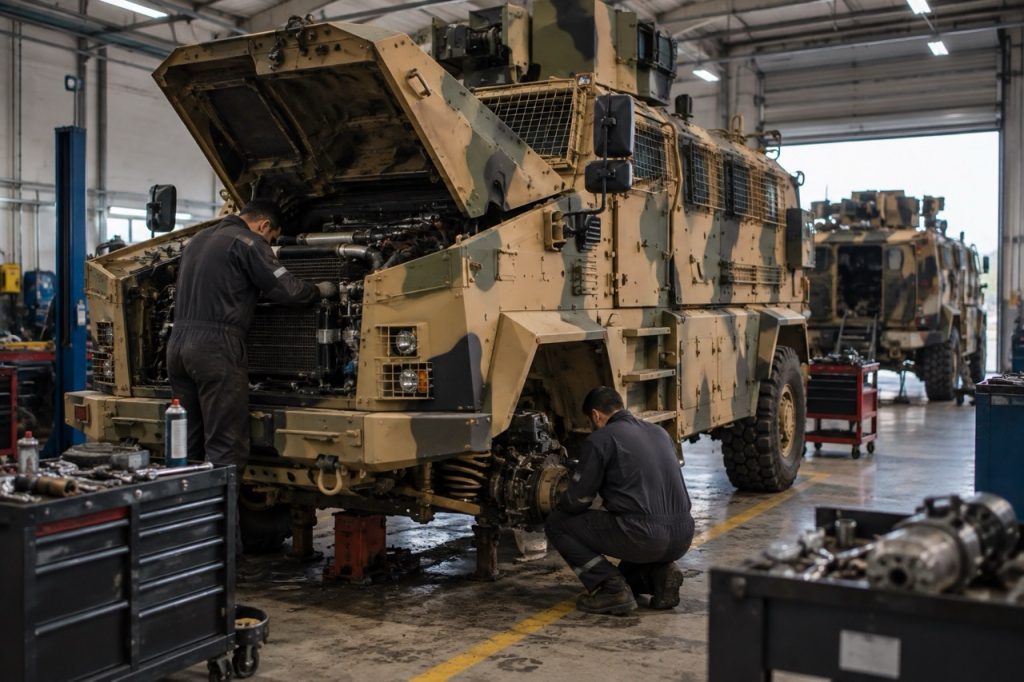
shock absorbers
What BMC’s public specification pages do not spell out is the detailed suspension geometry: whether the system uses coil springs, torsion bars, or a double wishbone layout, and how the front and rear differ. Specification aggregators outside BMC’s own site disagree with each other on this point, some describing coil springs, others double A arms with torsion bars. Because none of these can be confirmed against BMC or Turkish government publications, this article treats the exact spring and arm geometry as not publicly confirmed rather than repeating an unverified figure.
What is confirmed is the operational trade off independent suspension brings for fleet planners. A rigid leaf spring axle is mechanically simple: springs, shackles, bushings and shock absorbers are few in number and easy to inspect visually. An independent system multiplies the joint count, control arm bushings and alignment sensitive interfaces on each corner of the vehicle and its behavior under the mine protected V-hull’s substantial unsprung mass and payload swings is a different engineering problem than a leaf spring axle’s. This is consistent with how AB Defence frames Kirpi II sustainment: as a system that fails through gradual tolerance drift across many small joints and bushings rather than through a single dramatic component failure, which changes how a maintenance program has to be structured around it.
Mobility and Off Road Performance
BMC’s published performance figures for the baseline configurations show a more nuanced mobility picture than “newer is faster.” Kirpi I’s standard 4×4 is rated for a 105 km/h maximum road speed, 1,200 mm fording depth, 400 mm ground clearance and an 800 km range, on 14.00 R20 tires with CTIS and run flat capability standard. Kirpi II’s baseline 4×4, at the same tire size, is rated for a slightly lower 100 km/h maximum speed, a shallower 1,000 mm fording depth, the same 400 mm ground clearance, and a shorter range: 750 km on the Cummins engine, 700 km on the TUNA engine. Both generations list identical 60% gradeability and 30% maximum side-slope figures.
These are not regressions so much as trade offs. Kirpi II’s baseline gross vehicle weight rises to 22,000 kg from Kirpi I’s 19,710 kg, an increase of roughly 2.3 tonnes attributable to composite add on armor, the independent suspension hardware itself, and an upgraded cooling and electrical architecture. Carrying more armor and equipment on a platform with broadly similar fuel tankage and power to weight ratio produces exactly the kind of modest range and top speed reduction the figures show. The higher output Carrier Vehicle and METI configurations, both built on the 450 PS power pack and 24,000 kg gross weight, list a 450 mm ground clearance on the METI variant, the highest of any Kirpi configuration, and 700 km range with the larger 16.00 R20 tire fitment.
Both generations retain CTIS and run-flat tires as standard equipment, so this is not a capability that Kirpi II introduced; it carries forward from Kirpi I. What Kirpi II’s independent suspension does change in practical off road terms is wheel articulation on uneven ground and, by most manufacturer and defense media descriptions, ride quality over rough terrain, though BMC has not published quantified articulation or ride figures that would allow a numeric comparison.
Crew Comfort and Vehicle Stress
Independent suspension is widely credited, across MRAP class vehicles generally and Kirpi specifically, with reducing the jarring, high frequency shock transmitted to a rigid axle vehicle’s occupants on broken terrain, since each wheel can move independently rather than transmitting impacts through a shared axle beam. BMC’s Kirpi II materials describe improved comfort and handling alongside the suspension change, and the platform retains shock absorbing, mine protected seating across both generations as a separate protection feature.
Lower cabin vibration and shock loading over extended patrol or convoy durations plausibly reduces crew fatigue and lowers stress on mounted equipment such as radios, weapon stations and sensor packages. This article is not aware of published, quantified data isolating that effect for the Kirpi platform specifically, and no claim here should be read as a validated medical or human factors finding.
Maintenance: Is Kirpi II More Complex to Maintain?
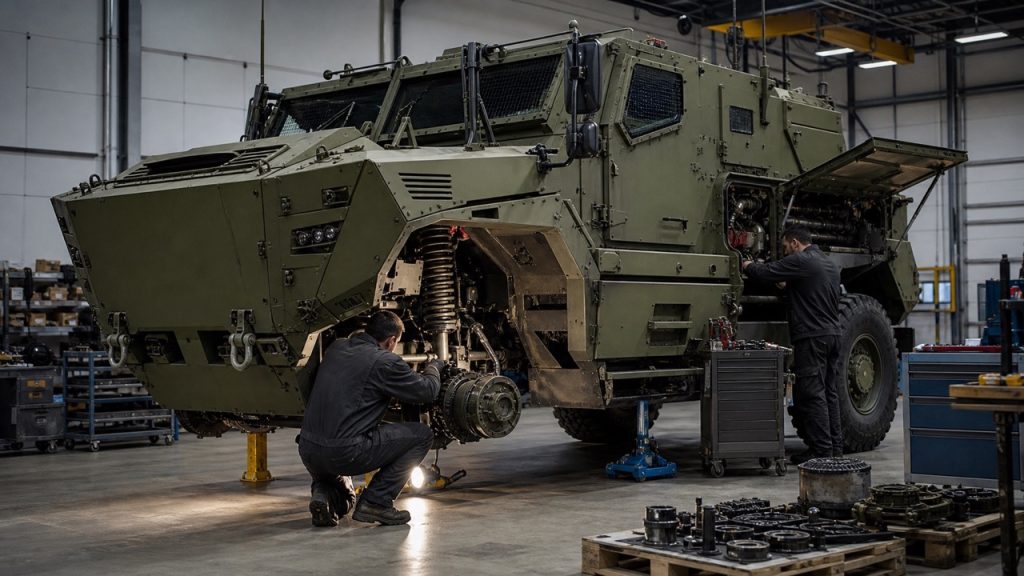
There is a real trade off here, and it runs in the direction fleet planners should expect from any leaf spring to independent suspension transition. Kirpi I’s rigid axle, leaf spring, drum brake configuration is mechanically straightforward: shackle pins, leaf packs and drum linings are well understood wear items with predictable inspection routines. Kirpi II’s independent suspension, combined with its move to disc brakes with ABS across every documented configuration, introduces more joints, more alignment sensitive interfaces and more electronic content, an ABS control system with wheel speed sensors that a drum braked Kirpi I does not carry.
AB Defence’s own platform engineering notes describe this as a shift from single point failures to cumulative tolerance drift: joints, control arm bushings and shock absorbers on an independent system wear gradually rather than failing outright, and if that gradual wear is not tracked as a system, small mismatches in alignment, damping and bushing condition compound into unpredictable handling and accelerated tire wear well before any single part is condemnable on its own. That is an engineering interpretation grounded in how independent suspension systems generally behave under payload, rather than a BMC published maintenance interval figure, and it should be read as such.
On the power pack side, the practical maintenance load depends heavily on which engine variant a given fleet actually operates. A Cummins ISL9E3-powered Kirpi II 4×4 shares its 375 PS engine family, Allison 3000 transmission and largely its charge air and cooling architecture with Kirpi I, which should ease parts commonality for units operating both generations side by side. A TUNA engined Kirpi II 4×4 introduces a different cylinder count and, presumably, a different accessory drive and filtration parts basket, though BMC has not published TUNA specific service interval documentation in its public materials at the time of writing. The 450 PS Cummins powered Carrier Vehicle and METI variants carry a materially larger cooling and charge air system, GHM/MERITOR transfer cases not fitted to other Kirpi configurations and on the Carrier Vehicle, four 12V/120Ah batteries rather than two, a considerably heavier electrical generation and storage requirement tied to their mission equipment loads.
No published BMC or Turkish government source available to this article specifies preventive maintenance intervals, NSNs, or part numbers for either generation. Any such figures a supplier quotes should be treated as that supplier’s own service program rather than a manufacturer published interval unless the manufacturer source is cited directly.
Kirpi I vs Kirpi II Technical Comparison
The table below summarizes verified baseline figures for the standard 4×4 troop carrier configuration of each generation. Higher payload variants (Carrier Vehicle, METI, ambulance) differ from this baseline as noted in the sections above.
| Feature | Kirpi I (4×4 baseline) | Kirpi II (4×4 baseline) | Operational / Maintenance Significance |
| Engine | Cummins ISL9E3 375 – 6 cyl, 8.9 L, 375 PS (275 kW) @ 2100 rpm, 1550 Nm @ 1100-1400 rpm | Same Cummins ISL9E3 375 as standard fit; BMC Power I4 TUNA option (4 cyl, 8.5 L, 380 PS/280 kW @ 2100 rpm, 1600 Nm) offered since Jan 2025 | No baseline power increase; TUNA option changes cylinder count, filtration and cooling architecture |
| Transmission / transfer case | Allison 3000 Series, 6F/1R; ZF two speed transfer case | Allison 3000 Series, 6F/1R; two speed transfer case (Carrier Vehicle uses Allison 3200 SP + GHM/MERITOR RTC60) | Core driveline family shared at baseline, easing parts commonality with Kirpi I |
| Axles / suspension | Rigid AxleTech 4000-series axles; parabolic leaf springs, telescopic hydraulic shocks, anti roll bar | Fully independent suspension, front and rear (spring/arm geometry not published by BMC; secondary sources disagree) | Defining generational change; shifts wear pattern from leaf spring/shackle wear to joint, bushing and alignment sensitive wear |
| Brakes | Drum type; full air dry service brake; spring parking brake; Jacobs brake | Disc type with ABS; dual circuit air service brake; mechanical spring handbrake; Jacobs brake | Disc/ABS upgrade improves stopping consistency but adds rotor, caliper and ABS wheel speed sensor service items |
| Tyres / CTIS / run-flat | 14.00 R20, CTIS, run-flat standard | 14.00 R20 baseline (16.00 R20 on 450 PS variants), CTIS, run-flat standard | Both generations share CTIS and run flat; not a Kirpi II-only feature |
| Max. speed | 105 km/h | 100 km/h | Small decrease at baseline configuration |
| Fording depth | 1200 mm | 1000 mm | 200 mm decrease at baseline configuration |
| Ground clearance | 400 mm | 400 mm (450 mm on METI variant) | Effectively unchanged at baseline |
| Range | 800 km | 750 km (Cummins) / 700 km (TUNA) | Decrease tied to added weight and armor, not an engine efficiency loss |
| Gross vehicle weight | 19,710 kg | 22,000 kg (24,000 kg on Carrier Vehicle / METI) | +2,290 kg baseline increase from composite add on armor, suspension hardware and cooling/electrical upgrades |
| Personnel | 13 | 13 (9 on METI, 3 on Carrier Vehicle) | Mission variants trade seating for equipment and payload |
What the Differences Mean for Military Fleets
For a fleet operating both generations, or evaluating a mixed acquisition, the practical planning questions follow directly from the verified differences above. Mission profile matters: a unit running dismounted patrol and convoy escort in varied terrain benefits from Kirpi II’s independent suspension and lower cabin vibration, while a unit prioritizing simple field level repairability and maximum range on a single tank may find Kirpi I’s rigid axle, leaf spring architecture easier to sustain with a smaller parts inventory and less specialized alignment equipment.
Maintenance infrastructure and technician training are the second variable. A workshop already equipped and trained for leaf spring axle service, shackle and bushing replacement, and drum brake work cannot simply extend that skill set to Kirpi II’s independent suspension and ABS equipped disc brakes without additional alignment tooling, ABS diagnostic equipment and technician familiarization. Spare parts planning should be built around the specific engine and configuration in the fleet, not around “Kirpi II” as a single line item; a unit with a mix of Cummins engined and TUNA engined 4x4s, or with Carrier Vehicles alongside standard troop carriers, is effectively sustaining several distinct power pack and driveline families under one platform name.
Vehicle availability, ultimately, is the sum of these choices. A fleet that identifies its exact vehicle baseline before procurement, rather than assuming uniform specifications across every “Kirpi II” in inventory, and that builds its preventive maintenance and parts stocking program around the independent suspension’s wear chain rather than treating it like a rigid axle, is better positioned to keep mission capable rates high across the vehicle’s service life.
Conclusion
The transition from Kirpi I to Kirpi II is real, verifiable and significant, but it is narrower and more configuration dependent than “next generation” marketing language suggests. The defining, confirmed change is the move from rigid leaf spring axles to independent suspension across every Kirpi II configuration, paired with a shift to disc brakes with ABS. Engine output, by contrast, did not increase at the standard 4×4 troop carrier level; the meaningful power increase to 450 PS is specific to the Carrier Vehicle and METI mission variants and a separate 380 PS indigenous engine option has existed since January 2025. Gross vehicle weight rose by roughly 2.3 tonnes at the baseline configuration, with a corresponding, modest reduction in top speed, fording depth and range.
None of this makes one generation categorically superior to the other for every mission; it makes them different engineering solutions with different sustainment requirements. Fleets get the most value from either when procurement and maintenance planning are built around the verified specification of the exact vehicle in service, not the platform name on its own.
Work With AB Defence
Partner with AB DEFENCE for Reliable Combat Support Vehicle Sustainment. AB DEFENCE is a specialist international supplier of military spare parts and fleet sustainment solutions serving NATO and allied defense organisations. With deep inventory across a wide range of combat support vehicle platforms, rigorous quality assurance processes, export compliance expertise, and a commitment to long term supply chain partnership, AB DEFENCE helps defense buyers maintain fleet availability, reduce sustainment costs, and meet their operational readiness obligations. Contact the AB DEFENCE team to discuss your spare parts requirements, strategic inventory planning, and long-term sustainment programme needs.
Contact AB Defence to discuss your procurement requirements and learn how we can support your fleet readiness objectives.
Related Military Spare Parts Categories, Vehicle Platforms & Technical Guides
Explore AB Defence’s NATO-codified (NSN) and genuine OEM spare parts catalog, platform technical specifications, and sustainment engineering guides related to this article:
Stocked Spare Parts Categories (NSN & OEM Catalog)
- BMC Kirpi MRAP Spare Parts (Kirpi I & Kirpi II) (597 stocked parts)
- Military Brake Calipers, Master Cylinders & Hydraulic Systems (103 stocked parts)
- Military Portal Axles, Differentials & Drive Shafts (107 stocked parts)
- Military Engine Internal Components & Overhaul Parts (104 stocked parts)
- Electrical, Electronic & Vision Systems for Military Vehicles (250 stocked parts)
- Full NATO NSN & OEM Spare Parts Catalog (16,760+ Parts)
Compatible Vehicle Platforms & System Hubs
- Kirpi I (BMC)
- Cobra II
- Ejder Yalçın
- Tactical Wheeled Vehicles
- Brake & Suspension Systems
- Request a B2B Quotation (RFQ) & Technical Support