September 8, 2026
How Oshkosh Military Trucks Maintain Mobility in Extreme Terrain Conditions
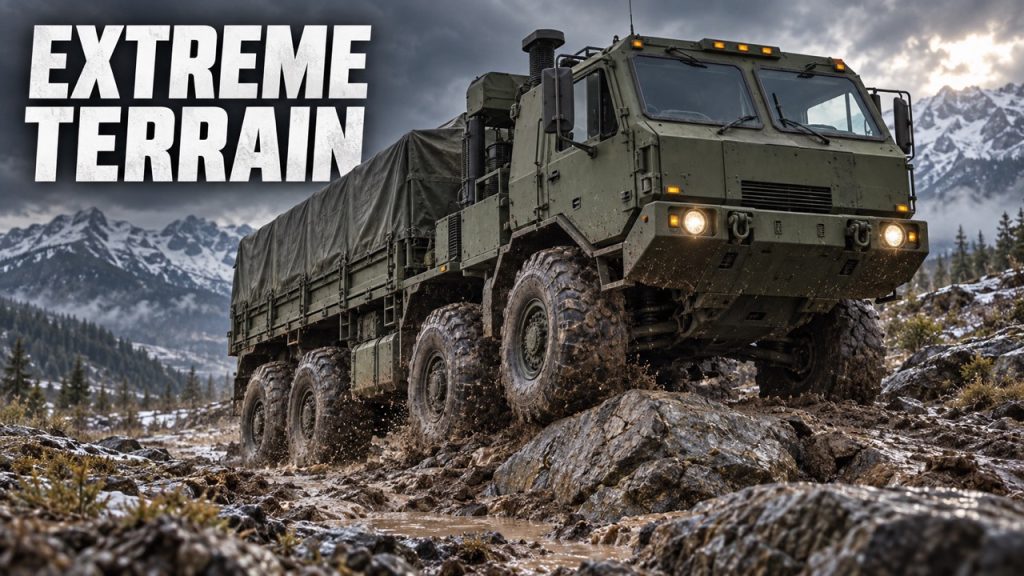
A tactical truck that cannot reach the objective is not a logistics asset it is a liability parked at the edge of the operating area. That is the problem Oshkosh Defense has engineered against for decades: how to move fuel, ammunition, troops and recovery equipment across mud, sand, snow and broken rock without stopping the mission.
The answer is not one invention but a stack of interacting systems independent suspension, central tire inflation, all wheel drivetrains and terrain specific geometry tuned together so that a fully loaded 8×8 truck can follow where a much lighter vehicle would bog down. This article walks through how those systems work, where they are used across the Oshkosh product line and where their limits actually sit.
Why Extreme Terrain Mobility Matters for Military Logistics
Combat power depends on sustainment reaching the point of need, and the point of need is rarely a paved road. Fuel resupply, ammunition transfer, casualty evacuation and equipment recovery all have to happen off the improved road network, often on terrain that was never meant to carry an 8×8 truck at gross vehicle weight.
When a sustainment vehicle gets stuck, the effect is not confined to that truck: it can strand the convoy behind it, expose personnel at a fixed location, and force a diversion of recovery assets that were needed elsewhere. Extreme terrain mobility is therefore not a performance figure on a spec sheet it is a readiness requirement that shapes how far forward logistics can operate and how quickly a unit can reposition.
Suspension Architecture and Wheel Travel
The starting point for Oshkosh’s terrain performance is the TAK-4® independent suspension system, developed by Oshkosh from the mid-1990s and first fielded on Marine Corps 5-ton truck upgrades before becoming standard across much of the company’s tactical wheeled vehicle line. Unlike a solid-axle leaf-spring setup, where one wheel dropping into a rut can lift the opposite wheel off the ground, an independent system lets each wheel move through its own arc, keeping more tires in contact with the ground at any given moment. On the up armored HMMWV application, Oshkosh reported that fitting TAK-4 delivered 14 inches of independent wheel travel and raised ground clearance to 17 inches, improving both obstacle clearance and standoff distance from underbody blast effects. The Medium Tactical Vehicle Replacement (MTVR), built on the same suspension family, is rated for 16 inches of wheel travel and a 70 percent off-road operating profile.
Oshkosh’s next generation system, TAK-4i® intelligent independent suspension, extended wheel travel further to 20 inches, which the company describes as 25 percent more than other suspension systems fielded on U.S. military vehicles at the time of its 2011 introduction while adding electronically controlled damping to improve ride quality and speed over rough ground. TAK-4i is the suspension fitted to the JLTV (Joint Light Tactical Vehicle) family, where Oshkosh states it delivers off-road speeds 70 percent faster than the M-ATV, previously the service’s best performing off road platform, without sacrificing ride quality for the crew. On the JLTV, the suspension can also be raised or lowered from inside the cab to meet different air, sea and land transport height requirements.
Suspension travel matters mechanically because it is what keeps torque going to the ground. A wheel that has lost contact with the surface cannot transmit power regardless of how much torque the engine and axles can deliver, so more usable wheel travel engineered, not just theoretical is a design lever the whole rest of the drivetrain depends on.
Tire Pressure Management and Ground Contact
Suspension travel solves the vertical problem; central tire inflation systems (CTIS) solve the footprint problem. CTIS lets the driver adjust air pressure in each tire from inside the cab, without stopping to air down manually. Lowering pressure increases the tire’s contact patch with the ground, spreading the vehicle’s weight over a larger area and reducing the ground pressure that would otherwise cause a tire to dig into soft soil, sand or snow. Raising pressure again for hard surfaced roads restores fuel efficiency and reduces tire wear.
Oshkosh’s current generation medium tactical platform, the FMTV A2, is equipped with CTIS alongside armored cabs and automatic braking as part of its mobility and survivability package. The system also has a secondary safety function: it can maintain a set pressure automatically in the event of a slow puncture, keeping a damaged tire usable long enough to reach a safer location for repair or replacement.
Drivetrain, Torque and Traction
Oshkosh’s heavier tactical trucks are built on all wheel drive architectures 6×6 on the MTVR, 8×8 on the HEMTT and LVSR families so that engine torque is available at every axle rather than concentrated on a pair of drive wheels. Oshkosh describes its involvement in all wheel drive engineering for off road mobility as dating back more than 90 years, tracing to the company’s origins building four wheel drive trucks in Oshkosh, Wisconsin. Power is distributed through transfer cases and axle assemblies engineered to route torque to whichever wheels retain traction, and combined with the independent suspension, the effect is a drivetrain that keeps pulling even when several tires are on loose or uneven ground rather than a firm surface.
On the HEMTT A4, this drivetrain is paired with a 500-horsepower Caterpillar® C15 engine, sized to move the truck’s gross vehicle weight across the grades and soft ground that heavy logistics missions require.
Designing Mobility Around Payload and Protection
Mobility, payload and armor protection are not independent variables improving one typically costs something in one of the other two, and Oshkosh’s engineering choices reflect that constant negotiation. Adding underbody armor and blast resistant hull structures increases curb weight, which in turn increases the load the suspension, tires and drivetrain must manage across the same terrain.
The U.S. Government Accountability Office’s review of the JLTV and M-ATV programs noted this tension directly: JLTV’s design requirements called for protection levels comparable to the M-ATV without a loss of payload or automotive performance, and GAO identified staying within vehicle weight limits for helicopter transportability as one of the program’s central engineering challenges. The M-ATV itself illustrates the trade off resolved in the other direction Oshkosh built it on the MTVR chassis specifically to inherit TAK-4 suspension mobility while absorbing the weight of MRAP level underbody protection, describing the result as capable of taking on additional armor while maintaining a 4,000-pound payload capacity. Every Oshkosh tactical vehicle reflects a version of this same calculation: how much protection and cargo a given chassis, suspension and drivetrain combination can carry without giving up the terrain performance the mission requires.
How Oshkosh Platforms Adapt to Different Terrain Types
No single feature accounts for cross country mobility; it is the combination of suspension, tire pressure and drivetrain responding differently to each terrain type that keeps a loaded truck moving.
Mud and soft soil
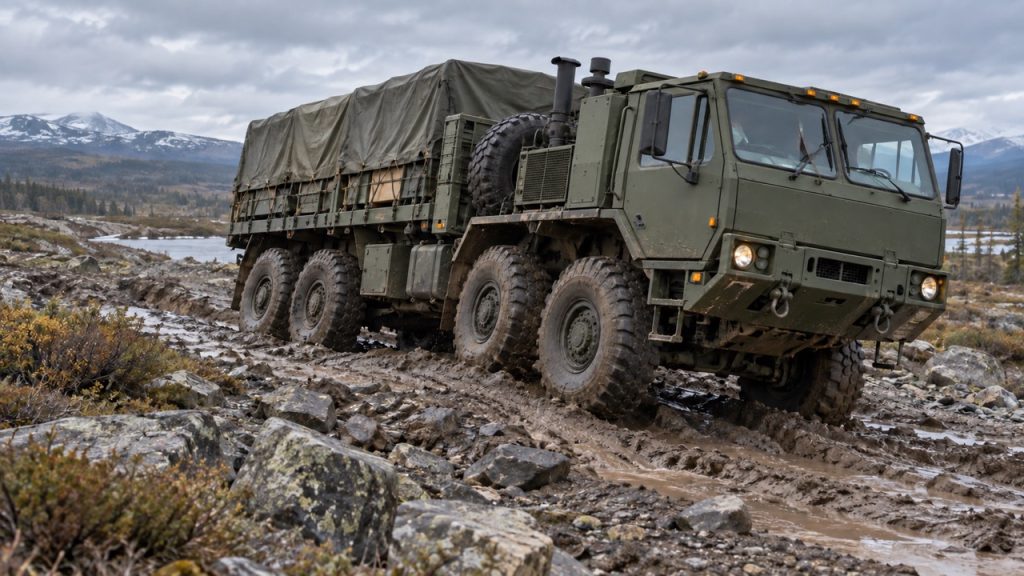
In mud, the primary risk is a tire cutting through the surface crust and losing traction as it digs deeper. Lowering tire pressure through CTIS widens the contact patch and helps the tire stay closer to the surface rather than sinking, while independent suspension travel keeps each wheel following the ground contour instead of hanging in a rut. All wheel torque distribution then allows the vehicle to keep pulling even if two or three wheels have reduced grip.
Sand and loose surfaces
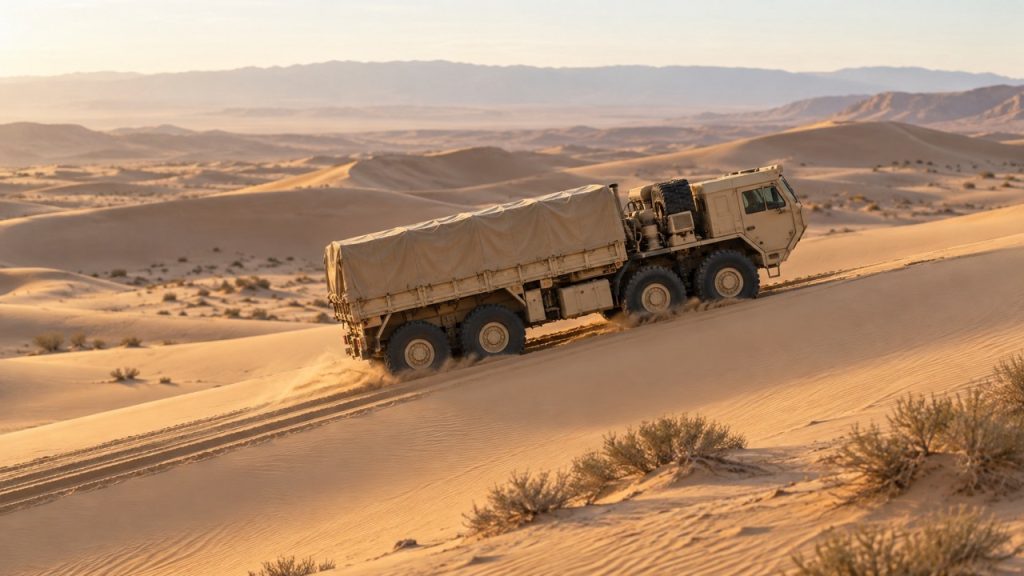
Sand behaves similarly to mud in that flotation spreading weight over a larger area matters more than raw power. Reduced tire pressure is typically the first adjustment for sand operations, and the same wheel travel and torque distribution characteristics that help in mud also apply here, allowing the vehicle to maintain momentum rather than stall in a soft dune face.
Snow and low traction conditions
On snow and ice, the challenge shifts from flotation to available grip. All wheel drive spreads the limited traction across more contact points, and suspension travel keeps tires loaded evenly rather than allowing weight transfer to strip traction from wheels that need it most on uneven, snow covered ground.
Rocks, gradients and broken ground
Rock and broken terrain test approach and departure angles and ground clearance rather than flotation. The HEMTT, for example, is rated for a 41-degree approach angle, a 45-degree departure angle, a 60 percent maximum grade and a 30 percent maximum side slope, figures compiled from U.S. Army technical documentation for the platform. These geometry figures determine whether the front or rear of the vehicle will strike an obstacle before the wheels can climb it, independent of how much torque or suspension travel the vehicle has available.
Representative Oshkosh Vehicle Platforms
The HEMTT (Heavy Expanded Mobility Tactical Truck) is Oshkosh’s 8×8 heavy logistics platform, built to move cargo, fuel, ammunition and recovery equipment, and the current HEMTT A4 variant is powered by a 500-horsepower Caterpillar C15 engine. The LVSR (Logistics Vehicle System Replacement), no longer in production but representative of the design lineage behind current heavy platforms, carried a 22.5-ton on road and 16.5-ton off road payload with self loading capability. The MTVR is the Marine Corps’ 6×6 medium payload workhorse, rated for 15 tons on road and 7.1 tons off road, and has accumulated more than 11,000 deliveries to the Marine Corps and Navy Seabees. The M-ATV was developed specifically for Afghanistan’s off-road terrain, combining an MRAP-level protected hull with the MTVR chassis and TAK-4 suspension. The FMTV A2 is Oshkosh’s current medium tactical platform, fielded with CTIS and armored cabs across a family of truck and trailer variants. The JLTV, in service since 2015 with more than 24,000 delivered to the U.S. military and allied forces, uses TAK-4i suspension to combine MRAP-level underbody protection with light vehicle mobility. Each of these platforms applies the same core mobility technologies independent suspension, CTIS where fitted, and all wheel drive scaled and combined differently to match its mission weight class.
Maintenance, Recovery and Operational Readiness
Mobility engineering only pays off if the vehicle stays available for the next mission, and sustainment has become a harder problem across the tactical wheeled vehicle fleet in recent years.
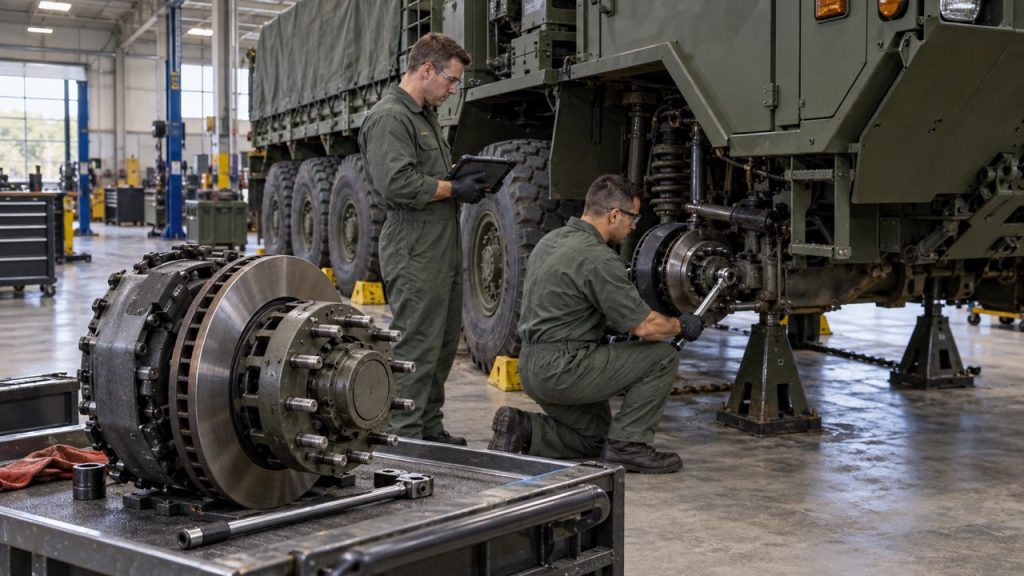
A September 2025 U.S. Government Accountability Office review of 18 Army and Marine Corps ground vehicles, including the JLTV, found that mission capable rates had declined for 16 of the 18 platforms reviewed between fiscal years 2015 and 2024, driven in significant part by parts shortages and a steep drop in depot level overhaul capacity. Suspension and drivetrain components that see extreme terrain use CTIS valves and control boxes, independent suspension arms, transfer cases and axle assemblies are exactly the kind of high wear items that depend on a reliable spare parts supply chain to keep a fleet mission capable rather than parked awaiting repair. For fleet operators, that makes verified sourcing of these mobility critical components as important to sustained off road performance as the original engineering.
Engineering Advantages and Practical Limits
The systems described here give Oshkosh platforms genuine, documented off road performance advantages: independent wheel travel measured in double digit inches, CTIS adjustable ground pressure, and all wheel torque distribution that keeps trucks moving where solid axle, single pressure vehicles would not.
But no combination of suspension and drivetrain engineering removes the underlying constraints of ground vehicle mobility. Payload and armor still add weight that the suspension and tires must carry across the same terrain, which is why GAO identified weight and payload trade offs as a defining engineering challenge for both the M-ATV and JLTV programs. Soil bearing capacity, standing water depth, extreme cold affecting fluids and batteries, driver training and the vehicle’s maintenance state all still set real limits on where and how fast a fully loaded truck can move, regardless of what its suspension and drivetrain specifications state on paper. Extreme terrain mobility, in other words, describes engineered capability relative to legacy solid axle vehicles not an absence of limits.
Oshkosh’s extreme terrain mobility is the product of several systems working together rather than any single breakthrough: TAK-4 and TAK-4i independent suspension that keeps wheels in contact with the ground, CTIS that adjusts the tire’s footprint to match soil or snow conditions, and all wheel drivetrains engineered to distribute torque to whichever wheels retain grip.
Those systems are scaled differently across the HEMTT, LVSR, MTVR, M-ATV, FMTV A2 and JLTV to match each platform’s payload and protection requirements, and each represents a deliberate trade off between mobility, weight and survivability rather than an unlimited capability. Sustaining that mobility over a vehicle’s service life depends as much on maintenance and spare parts availability for these mobility critical systems as it does on the original engineering.
Work With AB Defence
Partner with AB DEFENCE for Reliable Combat Support Vehicle Sustainment. AB DEFENCE is a specialist international supplier of military spare parts and fleet sustainment solutions serving NATO and allied defense organisations. With deep inventory across a wide range of combat support vehicle platforms, rigorous quality assurance processes, export compliance expertise, and a commitment to long term supply chain partnership, AB DEFENCE helps defense buyers maintain fleet availability, reduce sustainment costs, and meet their operational readiness obligations. Contact the AB DEFENCE team to discuss your spare parts requirements, strategic inventory planning, and long-term sustainment programme needs.
Contact AB Defence to discuss your procurement requirements and learn how we can support your fleet readiness objectives.
Related Military Spare Parts Categories, Vehicle Platforms & Technical Guides
Explore AB Defence’s NATO-codified (NSN) and genuine OEM spare parts catalog, platform technical specifications, and sustainment engineering guides related to this article:
Stocked Spare Parts Categories (NSN & OEM Catalog)
- Military Portal Axles, Differentials & Drive Shafts (107 stocked parts)
- Military Brake Calipers, Master Cylinders & Hydraulic Systems (103 stocked parts)
- Military Pneumatic Air Fittings, Brake Valves & Compressors (115 stocked parts)
- Military Vehicle Engines & Complete Power Assemblies (154 stocked parts)
- Electrical, Electronic & Vision Systems for Military Vehicles (250 stocked parts)
- Full NATO NSN & OEM Spare Parts Catalog (16,760+ Parts)
Compatible Vehicle Platforms & System Hubs
- OSHKOSH M984 A2
- Tactical Wheeled Vehicles
- Brake & Suspension Systems
- Engine & Powertrain Systems
- Hydraulics & Mechanical Components
- Request a B2B Quotation (RFQ) & Technical Support