August 27, 2026
Why Suspension Durability Is Critical in MRAP Class Vehicles
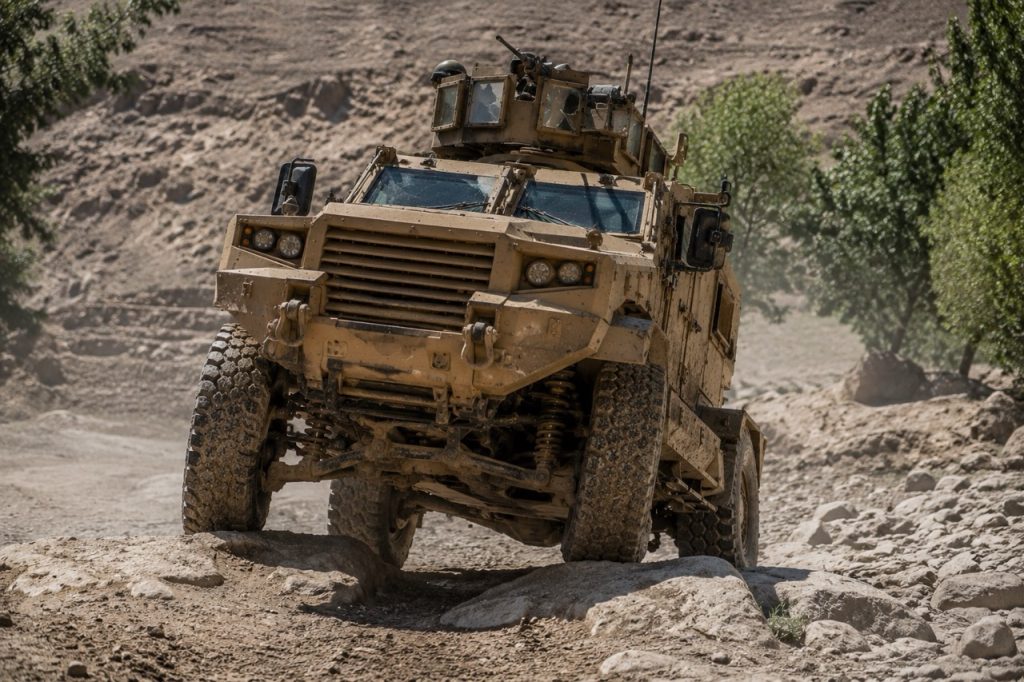
Mine Resistant Ambush Protected (MRAP) vehicles were built around a single, urgent premise: keep the crew alive when a mine or improvised explosive device (IED) detonates beneath or beside the vehicle. That premise shaped the hull geometry, the armor package and the protected crew compartment. It did not automatically solve mobility. A vehicle can be exceptionally well protected and still fail its mission if it cannot move reliably across the terrain it is asked to operate in, cannot be recovered efficiently when it breaks down, or spends more time in a maintenance bay than on the road.
Suspension durability sits at exactly that intersection between protection and performance. It is not a survivability system in the way armor or a blast deflecting hull is, and this article does not treat it as one. It is, however, the mechanical system responsible for keeping a heavily protected vehicle mobile, controllable and available for its next mission. Operational experience with MRAP vehicles in Iraq and, in particular, Afghanistan demonstrated this distinction with unusual clarity, and it remains directly relevant to any organization responsible for sustaining these fleets today.
MRAP Vehicles Place Exceptional Demands on Suspension Systems
MRAP class vehicles were not developed as clean sheet platforms optimized for weight efficiency or automotive refinement. They were fielded under wartime urgency, built to defeat a specific and evolving threat, often on chassis architectures adapted from existing commercial or semi commercial truck platforms rather than designed from a blank page around their eventual armor and payload requirements. The result was a family of vehicles that combined armored hulls, protected crew compartments, heavy wheel and tire assemblies, and substantial mission equipment on running gear that, in several early configurations, had not been engineered around that specific combination of loads.
The U.S. Government Accountability Office (GAO) documented this tension in its earliest oversight reporting on the program. GAO found that while most vehicles met their ballistic protection requirements during the first phase of developmental testing, automotive testing revealed shortcomings in reliability, mobility, handling and safety across vendors. GAO further noted that the compressed test schedule allowed for only limited automotive durability testing at that stage roughly 300 hard surface miles and 200 off-road miles per vehicle in the first phase and that no minimum reliability requirement had been established before large production orders were already committed. That gap between protection performance, which was validated early and rigorously, and automotive performance, which received comparatively less test exposure before fielding, is the starting point for understanding why suspension durability became such a pressing engineering and sustainment issue for the MRAP fleet.
| Engineering takeaway Blast protection and automotive durability are evaluated separately, using different test methods and different criteria. A vehicle can meet or exceed its ballistic protection requirement while still needing substantial suspension and running-gear engineering to meet its mobility and reliability requirements. Treating the two as a single “protection” category obscures where the actual engineering risk sits. |
Armor, Payload and the Challenge of Vehicle Weight
Armor protection is not weightless, and that added mass has to be carried by axles, control arms, springs, bushings and mounting hardware that, on several early MRAP platforms, were not originally sized around it. Beyond the armor package itself, MRAP vehicles carry crew, ammunition, communications and electronic countermeasure equipment, weapon stations, and other mission specific systems, all of which add to the load the suspension has to manage day to day. Large diameter, run flat capable tires and heavy wheel assemblies necessary for their own protective and mobility reasons contribute additional unsprung weight that the suspension and steering components must control through every terrain event.
This is a general engineering reality of purpose built protected vehicles rather than a claim about any single vehicle’s certified curb weight, and precise figures vary meaningfully by platform, armor level, and configuration which is one reason this article avoids citing a specific weight for any individual MRAP variant. What matters for fleet sustainment is the underlying principle: the added weight and added equipment change the loading environment the suspension operates in, compared with the lighter commercial or semi commercial platforms some MRAP designs were originally derived from. Components sized for a lighter, unarmored vehicle experience materially different stress once that same basic architecture is asked to carry an armored hull, a protected crew compartment and a full combat load.
This dynamic is also why suspension upgrades on several MRAP variants were pursued specifically as the vehicles’ armor packages and mission equipment loads increased over the course of their service life, rather than only as a response to terrain. GAO’s program reporting noted, for example, that DoD had not fully determined how a growing armor requirement would affect other automotive components such as tires and axles, and flagged this as an area of ongoing engineering risk for the broader tactical wheeled vehicle portfolio.
Why Rough Terrain Creates Severe Dynamic Loads
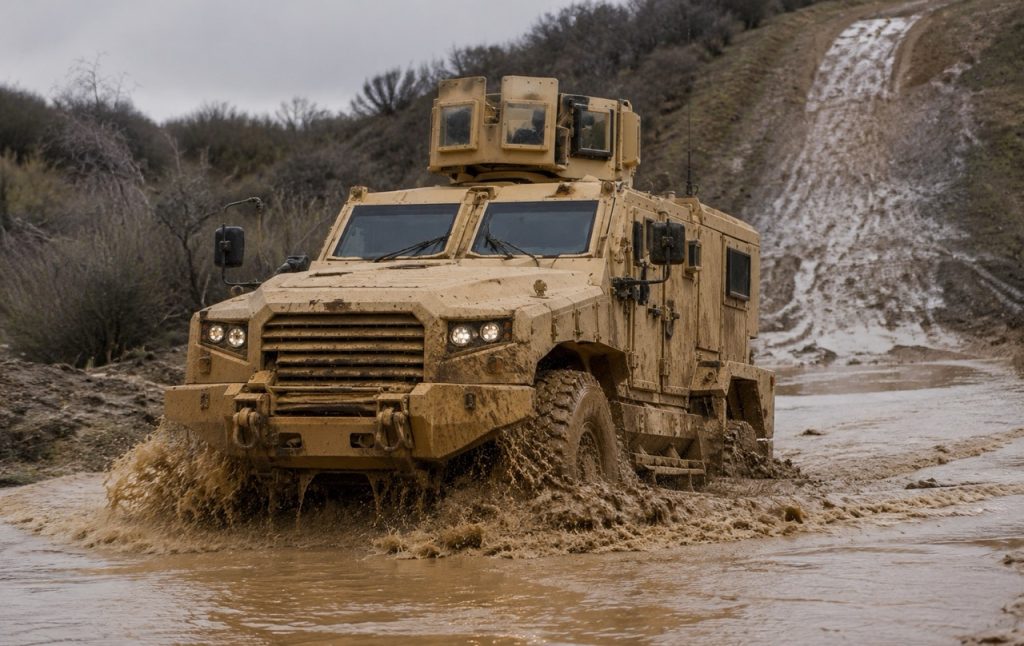
Static vehicle weight is only part of the engineering picture. Suspension components experience dynamic loading that can differ substantially from the vehicle’s weight at rest whenever the vehicle encounters potholes, embedded rocks, washboard surfaces, ditches, drop offs, or other terrain irregularities. Each of these events transmits a shock load through the tire, wheel, suspension arm, spring, damper and mounting structure. It is this repeated exposure to shock and vibration loading over the course of a deployment not simply carrying a heavy vehicle in a straight line on a paved road that drives fatigue and wear in suspension components.
Lessons from MRAP Operations in Afghanistan
The clearest evidence of the mobility challenge came directly from the field. As MRAP vehicles originally fielded in Iraq were redirected to support operations in Afghanistan, official reporting and Pentagon officials described a mismatch between the vehicles’ rigid axle suspension designs and the demands of Afghanistan’s rocky, mountainous, largely unpaved terrain. U.S. Marine Corps Brig. Gen. Michael Brogan, then commander of Marine Corps Systems Command, publicly stated that baseline MRAP vehicles used rigid axle suspensions that performed poorly on uneven, hilly ground, and that early production Cougar MRAPs were being pulled out of theater specifically to have their rigid suspensions replaced with configurations better suited to Afghanistan’s terrain and lack of road infrastructure.
GAO’s own program reporting reached a consistent conclusion, observing that operational use of MRAP vehicles had revealed a lack of maneuverability and off-road capability, and identifying this as a key factor behind the Department of Defense’s decision to pursue a lighter, more mobile MRAP variant purpose built for Afghanistan’s road and terrain conditions. That effort became the MRAP All Terrain Vehicle, or M-ATV. This history is a useful case study precisely because it shows survivability and mobility being evaluated, and addressed, as genuinely separate engineering problems a vehicle can clear one bar decisively while still requiring significant, deliberate engineering attention on the other.
It is also worth noting the scale at which the program was operating while these lessons emerged. By mid 2009, more than 16,000 MRAP vehicles had been produced and nearly 14,000 fielded across two theaters, at a total production cost of roughly $22.7 billion, according to GAO. Sustaining and adapting a fleet of that size, built by at least five different manufacturers, added its own layer of complexity to any mobility upgrade effort, since changes had to be engineered, tested and fielded across multiple, non identical vehicle families rather than a single standardized design.
The Role of Independent Suspension in MRAP Mobility
The mobility gap identified in Afghanistan was addressed through the deliberate adoption of independent suspension architecture, first in a purpose built new vehicle and subsequently as a retrofit to existing MRAP fleets.
The M-ATV and the TAK-4 system
The M-ATV program addressed the mobility shortfall directly by incorporating independent suspension into the vehicle’s architecture from the outset, rather than relying on the rigid axles used in earlier MRAP designs. The Oshkosh M-ATV, developed on the Medium Tactical Vehicle Replacement (MTVR) platform, used the Oshkosh patented TAK-4 independent suspension system, which by that point had already accumulated extensive government durability testing across the MTVR and related platforms and was in service on more than 10,000 MTVRs. According to the Director, Operational Test and Evaluation (DOT&E), the M-ATV was assessed as operationally effective, operationally suitable and survivable for armored tactical mobility and transport in support of Operation Enduring Freedom missions a designation reflecting both its protection performance and its automotive performance under formal test conditions, evaluated together rather than in isolation.
Retrofitting independent suspension to existing MRAP fleets
The mobility benefit of independent suspension was not limited to the purpose built M-ATV. The U.S. Marine Corps subsequently pursued independent suspension system (ISS) upgrade kits for its existing Cougar based MRAP fleet, a program documented in official Marine Corps guidance (MARADMIN 466/10) and in the Department of Defense’s Selected Acquisition Report for the Joint MRAP program. That report described the independent suspension upgrades as intended to enhance durability and mobility in the rural, mountainous terrain encountered in Afghanistan, with hundreds of Cougar Category I and Category II vehicles upgraded and fielded in theater, and with plans in place at the time to expand the approach to other MRAP variants including select MaxxPro and RG-31 vehicles.
Industry reporting from the period also indicates that more than one independent suspension solution was evaluated for this retrofit effort, including systems from Oshkosh and from AxleTech International, reflecting genuine engineering competition around how best to solve the mobility problem rather than a single predetermined answer. This retrofit effort illustrates a broader point relevant to any organization managing a protected vehicle fleet: suspension architecture was treated as a serious variable worth revisiting mid program based on operational feedback, not as a fixed characteristic of the vehicle class that had to be accepted as is.
| Important distinction These independent suspension programs were represented, in official and manufacturer documentation, as improvements to mobility, ride performance and durability not as changes to the vehicle’s blast or ballistic protection. Suspension durability supports the vehicle’s ability to remain mobile and available; the protection of the crew compartment remains a function of the armored hull, V shaped underbody geometry and related survivability architecture. Conflating the two overstates what a suspension upgrade actually does. |
Suspension Durability and Mission Availability
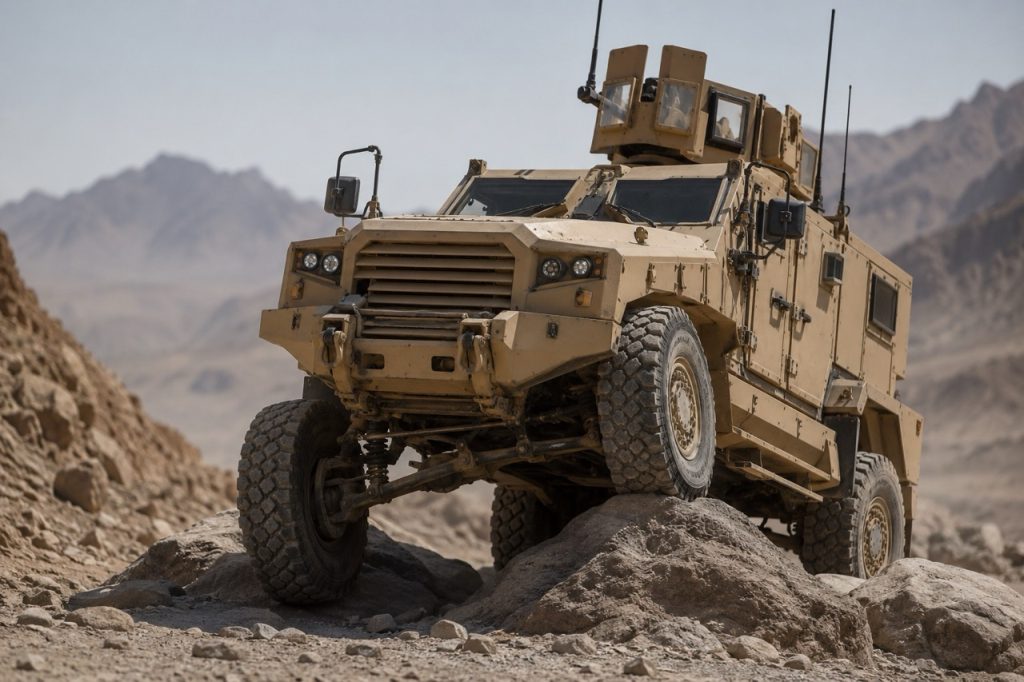
A suspension failure does not have to be catastrophic to affect a mission. A cracked control arm, a failed bushing, a worn ball joint or a damaged steering linkage can immobilize a vehicle in the field, triggering a recovery operation, consuming maintenance personnel and spare parts, and removing that vehicle from the available fleet until it is repaired. In a convoy context, a single disabled vehicle can affect the movement and security posture of the entire formation, since convoys generally have to account for recovery time and a security perimeter around a stationary vehicle.
GAO reporting on the broader MRAP program flagged sustainment and reliability as ongoing challenges even after the vehicles’ initial fielding, noting that long term sustainment costs and repair parts availability, including for high wear items such as tires, were still being worked out relative to the realities of operating a large, multi vendor fleet in theater. At the same time, GAO also reported that MRAP program officials cited fleet readiness levels consistently exceeding a 90 percent benchmark across theaters of operation as of early 2009 a figure worth citing precisely because it reflects the program’s own reported target and result, rather than an assumed or invented industry average. Sustained readiness at that level depends directly on the automotive systems, including suspension and running gear, continuing to function reliably under the vehicle’s actual operating conditions.
Vehicles that spend more time in maintenance bays or awaiting parts contribute less to available combat power, regardless of how well their armor performs when the vehicle is actually in use. This is why suspension durability is best understood as a readiness and mission availability issue as much as an automotive engineering one the two are, in practice, the same problem viewed from different vantage points.
Crew Control and Vehicle Handling
Suspension performance also shapes how predictably a vehicle handles on rough terrain, which affects driver workload and vehicle control during operations. Where supported by official testing and program documentation, independent suspension configurations such as TAK-4 were associated with improved off road mobility and handling characteristics compared with the rigid axle designs they replaced, contributing to the M-ATV’s assessed operational suitability referenced above. This article does not make claims about crew fatigue, injury rates or medical outcomes associated with suspension configuration, since reliable, MRAP specific data of that kind was not identified in the sources consulted; what can be stated with confidence is that predictable handling and consistent wheel contact with the ground are recognized engineering objectives of the independent suspension programs described here.
Engineering Considerations for Military Suspension Components
Military suspension systems for vehicles in this class rely on a range of components working together under sustained duty cycle stress: control arms, axle assemblies, coil or leaf springs, dampers, bushings, ball joints, wheel hubs, steering linkages and mounting brackets. Each of these parts has to be engineered, manufactured and installed to tolerances appropriate for repeated off-road shock loading rather than occasional light duty use.
- Control arms and axle assemblies carry the primary structural loads between the wheel and the chassis and are subject to both vertical shock and lateral cornering forces.
- Springs and dampers manage ride energy from terrain impacts; damper performance in particular degrades with heat and cycling, making duty cycle appropriate specification important.
- Bushings and ball joints are wear items by design, intended to absorb small movements and vibration, but they are also frequently the first components to show measurable degradation under sustained off road use.
- Wheel hubs and steering linkages affect both load carrying capacity and steering precision, and wear in these components can manifest as handling changes before it becomes a safety issue.
- Mounting brackets and structural attachment points transfer suspension loads into the vehicle frame or hull, and their integrity is foundational to every other component functioning as designed.
A bushing or ball joint that performs adequately in a commercial vehicle application may wear at an accelerated rate under the loads and terrain conditions a protected military vehicle regularly encounters. This is also why component provenance and manufacturing quality matter in a practical, operational sense rather than merely a procurement or paperwork sense. A suspension component that is dimensionally correct but manufactured to a lower material or tolerance standard can fail earlier than expected, and in a fleet context that translates directly into unplanned downtime, unscheduled maintenance, and, in the worst case, a vehicle that is unavailable when it is needed.
Maintenance, Spare Parts and Lifecycle Support
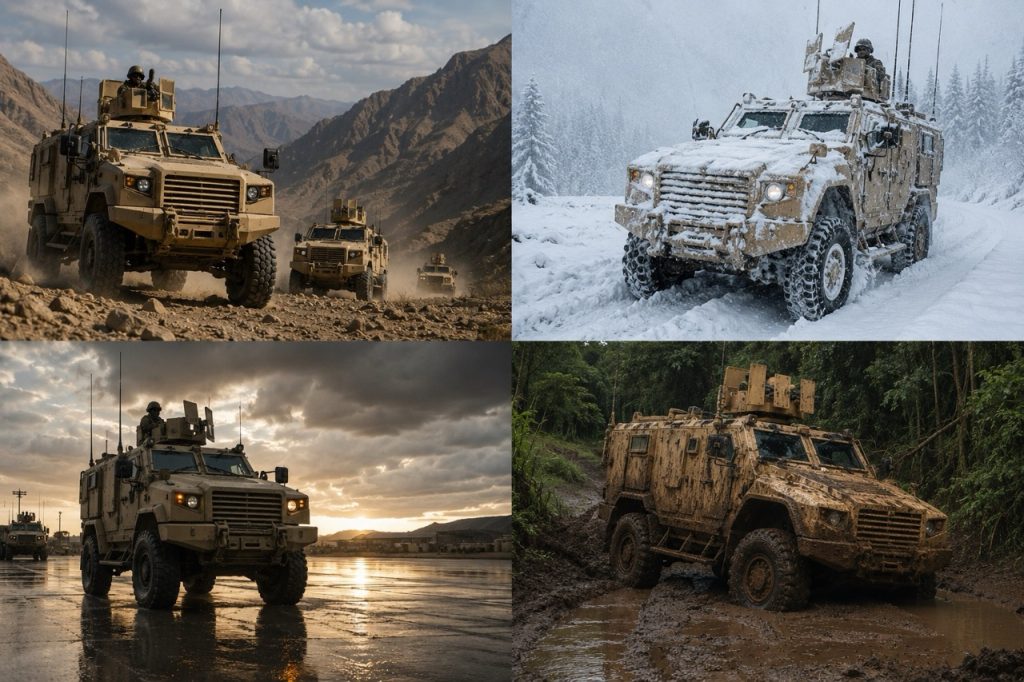
Because MRAP class vehicles differ meaningfully across manufacturers, configurations and armor levels, maintenance requirements and inspection intervals are not uniform across the vehicle family. Organizations sustaining these fleets generally follow platform specific technical manuals and manufacturer guidance rather than a single universal schedule, and this article deliberately does not propose a generic replacement interval for that reason. What is consistent across the class is the underlying requirement: regular inspection of suspension and steering components, prompt identification of wear or damage before it progresses to failure, and reliable access to correctly specified replacement parts when a component reaches the end of its service life.
This is where dependable sourcing becomes a practical, day to day operational concern for any organization maintaining a fleet of MRAP or similar protected vehicles, rather than an abstract quality consideration. Reliable identification of the correct part number and configuration for a given vehicle variant, combined with quality controlled sourcing and clear traceability from manufacturer to installation, reduces the risk of installing a component that is a poor match for the vehicle’s actual duty cycle and operating environment.
AB Defence works in this space as a supplier of spare parts and components for military wheeled and tracked platforms, including brake and suspension system components, and supports customers who need to source correctly identified, quality controlled parts for fleet sustainment. Lifecycle support of this kind does not replace platform specific engineering guidance or original manufacturer technical manuals, but it is a meaningful, practical part of keeping a protected vehicle fleet mechanically ready over years of continued service.
Frequently Asked Questions
Does a stronger suspension make an MRAP vehicle more blast-resistant?
No. Blast and ballistic protection in MRAP class vehicles comes from the armored hull, the protected crew compartment and, on many designs, a blast deflecting underbody geometry. Suspension durability affects mobility, handling and mission availability it is an automotive system, not a survivability system, and this article does not represent it as one.
Why did some early MRAP vehicles struggle with mobility in Afghanistan?
Several early MRAP designs used rigid axle suspensions that, according to Marine Corps officials, performed poorly on the uneven, hilly, largely unpaved terrain common in Afghanistan, in contrast with the more urban and road based operating environment in Iraq where many of the vehicles were originally fielded.
What is the TAK-4 suspension system?
TAK-4 is Oshkosh’s patented independent suspension system, originally developed for the Medium Tactical Vehicle Replacement (MTVR) and subsequently used on the M-ATV and, through a retrofit program, on a number of existing Cougar based MRAP vehicles to improve off-road mobility.
How often should MRAP suspension components be inspected?
Inspection and replacement intervals vary by vehicle platform, configuration and operating environment, and are governed by manufacturer and platform specific technical manuals rather than a single fleet wide standard. Regular inspection for wear in bushings, ball joints, control arms and mounting hardware is a consistent requirement across the vehicle class.
MRAP vehicles were developed to answer a specific and urgent threat, and their armored hulls and protected crew compartments did that job. Operational experience in Iraq and, especially, Afghanistan made clear that protection alone does not guarantee battlefield effectiveness. A vehicle that cannot reliably negotiate its operating terrain, maintain predictable handling, or remain mechanically available cannot fully deliver the capability it was built to provide, regardless of how well its armor performs.
Suspension durability sits squarely within that gap between protection and performance. It does not stop a blast, and it should not be described as though it does, but it is what keeps a heavily protected vehicle mobile, controllable and available for its next mission which is ultimately what makes the protection worth having in the first place. For organizations sustaining MRAP or comparable protected vehicle fleets today, that means treating suspension and running gear reliability, and the sourcing of correctly specified replacement components, as a core part of fleet readiness rather than a secondary maintenance concern.
Work With AB Defence
Partner with AB DEFENCE for Reliable Combat Support Vehicle Sustainment. AB DEFENCE is a specialist international supplier of military spare parts and fleet sustainment solutions serving NATO and allied defense organisations. With deep inventory across a wide range of combat support vehicle platforms, rigorous quality assurance processes, export compliance expertise, and a commitment to long term supply chain partnership, AB DEFENCE helps defense buyers maintain fleet availability, reduce sustainment costs, and meet their operational readiness obligations. Contact the AB DEFENCE team to discuss your spare parts requirements, strategic inventory planning, and long-term sustainment programme needs.
Contact AB Defence to discuss your procurement requirements and learn how we can support your fleet readiness objectives.
Related Military Spare Parts Categories, Vehicle Platforms & Technical Guides
Explore AB Defence’s NATO-codified (NSN) and genuine OEM spare parts catalog, platform technical specifications, and sustainment engineering guides related to this article:
Stocked Spare Parts Categories (NSN & OEM Catalog)
- BMC Kirpi MRAP Spare Parts (Kirpi I & Kirpi II) (597 stocked parts)
- Military Brake Calipers, Master Cylinders & Hydraulic Systems (103 stocked parts)
- Military Portal Axles, Differentials & Drive Shafts (107 stocked parts)
- Military Engine Internal Components & Overhaul Parts (104 stocked parts)
- Electrical, Electronic & Vision Systems for Military Vehicles (250 stocked parts)
- Full NATO NSN & OEM Spare Parts Catalog (16,760+ Parts)
Compatible Vehicle Platforms & System Hubs
- Kirpi I (BMC)
- Cobra II
- Ejder Yalçın
- Tactical Wheeled Vehicles
- Brake & Suspension Systems
- Request a B2B Quotation (RFQ) & Technical Support