August 5, 2026
OEM vs Alternative Spare Parts for Military Unimog Platforms
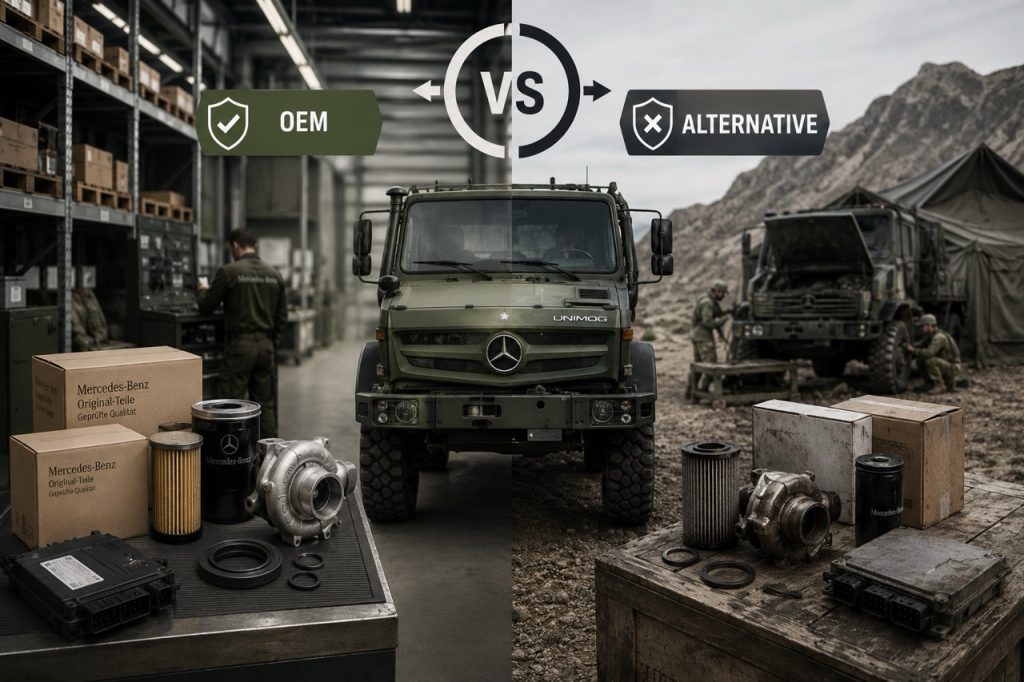
A Unimog does not fail gracefully. When a portal axle seal lets go on a resupply run through broken terrain, or a wiring harness corrodes inside a communications variant that has sat through three monsoon seasons, the vehicle stops being a logistics asset and becomes a maintenance problem sitting in the wrong place at the wrong time. What happens next whether the unit reaches into a bin of factory sourced components or works the phone to a qualified alternative supplier is rarely decided in the moment. It is decided months or years earlier, in the procurement policies, supplier qualification files, and sustainment plans that determine what kind of part is allowed anywhere near a mission critical vehicle.
The Mercedes-Benz Unimog has spent more than seven decades in military service precisely because it tolerates abuse that would retire lesser platforms. Portal axles, a torque tube frame, and a drivetrain built around simplicity rather than novelty have made it a mainstay for logistics resupply, troop transport, engineering and recovery work, communications shelters, and specialized utility roles across dozens of armed forces. But durability at the platform level does not remove the question that every fleet manager eventually has to answer for every individual component: OEM, or a qualified alternative?
This is not a question with a single correct answer. It is a procurement decision that changes depending on the component, its criticality, its position in the supply chain, and the operational tempo of the unit that depends on it. This article works through that decision from the perspective of people who actually own it defense procurement officers, fleet sustainment managers, and maintenance engineers rather than from the perspective of a parts catalogue trying to sell one category over the other.
Understanding OEM Parts in a Military Maintenance Context
In military vehicle sustainment, “OEM” refers to a component produced by, or under the direct design authority of, the original vehicle manufacturer in this case Mercedes-Benz Special Trucks and the wider Daimler Truck organization that engineers and validates the Unimog platform. Mercedes-Benz markets these as Genuine Parts, describing them as developed exclusively for the vehicle and tested to the manufacturer’s own quality requirements, distributed through a global service network and an online parts ordering platform used by its authorized service partners.
For military fleets, OEM status carries a second, equally important meaning beyond brand origin: configuration control. A genuine Unimog part is built to the exact specification, material composition, and manufacturing tolerance that the original type approval and, where applicable, the military acceptance testing were performed against. When a defense ministry or prime contractor certifies a Unimog variant for a given role whether that is a U4000-based logistics carrier, a U5000 platform, or a purpose built communications or ambulance shelter that certification implicitly assumes the vehicle is maintained with components matching its qualified baseline. Swapping in an unverified part does not just risk a part failure; it can, in the strictest reading, take the vehicle outside the configuration it was certified under.
Mercedes-Benz also offers a parallel category worth distinguishing from third party aftermarket supply: Genuine Remanufactured Parts. These are used components transmissions, cylinder heads, brake calipers, camshafts, drive shafts that are returned to the manufacturer, disassembled, cleaned, and rebuilt to original specification, with wear components replaced using new genuine parts. Because remanufacturing is performed under the OEM’s own quality system, these parts sit inside the OEM category for procurement purposes even though they are not newly manufactured, and they typically cost less than a new genuine part while carrying comparable fit and durability expectations.
What “Alternative” Spare Parts Actually Cover
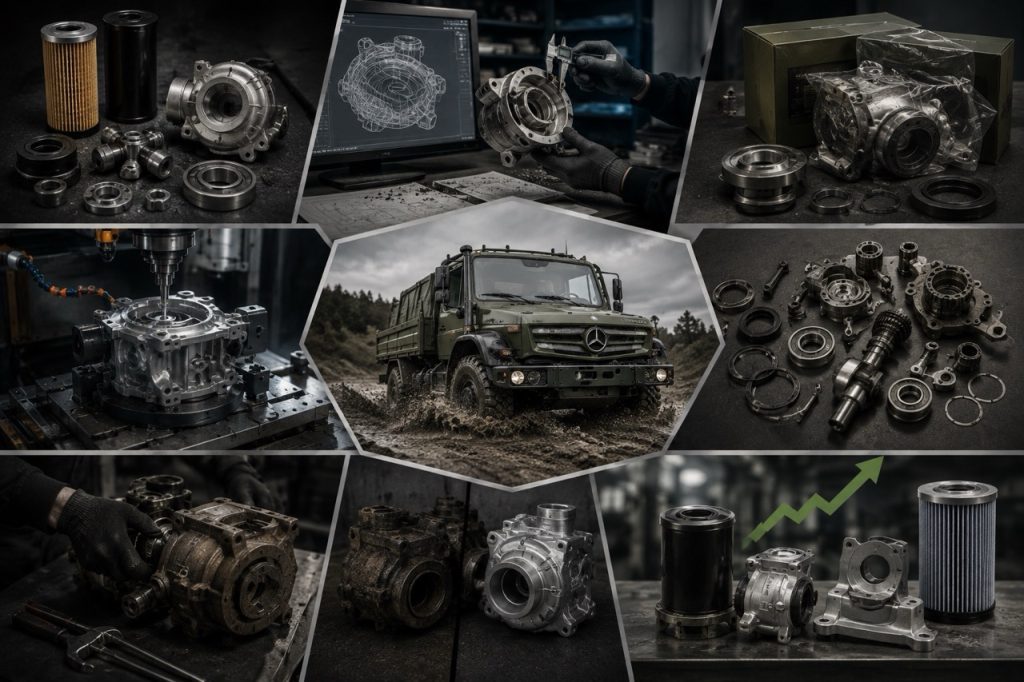
“Alternative spare parts” is a broad label that gets used carelessly in defense sustainment conversations, often collapsing several very different sourcing categories into one. For a fleet manager making a procurement decision, the distinctions matter as much as the OEM versus alternative split itself.
Certified Replacement Components
Components manufactured to the same form, fit, and function specification as the original part, produced by a supplier that has been formally qualified through documented testing and quality audits. In NATO aligned procurement environments, this qualification frequently references quality management frameworks such as AQAP (Allied Quality Assurance Publications) and ISO 9001, along with component level verification methods dimensional and material inspection, first article inspection (FAI), material test reports (MTR), and in some cases advanced verification light (AVL) or X-ray fluorescence (XRF) alloy testing. A certified replacement is not a guess; it is a documented equivalence claim backed by traceable evidence.
Reverse Engineered Components
Parts produced by measuring, testing, and replicating an original component’s geometry and material properties without access to the manufacturer’s design data. This approach is common for older or discontinued Unimog variants where the OEM no longer produces a part and no licensed alternative exists. Reverse engineering can be done rigorously with metallurgical analysis, dimensional scanning, and functional testing against the original or poorly, with only a visual match to the original part. The quality of the process, not the fact that it is reverse engineered, determines whether the resulting component belongs anywhere near a military vehicle.
Licensed Manufacturers
Companies producing components under a formal licensing or sub contracting arrangement with Daimler Truck or a Tier 1 supplier, using the same design data and, frequently, similar or shared manufacturing processes. These parts occupy a middle ground: not sold under the Mercedes-Benz brand, but built to the same engineering authority.
Independent Third Party Manufacturers
Suppliers producing components to a compatible specification without a licensing relationship to the OEM. Quality across this category varies enormously from defense focused manufacturers with rigorous internal quality systems and full traceability documentation, to commercial aftermarket suppliers whose parts were never intended for military service conditions. This is the category where supplier vetting does the most work.
Remanufactured and Overhauled Components (Non-OEM)
Used components rebuilt by an independent shop rather than the manufacturer’s own remanufacturing program. Overhaul, in defense maintenance terminology, typically refers to a more limited process inspection, cleaning, and replacement of specific wear items rather than a full teardown and rebuild to original tolerances. Both can be legitimate sustainment tools, but the rebuilding organization’s quality system, not the word “remanufactured” on an invoice, determines the reliability of the output.
Obsolete Part Replacements
Components engineered to replace a part the OEM no longer manufactures or supports. Legacy Unimog fleets some military operators still run variants dating to the 1970s and 1980s depend heavily on this category, since the manufacturer’s genuine parts catalogue for very old model series is necessarily thinner than for current production.
Upgrade Compatible Replacement Parts
Components that not only replace an original part but improve on it a filter with higher dirt holding capacity, a bushing in a more durable elastomer compound, a seal rated for a wider temperature range. These are deliberate design improvements rather than like for like substitutes, and procurement decisions here typically weigh operational benefit against the administrative burden of updating the vehicle’s technical documentation to reflect the change.
Where OEM Parts Provide the Greatest Operational Advantage
OEM components earn their premium most clearly in a specific set of circumstances rather than universally. Three factors tend to push the decision firmly toward genuine parts.
Configuration integrity on current-production platforms. For in service Unimog variants still supported by Mercedes-Benz Special Trucks, genuine parts guarantee the vehicle remains within its certified configuration baseline. This matters most for components tied to type approval, roadworthiness certification, or platform level safety systems, where a documented deviation can complicate everything from insurance and liability to interoperability agreements with allied forces operating the same platform.
Safety critical and mission critical systems where failure modes are severe. Braking system components, steering linkages, and structural suspension elements the portal axle housings, torque tube frame connections, and axle articulation joints that define the Unimog’s off-road capability are areas where the cost of a failure (vehicle loss, crew injury, mission abort in a contested environment) dwarfs any savings from an unverified alternative. Manufacturing tolerances on these components affect load distribution across the frame in ways that are difficult to verify without the OEM’s original engineering data.
Warranty covered fleets and factory supported lifecycle programs. New and recently delivered Unimog defense vehicles are typically covered by manufacturer warranty and, in many cases, integrated logistics support (ILS) arrangements that assume genuine parts maintenance. Mercedes-Benz Defence Trucks markets exactly this model a global network described as spanning thousands of authorized workshops as part of the value proposition for new build military orders. Using non genuine parts during the warranty period can void coverage entirely, turning a modest parts saving into a much larger liability if a related failure occurs later.
Where High Quality Alternative Parts Are a Practical Solution
Alternative parts are not a compromise made only under budget pressure. In several situations they are the more defensible procurement choice on operational grounds alone.
Legacy and out of production fleets. For older Unimog model series where the manufacturer’s own parts catalogue has thinned or a specific component has been discontinued, a qualified alternative supplier is often the only realistic path to keeping the vehicle mission capable. Waiting on a manufacturer special order process for a part that is no longer in regular production can mean weeks or months of downtime that a fleet sustainment plan cannot absorb.
High volume wear items and consumables. Filters, seals, bushings, bearings, brake pads, and similar wear components are replaced on a predictable schedule and consumed in large quantities across a fleet. For these categories, a certified alternative supplier with strong traceability and consistent quality control can materially reduce total cost of ownership without introducing meaningful additional risk, since the components are inspected and replaced frequently enough that any quality drift is caught early.
Forward-deployed and geographically dispersed operations. When a unit is operating far from an authorized Mercedes-Benz service partner, lead time becomes the dominant procurement variable. A regional or in theater qualified alternative supplier that can deliver in days rather than weeks may keep more vehicles mission ready than waiting for genuine parts shipped through a longer international logistics chain provided that supplier has been properly vetted rather than selected purely for speed.
Export restricted or single source situations. Where genuine parts are subject to export licensing delays, end user certification requirements, or geopolitical restrictions that add unpredictable lead time, a qualified second source reduces single point of failure risk in the sustainment plan. Defense logistics planners increasingly treat this kind of supply chain resilience as a readiness factor in its own right, not merely a cost consideration.
Component Criticality: The Real Basis for the Decision
Experienced sustainment managers rarely apply a single OEM or alternative rule across an entire vehicle. Instead, the decision is made at the component category level, based on criticality.
Mission Critical and Safety Critical Components
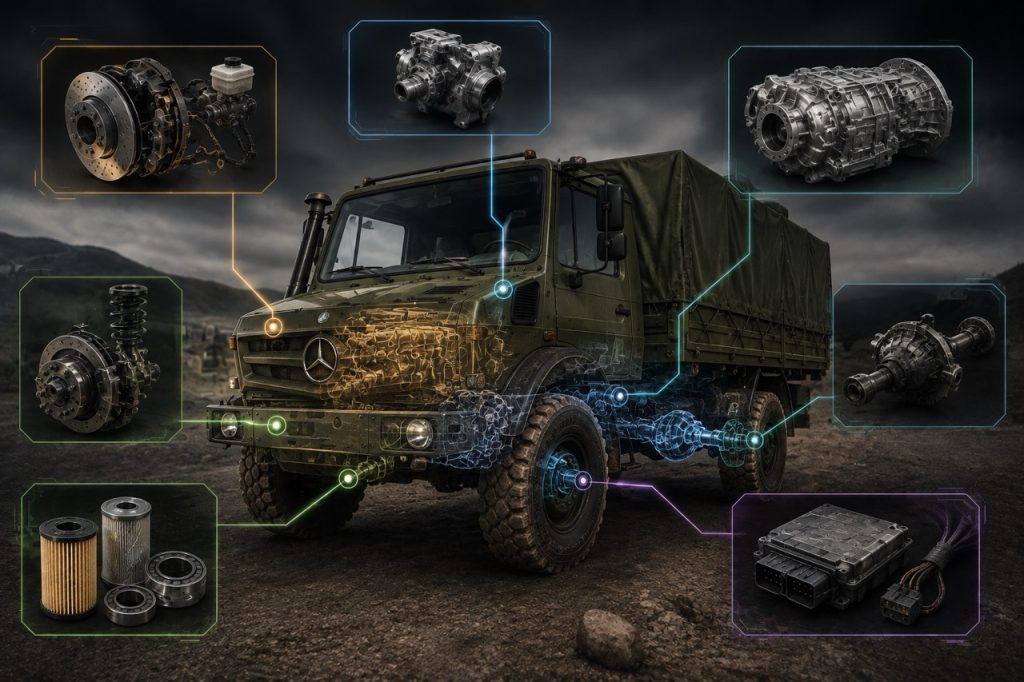
This category includes braking system components (calipers, master cylinders, brake lines), steering components, suspension and axle structural parts, driveline components carrying engine torque to the wheels, and engine components governing combustion integrity and cooling. For the Unimog specifically, this extends to the portal axle housings and gear sets, the torque tube and frame connection points that manage articulation under load, universal joints, and wheel hub assemblies. Procurement policy for these categories should default to OEM or rigorously certified alternatives only, with full material traceability and, where available, first article inspection results on file before the part is installed.
High Value Assemblies
Transmissions, transfer cases, differentials, and complete axle assemblies. These are expensive enough, and complex enough in their internal tolerances, that OEM or OEM remanufactured parts are usually the more economical choice over the vehicle’s remaining service life even when the upfront cost is higher a poorly matched alternative transmission component can cascade into far more expensive downstream damage.
Wear Items
Clutch assemblies, brake pads, bushings, seals, and bearings in non-structural applications. These are consumed on a maintenance schedule and, for a fleet of any size, represent significant recurring spend. This is the category where a well vetted alternative supplier typically delivers the strongest cost versus risk profile.
Consumables and Routine Maintenance Parts
Filters (oil, fuel, air, cabin), fluids, gaskets, and small hardware. Alternative sourcing is standard practice here across both civilian and military fleets, provided the supplier meets the fluid specifications and filtration standards the platform requires. Using an incorrectly rated filter or fluid on hydraulic or cooling systems is a common, avoidable source of premature component wear.
Electrical and Fuel System Components
Wiring harnesses, connectors, sensors, and fuel system components sit in an intermediate category. They are not always classed as safety critical, but poor manufacturing tolerances or substandard materials in these systems are a disproportionately common cause of intermittent faults that are expensive to diagnose in the field. Procurement standards for this category typically call for certified alternatives with documented environmental and durability testing, rather than open market sourcing.
The Risks of Counterfeit and Unverified Parts
The consequences of an unverified part are not hypothetical. The U.S. Government Accountability Office has documented, across multiple reviews of the Department of Defense supply chain, how counterfeit and non conforming components have entered military procurement channels through unvetted independent distributors and online purchasing platforms, with the potential to delay missions, degrade weapon system integrity, and endanger personnel. While much of that reporting has focused on electronic components, the same structural weakness suppliers with no accountable manufacturing pedigree and no meaningful traceability applies equally to mechanical components in ground vehicle fleets.
For a Unimog operator, the practical risks of sourcing outside a qualified supply chain fall into a consistent pattern: reduced material and dimensional quality that shortens component life; missing or fabricated documentation that makes root cause analysis impossible after a failure; inconsistent batch to batch quality that defeats predictive maintenance planning; and, in the worst cases, a part that fits but fails under load in a way that a legitimate manufacturer’s testing regime would have caught before the component ever reached a customer.
The operational cost compounds from there. A single unverified part failure rarely stays a single vehicle problem it typically triggers a fleet wide inspection of every vehicle that received parts from the same batch or supplier, consuming maintenance hours that a properly qualified supply chain would never have required.
How Professional Defense Suppliers Reduce This Risk
The gap between a reliable alternative parts supplier and a risky one is not the category of part they sell; it is the quality system behind it. Suppliers that defense procurement organizations can rely on for Unimog sustainment typically demonstrate the same core practices, regardless of whether they are producing certified replacements, remanufactured components, or obsolete part alternatives.
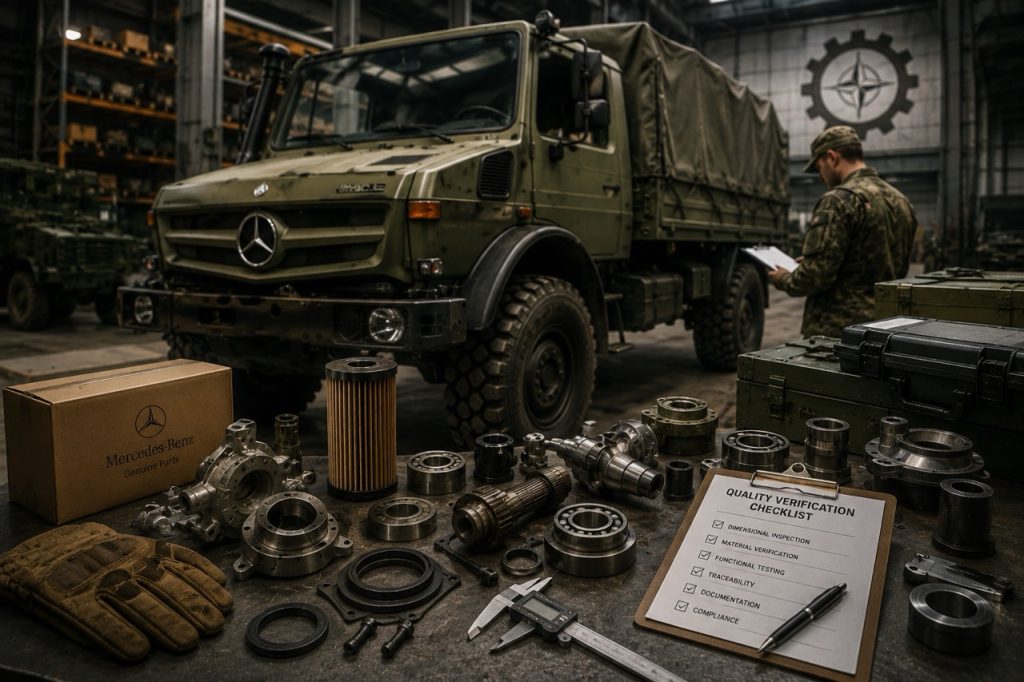
Supplier qualification comes first: formal audits of a manufacturer’s facilities, processes, and quality certifications commonly referencing ISO 9001 and, in defense specific contexts, AQAP before that supplier is approved to provide parts for military use. Incoming inspection follows at the receiving end, verifying that delivered components match specification before they enter inventory, using dimensional checks, material test reports, and, for critical components, first article inspection against the original design data.
Documentation and batch traceability run through the entire process: certificates of conformance, material test reports, and lot or batch identification that allow any component to be traced back to its manufacturing run if a quality issue surfaces later. Technical verification functional testing, and for high criticality parts, methods such as X-ray fluorescence alloy analysis confirms that a part is not just dimensionally correct but made from the specified material. Reliable logistics and consistent sourcing close the loop: a supplier that can commit to lead times and maintain sourcing continuity is as important to fleet readiness as the quality of any individual part, since an unreliable delivery schedule forces maintenance planners into exactly the emergency procurement decisions that create the most risk.
Total Cost of Ownership and Long Term Fleet Sustainment
Procurement officers evaluating OEM against alternative parts are rarely comparing two prices for the same transaction. They are comparing two different lifecycle cost curves. A genuine part typically carries a higher unit cost but a more predictable failure rate, stronger warranty backing, and for platforms still in production shorter lead times through an established distribution network. A qualified alternative typically carries a lower unit cost and, for legacy platforms, better availability, but shifts more of the quality assurance burden onto the buying organization’s own supplier vetting process.
Total cost of ownership calculations for a Unimog fleet need to weigh acquisition cost against maintenance frequency, unscheduled downtime, mission readiness rates, and the administrative cost of managing two parallel supply chains. In practice, most mature sustainment organizations end up running a hybrid model: OEM or OEM equivalent sourcing for mission critical, safety critical, and high value assemblies, paired with qualified alternative sourcing for wear items, consumables, and components for platforms the manufacturer no longer actively supports. This is not indecision; it is a criticality based procurement strategy applied consistently across the fleet.
Inventory management strategy follows the same logic. Fleet availability depends less on which category of part is stocked than on whether the right components of either category are positioned where downtime actually occurs. A well designed spares strategy holds OEM stock for the components where configuration integrity matters most, while building depth in alternative sourced wear items and consumables where volume and predictability make that the more resilient choice.
Legacy Fleets and the Obsolescence Problem
Military Unimog fleets frequently run far longer service lives than their commercial counterparts, and fleet managers responsible for older model series face a sustainment challenge that a simple OEM versus alternative framework does not fully capture: at some point, the manufacturer’s genuine parts catalogue for a given component may no longer exist at all. Mercedes-Benz has addressed part of this gap for civilian and lightly militarized fleets through its remanufacturing program and, for select applications, additive manufacturing of replacement parts but defense operators of decades old variants still routinely depend on qualified reverse engineered or obsolete part replacement suppliers to keep vehicles in service.
For these fleets, spare parts obsolescence planning is not an occasional exercise; it is a continuous discipline. Sustainment managers who track which components on a legacy platform are approaching end of support, and who qualify alternative suppliers for those components before a failure forces an emergency procurement, consistently achieve better readiness rates than those who wait for the crisis. Defense inventory optimization for aging fleets typically means holding deeper stock of the components most likely to become unavailable, rather than spreading inventory evenly across the parts list.
How Military Organizations Evaluate Replacement Parts
Across NATO and allied procurement environments, the evaluation process for a replacement part whether OEM or alternative tends to follow a consistent sequence rather than a single go/no-go decision. Component criticality is classified first, typically along the mission critical, safety critical, and non critical lines described above, since this classification determines how rigorous the qualification process needs to be. Supplier and part qualification follows, drawing on the NATO Codification System’s framework for form, fit, and function equivalence every item of supply that receives a NATO Stock Number is documented against interchangeability criteria that a replacement part, whatever its source, has to satisfy before it can be treated as equivalent to the original.
Cost versus operational risk analysis weighs unit price and lead time against the consequences of a failure a calculation that looks very different for a cabin air filter than for a steering linkage component. Budget constraints are real and legitimate inputs to defense procurement, but experienced sustainment organizations apply them within the criticality framework rather than across it, protecting spend discipline on consumables while holding a firmer line on parts tied to crew safety or platform certification. The result, when the process is followed consistently, is a fleet where cost efficiency and mission readiness are not actually in tension because the components where risk tolerance is lowest are the ones least likely to be sourced on price alone.
OEM vs Alternative Spare Parts: Key Differences at a Glance
| Factor | OEM / Genuine Parts | Qualified Alternative Parts |
| Configuration integrity | Matches certified platform baseline exactly | Requires documented form/fit/function verification |
| Typical unit cost | Higher | Generally lower |
| Availability for legacy platforms | May be limited or discontinued | Often the only viable source |
| Lead time (current production) | Reliable through OEM network | Varies by supplier; can be faster in theater |
| Warranty impact | Preserves manufacturer warranty | May void warranty on covered vehicles |
| Best suited to | Safety critical, mission critical, high value assemblies | Wear items, consumables, legacy/obsolete components |
| Quality assurance basis | OEM’s own engineering and test data | Supplier qualification, traceability, and independent testing |
There is no single right answer to “OEM or alternative” for a military Unimog fleet, and any supplier who claims otherwise is selling a policy, not a solution. The decision that actually protects mission readiness is made component by component, weighted by criticality, informed by the platform’s age and support status, and backed by real supplier qualification rather than price alone. Genuine parts remain the standard for the systems where a failure is unacceptable and where configuration control has legal or contractual weight. Rigorously qualified alternative parts remain an essential, legitimate tool for keeping wear items affordable, legacy fleets running, and forward deployed units supplied when the OEM channel cannot meet the operational tempo.
What separates a sound sustainment strategy from a risky one is not which category of part sits in the bin it is whether every part in that bin, regardless of source, can be traced back to a documented, qualified, accountable manufacturing process. Building that discipline into procurement policy, rather than deciding it vehicle by vehicle under time pressure, is what turns spare parts strategy into genuine fleet readiness.
Work With AB Defence
Partner with AB DEFENCE for Reliable Combat Support Vehicle Sustainment. AB DEFENCE is a specialist international supplier of military spare parts and fleet sustainment solutions serving NATO and allied defense organisations. With deep inventory across a wide range of combat support vehicle platforms, rigorous quality assurance processes, export compliance expertise, and a commitment to long term supply chain partnership, AB DEFENCE helps defense buyers maintain fleet availability, reduce sustainment costs, and meet their operational readiness obligations. Contact the AB DEFENCE team to discuss your spare parts requirements, strategic inventory planning, and long-term sustainment programme needs.
Contact AB Defence to discuss your procurement requirements and learn how we can support your fleet readiness objectives.
Related Military Spare Parts Categories, Vehicle Platforms & Technical Guides
Explore AB Defence’s NATO-codified (NSN) and genuine OEM spare parts catalog, platform technical specifications, and sustainment engineering guides related to this article:
Stocked Spare Parts Categories (NSN & OEM Catalog)
- Mercedes-Benz Unimog Military Spare Parts (562 stocked parts)
- Military Portal Axles, Differentials & Drive Shafts (107 stocked parts)
- Military Gearbox, Transfer Case & PTO Assemblies (108 stocked parts)
- Military Brake Calipers, Master Cylinders & Hydraulic Systems (103 stocked parts)
- Military Engine Cooling Systems, Radiators & Water Pumps (57 stocked parts)
- Full NATO NSN & OEM Spare Parts Catalog (16,760+ Parts)
Compatible Vehicle Platforms & System Hubs
- Unimog U 1300 L (1.5 Ton – 2.5 Ton)
- Unimog U 1500 L
- Unimog U 1700 L
- Unimog U 2150 L
- Unimog U 2450 L
- Request a B2B Quotation (RFQ) & Technical Support
Related Military Engineering & Sustainment Articles
- Unimog Military Spare Parts: What Every Fleet Manager Needs to Know Before Placing an Order
- Unimog Spare Parts for Military Fleets: Why AB Defence Is Your Trusted Supply Partner
- 5 Unimog Components Most Commonly Replaced in Military Operations
- What Are the Most Common Failures in Military Unimog Vehicles?