June 29, 2026
How Extreme Climate Conditions Affect Military Vehicle Components

Military vehicles are engineered to operate where civilian transport cannot. They cross deserts, traverse snow bound passes, work through monsoon mud, and idle for hours in salt laced coastal air. The operating envelope that makes these platforms essential is, paradoxically, the same envelope that relentlessly degrades them. Climate is not a background condition for military vehicle maintenance it is one of the dominant variables that determines component lifespan, maintenance intervals, and ultimately, mission readiness.
No deployed fleet operates under textbook conditions. A wheeled armored personnel carrier built to NATO standards may see service in the Sahel and, within the same operational year, be shipped north for arctic exercises. Each of those environments attacks the vehicle’s systems through fundamentally different mechanisms. Heat breaks down lubricants and cooking elastomers; cold embrittles metals and thickens fluids; humidity drives corrosion into every unsealed cavity; salt air turns fasteners into rust within weeks.
Understanding how each climate stresses specific components is not an academic exercise. For maintenance engineers, fleet managers, and defense procurement officers, it is the foundation of any credible preventive maintenance program. Components that fail in the field are not just expensive to replace they ground vehicles at the worst possible moment and place additional strain on forward logistics chains that are already operating near capacity.
This article examines the principal climatic environments in which military vehicles operate, identifies the component families most vulnerable to each environment, and outlines the maintenance practices that mitigate climate driven degradation before it becomes a mission critical failure.
Why Climate Is a Maintenance Planning Variable, Not an Afterthought
Procurement specifications describe what a vehicle can do under defined environmental limits. Maintenance manuals prescribe service intervals under standard conditions. Neither document, on its own, captures the reality of sustained operations in environments that sit at or beyond those limits. Climate becomes a maintenance variable the moment a vehicle leaves garrison.
Accelerated wear under extreme temperatures, moisture, and contamination does not announce itself. It compounds quietly, shortening the effective life of seals, bearings, fluids, and electrical insulation until a threshold is crossed often during an operation rather than during a scheduled service. The result is an unscheduled maintenance event that is more expensive in parts, labor, and lost availability than the preventive intervention that would have caught the problem.
From a logistics perspective, climate driven failures are particularly disruptive because they do not follow predictable patterns. A brake hose that would last 24 months under temperate conditions may fail at 9 months in a desert environment. An air filter that needs changing every 5,000 kilometers in a European garrison may need changing every 500 kilometers in a dust heavy operational area. Without maintenance schedules adjusted for operational climate, a fleet is effectively consuming its serviceability faster than the maintenance system accounts for.
| NATO STANAG 4172 and related environmental testing standards exist precisely because military equipment must be validated across a wide temperature and humidity range. But validation testing is not the same as sustained operational exposure. Field maintenance must bridge that gap. |
Extreme Heat and Desert Operations
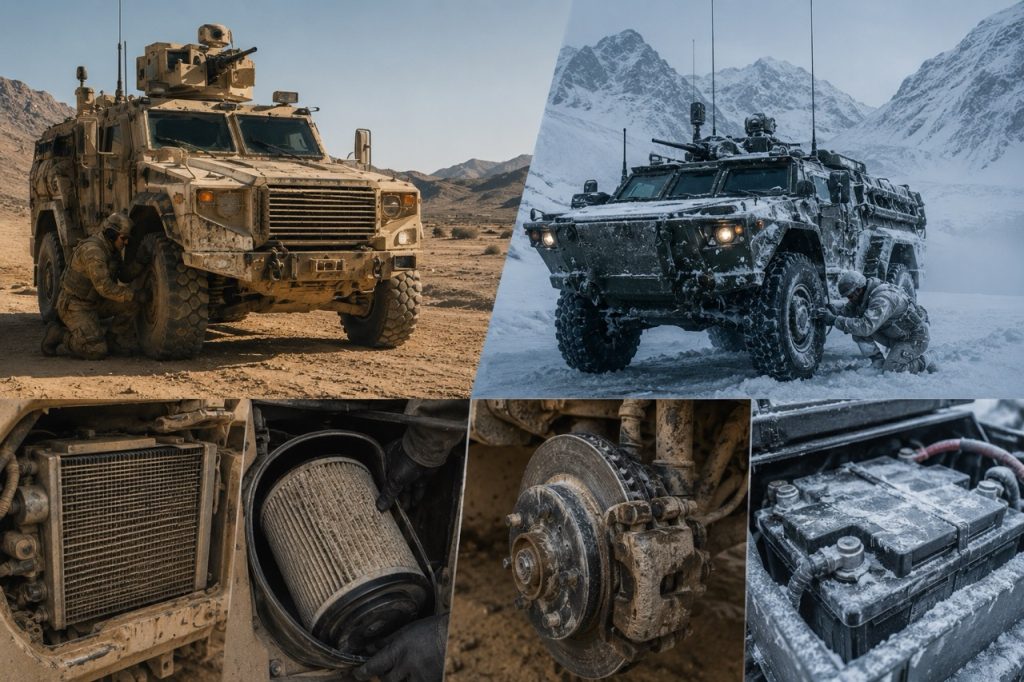
Desert and arid environments combine three forms of stress that act simultaneously: high ambient temperature, intense solar radiation, and airborne particulate matter. Each attacks a different system, and their combined effect accelerates wear across virtually every major component.
Engine and Cooling System
The cooling system is the first line of defense against thermal overload, and it is also the first system to be compromised in hot climates. Coolant that meets specifications at 20°C may degrade significantly faster when operating continuously at 50°C ambient with engine compartment temperatures that easily reach 120°C or higher. Coolant inhibitors break down, leading to corrosion inside the radiator, water jacket, and heater core. Aluminum components are particularly vulnerable once inhibitor concentrations fall below recommended thresholds.
Radiator cores accumulate dust and debris that reduce airflow, creating hot spots and reducing overall heat rejection capacity. Water pump seals degrade under high temperature cycling, and the thermostat a component that often receives little attention can stick or fail, preventing the system from reaching optimal operating temperature during colder night operations and then failing to regulate effectively when temperatures spike the following day.
Lubrication and Drivetrain
Engine oil viscosity is temperature dependent. Oils that perform well across temperate ranges thin out at high temperatures, reducing their ability to maintain the hydrodynamic film that separates moving surfaces. Transmission fluid faces similar stresses, and automatic transmissions in particular generate significant heat internally during heavy off road use. Differential and transfer case lubricants in tactical wheeled vehicles also require attention: extended high temperature operation can oxidize gear oils and degrade extreme pressure additives.
Driveshafts, CV joints, and universal joints packed with grease are vulnerable when that grease either evaporates volatile components or carbonizes under sustained heat, leaving behind a thick residue that no longer lubricates effectively. Routine re greasing intervals must be shortened in desert operations.
Rubber Components, Seals and Hydraulics
Hydraulic system
Hydraulic fluid itself degrades under heat, losing viscosity stability and oxidizing. Contamination from particulate ingress through a compromised breather or worn seals compounds the problem significantly. Hydraulic reservoirs should be inspected regularly for discoloration, which indicates oxidation or overheating, and fluid analysis conducted at shortened intervals during desert deployments.
shock absorber
Sand Abrasion, Dust Ingestion, and Electrical Systems
Fine sand particles are among the most destructive forces a vehicle encounters in arid environments. They infiltrate air intake systems, bypassing degraded or poorly seated air filters, and enter combustion chambers where they act as an abrasive, accelerating cylinder and ring wear dramatically. In extreme cases, turbocharger compressor wheel erosion can occur within hundreds of hours of operation in high particulate environments.
The same dust that enters the engine also invades brake assemblies, wheel bearings, and suspension joints. Bearings running in contaminated grease wear at rates that can be orders of magnitude higher than under clean conditions. Brake rotors and pads that accumulate fine grit function as a grinding compound against each other.
Electrically, heat combined with UV exposure degrades wire insulation and connector housings. Control modules mounted without adequate thermal protection can reach temperatures that exceed their operating limits. Battery performance drops sharply at high temperatures, and despite the common perception that cold kills batteries, sustained operation above 45°C shortens battery life more severely over the long term.
Cold Weather and Arctic Operations
Arctic and cold weather operations impose a fundamentally different set of stresses. Where heat breaks down chemistry and accelerates oxidation, cold affects the physical properties of materials directly thickening fluids, embrittling metals and polymers, and reducing the electrochemical efficiency of batteries and sensors.
Cold Starts and Lubrication
The most immediately dangerous moment for a cold soaked vehicle is the initial start. Engine oil that has been sitting at -30°C or lower may have the consistency of molasses, and the oil pump must work against extreme resistance to circulate it to bearing surfaces. During those first seconds of operation before the oil warms enough to flow properly bearing surfaces experience metal to metal contact that would not occur under normal conditions. Multi grade oils with low temperature performance ratings mitigate this, but only if the correct specification is in service.
Gear lubricants in differentials and transfer cases face similar issues. Wax crystallization in mineral based gear oils at sub zero temperatures can restrict flow and starve gear mesh contact surfaces. Synthetic lubricants with a low pour point are standard practice for arctic qualified vehicles.
Fuel System and Hydraulics
Diesel fuel gelling is a well documented cold weather failure mode. Paraffin wax naturally present in diesel begins to crystallize at temperatures that vary by fuel specification, eventually clogging fuel filters and starving the injection system. Fuel additives, arctic grade fuel blends, or heated fuel lines are all part of proper cold weather sustainment. Fuel filters that would last months in temperate service may clog within hours in extreme cold without the correct fuel specification.
Hydraulic systems that use standard fluid may become sluggish or unresponsive in severe cold, creating dangerous delays in brake or steering response. Hydraulic hoses also lose flexibility at low temperatures, increasing the risk of stress cracking when the system first pressurizes.
Seals, Rubber and Structural Components
The transition temperature below which rubber transitions from elastic to glassy behavior varies by compound, but most standard elastomers begin losing significant flexibility below -20°C. Seals that function perfectly at 20°C may permit leakage at -30°C simply because they have contracted and lost preload against mating surfaces. Suspension bushings made of standard rubber can crack under dynamic loading in extreme cold. Air brake system components require particular attention, as diaphragm cracking can cause brake failure.
Metal fatigue characteristics change at low temperatures as well. Certain steel alloys exhibit a ductile to brittle transition, meaning impact loads that a component would absorb plastically at normal temperatures can cause fracture in arctic conditions. Suspension arms, axle housings, and tow hooks are components where this phenomenon warrants engineering scrutiny.
Electrical Systems and De icing Chemical Corrosion
Battery capacity drops with temperature according to well-established electrochemical principles. A battery that delivers 100% of rated capacity at 20°C may deliver less than 60% at -20°C, while starter motor loads increase simultaneously because engine oil viscosity has increased. Electrical connectors that have accumulated any moisture can freeze, preventing proper engagement. De icing chemicals applied to roads and runways contain chloride compounds that are highly aggressive toward unprotected steel and aluminum. Undercarriage components, brake assemblies, and suspension joints exposed to de icing chemicals require prompt washing and inspection.
High Humidity and Tropical Environments
Tropical and jungle environments add moisture as the primary threat. Sustained high humidity, combined with elevated temperatures, creates ideal conditions for corrosion, fungal growth, and the infiltration of moisture into systems that depend on dry, clean environments to function reliably.
Electrical connectors and sensor interfaces are among the first casualties. Even connectors designed with IP rated sealing degrade over time, and once moisture penetrates a connector, galvanic corrosion between dissimilar metals proceeds rapidly. Resistance increases, signals become erratic, and the fault is often misdiagnosed as an electronic module failure rather than a connector issue leading to unnecessary and expensive module replacements.
Wiring harnesses in high humidity environments develop insulation breakdown over time, particularly at chafe points where vibration creates micro abrasion. Fuel system components, including injector seals and fuel sender units, are vulnerable to moisture contamination. Hydraulic systems, if breather caps are not maintained and fluid is not changed at appropriate intervals, absorb moisture that lowers the fluid’s boiling point a critical safety issue for braking systems.
Brake assemblies in humid environments corrode from the outside in. Rotors that sit unused for even short periods develop surface rust that, while initially superficial, creates rough contact zones that accelerate pad wear. Caliper pistons can seize if protective coatings fail. Interior surfaces of drum brakes accumulate moisture that combines with brake dust to form a corrosive paste.
Fasteners throughout the vehicle are vulnerable. Bolts, nuts, and clips made of standard steel can corrode to the point where removal requires destructive methods, complicating maintenance significantly. Stainless or coated fasteners in corrosion-critical locations are a worthwhile investment for vehicles assigned to tropical theaters.
Coastal and Marine Environments
Salt spray presents one of the most aggressive corrosive environments that military vehicles encounter. Sodium chloride in suspension deposits on every exposed surface, and in the presence of moisture and oxygen, it accelerates electrochemical corrosion at rates far higher than those seen in inland environments.
Frame and body corrosion is the most visible consequence of sustained coastal operations. Weld seams and body joints trap salt and moisture, creating ideal conditions for crevice corrosion that is difficult to detect until structural integrity is already compromised. Regular washing with fresh water after operations near the coast is a basic but essential countermeasure.
Galvanic corrosion is a specific threat wherever two different metals are in contact. Military vehicles use aluminum, steel, copper, and various alloys in close proximity. In the presence of a salt electrolyte, these form galvanic cells that sacrifice the less noble metal. Without proper isolation between dissimilar metals through coatings, washers, or compatible fasteners this process can quickly destroy mounting brackets, electrical grounding straps, and structural joints.
Braking systems are acutely vulnerable in coastal environments. Brake rotors, calipers, and hydraulic fittings are exposed to road spray carrying salt. Stainless steel brake lines are preferable in coastal service. Bearing seals in wheel hubs require regular inspection and re packing to ensure salt contaminated water does not reach the bearing surfaces.
Mountain and High Altitude Operations
Altitude introduces a set of performance challenges that are often underestimated during planning. Atmospheric pressure decreases with altitude, reducing air density. For naturally aspirated engines, this directly reduces the mass of oxygen available for combustion, dropping power output. Turbocharged engines compensate more effectively but impose additional thermal and mechanical stress on the turbocharger itself, which must spin faster to maintain boost pressure.
Cooling systems operate less efficiently at altitude, because the lower density air carries less heat away from the radiator per unit volume. Vehicles working hard on mountain grades at altitude can experience overheating even when ambient temperatures are relatively low. Transmission and brake system cooling faces the same constraint.
Mountain operations place severe demands on braking systems through repeated high speed downhill descents. Brake fade the temporary loss of braking effectiveness caused by heat buildup İs a serious risk when brakes are applied repeatedly over extended descents. Brake rotor and caliper temperatures can exceed the limits of standard brake fluid, reducing pedal firmness. Routing fuel and hydraulic lines in mountain service requires attention to vibration loads at steep grades and the cumulative effect of articulation over rock terrain on suspension and driveline components.
Components Most Vulnerable to Extreme Climate Conditions
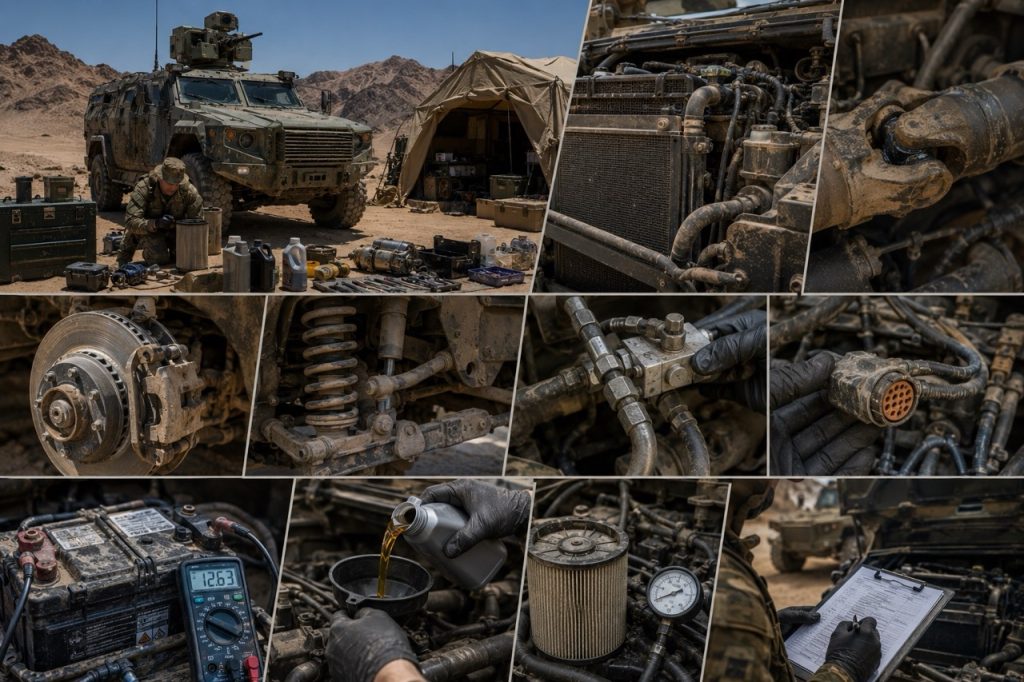
While every major system of a military vehicle is affected by climate to some degree, certain components show disproportionate sensitivity to environmental extremes. The following areas require particular attention during climate adjusted maintenance planning:
Engine and Cooling Group
- Radiator: Core blockage from dust and debris in desert conditions; corrosion in coastal and tropical environments; requires flushing and inhibitor replenishment at shortened intervals.
- Water Pump: Seal degradation in high-heat conditions; impeller corrosion in salt environments; a failed water pump cascades to engine overheating within minutes.
- Thermostat: Subject to sticking open or closed; in cold climates a stuck-open thermostat prevents the engine from reaching operating temperature; in hot climates a stuck-closed thermostat causes immediate overheating.
- Coolant Hoses: Crack and harden under sustained heat and UV exposure; collapse under vacuum in cold starts if the inner reinforcement is compromised.
Drivetrain Components
- Transmission: Fluid degradation under heat accelerates clutch pack wear; in cold climates, delayed fluid flow on startup can cause erratic shifting and premature failure of friction elements.
- Transfer Case and Differentials: Lubricant must match operational temperature range; contamination from compromised seals dramatically shortens gear life.
- Driveshafts, CV Joints, Universal Joints: Grease breakdown under heat or displacement by water intrusion; the resulting metal-to-metal contact generates rapid wear and audible symptoms that precede failure.
Suspension System
- Suspension Bushings: Rubber compounds are sensitive to temperature extremes; UV and ozone exposure in desert environments accelerates cracking; cold brittleness increases fracture risk under impact.
- Shock Absorbers: Seal degradation leads to fluid weeping and loss of damping; vehicles with failed shocks place excessive dynamic loads on chassis, springs, and tires.
- Leaf Springs and Coil Springs: Metal fatigue accelerated by repeated high-load cycling over rough terrain; corrosion at contact points between leaf layers reduces clamping force.
- Control Arms and Wheel Bearings: Bearing seals that fail admit contaminants; early bearing failure is detectable through vibration and handling changes before catastrophic seizure occurs.
Braking System
- Brake Rotors and Calipers: Corrosion in coastal and humid climates; thermal cracking from overheating on mountain descents; caliper seizure from salt intrusion.
- Brake Hoses: Cold-climate brittleness can cause cracking on pressurization; high-heat environments accelerate inner liner degradation; replace at first signs of external cracking.
- Brake Fluid: Hygroscopic by nature; moisture absorbed in humid climates lowers boiling point and reduces braking margin; fluid change intervals must reflect operational environment.
Electrical and Electronic Systems
- Wiring Harnesses: Insulation breakdown under UV, heat, and moisture; chafe protection degrades before the wires themselves; harness routing inspection is often deferred despite its importance.
- Connectors and Sensors: Corrosion is the primary failure mode in humid and coastal environments; dielectric grease application at assembly is a critical preventive measure.
- Batteries and Alternators: Battery capacity loss in cold; accelerated aging in heat; alternator voltage regulation can be affected by extreme temperature swings.
- Starter Motors: High current demand on cold starts; thermal damage on hot restarts following heat soak; brush and commutator wear accelerated by extreme conditions.
Hydraulic Systems and Seals
- Hydraulic Lines and Hoses: Cold embrittlement and heat oxidation both compromise the outer jacket; pressure testing after seasonal extremes is warranted.
- Hydraulic Seals: Seal compound selection must match the operational temperature range; wrong compound selection is a common root cause of field failures.
- Air Intake Filters: The first line of defense against dust and particulate ingestion; inspection frequency must be drastically increased in desert and high dust environments.
- Fuel Filters: Susceptible to gelling in cold climates and to contamination in dusty, humid environments; a blocked fuel filter can shut down an engine without warning.
Preventive Maintenance Strategies for Extreme Climate Operations
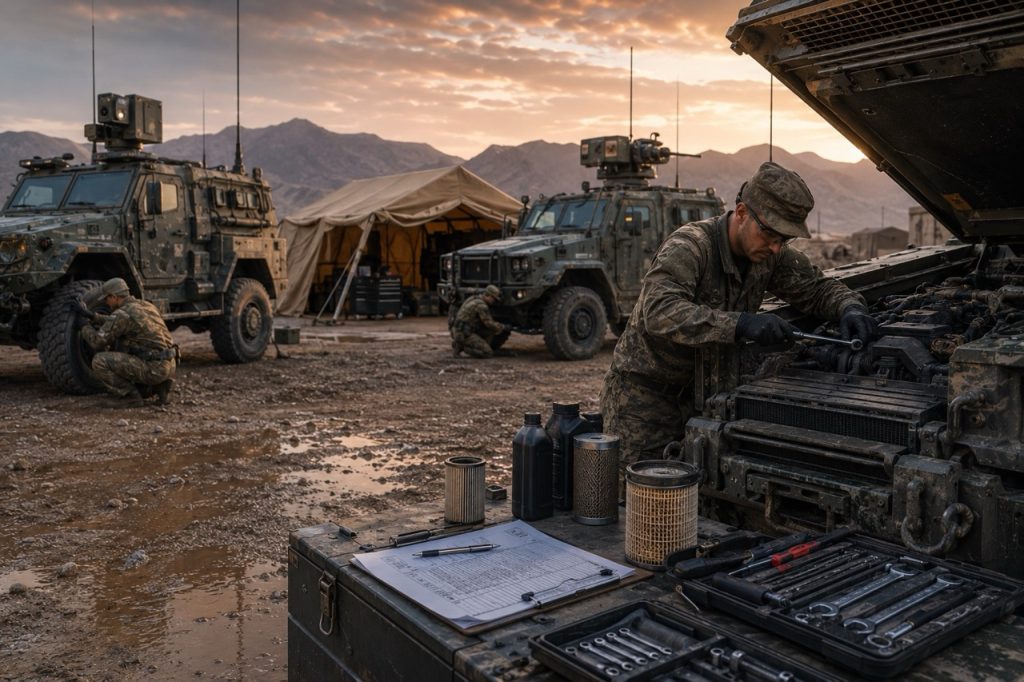
No maintenance program designed for temperate garrison operations is adequate for vehicles deployed in extreme environments. The fundamental requirement is to adjust intervals, inspection criteria, and material specifications based on the operational climate, not on the default schedule written for standard conditions.
Climate Adjusted Maintenance Intervals
The first step is reducing service intervals for all climate sensitive systems. In desert operations, air filter inspections move from kilometers-based to daily operations based. Coolant condition checks that occur quarterly in garrison may need to occur monthly in sustained heat. Hydraulic fluid analysis, often treated as an annual task, should be conducted at significantly shorter intervals when vehicles are working in temperature extremes or dusty conditions.
Lubrication and Fluid Management
Operational climate should drive fluid specification selection. Using a single viscosity engine oil across tropical and arctic theaters is inappropriate. Synthetic multi grade lubricants with a wide temperature performance range are the appropriate baseline for military vehicles that may be rapidly redeployed. Gear oils, hydraulic fluids, and greases should all be selected with the lowest expected operating temperature in mind, while also verifying their performance at the upper end.
Fluid analysis programs sending oil, coolant, and hydraulic fluid samples to a laboratory for spectrometric analysis provide early warning of internal wear and contamination before the damage becomes irreversible. This approach is particularly valuable for transmissions and differentials, where internal failures are otherwise difficult to detect until function degrades noticeably.
Corrosion Prevention Protocols
Vehicles deployed to coastal or high humidity environments require a systematic corrosion prevention program that goes beyond applying paint. Cavity wax application to enclosed sections, anti corrosion treatment of under body surfaces, and application of dielectric grease to electrical connectors are all standard measures for sustained coastal operations. After operations near salt water or in environments where de icing chemicals are present, vehicles should be washed thoroughly including undercarriage before re entry into the maintenance facility.
Fastener condition should be inspected at every scheduled service in corrosive environments. A fastener that cannot be removed without damage means that the next maintenance task on that assembly becomes a repair job rather than a routine service.
Filter and Seal Management
Air, fuel, hydraulic, and oil filters are expendable items that should be treated as high priority in harsh environments. Maintaining an adequate stock of the correct filter elements is a logistics function, but the decision about when to replace them is a maintenance engineering function. Visual inspection combined with differential pressure monitoring provides the most reliable replacement criterion in dusty environments.
Battery and Electrical System Servicing
Battery testing under load rather than simple voltage checks is the only reliable method for identifying batteries approaching the end of their service life. In cold climates, this testing should occur before the cold season begins. Electrical connector condition, including inspection for corrosion, cracked insulation, and proper seating, is a maintenance task that is frequently deferred because it lacks obvious mechanical symptoms until a fault develops.
OEM Replacement Components
The quality of replacement parts has a direct effect on how long a repair holds up under environmental stress. Non OEM seals, hoses, and bearings may meet dimensional specifications but fail to match the material performance of original components across the full operational temperature range. For vehicles operating in extreme environments, OEM equivalent parts with verified material certifications are the appropriate standard. Traceability documentation manufacturer certificates, batch records, and material test reports provides assurance that what has been installed will perform as specified.
How Preventive Maintenance Drives Operational Readiness
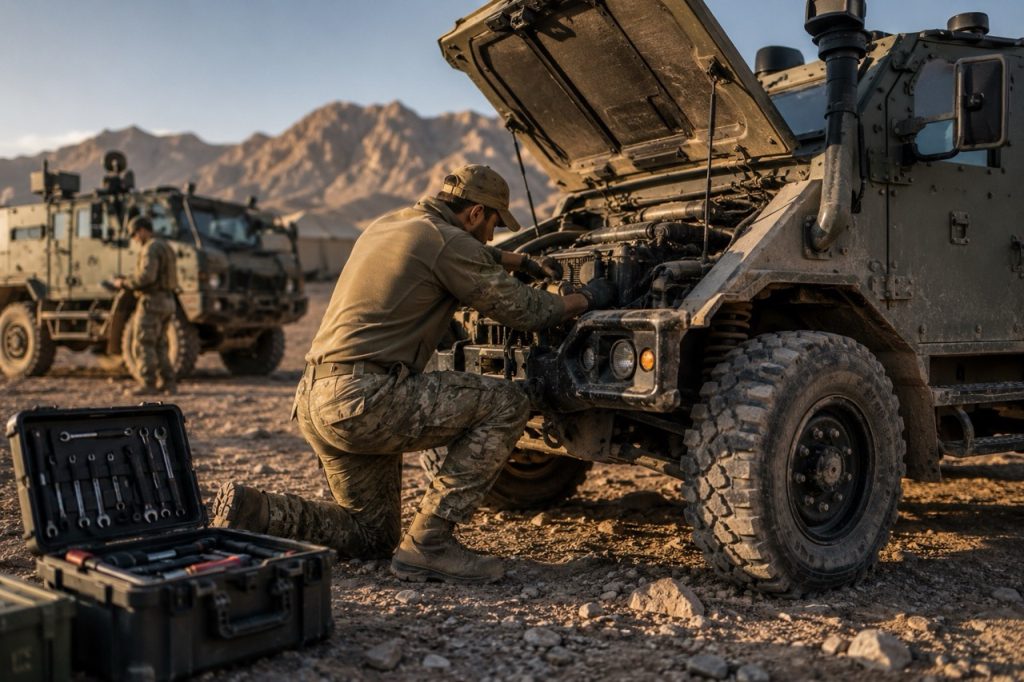
Fleet readiness is not determined by acquisition decisions alone. It is determined, day by day, by the quality and timeliness of maintenance. A vehicle that is acquired to specification but maintained on a schedule that does not account for its operational environment will degrade faster than the maintenance system expects, creating equipment shortfalls that compound over time.
The relationship between preventive maintenance and vehicle availability is straightforward: deferred maintenance becomes unscheduled downtime. Unscheduled downtime during operations is disproportionately costly in labor, in parts consumption, in logistics burden, and in mission impact. The economics consistently favor investing in preventive action. A replaced coolant hose costs a fraction of an engine overhaul. A new set of brake hoses is trivially inexpensive compared to a brake system failure during a tactical withdrawal.
Climate adjusted preventive maintenance also extends component life, which directly reduces lifecycle costs. Suspension bushings that would last 30,000 kilometers in temperate conditions may fail at 10,000 kilometers under desert cycling if allowed to degrade without intervention. Replaced at the correct interval informed by environmental operating data those same components recover a significant fraction of their expected service life.
Beyond cost, there is the safety and mission effectiveness dimension. Vehicles that are available and reliable allow commanders to plan with confidence. Mechanical failures at critical moments are not just logistics problems they affect mission outcomes and the safety of crews who depend on their equipment functioning when it must. A fleet maintained to a standard that accounts for its operational environment is a strategic asset. A fleet maintained to a standard that ignores environmental realities is a liability.
Extreme environments are not exceptional conditions for military vehicles they are routine. The deserts, arctic regions, tropical jungles, coastal installations, and mountain passes where these platforms operate represent the full range of climatic stress that engineering and maintenance must account for throughout the vehicle’s service life.
Climate cannot be negotiated with, but its impact on military vehicle components can be managed. The mechanisms by which heat, cold, moisture, salt, dust, and altitude attack engines, cooling systems, drivetrains, suspension components, braking systems, electrical systems, and hydraulic circuits are understood in sufficient detail to design effective countermeasures provided those countermeasures are implemented consistently.
That implementation begins with maintenance planning that treats operational climate as a first-order variable. It continues with fluid specifications and replacement intervals adjusted for the actual environment, not the default schedule. It depends on the quality of replacement components installed, the rigor of corrosion prevention programs, and the consistency with which inspections are conducted and findings acted upon.
Mission readiness is not a state that vehicles arrive in from the factory. It is a condition that is actively maintained, day after day, in the face of environments that are always working against it. The fleets that maintain the highest availability rates under harsh conditions are not the ones with the newest vehicles they are the ones with the most disciplined maintenance programs.
Work With AB Defence
Partner with AB DEFENCE for Reliable Combat Support Vehicle Sustainment. AB DEFENCE is a specialist international supplier of military spare parts and fleet sustainment solutions serving NATO and allied defense organisations. With deep inventory across a wide range of combat support vehicle platforms, rigorous quality assurance processes, export compliance expertise, and a commitment to long term supply chain partnership, AB DEFENCE helps defense buyers maintain fleet availability, reduce sustainment costs, and meet their operational readiness obligations. Contact the AB DEFENCE team to discuss your spare parts requirements, strategic inventory planning, and long-term sustainment programme needs.
Contact AB Defence to discuss your procurement requirements and learn how we can support your fleet readiness objectives.
Related Military Spare Parts Categories, Vehicle Platforms & Technical Guides
Explore AB Defence’s NATO-codified (NSN) and genuine OEM spare parts catalog, platform technical specifications, and sustainment engineering guides related to this article:
Stocked Spare Parts Categories (NSN & OEM Catalog)
- NATO Standard Defence Components & Military Hardware (12,993 stocked parts)
- M60 Tank Spare Parts (M60A1 / M60A3 / M60T) (497 stocked parts)
- M109 Self-Propelled Howitzer Spare Parts (585 stocked parts)
- BMC Kirpi MRAP Spare Parts (Kirpi I & Kirpi II) (597 stocked parts)
- Mercedes-Benz Unimog Military Spare Parts (562 stocked parts)
- Full NATO NSN & OEM Spare Parts Catalog (16,760+ Parts)
Compatible Vehicle Platforms & System Hubs
- Platforms
- Product Groups
- Quality
- Capabilities
- Tracked Armoured Vehicles
- Request a B2B Quotation (RFQ) & Technical Support