June 15, 2026
Armored Vehicle Suspension Failures: 6 Warning Signs Maintenance Teams Should Never Ignore
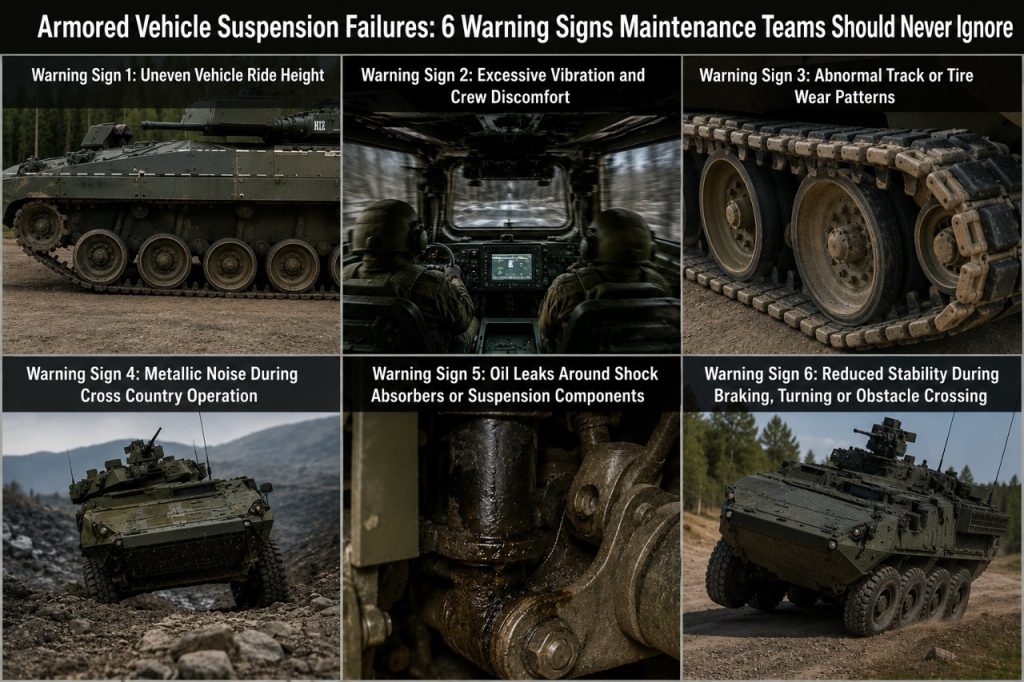
Suspension systems
For tracked and wheeled armored platforms alike, the suspension system is the mechanical interface between the vehicle’s mass and the terrain beneath it. It controls weight distribution across road wheels and axles, absorbs the energy of rough ground, and provides the stability necessary for accurate weapon employment, crew survivability, and sustained mobility in demanding operational environments. When suspension performance degrades, the effects cascade across virtually every other major vehicle system.
What makes armored vehicle suspension failures particularly problematic from a fleet management perspective is that they rarely announce themselves dramatically at the outset. The warning signs develop gradually a barely perceptible change in ride height here, a new vibration frequency there and maintenance teams operating under high operational tempo frequently dismiss these early indicators as routine wear rather than the precursors to serious mechanical failure they often are.
This article identifies six critical warning signs of armored vehicle suspension failure that no maintenance team should overlook. Understanding these indicators, the underlying failure mechanisms that produce them, and the appropriate inspection and response protocols can prevent the kind of unplanned downtime that compromises fleet readiness, increases lifecycle costs, and in operational contexts degrades mission effectiveness at the worst possible moment.
Why Suspension Health Directly Affects Fleet Readiness
The suspension system of an armored vehicle bears a burden that has no civilian equivalent. A heavy infantry fighting vehicle or main battle tank operates across terrain that would destroy a commercial truck within hours, while simultaneously managing the weight of armor, armament, and crew that can exceed the gross vehicle weight of multiple commercial vehicles combined. The suspension must manage all of this under conditions that include extreme temperature ranges, water crossing, debris impacts, and the concussive forces associated with vehicle fired weapons.
From an engineering standpoint, the suspension performs four primary functions simultaneously. It supports the vehicle’s static weight through springs whether torsion bars, coil springs, or hydropneumatic elements and distributes that load across the available ground contact area. It controls dynamic load transfer during acceleration, braking, and turning through dampers and shock absorbers. It maintains consistent ground contact for both traction and stability. And it isolates the hull, crew compartment, and onboard systems from the shock energy generated by rough terrain.
The consequences of suspension degradation extend well beyond ride quality. A suspension system that has lost geometry through worn bushings or fatigued springs will cause uneven load distribution across track links or tires, accelerating wear rates dramatically and shortening component service life. Poor damping performance increases the peak forces transmitted to the vehicle hull, creating fatigue stress in mounting points, accelerating wear on road wheels and return rollers, and exposing electronic systems to vibration amplitudes they were not designed to tolerate continuously.
From a fleet readiness perspective, the financial implications are significant. Replacing a set of torsion bars or suspension bushings during a scheduled maintenance interval is a manageable cost with predictable downtime. The same work carried out as an emergency repair following a mobility kill, with associated recovery costs and mission disruption, represents a substantially larger burden. Effective suspension maintenance is fundamentally a cost management strategy as much as it is a vehicle safety practice.
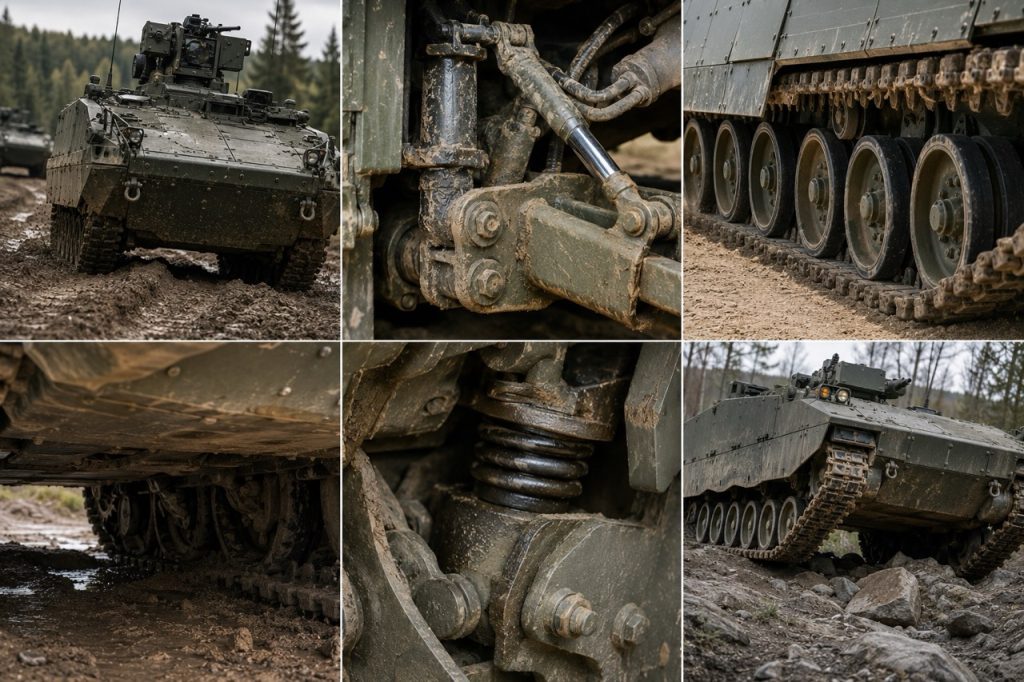
Warning Sign 1: Uneven Vehicle Ride Height
When an armored vehicle sits noticeably lower on one side than the other, or when the front and rear ride heights diverge beyond design tolerances, experienced mechanics know to investigate immediately. Uneven ride height is one of the most reliable early indicators of suspension structural failure and it is never simply cosmetic.
The most common cause on tracked military vehicles is torsion bar fatigue. Torsion bars are the primary springing elements in vehicles such as the M1 Abrams, the Bradley Fighting Vehicle, the Leopard 2, and numerous other platforms. They function by twisting along their longitudinal axis to absorb suspension travel, returning to their neutral position as the load decreases. Over operational life, particularly in vehicles exposed to high gross weights, frequent cross-country operation, or sustained high-tempo deployments, torsion bars accumulate fatigue stress. The metal progressively loses its elastic recovery, and the bar eventually takes a permanent set meaning it no longer returns the road wheel arm to the correct neutral position. The vehicle settles lower on the affected side.
Coil spring and hydropneumatic suspension systems exhibit analogous failure modes. Coil springs can suffer fatigue fracture, visible as a broken coil, or simply take a set due to material degradation over extended service life. Hydropneumatic suspension units found on vehicles such as the Challenger 2, the CV90, and many modern wheeled armored vehicles can lose their charged nitrogen pressure through seal leakage, resulting in a collapsed unit that provides dramatically reduced ride height and spring travel.
Worn or deteriorated suspension arm bushings also contribute to ride height asymmetry. As bushings degrade, they allow the suspension arm to move outside its designed pivot geometry, which can create a false indication of height change while also corrupting the alignment relationship between road wheels and hull.
Inspection recommendation: Ride height checks should be performed on level ground with the vehicle at normal combat weight. Reference dimensions for neutral suspension position should be available in the platform’s maintenance manual. Any side to side differential exceeding the specified tolerance warrants immediate investigation of torsion bar condition, spring integrity, and hydropneumatic charge pressure before the vehicle returns to service.
Warning Sign 2: Excessive Vibration and Crew Discomfort
Vibration is inherent to the operation of tracked and heavy wheeled vehicles across unimproved terrain. Crews develop an intuitive sense of what their particular platform feels like during normal operation and that intuition is a genuine diagnostic tool. When the character of vehicle vibration changes, when new frequencies appear, or when amplitudes increase noticeably over a short operational period, the change almost always reflects a specific mechanical deterioration.
The most common culprit is shock absorber wear. Military vehicle shock absorbers are hydraulic dampers that control the rate at which suspension springs compress and extend. They do this by forcing hydraulic fluid through calibrated internal valves, converting suspension motion energy into heat. As dampers age, their internal seals deteriorate, valve tolerances loosen, and the hydraulic fluid can become contaminated or aerated. The result is a progressive loss of damping performance the damper still moves, but it no longer controls the rate of movement effectively. The spring is free to oscillate at or near its natural frequency, and the crew feels the result as a characteristic bouncing or pitching motion that does not decay quickly after an obstacle crossing.
The operational consequences extend well beyond crew comfort. Driver fatigue accumulates rapidly in a poorly damped vehicle, degrading reaction times and decision-making capacity over the course of a long patrol or road march. Gunner effectiveness is compromised because optical systems move in sympathy with the suspension oscillation. Electronic systems communication equipment, fire control computers, navigation systems are exposed to vibration energy that accelerates connector wear, solder joint fatigue, and mounting hardware loosening. And the suspension components themselves, cycling more rapidly and through greater amplitudes than designed, accumulate fatigue damage at an accelerated rate.
Hydropneumatic suspension units can also develop internal gas-oil mixture problems when seals fail, producing a characteristic change in spring rate and damping behavior. In some configurations, individual units can be pressure-tested to identify those that have lost their charge or developed internal bypass, allowing targeted replacement rather than a fleet-wide overhaul.
Inspection recommendation: Damper condition should be evaluated both visually and functionally. A visual inspection identifies external seal leakage any oil weeping from the damper body or around the rod seal indicates internal seal failure. Functional evaluation involves assessing vehicle bounce recovery after a controlled load application; a vehicle that oscillates more than once before settling has insufficient damping. Dampers that have covered their replacement interval should be replaced proactively rather than run to failure.
Warning Sign 3: Abnormal Track or Tire Wear Patterns
Wear patterns on tracks and tires carry diagnostic information that maintenance teams frequently underuse. The tendency is to assess wear rate how quickly the component is wearing rather than wear pattern where and how it is wearing. But the pattern is often a far more informative signal, particularly for identifying suspension-related problems before they progress to component failure.
On wheeled armored vehicles, abnormal tire wear patterns are among the earliest detectable indicators of suspension geometry degradation. Camber wear concentrated on one shoulder of a tire indicates that the wheel is no longer running vertical to the ground plane, a condition caused by worn control arm bushings, damaged lower or upper arm geometry, or a bent component. Feathering or sawtooth wear across the tread width indicates toe misalignment, also typically attributable to worn suspension pivots or damaged track rods. Cupping or scalloping wear, where the tread shows a repeating high-low pattern around the circumference, indicates wheel hop caused by insufficient damping pointing back to shock absorber performance degradation.
On tracked vehicles, the diagnostic approach is different but equally informative. Road wheel wear patterns specifically uneven wear across the width of the wheel rim where it contacts the track can indicate that individual road wheel arms are deflecting differently under load due to torsion bar fatigue or bushing wear. Track link wear that is accelerated or asymmetric across the vehicle’s width may indicate that the vehicle is not running true, which itself reflects suspension geometry issues. Excessive sprocket wear can result from the track being under incorrect tension, which is often the result of idler adjustment attempts to compensate for suspension settling rather than correcting the underlying problem.
One important principle is that abnormal wear is a lagging indicator relative to the suspension failure that caused it. By the time wear pattern deviation becomes clearly visible, the underlying suspension component failure has typically been present for some time. This makes the connection between wear pattern investigation and suspension inspection particularly important finding abnormal wear should trigger a full suspension geometry review, not simply a component replacement.
Inspection recommendation: Track and tire inspection should include pattern analysis at every scheduled service, with photographs recorded to track pattern development across service intervals. Any new wear pattern deviation should be accompanied by a suspension geometry check covering bushing condition, arm deflection, and damper performance.
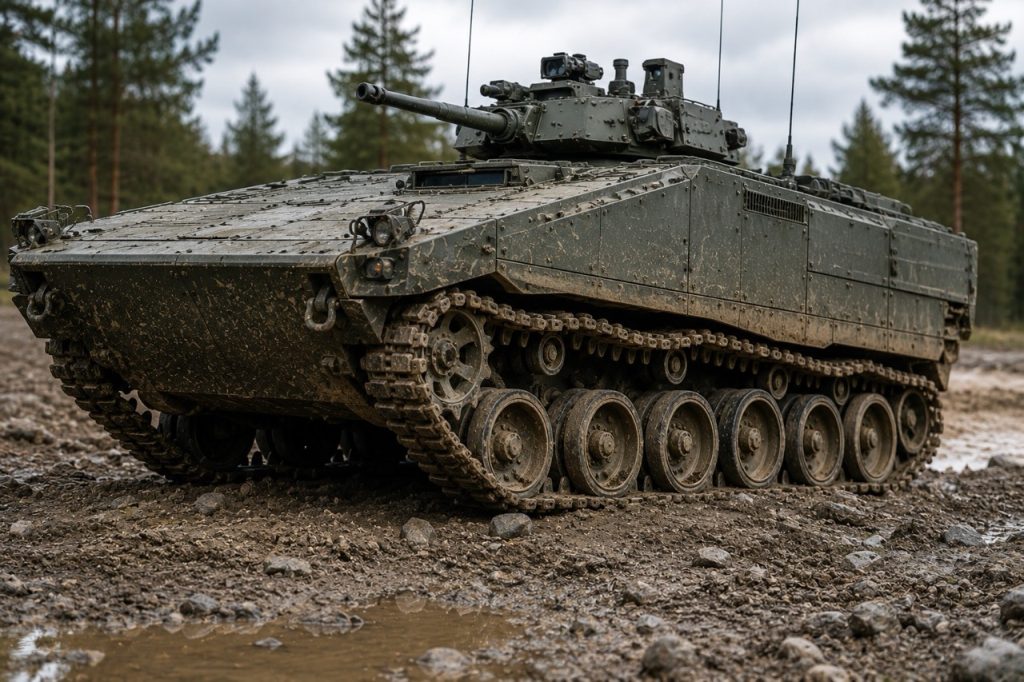
Warning Sign 4: Metallic Noise During Cross Country Operation
Armored vehicles are not quiet machines. The noise environment during cross-country operation includes track clatter, engine load noise, turret traverse mechanisms, and the general acoustic signature of heavy machinery working hard across rough terrain. Against that background, detecting a new or changed metallic noise requires trained crew attention and a disciplined reporting culture because these sounds, when they occur, are rarely insignificant.
Repetitive metallic knocking or clunking sounds that correlate with suspension travel sounds that increase in frequency as vehicle speed increases, or that occur specifically when traversing obstacles most commonly indicate worn or failed suspension bushings, loose mounting hardware, or damaged control arm components. Bushings are the rubber or polyurethane elements that line the pivot points of suspension arms and allow controlled articulation while dampening metal to metal contact. As bushings deteriorate, they lose material and compliance, allowing the metal components they separate to make contact under load. The result is a characteristic knock that ranges from a subtle irregularity at low speed to a pronounced clunking under hard suspension loading.
Torsion bar mounting wear is another source of metallic noise that maintenance teams sometimes fail to identify correctly. The torsion bar is splined into its mounting points, and as these splines wear due to micro movement under cyclic loading a very characteristic ticking or clicking sound develops. This sound tends to be more apparent at lower speeds where individual suspension loading events are distinguishable, and it may temporarily improve after lubrication of accessible points, which can lead maintenance personnel to incorrectly conclude the problem has been resolved.
Control arm damage which can result from obstacle strikes, mine blast loading, or simply metal fatigue at stress concentration points may produce structural sounds that differ in character from bushing noise. A bent or cracked control arm may not produce obvious noise under light loading but may generate significant metallic sound when the suspension is fully loaded during obstacle crossing. In severe cases, visual inspection will identify the deformation; in fatigue crack cases, the deformation may not be visible without NDT techniques.
Inspection recommendation: All new metallic sounds reported by crew should be investigated promptly, with the vehicle driven by maintenance personnel over an obstacle course or rough ground to localize and characterize the noise. Bushing condition, mounting bolt torque values, and control arm integrity should be assessed systematically. A noise that cannot be definitively attributed to a known serviceable component should halt the vehicle from further operation until root cause is identified.
Warning Sign 5: Oil Leaks Around Shock Absorbers or Suspension Components
Hydraulic fluid leakage from suspension dampers is one of the most clearly interpretable warning signs available to a maintenance team and one of the most commonly deferred. A small oil film around a shock absorber rod seal is easy to rationalize as minor seepage, particularly when the vehicle is otherwise performing acceptably. This rationalization is a significant maintenance error with predictable consequences.
Hydraulic dampers function through controlled fluid displacement within a sealed cylinder. The integrity of that seal is the foundation of the damper’s performance. When the rod seal begins to leak, it is indicating that the seal material has degraded, that contamination has scored the rod surface, or that cyclic loading has caused seal extrusion. At the point visible leakage appears, the seal has already been failing progressively the visible oil is a late stage indicator of an internal process that began earlier.
As the seal leak progresses, the damper loses hydraulic fluid from its working chamber. This loss has two consequences. First, it directly reduces the volume of fluid available for damping, degrading the damper’s ability to control suspension travel. Second, as fluid level drops, air can be drawn into the system through the compromised seal, causing aeration of the remaining fluid. Aerated hydraulic fluid is compressible, which transforms the damper from a viscous damping device into something closer to a pneumatic spring it stores energy rather than dissipating it, and suspension control deteriorates rapidly once this occurs.
On hydropneumatic suspension units, seal failure has additional implications. These systems maintain a charged nitrogen accumulator that provides the spring function. A leaking gas seal allows nitrogen pressure to decrease, which simultaneously reduces ride height and spring rate. The vehicle sits lower, the spring becomes softer, and in severe cases the suspension unit may bottom out on hard obstacles, transmitting full impact loading directly to the vehicle hull and mounting structure.
Contamination is also a concern with hydraulic suspension leaks. Hydraulic fluid contaminated with road dust and debris can cause abrasive damage to internal bore surfaces, accelerating wear in the remaining functional seals and valving. A vehicle operated with a known leaking damper for extended periods may require complete damper replacement with bore refinishing rather than the simpler seal replacement that would have been adequate if the problem had been addressed earlier.
Inspection recommendation: Any evidence of hydraulic leakage from shock absorbers or suspension units should be classified as requiring immediate attention rather than deferred to the next service interval. The affected unit should be evaluated for replacement at the earliest practicable opportunity, and the vehicle’s damping performance should be assessed prior to continued high-tempo operation. Clean, dry inspection of damper exteriors should be part of every daily maintenance check.
Warning Sign 6: Reduced Stability During Braking, Turning or Obstacle Crossing
Stability degradation is the warning sign that maintenance teams find most difficult to quantify but that experienced crews identify with high reliability. The vehicle feels different it rolls more in turns, pitches more under braking, or wallows rather than recovering cleanly from obstacles. These behavioral changes are not imaginary. They reflect real changes in the mechanical relationship between the vehicle’s mass and its suspension system, and they carry direct operational risk.
Excessive body roll during cornering is one of the most common manifestations. On a vehicle with degraded suspension, a significant proportion of the cornering load is transferred through body roll rather than being managed by the suspension geometry. This reduces the lateral load-bearing capacity of the system and, on wheeled vehicles, increases the risk of rollover on side slopes. On tracked vehicles, it increases the risk of track throw on sharp turns. The root causes include worn anti-roll bar links, fatigued torsion bars, degraded dampers, and collapsed bushings that allow suspension geometry to deviate significantly from design.
Pitch oscillation under braking where the vehicle nose dips heavily and then rebounds, sometimes with secondary oscillation indicates damper degradation, as this is precisely the type of dynamic load transfer that properly functioning dampers are designed to control. In combat vehicles that may need to make rapid position changes, stop quickly from high speed, or brake on uneven terrain, this loss of pitch control has direct safety implications. Extended pitch oscillation also disturbs the fire control solution on platforms where the main gun is not fully stabilized, delaying accurate target engagement.
Obstacle crossing performance degradation is particularly telling. A vehicle with healthy suspension absorbs an obstacle by allowing suspension travel to manage the energy input, with the damper controlling the rate of travel and the spring returning the road wheel to ground contact smoothly. A vehicle with worn suspension bottoms out more readily, produces harder jolts through the hull, and recovers more slowly to normal ride height after the obstacle. Crews notice this change in character clearly, particularly on regularly traveled training routes where they have a strong reference for normal vehicle behavior.
Reduced high-speed cross-country performance where the vehicle’s practical speed limit is constrained by instability rather than terrain or engine power is a fleet readiness impact that directly limits operational flexibility. A vehicle that is mechanically capable of 60 km/h on track but unstable above 35 km/h due to suspension degradation is, in operational terms, a significantly reduced asset.
Inspection recommendation: Crew stability assessments should be incorporated into maintenance reporting processes as a recognized diagnostic input. Vehicles reported by operators as feeling unstable or having changed handling characteristics should receive a full suspension inspection covering damper performance, bushing condition, anti-roll system integrity, and spring element condition before the subjective report is dismissed as opinion.
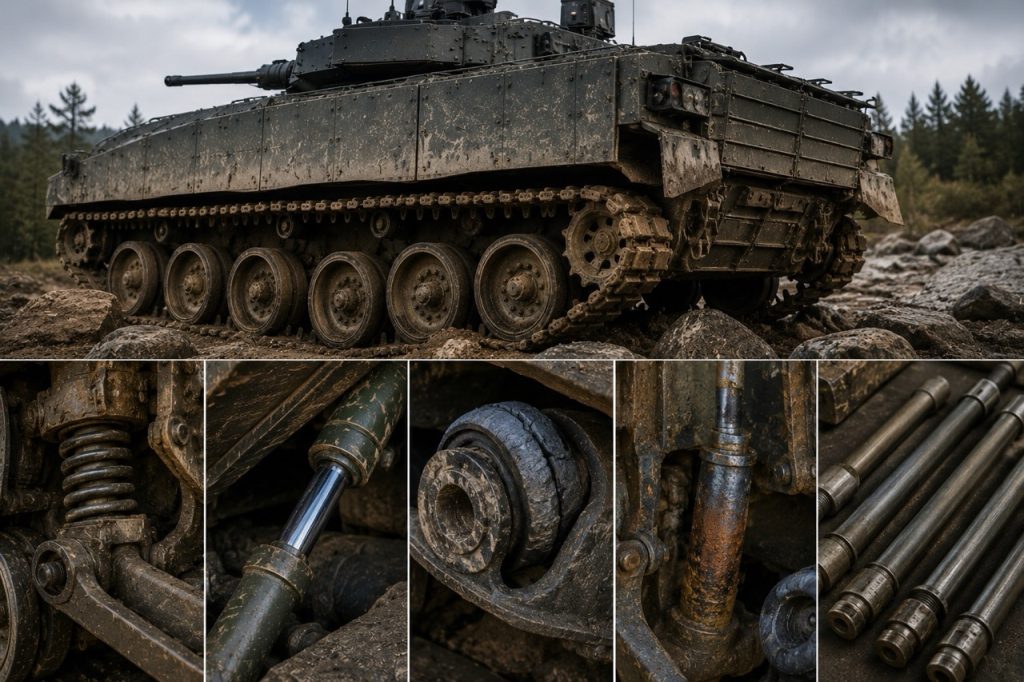
Common Causes of Premature Suspension Failure in Military Fleets
Understanding why suspension systems fail prematurely is as important as recognizing the warning signs when they do. Several factors consistently appear as root causes in defense fleet maintenance analysis.
Overloading is among the most significant. Military vehicles are routinely operated at or above their design gross vehicle weight during operational deployments, where additional armor packages, equipment racks, and supplies push the suspension beyond its rated load envelope. Suspension springs and dampers designed for nominal vehicle weight experience dramatically increased stress cycles at overloaded weights, shortening their service life proportionally.
Terrain severity accelerates wear in ways that accumulated mileage figures do not capture well. A vehicle operating primarily on paved roads covers far more kilometers per unit of suspension wear than the same vehicle conducting frequent cross country patrols over rocky or broken terrain. Maintenance scheduling based on kilometers or hours without terrain weighting will systematically under maintain vehicles in demanding operational environments.
Corrosion is a pervasive threat to suspension systems in marine, tropical, and high humidity environments. Torsion bars, control arms, and mounting hardware are typically high strength steel components that are vulnerable to stress corrosion cracking a failure mode where surface corrosion combines with structural stress to propagate cracks far faster than either factor alone would produce. Protective coating integrity on suspension components should be treated as a maintenance priority rather than an aesthetic concern.
Deferred maintenance is perhaps the most controllable cause of premature failure. Bushings that are identified as marginal during an inspection but not replaced because replacement is inconvenient or parts are unavailable continue to wear and allow increasing metal to metal contact, accelerating damage to the surrounding components they were protecting. A bushing replacement deferred for one service interval frequently results in control arm damage that makes the next maintenance event far more expensive and time consuming.
Component quality is a factor that defense fleets must take seriously. The suspension systems of military vehicles operate within tight engineering tolerances; a torsion bar or damper that does not meet the material specification or manufacturing tolerance of the original design will not perform equivalently, regardless of what the accompanying documentation claims. Procurement decisions that prioritize unit cost over verified quality create maintenance problems that accumulate across the fleet lifecycle.
Preventive Maintenance Strategies for Defense Fleets
Effective suspension maintenance in military fleets requires a structured approach that goes beyond reactive repair. The most capable defense maintenance organizations operate suspension health management as a continuous process, not a point in time event.
Scheduled inspection intervals should be defined not just by time or mileage but by operational context. A vehicle returning from intensive cross country operations in a demanding environment should receive a suspension inspection regardless of whether its scheduled interval has elapsed. Inspections should have standardized checkpoints covering ride height measurement, bushing visual assessment, damper external condition, hardware torque verification, and operator-reported symptoms the last item being one that many inspection checklists omit but that provides valuable early warning data.
Condition monitoring approaches are increasingly accessible to defense fleets. Simple vibration analysis, using compact accelerometers mounted on the hull or crew compartment, can provide continuous data on suspension behavior that allows comparison to baseline profiles established during acceptance testing or after overhaul. Deviations from the baseline that develop gradually are frequently detectable before they produce operator-perceptible symptoms, giving maintenance planners lead time to schedule replacements within planned maintenance windows rather than as emergency repairs.
Component traceability requirements should extend to suspension spare parts. Every replacement torsion bar, shock absorber, or control arm bushing installed should have documented provenance manufacturer identification, batch number, and certification documentation sufficient to support quality related investigation if a component fails prematurely. This traceability also supports predictive maintenance by enabling analysis of replacement patterns across the fleet to identify components or suppliers with above average failure rates.
Planned replacement cycles for high wear suspension consumables particularly bushings and dampers should be established based on verified service life data for the specific platform and operational pattern, rather than relying solely on the original equipment manufacturer’s nominal service life figures, which may reflect different operational conditions. Fleet data collected over multiple maintenance cycles can produce statistically grounded replacement intervals that balance component utilization against failure risk.
The economic case for preventive maintenance in suspension systems is straightforward. The parts and labor cost of replacing a set of torsion bar bushings during a planned maintenance window is a fraction of the cost of vehicle recovery, emergency parts procurement, and unplanned downtime resulting from a suspension failure in the field. Fleet managers who can quantify this relationship have a compelling business case for defending preventive maintenance budgets against operational pressure to extend intervals.
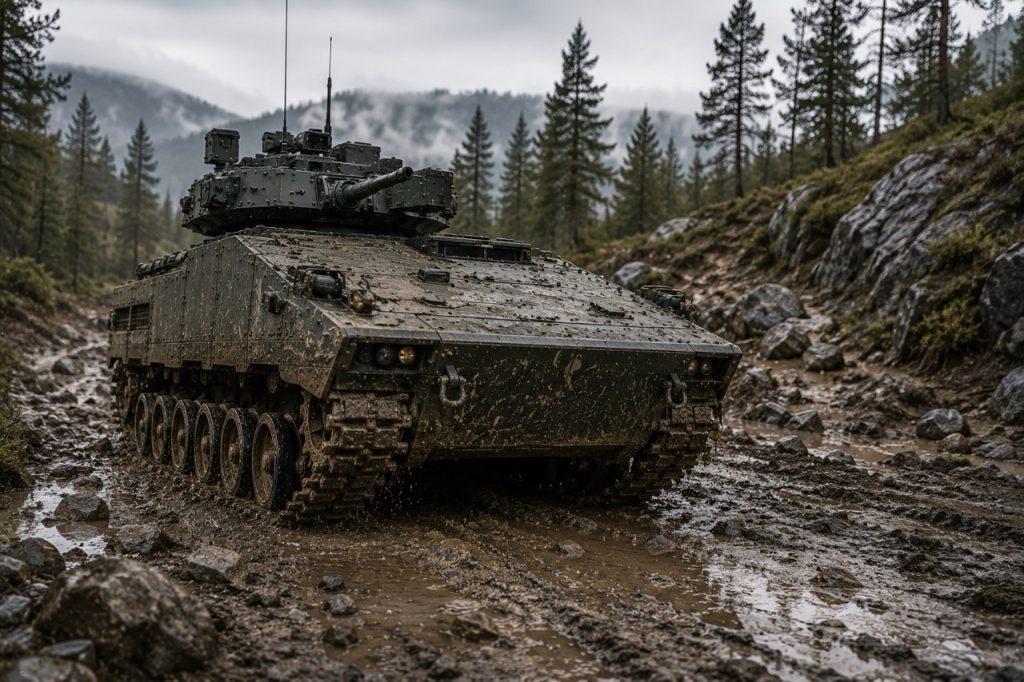
Why Quality Spare Parts Matter in Military Suspension Systems
The performance characteristics of a suspension system are the product of precise engineering: specific material properties in torsion bars and springs, calibrated damping curves in hydraulic shock absorbers, controlled durometer ratings in bushings, and tight dimensional tolerances throughout. These are not characteristics that can be verified by visual inspection or even basic dimensional measurement alone they require material certification, manufacturing process verification, and in some cases functional testing.
This engineering reality makes the source and quality of suspension spare parts a direct determinant of the maintenance outcomes achieved. A torsion bar manufactured from steel that does not meet the fatigue life specification will fail sooner than expected potentially in the field rather than at the maintenance depot. A shock absorber with valve tolerances outside specification will either over-damp (creating a harsh ride that transmits excessive force to the hull) or under damp (allowing uncontrolled suspension oscillation). A bushing with incorrect Shore hardness will either wear too quickly or transmit too much vibration energy to surrounding metal components.
For defense organizations sourcing military vehicle suspension components, quality assurance documentation is not optional paperwork it is the evidence base for the maintenance decisions that follow. Certificates of Conformance, material test reports, and where applicable First Article Inspection results provide the documentation trail that supports both in service reliability and post-failure investigation. Quality management systems certified to standards such as ISO 9001 or AS9100 provide additional assurance that a supplier’s manufacturing processes are systematically controlled.
Component traceability is equally important in the context of obsolescence. Many armored vehicle platforms in service today were designed and initially fielded decades ago. As original equipment manufacturers reduce or discontinue support for legacy platforms, defense organizations must source suspension components from alternative suppliers. In this environment, verified interchangeability data confirming that a replacement component meets the form, fit, and function requirements of the original becomes a critical quality assurance deliverable, not an administrative convenience.
Defense logistics professionals responsible for suspension component procurement should approach supplier evaluation with the same rigor they would apply to any other safety critical vehicle component. Supplier qualification processes should assess manufacturing capability, quality management systems, material sourcing practices, and the ability to provide the documentation that defense quality requirements demand. The unit price of a torsion bar or damper is a relatively small consideration compared to the cost implications of receiving a component that fails to perform as specified in service.
Maintaining the Foundation of Operational Mobility
Suspension failures in armored vehicles are rarely sudden, unpredicted events. They develop through recognizable stages, provide identifiable warning signs, and respond to timely intervention. Maintenance teams that build systematic suspension health monitoring into their operational routines and that take the early warning signs seriously rather than deferring investigation consistently achieve better fleet availability, lower lifecycle costs, and fewer unplanned maintenance events than those operating in a purely reactive mode.
The six warning signs described in this article uneven ride height, excessive vibration, abnormal wear patterns, metallic noise during operation, hydraulic leakage, and stability degradation represent the most consistently observable early indicators that suspension systems are approaching a failure threshold. None of them require sophisticated diagnostic equipment to detect; they require informed attention and a maintenance culture that treats operator reported vehicle behavior as valid diagnostic input rather than subjective complaint.
Fleet sustainment managers and procurement professionals have a direct role in supporting effective suspension maintenance by ensuring that the right replacement components are available when inspections identify the need for replacement, and that the components sourced meet the quality and documentation standards that military platforms require. Preventive maintenance is only as effective as the supply chain that enables it.
AB DEFENCE supports defense organizations and prime contractors with a comprehensive portfolio of military vehicle suspension spare parts including torsion bars, shock absorbers, road wheels, bushings, control arms, and associated mounting hardware sourced and supplied in compliance with defense quality standards. Contact AB DEFENCE to discuss your fleet’s suspension sustainment requirements and explore how a reliable supply partnership can contribute directly to your operational readiness objectives.
Work With AB Defence
Partner with AB DEFENCE for Reliable Combat Support Vehicle Sustainment. AB DEFENCE is a specialist international supplier of military spare parts and fleet sustainment solutions serving NATO and allied defense organisations. With deep inventory across a wide range of combat support vehicle platforms, rigorous quality assurance processes, export compliance expertise, and a commitment to long term supply chain partnership, AB DEFENCE helps defense buyers maintain fleet availability, reduce sustainment costs, and meet their operational readiness obligations. Contact the AB DEFENCE team to discuss your spare parts requirements, strategic inventory planning, and long-term sustainment programme needs.
Contact AB Defence to discuss your procurement requirements and learn how we can support your fleet readiness objectives.
Related Military Spare Parts Categories, Vehicle Platforms & Technical Guides
Explore AB Defence’s NATO-codified (NSN) and genuine OEM spare parts catalog, platform technical specifications, and sustainment engineering guides related to this article:
Stocked Spare Parts Categories (NSN & OEM Catalog)
- Military Brake Calipers, Master Cylinders & Hydraulic Systems (103 stocked parts)
- Electrical, Electronic & Vision Systems for Military Vehicles (250 stocked parts)
- Military Pneumatic Air Fittings, Brake Valves & Compressors (115 stocked parts)
- Military Portal Axles, Differentials & Drive Shafts (107 stocked parts)
- Military Cab, Armor Body Panels, Mirrors & Structural Hardware (130 stocked parts)
- Full NATO NSN & OEM Spare Parts Catalog (16,760+ Parts)
Compatible Vehicle Platforms & System Hubs
- Brake & Suspension Systems
- Hydraulics & Mechanical Components
- Electrical, Electronic & Vision Systems
- Body, Panel & Gasket Solutions
- Tactical Wheeled Vehicles
- Request a B2B Quotation (RFQ) & Technical Support
Related Military Engineering & Sustainment Articles
- Military Brake System Failures: Causes, Risks and Maintenance Priorities
- Military Vehicle Hydraulic System Failures: Causes, Maintenance and Critical Spare Parts
- Why Military Vehicle Electrical Systems Fail: Common Problems and Spare Parts
- 8 Components Most Frequently Replaced in Armored Military Vehicles