June 4, 2026
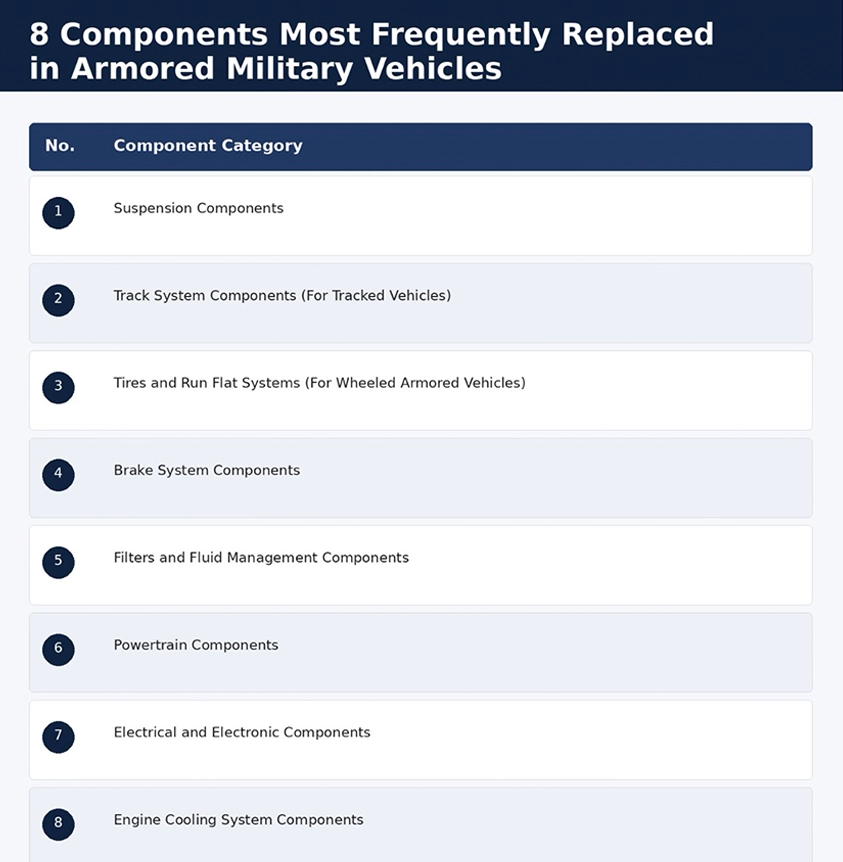
8 Components Most Frequently Replaced in Armored Military Vehicles
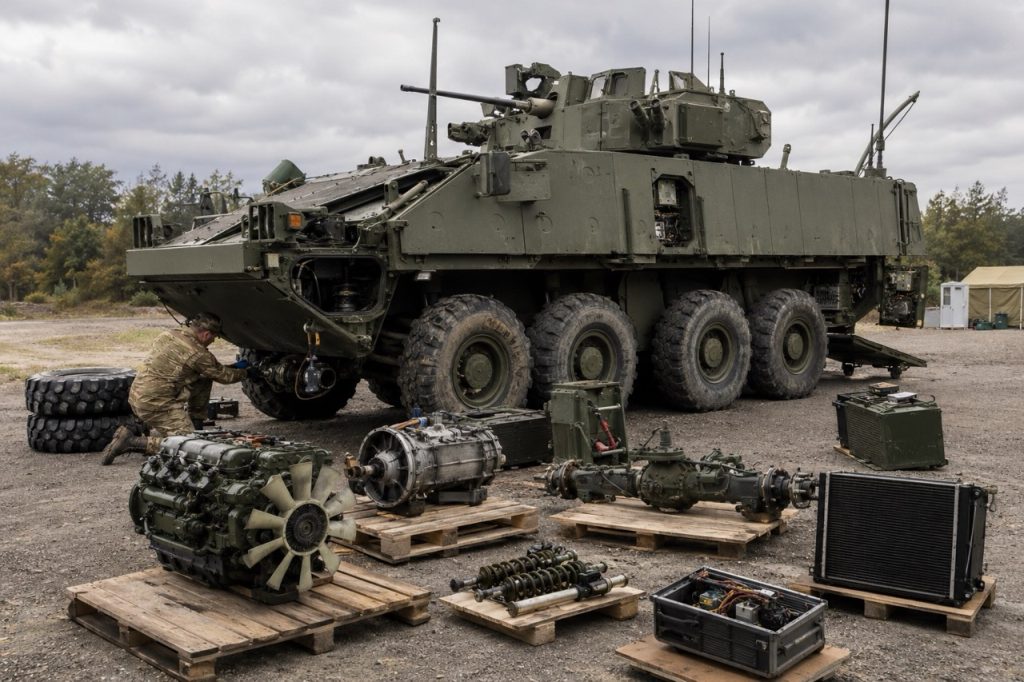
Armored military vehicles operate in environments that would quickly render civilian transport unserviceable. From the dust choked desert corridors of the Sahel to the freeze thaw terrain cycles of Eastern European training grounds, these platforms are expected to perform under conditions that push every mechanical system to its limits and beyond. The consequence is inevitable: components wear, degrade, and fail, and the speed at which damaged parts are identified and replaced directly determines whether a vehicle returns to the fight or sits in a maintenance bay waiting for spare parts that may not yet be on the shelf.
For defense procurement officers, fleet sustainment managers, and military logistics professionals, understanding which components experience the highest replacement rates is not merely an academic exercise. It is the foundation of sound inventory planning, lifecycle cost management, and operational readiness. A fleet that runs out of brake pads or track shoes during a high tempo exercise is a fleet that fails its mission. And in combat, that failure carries consequences far beyond financial.
This article examines the eight categories of armored military vehicle spare parts most frequently demanded by maintenance operations worldwide, exploring the mechanical and environmental factors that drive wear, the operational consequences of deferred replacement, and the sustainment strategies that leading defense organizations use to stay ahead of component degradation.
Why Certain Components Experience Higher Wear Rates in Armored Military Vehicles
Before examining individual component categories, it is worth understanding the systemic factors that make armored vehicle maintenance fundamentally different from maintaining civilian or light military transport fleets. The convergence of these factors explains why armored military vehicle spare parts demand is both high in volume and challenging to predict.
Extreme Weight and Mechanical Stress
A modern main battle tank can weigh between 55 and 70 tonnes. Even lighter platforms such as infantry fighting vehicles (IFVs) and mine resistant ambush protected (MRAP) vehicles routinely tip the scales at 15 to 30 tonnes. This mass places enormous and sustained stress on every mechanical interface suspension mounts, brake systems, drivetrain components, and track assemblies all operate at the extreme end of their design envelopes as a matter of routine.
Off Road Operations and Terrain Severity
Armored vehicles are rarely confined to prepared surfaces. Tactical deployments, training exercises, and combat operations require these platforms to traverse terrain that generates continuous shock loading, abrasive contact, and torsional stress. Rocky ground accelerates track wear. Sandy or silty environments saturate air and fuel filters far faster than clean-air operation would suggest. Wet or muddy conditions introduce water ingress risks into electrical systems and accelerate corrosion in exposed mechanical interfaces.
High Operational Tempo and Limited Recovery Time
During exercises and operational deployments, armored vehicles are often driven for extended periods with minimal downtime for inspection or servicing. NATO sustainment doctrine acknowledges that in high intensity conflict scenarios, scheduled maintenance intervals may be compressed or bypassed entirely, with condition based replacement replacing time based schedules. This further amplifies wear rates on high stress components.
Long Service Life Expectations
Many armored platforms in service today were originally designed in the 1970s and 1980s, with some nations operating upgraded variants that have accumulated decades of service life. Extended service increases the probability of cumulative fatigue failures in structural components and makes original equipment manufacturer (OEM) spare parts increasingly difficult to source as production runs end and supply chains mature.
Environmental Exposure and Corrosion
Electrical connectors, wiring harnesses, hydraulic fittings, and cooling system hoses are all vulnerable to the corrosive effects of salt, moisture, fuel contamination, and UV exposure. Tropical climates accelerate rubber degradation. Arctic environments cause seal failures and lubricant thickening that places abnormal loads on mechanical systems. No single environment is benign from a component durability perspective.
1. Suspension Components
The suspension system of an armored vehicle is its primary interface with the ground, absorbing the continuous shock and vibration generated by off-road movement while maintaining crew comfort, vehicle stability, and weapons platform accuracy. Given the weight these systems support and the terrain they must negotiate, it is unsurprising that suspension components rank among the highest-volume armored military vehicle spare parts categories across virtually all tracked and wheeled platforms.
Shock Absorbers and Dampers
Hydraulic shock absorbers and dampers lose their damping capacity progressively through fluid degradation, seal wear, and internal valve wear. On vehicles operating in rocky or heavily undulating terrain, the rate of damper degradation is significantly accelerated. Loss of damping control affects vehicle handling, crew fatigue, and the accuracy of mounted weapon systems making timely replacement operationally significant beyond pure mobility concerns.
Torsion Bars
Many tracked platforms, including IFVs and main battle tanks, use torsion bar suspension systems. Torsion bars are precision engineered spring elements that absorb and distribute road wheel loads through controlled torsional deflection. Repeated high cycle loading, particularly during hard landings from ramps or obstacles, can cause progressive fatigue cracking. Replacement requires specialist tooling and correctly torqued installation to restore designed suspension geometry.
Suspension Arms and Bushings
Suspension arm bushings typically polyurethane or rubber bonded metal assemblies are among the highest turnover individual parts in armored vehicle maintenance. They isolate vibration, allow controlled articulation of suspension geometry, and wear through normal use faster than almost any other structural component. Their relatively low unit cost and high replacement frequency make them a critical item for forward deployed maintenance stocks.
Maintaining adequate suspension spare parts stocks is one of the most reliable indicators of fleet readiness. Fleets that carry adequate torsion bar, shock absorber, and bushing stocks consistently demonstrate higher operational availability rates than those that treat suspension maintenance reactively.
2. Track System Components (For Tracked Vehicles)
For tracked armored platforms including main battle tanks, IFVs, armored personnel carriers (APCs), and self propelled artillery the track system is both the primary mobility mechanism and one of the most demanding maintenance requirements in the entire vehicle lifecycle. Track wear is continuous, predictable, and unavoidable, and the failure to maintain adequate stocks of track system spare parts is one of the most common causes of reduced fleet availability in tracked vehicle fleets worldwide.
Track Shoes and Track Pads
Track shoes are the individual links that form the continuous loop of the track assembly. Rubber track pads bonded or bolted to track shoes protect road surfaces during training and reduce noise signature, but wear rapidly on hard surfaces. Track shoe wear is a function of both mileage and terrain hardness: operations in rocky or highly abrasive environments can consume track pads at rates two to three times higher than those seen on softer ground. Tracking shoe replacement is a high volume, high frequency maintenance activity on all tracked platforms.
Track Pins and Bushings
Track pins and bushings connect individual track shoes and allow the track assembly to articulate around the drive sprocket, idler, and road wheels. As these components wear, track pitch increases the effective lengthening of the track loop requiring track adjustment and, eventually, replacement. Worn pins and bushings also increase the risk of track throwing, a serious mobility loss event that requires significant recovery effort in field conditions.
Road Wheels, Idler Wheels, and Sprockets
Road wheels support the vehicle weight as it bears directly on the track. Idler wheels maintain track tension at the front of the running gear. Sprockets drive the track through engagement with track pins. All three components are subject to sustained high load operation and must be replaced on a condition based or mileage based schedule. Sprocket teeth are particularly vulnerable to wear from gritty or abrasive terrain, and worn sprockets accelerate pin and bushing wear if not replaced promptly.
3. Tires and Run Flat Systems (For Wheeled Armored Vehicles)
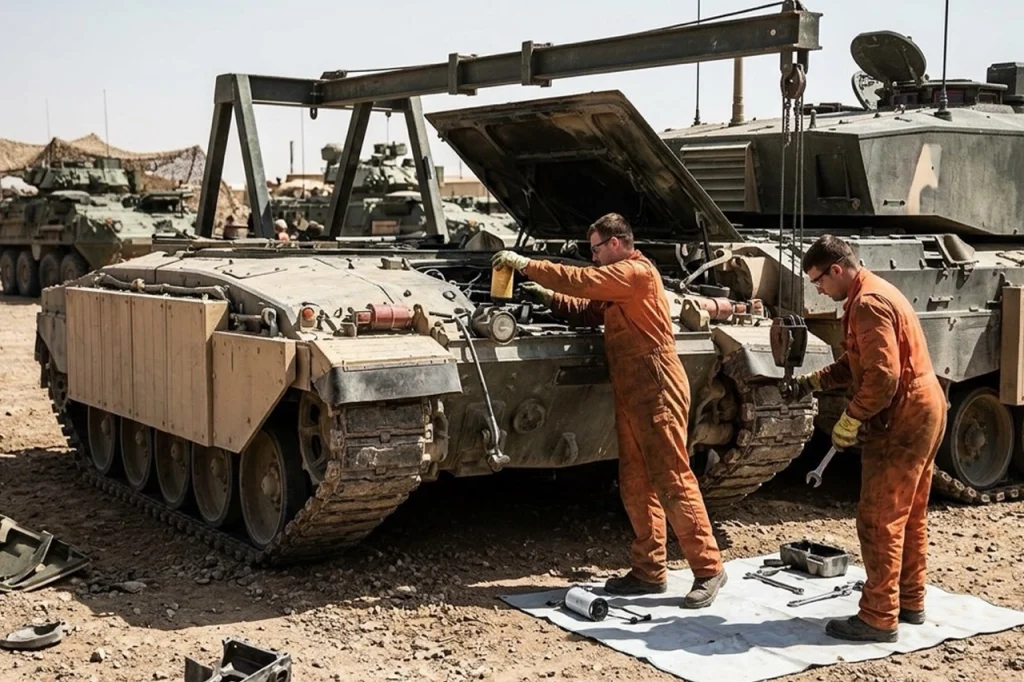
Wheeled armored platforms including MRAPs, 8×8 and 6×6 APCs, reconnaissance vehicles, and tactical wheeled combat platforms depend on their tire and run flat systems for both mobility and crew survivability. Unlike civilian vehicle tires, military-specification tires must tolerate not only the mechanical demands of of road operation but also the consequences of combat damage, including blast overpressure, fragmentation, and small arms fire.
Tire Degradation Patterns
Military vehicle tires are subjected to load cycles, sidewall flexion, and abrasive surface contact that accelerate degradation beyond what laboratory test protocols typically model. Heavy loads on rocky terrain create localized stress concentrations that cause carcass fatigue over time. UV exposure and ozone degradation affect sidewall rubber chemistry even when vehicles are in storage, making age based replacement a necessary complement to condition inspection in warm or high-altitude environments.
Run Flat Inserts
Run-flat inserts typically polyurethane or cellular foam rings fitted inside the tire rim allow a wheeled armored vehicle to continue operating at reduced speed after tire failure, providing the crew time to egress a threat area before halting. Run flat inserts are among the most important survivability components on wheeled armored vehicles, and their condition must be maintained alongside standard tire inspection. Damaged or degraded inserts that are not replaced represent a potentially critical failure point in combat situations where vehicle self recovery is not possible.
Maintaining a sufficient stock of correctly sized tires and run flat inserts for each vehicle variant in a fleet is a routine but often underestimated spare parts planning challenge, particularly for nations operating multiple wheeled platform types with different tire specifications.
4. Brake System Components
Braking a fully loaded armored vehicle particularly on steep or loose terrain places extraordinary thermal and mechanical stress on every element of the brake system. The physics are unforgiving: the kinetic energy that must be absorbed by the brake system scales with vehicle mass, and armored vehicles are among the heaviest ground platforms operated by any military force. The result is accelerated brake component wear that places brake parts firmly within the core category of armored military vehicle spare parts.
Brake Pads and Discs
Brake pads are the highest turnover item within the brake system. Friction material thickness is consumed at rates that vary significantly with terrain gradient, vehicle weight, and driver technique. Mountain or hilly training environments consume pads substantially faster than flat terrain. Brake discs, while longer lived, are subject to thermal cracking and surface glazing under repeated high energy braking events. Warped or cracked discs reduce braking performance and create vibration that can affect vehicle systems and crew.
Calipers and Hydraulic Components
Brake calipers, hydraulic lines, master cylinders, and wheel cylinders are less frequently replaced than friction materials but remain critical replacement items in the medium to long maintenance cycle. Hydraulic seal degradation accelerated by fluid contamination or thermal cycling can cause brake fade or complete loss of braking on individual wheels. Maintaining brake system hydraulic integrity is a safety critical maintenance requirement that cannot be deferred without risk.
5. Filters and Fluid Management Components
Filters are the first line of defense against the contamination that operating environments continuously introduce into vehicle systems. Air, fuel, hydraulic, and oil filters are among the highest turnover consumable items in armored vehicle maintenance, and their apparently simple function conceals an operationally critical role: a clogged air filter can cause engine power reduction and accelerated wear; a contaminated fuel filter can cause injection system damage; a failed hydraulic filter can introduce particulate into actuators and pumps that cause damage orders of magnitude more expensive than the filter itself.
Air Filtration
Dust and particulate ingestion is the primary air filtration challenge in military environments. Operations in desert, sandy, or disturbed terrain environments can reduce air filter service life from hundreds of hours to dozens, requiring significantly increased inspection and replacement frequency. Some armored vehicles are fitted with pre cleaners and cyclonic separators to reduce primary filter load, but even with these systems, air filter replacement remains a high frequency maintenance task.
Fuel, Hydraulic, and Oil Filtration
Fuel filter contamination from particulate, water ingress, or microbial growth in warm climates can cause fuel system faults that are difficult to diagnose without proper testing equipment. Hydraulic filter condition directly affects the health of all hydraulically actuated systems including suspension, steering, weapon station drives, and ramp/hatch mechanisms on APCs and IFVs. Engine oil filter health reflects oil condition and provides an early warning indicator of internal engine wear when combined with oil analysis programs.
Preventive filter replacement replacing at defined intervals rather than waiting for performance degradation is consistently the most cost effective maintenance investment available to armored fleet operators. The cost of a filter set is invariably a fraction of the repair cost for the system failures that contamination causes.
6. Powertrain Components
The powertrain of an armored vehicle encompassing the transmission, driveshafts, differentials, transfer cases, and associated drivetrain components is responsible for translating engine power into vehicle movement under conditions that would overwhelm commercial vehicle drivelines. The mechanical loads involved are severe, and the consequences of powertrain component failure in operational contexts range from mission abort to complete vehicle immobilization.
Drive Shafts and Universal Joints
Drive shafts transmit torque from the transmission or transfer case to the driven axles or sprockets. Universal joints at each end of the shaft accommodate the angular articulation of the suspension and allow torque transfer across changing angles. In armored wheeled vehicles, universal joints are subjected to high torque inputs combined with extreme articulation angles during off road operation a combination that accelerates wear in the cruciform bearing assemblies and journals. Universal joint failure is typically sudden, resulting in complete loss of drive to the affected axle.
Differentials and Transfer Cases
Differentials and transfer cases distribute drive torque between axles and between high and low range in multi axle drive systems. These components are generally longer lived than driveshaft components but are subject to progressive bearing and gear wear that manifests as vibration, noise, and eventual failure if not addressed through timely overhaul or replacement. Differential failure can reduce a multi axle wheeled platform to two-wheel drive, significantly compromising off road mobility.
Transmission Components
Both manual and automatic transmissions fitted to armored vehicles are precision assemblies that require correct fluid levels, appropriate fluid specification, and timely service to maintain reliability. Clutch components in manual transmission vehicles wear through the repeated high load engagement cycles typical of off road driving, while automatic transmission valve bodies and friction packs are vulnerable to overheating during sustained low speed maneuvering. Transmission spare parts are typically high value, long lead items that require careful inventory management.
7. Electrical and Electronic Components
The electrical and electronic architecture of modern armored vehicles has grown substantially in complexity over the past three decades. Contemporary platforms integrate vehicle management systems, digital fire control, situational awareness systems, intercom and communications networks, integrated power management units, and sensor suites into a vehicle wide electronic architecture. This sophistication delivers significant operational capability but it also introduces a substantial and growing category of armored military vehicle spare parts requirements that did not exist on earlier platforms.
Wiring Harnesses and Connectors
Wiring harnesses are among the most maintenance intensive electrical components on armored vehicles. The combination of vibration, thermal cycling, chemical exposure, and mechanical chafing in the tight routing spaces of an armored hull creates conditions under which insulation degrades, connector contacts corrode, and individual conductors fracture. Intermittent electrical faults caused by harness degradation are among the most time consuming to diagnose, as they may not manifest consistently under workshop conditions. Maintaining stocks of platform specific harness assemblies and MIL spec connector components is a prerequisite for effective electrical maintenance.
Sensors and Electronic Control Units
Modern armored vehicles rely on networks of sensors temperature, pressure, position, speed, fire detection, and NBC detection among others to monitor vehicle system health and support crew and maintenance decision making. Electronic control units (ECUs) process sensor data and control vehicle functions across powertrains, suspension systems, and weapon platforms. Both sensors and ECUs are vulnerable to the vibration, moisture, and electromagnetic environment of armored vehicle operation, and both require available replacement stocks to enable rapid fault resolution.
Power Distribution Units
Power distribution units, bus bars, fuse assemblies, and relay modules manage the electrical power architecture of the vehicle. Faults in power distribution components can disable multiple vehicle systems simultaneously and are often the root cause of apparently unrelated electrical failures across different vehicle functions. These components are frequently available from defense aftermarket specialists where original procurement channels have long lead times or have been discontinued.
8. Engine Cooling System Components
The cooling system of an armored vehicle engine must manage the substantial heat rejection of a high power military powerplant operating under load often in high ambient temperatures, with limited airflow through a heavily armored hull. Cooling system health is directly linked to engine longevity and operational availability: a cooling system failure can overheat and destroy an engine worth hundreds of thousands of dollars in a matter of minutes. Engine cooling components therefore represent both a high frequency maintenance category and a critical preventive maintenance priority.
Radiators
Military vehicle radiators are typically large, multi row assemblies designed to maximize heat transfer in restricted hull spaces. They are vulnerable to internal scale and corrosion if coolant chemistry is not maintained correctly, and to external damage from debris, shrapnel, or pressure washing at excessive proximity. Radiator failure either through leakage or internal blockage results in immediate cooling system compromise. Given the lead times and costs associated with OEM radiator procurement, maintaining forward stocks of serviceable radiators or qualified aftermarket alternatives is important for fleets operating at sustained high tempo.
Water Pumps, Cooling Fans, and Thermostats
Water pump impeller wear, seal failure, and bearing degradation are among the most common individual cooling system faults. Water pump replacement is a routine maintenance activity on high mileage armored vehicles. Cooling fan clutches or hydraulic fan drives can fail in ways that reduce fan speed without triggering obvious warning indications, causing gradual coolant temperature creep under load. Thermostat failures either stuck open, causing under temperature operation that accelerates engine wear, or stuck closed, causing rapid overheating are simple to prevent through scheduled replacement but can cause serious damage if missed.
Hoses and Coolant System Seals
Coolant hoses are rubber or silicone assemblies that are subject to thermal cycling, ozone degradation, and pressure fatigue over time. Hard spots, soft spots, swelling, and surface cracking are all indicators of imminent hose failure. Given the catastrophic consequences of a sudden hose failure during operation, proactive replacement as part of scheduled maintenance rather than waiting for failure indications is standard practice in well managed armored vehicle fleets.
The Operational Consequences of Delayed Component Replacement
The connection between spare parts availability and fleet operational readiness is direct and well documented in defense sustainment literature. Deferred component replacement, whether driven by budget constraints, supply chain failures, or inadequate maintenance planning, consistently results in a predictable set of operational degradations that compound over time.
The most immediate consequence is reduced fleet availability. When multiple vehicles in a fleet are awaiting the same scarce component whether suspension arms, track pads, or brake discs fleet availability can collapse rapidly. Defense organizations that have experienced high intensity training exercises or prolonged operational deployments are familiar with the phenomenon of cascading maintenance backlogs, where deferred repairs across multiple systems eventually combine to render vehicles non mission capable.
Delayed replacement also increases total lifecycle maintenance costs. The physics of mechanical degradation are cumulative: a worn universal joint that is not replaced accelerates wear on connected drive shaft and differential components. A failed damper that is not addressed degrades suspension geometry, increasing wear on bushings, torsion bars, and road wheels. Each deferred repair creates downstream repair requirements that are invariably more expensive than the original replacement would have been.
Safety implications are also significant. Degraded brake systems, compromised steering components, and fatigued structural suspension elements all represent genuine crew safety risks. Military vehicle accidents during training have resulted in serious injuries and fatalities that post incident investigations have attributed to maintenance deferrals and inadequate spare parts availability. The human cost of deferred maintenance is rarely captured in procurement cost analyses but is understood by experienced sustainment professionals.
Fleet availability is the ultimate measure of sustainment performance. Every hour a vehicle sits waiting for a spare part represents not just a cost it represents a degradation of the operational capability that the defense budget was intended to purchase.
How Defense Organizations Reduce Failure Rates and Improve Fleet Readiness
Leading defense organizations have developed structured approaches to managing armored vehicle component wear that move beyond reactive maintenance into proactive sustainment strategies aligned with NATO sustainment concepts and modern fleet management practices.
Condition-Based and Predictive Maintenance
Condition based maintenance (CBM) replaces time interval servicing with data driven replacement decisions based on actual component condition. Oil analysis, vibration monitoring, thermal imaging of brake systems, and electronic diagnostic data from vehicle management systems all provide early indicators of component degradation before failure occurs. CBM programs consistently demonstrate reduced component waste, better failure prediction, and improved maintenance planning compared with pure mileage or hour based intervals.
Strategic Spare Parts Stockholding
Forward positioned spare parts stocks positioned at unit, formation, and national support echelons are essential for maintaining operational tempo during high intensity training or operations. Strategic stockholding requires accurate demand forecasting based on historical consumption data, vehicle population statistics, and operational intensity assumptions. Nations operating within NATO frameworks benefit from standardized spare parts identification systems and cooperative logistics arrangements that allow inter-nation support in certain circumstances.
Obsolescence Management
As armored platforms age, OEM supply chains for original spare parts progressively contract. Manufacturers discontinue production runs, suppliers close, and drawing packages become the only route to manufactured replacements. Proactive obsolescence management identifying at risk components years before supply chain failures occur, qualifying alternative suppliers, and building strategic stocks of critical items is a discipline that distinguishes mature defense sustainment organizations from those that encounter crises when OEM supply finally ends.
Lifecycle Sustainment Planning
Integrating spare parts planning into vehicle lifecycle management from acquisition through mid life upgrade to disposal creates the conditions for consistent fleet readiness across the full service life. Lifecycle sustainment contracts where the OEM or a prime integrator is contractually responsible for defined availability levels are increasingly common in NATO procurement, shifting performance risk from defense organizations to industrial partners with greater visibility of component supply chains.
The Importance of Reliable Military Spare Parts Supply Chains
The operational value of well maintained armored vehicle fleets depends entirely on the supply chains that deliver replacement components to maintenance facilities. A technically excellent maintenance program supported by a fragile or poorly managed supply chain will consistently fail to deliver the readiness levels that defense organizations require.
Lead time management is the central challenge. Military specification components often have manufacturing lead times of weeks or months, and some specialist items particularly for older platforms with limited OEM support may require months of procurement effort even under urgent operational need. Defense organizations that manage their spare parts supply chains effectively maintain demand forecasting processes that initiate procurement well ahead of anticipated consumption, avoiding the premium costs and capability impacts of emergency procurement.
Quality assurance and traceability are non negotiable in military spare parts procurement. The consequences of a substandard component entering service on an armored vehicle particularly in safety critical systems such as brakes, steering, or suspension range from operational unreliability to catastrophic failure with crew safety implications. Defense organizations and their qualified suppliers maintain rigorous quality management systems, material traceability documentation, and first article testing requirements that together provide confidence in component integrity.
Supplier qualification is a time consuming but essential process. Qualified defense spare parts suppliers are those that have demonstrated compliance with relevant quality, technical, and regulatory requirements, often including ISO 9001 certification, NATO supply code compliance, and military specification alignment. Building relationships with a diversified portfolio of qualified suppliers rather than single source dependency on OEM channels provides resilience against supply disruptions and competitive pricing that allows defense budgets to deliver better readiness outcomes.
The increasing complexity of global supply chains has also introduced counterfeit component risks that defense procurement must actively manage. Fraudulent spare parts particularly electronic components and safety critical mechanical parts have been identified in defense supply chains globally. Robust supplier qualification, material traceability requirements, and inspection protocols at goods receipt are the primary defenses against this risk.
Maintaining the operational readiness of armored military vehicle fleets is fundamentally a logistics and sustainment challenge. The eight component categories discussed in this article suspension systems, track components, tires and run flat systems, brake systems, filters, powertrain components, electrical systems, and engine cooling systems represent the core of any armored vehicle spare parts program because they combine high wear rates, operational criticality, and predictable demand patterns that reward proactive planning.
The common thread linking all effective armored vehicle sustainment programs is the recognition that readiness is bought not only at the vehicle acquisition stage but through every subsequent decision about maintenance scheduling, spare parts stocking, supplier qualification, and lifecycle planning. Vehicles that are maintained on defined cycles with properly stocked spare parts inventories consistently outperform those maintained reactively, and the total lifecycle cost of proactive maintenance is invariably lower than the combined cost of deferred repairs, emergency procurement, and capability gaps.
Defense organizations that treat armored military vehicle spare parts supply as a strategic priority investing in qualified supplier relationships, predictive maintenance programs, and strategic stockholding will consistently deliver higher fleet availability and better value from their vehicle fleets across the full service life.
Work With AB Defence
AB Defence operates as a specialized international supplier of military spare parts and fleet sustainment solutions, serving defense procurement organizations, military logistics managers, and armed forces across NATO and allied nations. With a rigorous approach to quality assurance, full documentation traceability, and deep technical expertise across a broad range of military vehicle and equipment platforms, AB Defence is structured to meet the demanding standards that defense procurement officers rightly require.
Whether you are managing aging fleet sustainment, sourcing critical components against compressed timelines, or seeking a long-term supply chain partner with genuine defense industry expertise, AB Defence offers the technical capability, compliance framework, and operational reliability that defense supply chains depend on.
Contact AB Defence today to discuss your procurement requirements and learn how we can support your fleet readiness objectives.
Related Military Spare Parts Categories, Vehicle Platforms & Technical Guides
Explore AB Defence’s NATO-codified (NSN) and genuine OEM spare parts catalog, platform technical specifications, and sustainment engineering guides related to this article:
Stocked Spare Parts Categories (NSN & OEM Catalog)
- NATO Standard Defence Components & Military Hardware (12,993 stocked parts)
- M60 Tank Spare Parts (M60A1 / M60A3 / M60T) (497 stocked parts)
- M109 Self-Propelled Howitzer Spare Parts (585 stocked parts)
- BMC Kirpi MRAP Spare Parts (Kirpi I & Kirpi II) (597 stocked parts)
- Mercedes-Benz Unimog Military Spare Parts (562 stocked parts)
- Full NATO NSN & OEM Spare Parts Catalog (16,760+ Parts)
Compatible Vehicle Platforms & System Hubs
- Platforms
- Product Groups
- Quality
- Capabilities
- Tracked Armoured Vehicles
- Request a B2B Quotation (RFQ) & Technical Support