May 3, 2026
Unimog Military Truck Support: Why Mobility Starts with Reliable Components
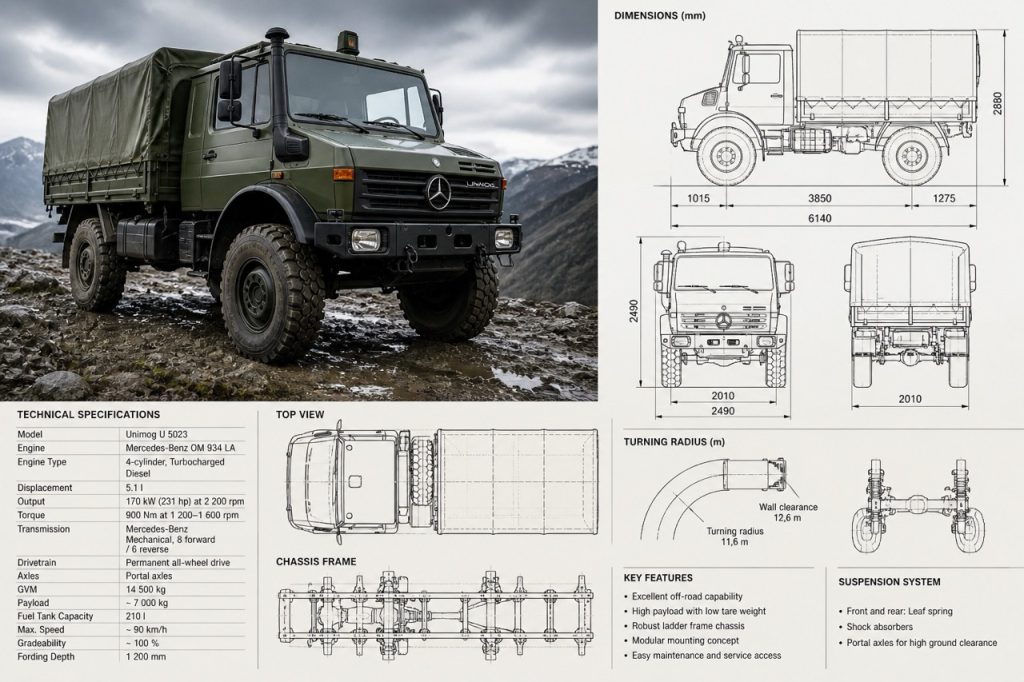
Few platforms in the history of military logistics have demonstrated the durability, adaptability, and cross-terrain performance of the Mercedes-Benz Unimog. Since its introduction into military service in the early 1950s, the Unimog has become one of the most widely deployed tactical utility vehicles across NATO member states, partner nations, and armed forces operating in every climate from Arctic tundra to desert terrain. Its continued relevance after more than seven decades is not accidental. It is the result of exceptional engineering, continuous development, and above all, disciplined sustainment.
Yet even the most robust platform in the world cannot perform when its components fail. Mobility, in the truest operational sense, is not simply a product of design; it is the result of every bearing, seal, filter, and control module functioning as intended. For military planners, fleet managers, and defense contractors, understanding the relationship between component reliability and operational readiness is not a matter of engineering theory. It is a matter of mission success.
This article explores the Unimog’s role in modern military operations, the critical components that sustain its performance, and the maintenance and supply chain strategies that keep fleets ready when it matters most.
The Role of Unimog in Military Operations
The Unimog occupies a unique position in military fleets because it genuinely defies narrow categorization. It is not simply a truck. Across NATO and allied forces, Unimog variants serve as logistics carriers, troop transport platforms, engineering support vehicles, recovery assets, mobile command posts, and specialist mission platforms. That versatility is central to its enduring appeal.
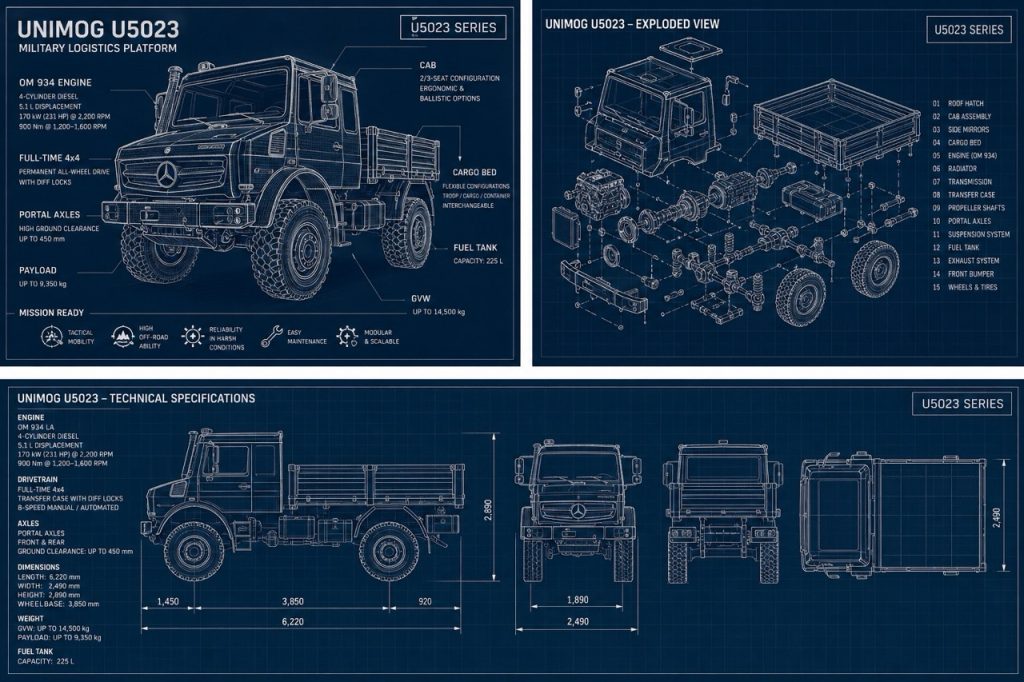
The platform’s off-road capability is defined by its portal axle design, which elevates the axle’s center above the wheel hubs and produces exceptional ground clearance. Combined with a long-travel suspension system and a relatively short wheelbase on certain variants, the Unimog can navigate terrain that would halt conventional trucks. River crossings, steep gradients, soft ground, and heavily rutted tracks are managed with a confidence that matters enormously in forward logistics operations.
Current military variants include the Unimog U 5000, U 4000, and the High Mobility variants, all of which have been procured by armies including the Bundeswehr, the British Army, and a range of Middle Eastern, African, and Asian defense forces. In many of these contexts, the Unimog is not simply one vehicle among many; it is the primary medium-weight mobility asset for the entire formation.
Given this breadth of operational use, the consequences of vehicle downtime are serious. A disabled Unimog in a forward resupply convoy is not merely an inconvenience; it is a logistics failure with potential tactical consequences. This is why sustainment strategy, and specifically the reliability of spare parts, is treated as a mission-critical discipline.
Why Reliability Depends on Components
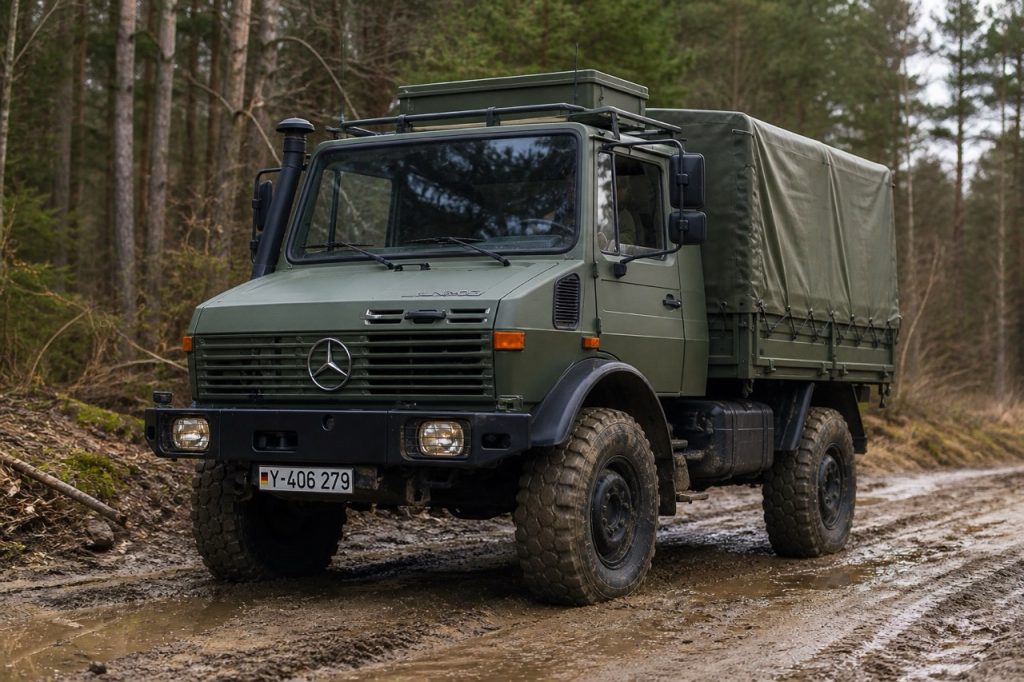
Military vehicles operate in conditions that would be considered extreme by any civilian maintenance standard. The Unimog in service faces temperature swings from minus 40 degrees Celsius in northern European exercises to well above 50 degrees in Gulf region deployments. Dust, moisture, salt air, constant vibration, and the mechanical stress of cross-country driving all accelerate component wear far beyond what manufacturers predict under standard conditions.
Component failures in military vehicles do not follow a simple linear pattern. A failing suspension bushing does not simply cause ride discomfort; it alters wheel geometry, accelerates tyre wear, and introduces stresses into adjacent components that can trigger cascading failures. A degraded fuel filter does not merely reduce engine efficiency; it can cause injector contamination that renders an engine unserviceable in the field. In harsh operational environments, the margin between a manageable maintenance task and a vehicle write-off can be determined by whether a single component was replaced on schedule.
For defense procurement specialists and fleet managers, this reality has clear implications. Maintaining operational readiness requires more than a well-designed vehicle. It requires a continuous, reliable supply of correctly specified components and a maintenance culture that treats preventive action as the default, not the exception.
Critical Unimog Spare Parts for Fleet Sustainment
Understanding which components are most critical to operational uptime requires looking at both failure frequency and failure impact. The following categories represent the core of any intelligent Unimog spare parts strategy.
Powertrain Components
The engine and drivetrain form the heart of any vehicle’s capability, and in the Unimog this is particularly true given the demanding nature of its typical operating environment. Military Unimog variants are predominantly powered by Mercedes-Benz OM diesel engines, which are recognized for their robustness but require consistent attention to consumables and wear components.
Engine spare parts that demand priority stocking include injection nozzles and injector seals, which are susceptible to contamination from poor-quality fuel encountered in theater. Turbocharger components, including intercooler hoses and boost pressure sensors, see elevated wear under high-load cross-country conditions. Cylinder head gaskets, cooling system hoses, and water pump seals represent lower-cost items with high replacement frequency that should never be underestimated in a pre-deployment kit.
The Unimog’s transfer case and differential assemblies are among the most engineered aspects of the platform, providing its ability to vary drive configuration for different terrain types. Maintaining stocks of differential seals, transfer case bearings, and driveshaft universal joints is essential for any fleet operating off-road regularly.
Suspension and Axle Systems
The portal axle arrangement that gives the Unimog its legendary ground clearance is also among the most mechanically complex elements of the vehicle. Portal housing oil seals, wheel hub bearings, and king pin components are subject to significant cyclic loading and must be inspected and replaced according to manufacturer schedules, not simply when failure occurs.
Coil springs, shock absorbers, and stabilizer bar bushings contribute directly to the vehicle’s ability to maintain stability and driver control over rough ground. A degraded shock absorber on a loaded Unimog significantly increases the risk of body roll on side slopes, which is a real safety concern in mountain or desert operations. These components should be treated as safety-critical items rather than comfort features.
Braking Systems
Unimog military variants use hydraulically activated drum or disc brake configurations depending on the variant and production year, with compressed air assist systems on heavier configurations. Brake drum and disc condition directly governs the vehicle’s stopping performance when loaded on steep gradients, making brake components among the highest safety priority items in any maintenance regime.
Brake pad and lining stocks should be maintained generously. Air system components, including desiccant dryer cartridges, brake chamber diaphragms, and relay valves, require scheduled replacement intervals that should be strictly enforced regardless of apparent condition, since air brake failures are difficult to predict without invasive inspection.
Electrical and Control Systems
Modern Unimog military variants incorporate increasingly sophisticated electrical architectures, including CAN bus-based diagnostics, electronic engine management, and integrated lighting systems designed for blackout or reduced signature operations. Electrical faults are among the most common causes of vehicle downtime in military fleets and often the most difficult to diagnose without proper tooling.
Maintaining stocks of commonly failing electrical components, including alternators, starter motors, fuse assemblies, wiring loom junction connectors, and diagnostic interface modules, can be the difference between a thirty-minute field repair and a prolonged recovery operation. Equally important is ensuring that maintenance personnel have access to wiring diagrams and diagnostic software compatible with the specific Unimog variant in service.
Filters, Seals, and Consumables
It would be easy to underestimate the operational importance of filters, seals, and fluid consumables, but experienced fleet managers know that more catastrophic failures begin with neglected consumables than any other cause. Engine oil filters, fuel filters, air filters, and transmission fluid filters should be stocked at three to five times the expected consumption rate for any deployed operation, precisely because resupply during active operations is unreliable.
Maintenance Strategies for Maximum Uptime
No spare parts strategy operates in isolation. The components stocked must be matched by a maintenance framework that ensures they are actually used at the right intervals and in the right sequence.
Preventive maintenance remains the foundation of sound military vehicle sustainment. Adhering to scheduled service intervals, regardless of current vehicle condition, is the single most cost-effective way to reduce unplanned downtime. The Unimog’s service schedule, which is documented in detail in Mercedes-Benz technical publications, defines intervals for oil changes, filter replacements, axle fluid changes, and brake inspections that should be treated as non-negotiable in a professional fleet management regime.
Corrective maintenance, while unavoidable, should be treated as a failure of the preventive system rather than an acceptable baseline. When corrective actions are required, their frequency and nature should be analyzed to identify whether they point to a systemic issue in the preventive schedule or a parts quality problem. This diagnostic approach, sometimes referred to as reliability-centered maintenance, is increasingly standard practice among sophisticated defense fleet operators.
Lifecycle support planning requires consideration not only of current parts availability but of the vehicle’s position in its overall service life. Older Unimog variants in particular may require access to legacy components that are no longer manufactured by OEM suppliers, making the role of specialist defense vehicle parts suppliers increasingly important as fleets age.
Challenges in Military Vehicle Sustainment
The sustainment of military vehicle fleets involves challenges that have no direct civilian equivalent, and understanding them is essential for defense procurement specialists and logistics planners.
Supply chain disruption is a permanent reality for defense logistics. Political instability, export restrictions, shipping delays, and manufacturing lead times all introduce uncertainty into parts availability at precisely the moments when demand is highest. The COVID-19 pandemic exposed this vulnerability acutely, with global semiconductor shortages affecting everything from engine control units to diagnostic equipment. Maintaining strategic buffer stocks of critical components at national or formation level is the most direct mitigation, but it requires sustained procurement funding and disciplined inventory management.
Aging fleets present a distinct challenge. Many Unimog military variants in service today were produced in the 1980s and 1990s, and for these vehicles, OEM parts supply is increasingly limited. Aftermarket sourcing becomes essential, but it must be approached with rigorous quality control. Not all aftermarket parts meet the specifications required for military service, and the consequences of a substandard component failing in the field are significantly worse than the consequences of a delayed delivery.
Harsh operational environments accelerate wear at rates that standard service schedules do not fully account for. A fleet operating in a high-dust desert environment may require air filter changes at half the normal interval. A vehicle used daily for river crossings will see elevated corrosion in areas that are rarely inspected in temperate environments. Maintenance officers must understand their specific operating environment and adjust service intervals accordingly.
How Reliable Suppliers Improve Fleet Readiness
The quality of a fleet’s spare parts supplier is, in practical terms, as important as the quality of the vehicles themselves. A technically excellent vehicle grounded by unavailable parts delivers zero operational value, whereas a well-supported vehicle with reliable parts availability remains mission-capable through its entire service life.
When evaluating spare parts suppliers for military vehicle sustainment, defense procurement professionals should prioritize several key attributes. First, specification compliance: every part supplied must meet or exceed the dimensional and material specifications defined by the original manufacturer. For safety-critical components such as brake parts and steering assemblies, this is a non-negotiable requirement. Second, supply reliability: the ability to fulfill orders at short notice, maintain adequate stock levels, and provide accurate lead time information is operationally essential. A supplier who cannot reliably deliver within defined lead times cannot be incorporated into a serious logistics plan.
The debate between OEM and aftermarket components is nuanced in a military context. OEM parts provide the highest assurance of specification compliance but are often unavailable for older vehicles or command prohibitive lead times. High-quality aftermarket components from certified defense supply chain partners can offer a viable and cost-effective alternative, provided they are sourced from suppliers with documented quality management systems and relevant defense industry certifications.
Global sourcing capability is increasingly important as military operations become more geographically distributed. A supplier with established logistics partnerships across Europe, the Middle East, and Asia can support forward-deployed units more effectively than a domestically focused distributor. For defense forces operating in coalition contexts, the ability to supply across national boundaries without prohibitive regulatory friction is a meaningful competitive advantage.
Conclusion: Mobility Begins Long Before the Wheels Turn
The Unimog’s reputation as one of the world’s most capable military utility vehicles has been earned through decades of operational service across conditions that would have defeated lesser platforms. But that reputation is contingent on one fundamental reality: the vehicle must be maintained with the same engineering discipline that went into designing it.
Operational mobility is not solely a function of vehicle design. It is the cumulative result of every correctly installed filter, every timely seal replacement, every shock absorber changed at the right interval. For defense forces and defense contractors responsible for sustaining Unimog fleets, the message is straightforward: invest in your spare parts strategy with the same seriousness that you invest in vehicle procurement, because the two are inseparable.
AB Defence specializes in the supply of military vehicle spare parts and sustainment solutions, with deep expertise in Unimog platform support. From powertrain components to electrical assemblies, AB Defence provides defense-grade parts that keep fleets operational across every environment. To explore available components or discuss a fleet sustainment program, visit our military vehicle spare parts catalogue or contact our specialist team directly.
Frequently Asked Questions
What are the most critical spare parts to stock for a Unimog military fleet?
The highest-priority items for any Unimog military spare parts inventory are engine consumables (oil, fuel, and air filters), drivetrain seals and gaskets, brake pads or linings, shock absorbers, and electrical components including alternators and starter motors. For older variants, legacy-specific components such as portal axle seals and injection pump kits should be given particular attention given their limited OEM availability.
How often should military Unimog vehicles be serviced in operational conditions?
Standard Mercedes-Benz service intervals provide the baseline, but operational conditions often require more frequent attention. In high-dust environments, air filter inspection and replacement intervals should be halved. Vehicles subjected to river crossings require more frequent inspection of axle oil and electrical connections for water ingress. The guiding principle is that environmental conditions in theater should always be factored into service planning, not simply assumed to match the standard schedule.
Can aftermarket spare parts be used for military Unimog vehicles?
Yes, when sourced from reputable defense supply chain partners with documented quality management systems. The key requirement is specification compliance: dimensions, materials, and performance characteristics must match or exceed original manufacturer standards. For safety-critical systems including brakes, steering, and fuel delivery, quality verification is particularly important. Engaging a supplier with established defense industry certifications and a track record in military vehicle sustainment significantly reduces the risk associated with aftermarket procurement.
What is the typical lifespan of a Unimog in military service?
With disciplined preventive maintenance and reliable parts support, Unimog military variants routinely exceed 30 years of operational service. Many Bundeswehr and British Army vehicles produced in the 1980s remain in active use today. The key determinant of service life extension is not the vehicle’s original build quality, which is high, but the consistency of maintenance and the availability of parts throughout the vehicle’s service life. Lifecycle support planning should begin at the point of procurement, not when the vehicle approaches the end of its expected life.
How does AB Defence support Unimog fleet sustainment?
AB Defence supplies a comprehensive range of Unimog military spare parts covering powertrain, suspension, braking, electrical, and consumable categories. The company works with both current-production and legacy Unimog variants and maintains sourcing relationships across the global defense supply chain to ensure availability regardless of vehicle age or original production configuration. Defense procurement officers and fleet managers can access parts listings and request quotes through the AB Defence online catalogue or by contacting the specialist team directly.
Related Military Spare Parts Categories, Vehicle Platforms & Technical Guides
Explore AB Defence’s NATO-codified (NSN) and genuine OEM spare parts catalog, platform technical specifications, and sustainment engineering guides related to this article:
Stocked Spare Parts Categories (NSN & OEM Catalog)
- Mercedes-Benz Unimog Military Spare Parts (562 stocked parts)
- Military Portal Axles, Differentials & Drive Shafts (107 stocked parts)
- Military Gearbox, Transfer Case & PTO Assemblies (108 stocked parts)
- Military Brake Calipers, Master Cylinders & Hydraulic Systems (103 stocked parts)
- Military Engine Cooling Systems, Radiators & Water Pumps (57 stocked parts)
- Full NATO NSN & OEM Spare Parts Catalog (16,760+ Parts)
Compatible Vehicle Platforms & System Hubs
- Unimog U 1300 L (1.5 Ton – 2.5 Ton)
- Unimog U 1500 L
- Unimog U 1700 L
- Unimog U 2150 L
- Unimog U 2450 L
- Request a B2B Quotation (RFQ) & Technical Support
Related Military Engineering & Sustainment Articles
- Unimog Military Spare Parts: What Every Fleet Manager Needs to Know Before Placing an Order
- Unimog Spare Parts for Military Fleets: Why AB Defence Is Your Trusted Supply Partner
- 5 Unimog Components Most Commonly Replaced in Military Operations
- What Are the Most Common Failures in Military Unimog Vehicles?