March 13, 2026
How a US-Iran Conflict Could Affect Military Spare Parts Supply Chains
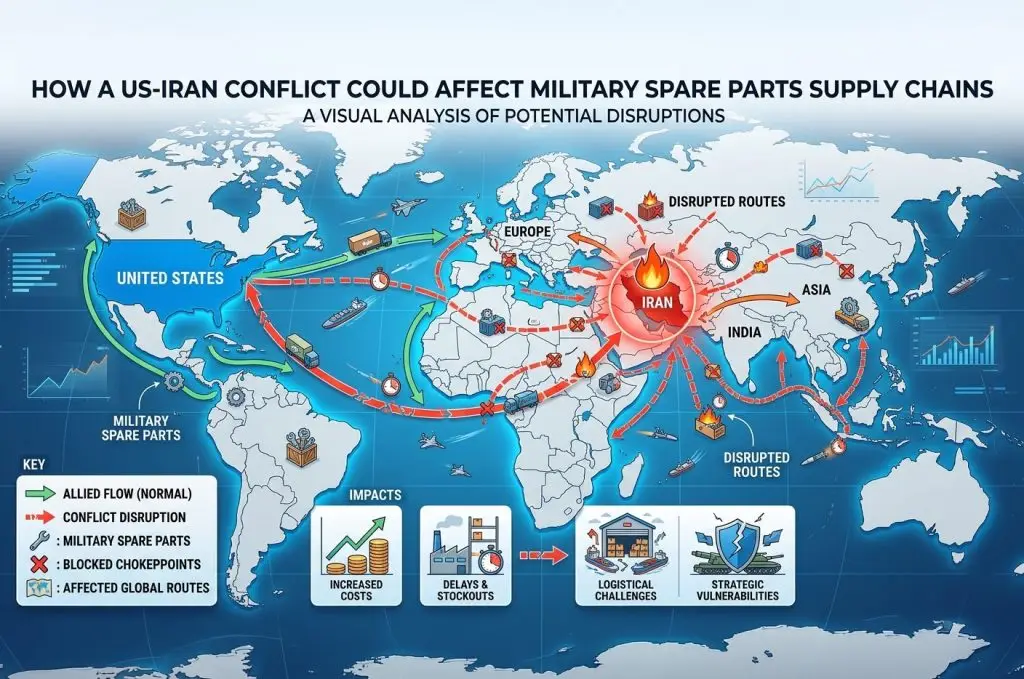
When analysts discuss the potential consequences of a US-Iran military conflict, the conversation tends to center on energy markets, air defense capabilities, and naval dynamics in the Persian Gulf. What receives far less attention — but is equally consequential for defense organizations operating outside the immediate theater is the downstream effect on military spare parts supply chains.
For defense procurement professionals, MRO buyers, and military vehicle fleet managers, the critical question is not who fires first. It is whether the correct engine air filter, the right gearbox seal, or the exact suspension component will arrive on time, correctly verified, and at a manageable cost when it is needed most.
This article does not offer political analysis. It examines, from a logistics and sustainment perspective, how regional conflict in the Middle East can materially affect military vehicle spare parts sourcing, procurement lead times, freight economics, and fleet readiness and what defense buyers should be doing to prepare.
Why Regional Conflict Matters for Military Spare Parts Logistics
Maritime Chokepoints and Shipping Route Disruption
The Strait of Hormuz is one of the most strategically significant maritime chokepoints in the world. Approximately 20 percent of global oil tanker traffic passes through it. But it is not only petroleum products that move through this corridor. A considerable volume of containerized cargo, including components, sub-assemblies, and industrial goods that feed defense supply chains, transits routes that would be directly affected by any escalation involving Iran’s naval forces or anti-ship capabilities.
The Bab el-Mandeb Strait, separating the Horn of Africa from the Arabian Peninsula, represents a secondary pressure point. Disruption there has already been demonstrated in recent years by Houthi activity in the Red Sea, which forced major shipping operators to reroute vessels around the Cape of Good Hope. That rerouting added thousands of nautical miles to transit times and significantly increased shipping costs.
In a US-Iran conflict scenario, both chokepoints could face simultaneous pressure. For defense spare parts buyers sourcing components from manufacturers in Europe, Asia, or North America whose goods must transit these corridors, the effect would be immediate: longer lead times, higher freight costs, and greater uncertainty on delivery windows.
Insurance Costs and War Risk Premiums
Beyond pure logistics, shipping insurance in conflict-affected sea lanes undergoes rapid repricing. War risk premiums applied to cargo moving through the Persian Gulf region can increase sharply within days of escalation signals. These premium increases are passed directly through freight and forwarding costs to the end buyer.
For military procurement offices or contractors managing fixed-price sustainment contracts, an unexpected surge in war risk insurance costs can create budget pressure that was not anticipated when contracts were written. In practice, this means that parts that were economically viable to source one week may become significantly more expensive the next, creating difficult decisions for procurement teams under operational pressure.
Energy Costs and Their Effect on Logistics Pricing
Oil price volatility linked to Middle East conflict feeds directly into aviation and surface freight costs. Military spare parts that move by air freight — as urgently needed components frequently do are particularly sensitive to fuel surcharge increases. A sustained increase in jet fuel prices translates directly into higher air freight rates, compressing the cost advantage of airlifting parts to deployed or forward-positioned fleets.
Cyber Risk in Defense Procurement Systems
Regional escalation, particularly one involving Iran, carries a well-documented cyber dimension. Iranian state-sponsored threat actors have previously targeted defense contractors, logistics platforms, and procurement systems. A conflict scenario increases the probability of cyber operations directed at defense supply chain infrastructure including supplier portals, ERP systems used by parts distributors, and digital documentation platforms.
For defense spare parts procurement, a cyberattack on a key supplier’s order management system can delay order confirmation, corrupt part number data, or compromise traceability documentation. These are not abstract risks. They are operational risks that procurement planners must incorporate into their continuity thinking.
What This Means for Military Vehicle Fleet Readiness
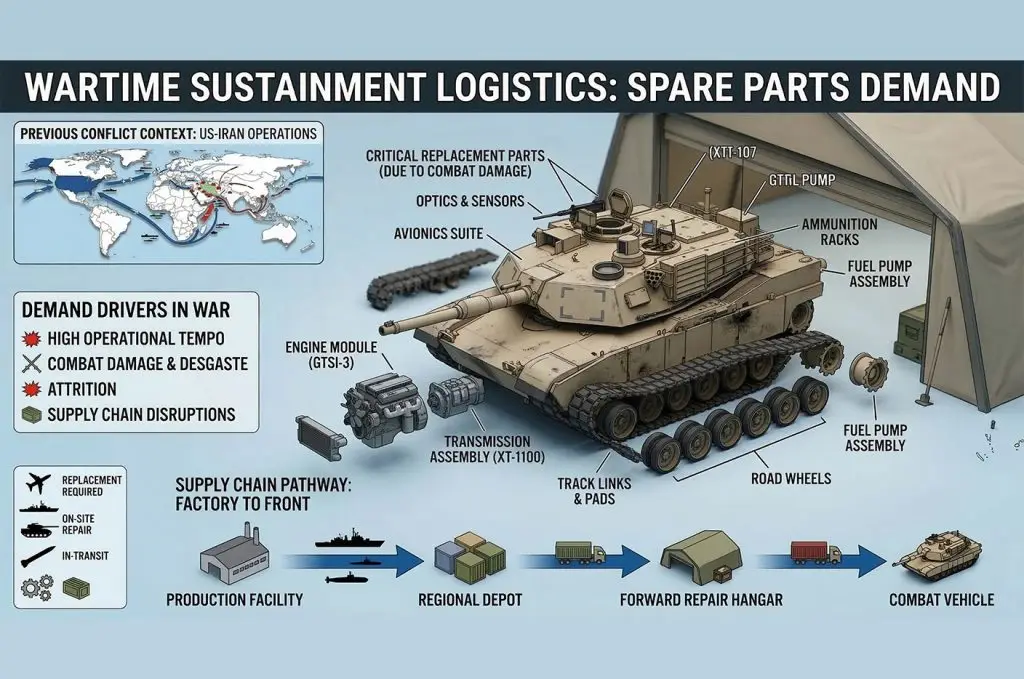
Military vehicle readiness is a function of part availability, part accuracy, and maintenance cycle discipline. When any one of these elements is disrupted, readiness rates fall.
The most common failure mode during supply chain disruption is not total absence of parts. It is the wrong part arriving, the right part arriving late, or the correct part arriving without proper documentation. Each of these outcomes produces the same result from a fleet management perspective: a vehicle that cannot be certified as mission-ready.
Fleet operators managing tracked armored vehicles, wheeled tactical platforms, or artillery systems face different exposure depending on where their critical components originate and how many layers of supply chain intermediary exist between manufacturer and end user. Platforms with large global user bases and well-established aftermarket ecosystems such as the M113 APC or the HMMWV tend to have deeper parts availability. Legacy platforms and regionally produced systems may face sharper constraints if their supply routes are affected.
The economic cost of vehicle downtime in an operational environment is difficult to quantify precisely, but it is never trivial. Maintenance backlogs compound. Cannibalization of parts from lower-priority vehicles begins. Fleet availability percentages decline. In a scenario where operational tempo is simultaneously increasing due to regional tensions, the timing is maximally unfavorable.
The Spare Parts Categories Most Likely to Be Affected
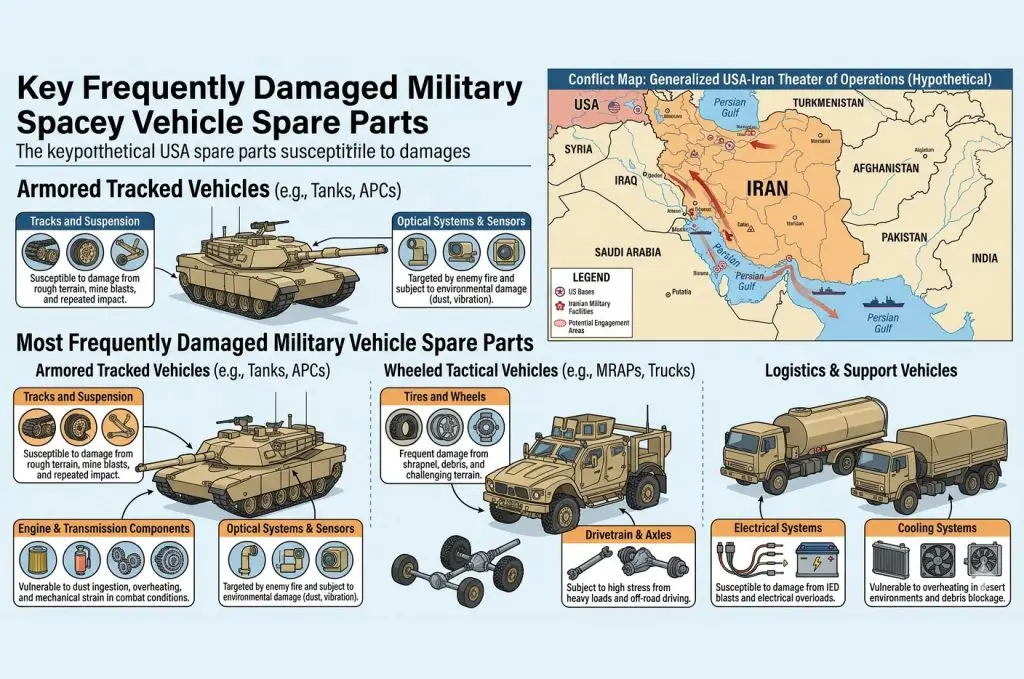
Engine and Powertrain Components
Engine and powertrain parts represent the highest-criticality category for most military vehicle platforms. Components including air filters, fuel filters, oil filters, gaskets, piston rings, fuel injection parts, and cooling system elements must meet platform-specific tolerances. There is limited room for substitution.
For platforms like the Unimog widely used across multiple NATO and partner nation armies as a utility and tactical vehicle powertrain parts sourcing depends on supply chains that run through European manufacturers. Disruption to shipping routes or increases in air freight costs can affect lead times on these components, even when they originate far from the conflict zone.
For tracked platforms such as the M60 main battle tank series or the M113 APC, engine component sourcing for legacy variants requires careful attention to superseded part numbers, technical manual alignment, and verification against current production equivalents. During supply disruptions, the risk of receiving substituted parts that do not meet the original specification increases.
Electrical and Electronic Systems
Electrical systems are among the most platform-specific and least interchangeable categories in military vehicle maintenance. Wiring harnesses, switchgear, control modules, and communication system interfaces are typically engineered to exact platform variants. A component manufactured for one production batch of a vehicle may not be compatible with a later batch, even if the external appearance is similar.
During periods of supply chain stress, there is an increased risk that buyers under procurement pressure will accept parts that appear to match but are not correctly verified. For electrical and electronic systems, this risk is particularly acute because incorrect installation may not be immediately apparent but can cause system failure under operational conditions.
Platforms such as the Kirpi MRAP or Cobra armored vehicle, which have more regionally concentrated supply chains, may face specific sourcing challenges if their electrical component suppliers are located in areas affected by logistical disruption.
Filtration and Fluid Systems
hydraulic system
For military vehicles operating in Middle Eastern dust and heat conditions conditions that stress filtration systems heavily procurement of correctly specified filters on correct service intervals is essential. Supply chain disruption that delays filter availability can force extended service intervals beyond manufacturer limits, accelerating mechanical wear on engines and hydraulic components that are far more expensive to replace.
Suspension, Braking, and Mobility Systems
Suspension and braking systems absorb the highest mechanical stress of any vehicle system in off-road military operations. Shock absorbers, torsion bars, brake calipers, brake pads, and wheel bearings are high-wear items that require regular replacement on active fleets.
For wheeled tactical vehicles including Oshkosh platforms and HMMWV variants, suspension components are critical to cross-country mobility performance. Extended lead times on these parts due to freight disruption can directly affect the number of vehicles available for operations. For heavier tracked platforms, road wheel assemblies, track pins, and drive sprocket components represent similar criticality levels.
Why Platform-Specific Verification Becomes More Important During Conflict
In stable procurement environments, parts verification is a routine administrative step. In disrupted supply chain conditions, it becomes a primary risk management function.
When standard supply routes are under pressure and procurement teams are working against shorter timelines, the temptation to accept “close enough” parts increases. This is precisely when verification discipline must be most rigorous.
Platform-specific verification means confirming the exact vehicle variant, production year, and configuration before specifying a part. It means cross-referencing OEM part numbers against current technical manuals, checking National Stock Number (NSN) records for applicable cross-references, and verifying whether the original part number has been superseded by a revised specification.
Supersession chains are particularly relevant for legacy platforms. A part number that was correct for an M113 produced in one decade may have been superseded multiple times, and the current equivalent may have dimensional or material differences that are not obvious from a catalog listing.
Traceability documentation becomes equally important during supply disruption. Parts that arrive without proper certificates of conformance, material test reports, or manufacturer documentation create compliance and safety risk that can result in parts being rejected during inspection often after significant time and cost has already been expended.
The discipline of rejecting a part that is not correctly verified even under operational pressure — is one of the clearest distinctions between professional defense spare parts procurement and informal sourcing.
How AB Defence Supports Spare Parts Continuity Across Military Platforms
AB Defence operates as a platform-focused defense spare parts supplier. The approach taken is not catalog-based generic sourcing. It is system-level engagement with the specific requirements of the platform in question.
For procurement teams managing diverse fleets a mix of wheeled tactical vehicles, tracked armored platforms, and utility vehicles across multiple programs — this means working with a supplier that understands the technical context of each request rather than simply matching a number to a catalog entry.
AB Defence supports sourcing across a range of military vehicle platforms, applying part number verification, supersession checking, and documentation discipline to each request. RFQ-based engagement means that sourcing decisions are driven by the specific details of each requirement: exact platform variant, OEM or NSN reference, quantity, urgency classification, and any applicable technical documentation.
During periods of supply chain disruption, this approach is especially relevant. When standard procurement routes are under pressure, having a supplier with system-level platform knowledge and established sourcing networks reduces the risk of incorrect part matching, documentation failures, and sourcing delays.
Related Military Vehicle Platforms and System Areas
Defense procurement teams researching spare parts support for specific platforms can explore AB Defence’s dedicated platform and system pages for detailed sourcing information.
Platform areas include:
Tactical wheeled vehicles including the Unimog series, HMMWV variants, and Oshkosh platforms. These platforms cover a broad range of army utility, logistics, and tactical mobility roles, with distinct powertrain, filtration, and suspension part families.
Tracked armored platforms including the M60 main battle tank, M113 APC, and M109 self-propelled howitzer series. These legacy platforms require particular attention to supersession management and historical part number traceability.
Protected mobility vehicles including the Kirpi MRAP and Cobra armored vehicle, where platform-specific electrical and structural components require exact variant verification.
System category pages cover engine and powertrain parts, transmission components, filtration systems, electrical and electronic parts, brake and suspension systems, and hydraulic and mechanical components. These pages are organized by system type to support buyers sourcing across multiple platforms within a single procurement cycle.
What Buyers Should Prepare Before Sending an RFQ During Supply Disruptions
Procurement efficiency during supply chain pressure depends significantly on the quality of information provided at the RFQ stage. The following information should be compiled before submitting a request:
Platform name and exact variant designation. For example, M113A1 versus M113A3 carry different part specifications across multiple systems.
Production year or hull number range, where applicable. This is particularly relevant for platforms that underwent mid-production configuration changes.
OEM part number or NSN reference. Both should be provided if available. If only one is available, note which reference system is being used.
Technical manual reference and figure or item number, if the part was identified from a technical manual rather than a previous procurement record.
Quantity required, with distinction between immediate operational requirement and planned stock replenishment. This affects sourcing priority and lead time negotiation.
Urgency classification and required delivery date. Realistic delivery expectations allow sourcing to be structured appropriately, including air freight options where lead time is critical.
Condition photographs or part labels from the removed component. For mechanical and structural parts, photographs of the installed configuration and the removed part’s markings can prevent misidentification.
Fleet status information — whether the platform is active, in long-term storage, or undergoing a maintenance cycle helps clarify the operational context and documentation requirements.
Conclusion
A US-Iran military conflict, or sustained regional escalation in the Middle East, would affect defense spare parts supply chains in ways that extend well beyond the immediate geography of any engagement. Maritime chokepoints, insurance pricing, freight costs, cyber risk, and procurement system disruption all create conditions in which parts availability, lead times, and verification integrity become harder to manage simultaneously.
For defense fleet managers and procurement teams, the lesson is consistent: supply chain resilience is not built during a crisis. It is built in advance, through supplier relationships that carry platform knowledge, verification discipline, and sourcing depth into conditions of pressure.
Operational readiness depends on the right part, verified correctly, with traceable documentation, delivered within a workable lead time. In stable conditions this is achievable through standard procurement channels. In disrupted conditions, it depends on the supplier network and the verification practices already in place.
AB Defence works with defense procurement teams, MRO buyers, and government sourcing organizations to support spare parts continuity across multiple military vehicle platforms. If your fleet is facing sourcing pressure or you are planning ahead for supply chain uncertainty, contact AB Defence with your platform details, part references, and RFQ requirements.
Planning Ahead for Supply Chain Disruption?
Submit your RFQ to AB Defence with your platform name, variant, OEM or NSN part numbers, and required quantities. Our team will review your requirement and respond with sourcing options, lead time estimates, and documentation details. Whether you are managing an active fleet, preparing a sustainment stock, or supporting a procurement program, AB Defence is ready to assist.
Related Military Spare Parts Categories, Vehicle Platforms & Technical Guides
Explore AB Defence’s NATO-codified (NSN) and genuine OEM spare parts catalog, platform technical specifications, and sustainment engineering guides related to this article:
Stocked Spare Parts Categories (NSN & OEM Catalog)
- NATO Standard Defence Components & Military Hardware (12,993 stocked parts)
- M60 Tank Spare Parts (M60A1 / M60A3 / M60T) (497 stocked parts)
- M109 Self-Propelled Howitzer Spare Parts (585 stocked parts)
- BMC Kirpi MRAP Spare Parts (Kirpi I & Kirpi II) (597 stocked parts)
- Mercedes-Benz Unimog Military Spare Parts (562 stocked parts)
- Full NATO NSN & OEM Spare Parts Catalog (16,760+ Parts)
Compatible Vehicle Platforms & System Hubs
- Platforms
- Product Groups
- Quality
- Capabilities
- Tracked Armoured Vehicles
- Request a B2B Quotation (RFQ) & Technical Support