AB DEFENCE Platform support
M107 / M110 Series
Explore platform information, technical systems and spare parts support.
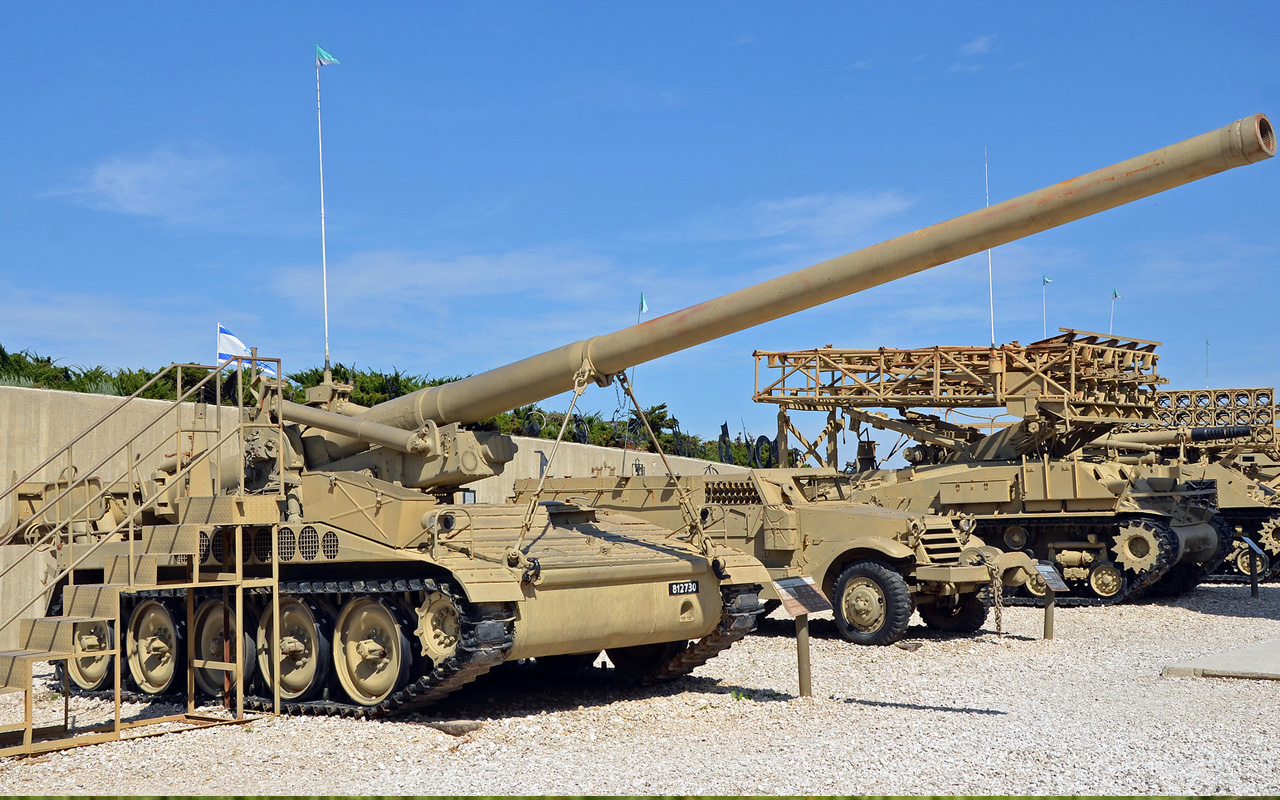
The M107 is a self-propelled 175 mm artillery system developed to deliver long-range fire support on the battlefield, widely used by NATO forces for engaging distant strategic targets. The M110, developed on a similar chassis, is a self-propelled 203 mm (8-inch) howitzer designed to provide powerful heavy artillery support for ground forces, valued for its high-impact firepower and long operational service across multiple armies.
Request a QuoteThe Common Chassis That Built a Platform Family
In the late 1950s, the US Army set out to replace the M55 — a 44-tonne gasoline-powered heavy artillery vehicle that could not be air-transported, burned fuel at a rate that limited its operational range to 260 kilometres, and posed a constant fire hazard in combat. The requirement that replaced it was deliberately different: new heavy artillery systems would share a common chassis, be transportable by air, run on diesel, and be light enough that batteries could redeploy before enemy counter-battery fire found their position. Pacific Car and Foundry won the contract with two prototype chassis — the T235E1 and T236E1 — that were mechanically identical. The only difference was the ordnance fitted at the rear. In March 1961, both were standardised: the T235E1 as the M107 and the T236E1 as the M110. The T120E1, the third member of the family, became the M578 Light Recovery Vehicle.
Understanding this origin is not background reading. It is the foundation of every parts procurement decision for this family. The Detroit Diesel 8V-71T engine, the Allison XTG-411-2A cross-drive transmission, the torsion bar suspension, the running gear, and the hydraulic system are identical across M107, M110, M110A1, M110A2, and M578. When a procurement officer orders engine components for a battery operating both M107-derived and M110A2 vehicles, they are ordering from the same list. The only point at which the two diverge is the ordnance and its associated mounting, recoil, and loading hardware — and even there, the M158 mount that carries both the 175mm M113 gun and the 203mm M2A2 howitzer is a common assembly. AB Defence structures its M107/M110 parts coverage around this reality, maintaining a single automotive parts pool that serves the entire family.
The Detroit Diesel 8V-71T: A Two-Stroke Engine in a Tracked Artillery Role
The 8V-71T is a member of Detroit Diesel's Series 71 engine family — the most widely deployed two-stroke diesel powerplant in American military tracked vehicles of the Cold War era. The "71" refers to the swept volume per cylinder in cubic inches (71 in³, approximately 1,163 cc); eight cylinders in a V8 configuration give a total displacement of roughly 9.3 litres. The two-stroke cycle produces a power stroke on every downward piston travel, giving the engine strong low-speed torque and responsive throttle behaviour well-suited to a 28-tonne vehicle operating across varied terrain.
The induction system is the engine's defining technical characteristic. A roots-type positive-displacement supercharger — mechanically driven from the crankshaft — provides the primary scavenging and charging function at all engine speeds. A turbocharger supplements this at higher loads, connected to the supercharger by a thin steel shaft described in period documentation as "pencil sized" — the quill shaft. This shaft transmits turbocharger-derived drive to the supercharger blower, and it operates under sustained torsional stress during load transitions. Quill shaft failure causes immediate loss of supercharger assistance and a corresponding drop in power output; it is a known failure mode in high-hour fleets and AB Defence stocks it as a priority item specifically because general commercial Detroit Diesel catalogues often do not carry it for non-military two-charger installations.
The engine drives through the Allison XTG-411-2A cross-drive transmission — a hydromechanical unit providing four forward and two reverse gears with an integrated differential steering mechanism. "Cross-drive" means the transmission handles steering by controlling differential speed between the two track runs internally; the driver uses a conventional steering wheel, with the transmission managing track speed differential continuously. No separate steering brakes or clutches are involved. The same transmission, in evolved form, powers the M109 howitzer family — a commonality that gives AB Defence's sourcing network for XTG-411-2A components breadth beyond the M107/M110 alone.
An engine-driven hydraulic pump provides power for gun traverse, the rammer-loader assembly, and rear spade deployment. A manual hand crank backs up the traverse function — a provision that has seen operational use more frequently than doctrine intended, because improper use of the hydraulic system to force-deploy the spade rather than lower it through its designed sequence consistently caused hydraulic cylinder damage, leaving the manual backup as the only available traverse means until the hydraulic circuit was repaired.
M107 — The 175mm Self-Propelled Gun
Origins and Service Introduction
The M107 entered US Army service in 1962. The first M107 battalion was formed at Fort Sill, Oklahoma, in January 1963. Production was initially contracted to Pacific Car and Foundry; FMC Corporation of San José and Bowen-McLaughlin-York of York, Pennsylvania, joined as additional producers at a later stage, bringing total M107 production to 524 vehicles. The US Army deployed the M107 at corps level in battalions of twelve guns — a doctrinal decision that reflected the weapon's primary role as deep fire support rather than divisional direct-support artillery.
Ordnance: The 175mm M113 Gun in M158 Mount
The M107's weapon is the 175mm M113 gun — a long-barrelled, high-velocity cannon with a 60-calibre barrel length, mounted in the M158 cradle. It has no bore evacuator and no muzzle brake. The recoil system is hydropneumatic, with minimum recoil of 0.711 metres and maximum recoil of 1.778 metres. Elevation runs from -2° to +65°; traverse is 30° left and right from centreline. All elevation and traverse are hydraulically assisted, with manual controls available.
The 175mm calibre is not common to any other weapon in the US Army inventory — a deliberate design choice that traded ammunition commonality for exceptional range. The standard HE projectile, the M437A1 or M437A2, weighs 66.78 kg and achieves a maximum range of approximately 32,700 metres. This made the M107 the longest-ranged mobile artillery piece operated in the Vietnam theatre, outranging Soviet-supplied 130mm M46 heavy field guns by a significant margin. Israel was the only operator to procure extended-range projectiles developed by Gerald Bull's Space Research Corporation, which could achieve approximately 40,000 metres — a range that required ballistic computers to account for the curvature of the earth when firing at maximum elevation.
One documented technical limitation of the 175mm M113 gun was premature barrel fatigue in early production. High-strength steel alloys used in the gun's design were later found to be susceptible to brittle fracture at round counts far below the theoretical service life — an in-service failure that significantly advanced the science of fracture mechanics in high-pressure gun steels and contributed to improved design practices for subsequent barrel programmes. The barrel service life issue contributed to the M107's eventual replacement by the M110 series, where the 203mm barrel could be better optimised for sustained operational rates of fire.
Combat Record
Vietnam (1965–1975): The M107's operational combat debut took place on 19 November 1965 — the first time a 175mm self-propelled gun had been fired in combat. US M107 crews nicknamed the gun Sấm Sét ("Lightning") and Vua Chiến Trường ("King of the Battlefield"), reflecting the psychological impact of its range and projectile weight. At the Siege of Khe Sanh in 1968, M107 batteries provided long-range fire support that proved critical to the garrison's survival against sustained NVA pressure. The weapon's ability to reach targets well beyond the range of counter-battery artillery available to the NVA was its primary tactical value; its relative inaccuracy at extreme range was accepted as an acceptable trade-off for this reach. Several M107s were captured by North Vietnamese forces and subsequently operated by the PAVN Artillery Corps, which fielded them into the 1980s.
Yom Kippur War (1973): The Israel Defence Forces designated their M107s as Romach ("Spear") and deployed approximately 175 vehicles in October 1973. The IDF's use of the M107 in the suppression of Egyptian and Syrian air defence systems is among the most documented applications of the weapon in combat. Of the 15 Egyptian SA-2 surface-to-air missile batteries destroyed on the east bank of the Suez Canal during the war, 13 were attributed to IDF M107 fire. During Operation Gazelle, M107s operating from positions east of the Canal engaged targets west of the Suez in support of Ariel Sharon's crossing forces. At maximum elevation, IDF crews fired into the outskirts of Damascus — a range requiring ballistic corrections for atmospheric refraction and Earth curvature. Post-war, Space Research Corporation extended-range projectiles were procured to extend effective range further.
Iran-Iraq War (1980–1988): Iranian M107s — received under pre-revolution US military assistance programmes — were among the most intensively operated examples of the platform outside US service. Under complete embargo from their original supplier, Iranian Army mechanics maintained these vehicles through eight years of attritional warfare, developing improvisational parts sourcing and maintenance procedures that represent one of the most demanding tests of the M107's field maintainability under adversarial supply conditions.
The M107's End in US Service and the Conversion Programme
The US Army retired the M107 from active service in the late 1970s. The primary drivers were barrel fatigue accumulation in high-cycle-count fleet vehicles, the obsolescence of a dedicated calibre with no commonality to any other weapon, and the availability of the M110A1 and M110A2, which offered comparable or superior range through a 203mm barrel compatible with the broader NATO heavy artillery logistics chain. The conversion cost — less than USD 100,000 per vehicle at 1970s prices — made it economically straightforward to retube surviving M107 hulls to M110A1 or M110A2 standard rather than retire them. By 1981, all US Army and Marine Corps M107s had been converted to M110A2 configuration.
The conversion process, when performed at battalion level, required two M578 cranes working in coordination — one at each end of the barrel — and demanded precise positioning of the replacement barrel into the cradle to avoid damaging the brass runners. It could be performed at Ordnance Depot Support Units or fixed depots including Anniston Army Depot, Picatinny Arsenal, and the Miesau Army Depot in Germany. The same two-crane procedure was used monthly for engine and transmission removal — both covered by two aluminium deck plates — to clean the powerpack compartment, a routine maintenance step that reflects the open-chassis architecture of the vehicle.
For parts procurement in 2026: the overwhelming majority of vehicles that entered national inventories as M107s have been converted to M110A1 or M110A2 standard at the ordnance level. AB Defence confirms the installed ordnance from each vehicle's armament data plate before supplying any barrel, breech, recoil, or mounting component. A chassis documented as M107 in a national inventory register does not establish that the vehicle still carries 175mm ordnance.
M107 Technical Specifications
| Parameter | Specification |
|---|---|
| Designation | 175mm Self-Propelled Gun M107 |
| Prototype Designation | T235E1 |
| Standardised | March 1961 |
| Service Entry | 1962 |
| Production Total | 524 vehicles |
| Producers | PACCAR; FMC Corporation; BMY |
| Combat Weight | 28,168 kg |
| Hull Length | 5.72 m |
| Length, gun forward | 11.26 m |
| Width | 3.15 m |
| Height | 3.68 m |
| Ground Clearance | 0.44 m |
| Ground Pressure | 0.82 kg/cm² |
| Main Armament | 175mm M113 Gun in M158 Mount |
| Barrel Length | L/60 |
| HE Projectile Weight | 66.78 kg (M437A1 / M437A2) |
| Muzzle Velocity | 914 m/s |
| Maximum Range | ~32,700 m (standard HE) |
| Extended Range (IDF only) | ~40,000 m (SRC projectile) |
| Traverse | 30° left / 30° right |
| Elevation | -2° to +65° |
| Recoil System | Hydropneumatic |
| Bore Evacuator | None |
| Muzzle Brake | None |
| Ammunition Stowage | 2 rounds on vehicle |
| Total Crew | 13 (5 on vehicle + 8 in M548) |
| Engine | Detroit Diesel 8V-71T |
| Output | 302 kW / 405 hp at 2,300 rpm |
| Transmission | Allison XTG-411-2A |
| Max Road Speed | ~56 km/h |
| Road Range | ~725 km |
| Fuel Capacity | ~1,137 litres |
| Electrical System | 24-volt, negative ground |
M110 Series — The 203mm Self-Propelled Howitzer Family
Where the M107 optimised for range above all else, the M110 traded muzzle velocity for a heavier projectile and greater destructive effect per round. The 203mm calibre — the "8-inch" of US artillery tradition — fires a projectile weighing 92.53 kg in its standard HE M106 configuration: nearly 40% heavier than the M107's 66.78 kg round. At a time when nuclear artillery shells were a standard component of US Army fire support doctrine, this calibre was particularly significant: the W33 nuclear artillery round, compatible with the M110 series, was fielded as a genuine corps-level fire support option within NATO's flexible response posture. The M110 never fired a nuclear round in combat, but its nuclear capability was an explicit factor in keeping the platform in service long after it might otherwise have been superseded — multiple sources confirm this was the primary reason for the M110's extended operational life.
The M110 entered US Army service in 1963, one year after the M107. The first M110 battalion was formed at Fort Sill early in 1963. Total production across all M110 variants reached 1,078 vehicles produced by PACCAR, FMC, and BMY. Unlike the M107, the M110 series was progressively upgraded through two distinct improvements — the M110A1 and M110A2 — rather than being replaced by a different platform. The evolution from original M110 through M110A1 to M110A2 is the story of how a sound automotive chassis was progressively upgunned to extend its operational relevance across three decades.
M110 — The Original 203mm Configuration
The original M110, standardised as the T236E1 and entering service in 1963, carried the M2A2 203mm howitzer in the M158 mount — a short barrel with no bore evacuator and no muzzle brake. This original configuration is visually distinct from later variants: the barrel is considerably shorter relative to the hull length, giving the vehicle a compact, almost stubby appearance compared to the M107's dramatically extended 175mm gun or the later M110A1/A2's longer tube.
The short M2A2 barrel imposed a significant range limitation. Maximum range with standard HE was approximately 16,800 metres — less than half the M107's reach. With rocket-assisted projectiles, this could be extended to approximately 22,900 metres, but the standard HE range meant that M110 batteries in the original configuration had to deploy considerably closer to the forward line of troops than the M107, accepting greater exposure to enemy counter-battery fire. The trade-off was accuracy: the 8-inch howitzer was widely acknowledged as the most accurate weapon in the US field artillery inventory of its generation, capable of placing rounds within a radius that made it genuinely effective for precision engagement of hardened point targets rather than just area suppression.
Vietnam operations with the original M110 confirmed the platform's accuracy reputation while exposing its range deficit. The platform served alongside M107 batteries, with the two weapons complementing each other: M107 reaching deep targets with high-velocity fire, M110 engaging closer targets with heavier, more accurate rounds. The M110's nuclear-capable status and its accuracy profile made it the default choice for any mission that required precision at the expense of range — including close fire support to embattled positions and the destruction of hardened fortifications.
Original M110 vehicles still in service as unconverted examples are rare. AB Defence confirms installed barrel configuration from armament data before supplying any ordnance component to vehicles recorded as original M110 specification.
Original M110 Technical Specifications
| Parameter | Specification |
|---|---|
| Armament | 203mm M2A2 Howitzer in M158 Mount |
| Barrel | Short — no bore evacuator, no muzzle brake |
| HE Projectile Weight | 92.53 kg (M106) |
| Muzzle Velocity (charge 8) | 587 m/s |
| Maximum Range (standard HE) | 16,800 m |
| Maximum Range (RAP) | ~22,900 m |
| Service Entry | 1963 |
| Combat Weight | ~26,534 kg |
| Hull Length | 5.72 m |
| Length, gun forward | 7.47 m |
| Height | 2.93 m |
M110A1 — The Long Barrel That Changed the Range Equation
Development of an extended-range variant began in 1969 under the US Army Armament Command, driven by two concurrent pressures: the original M110's limited range relative to the M107 it was meant to complement, and the availability of new 203mm ammunition types — improved HE, rocket-assisted projectiles, improved conventional munitions — that required a higher-pressure chamber and longer barrel to achieve their designed performance. The result was standardised as the M110A1 in March 1976 and entered service in January 1977.
The defining change is the M201 203mm barrel — a longer tube designated L/37, substantially extended compared to the M2A2. The M201 has no muzzle brake in the M110A1 configuration; that addition would come with the A2. The M201 barrel is also fitted with a bore evacuator positioned along the barrel's length — a device absent from both the original M107 and the original M110. The bore evacuator uses residual propellant gas pressure after the projectile exits the muzzle to create a flow of air through the bore from breech to muzzle, clearing combustion gases from the chamber before the breech is opened for loading. Without it, opening the breech after firing forces toxic combustion gases into the fighting compartment; with it, the breech can be opened immediately after firing without hazard to the crew.
The direct fire elbow telescope M139 was added as a new aiming option, providing a direct vision sight for emergency direct fire engagements at close range.
The range improvement from M2A2 to M201 was dramatic. Standard HE range with charge 8 propellant reached 22,900 metres — a 36% increase over the original M110. With rocket-assisted projectiles, 29,100 metres was achievable. The M110A1 effectively superseded both the original M110 and the M107 in US Army Europe by 1980, with both earlier vehicles phased out in favour of the unified A1 standard. The conversion cost remained below USD 100,000 per vehicle, making it economically straightforward to bring the entire surviving fleet to M201 barrel standard.
M110A1 vs Original M110: What Changed for Parts
The M201 barrel and bore evacuator assembly are specific to the M110A1/A2 configuration and are not interchangeable with M2A2 components. The bore evacuator represents an entirely new assembly class — absent from both M107 and original M110 — with its own seal kits, valve assemblies, and mounting hardware. The direct fire telescope M139 mount is M110A1-specific. AB Defence supplies bore evacuator assemblies and seal kits as dedicated M110A1/A2 components.
M110A1 Technical Specifications
| Parameter | Specification |
|---|---|
| Armament | 203mm M201 Howitzer in M158 Mount |
| Barrel | Long — L/37; bore evacuator fitted; no muzzle brake |
| HE Projectile Weight | 92.53 kg (M106) |
| Muzzle Velocity (charge 8) | 711 m/s |
| Maximum Range (charge 8) | 22,900 m |
| Maximum Range (RAP) | 29,100 m (M650 HERA) |
| Maximum Propellant Charge | Charge 8 (M188A1) |
| Standardised | March 1976 |
| Service Entry | January 1977 |
| Added Optics | Direct fire elbow telescope M139 |
| Bore Evacuator | Fitted — new part not present on M110 or M107 |
M110A2 — The Definitive Production Standard
The M110A2 represents the final and most capable configuration of the series. Standardised in 1978 with first production vehicle completed by Bowen-McLaughlin-York in February 1980, it is built on the M110A1 ordnance installation with one critical addition: a double-baffle muzzle brake fitted to the muzzle of the M201 barrel.
The muzzle brake's function in this application is not primarily signature management — it is recoil mitigation. The M201 barrel firing charge 8 propellant generates recoil forces that are near the limits of the M158 mount's hydropneumatic recoil system. Adding charge 9 — the M118A1 propellant — without a muzzle brake would produce recoil forces that would damage the mount and eventually the chassis. The double-baffle muzzle brake vents approximately 30-35% of the propellant gas force laterally before it contributes to rearward barrel movement, reducing the recoil impulse to within the mount's tolerance and allowing charge 9 to be fired safely.
The practical consequence is a significant range extension. Charge 9 with the M106 HE projectile extends maximum range to approximately 29,100 metres. With the M650 HERA rocket-assisted projectile and charge 9, range reaches the same figure under the most favourable conditions — making the M110A2 genuinely competitive with Soviet-era 240mm and 203mm heavy artillery systems in the deep-fires role. The M110A2 also introduced compatibility with the M509 improved conventional munitions projectile — a carrier round dispensing submunitions — and retained compatibility with all nuclear-capable 203mm rounds in the NATO inventory, including the W33.
The M110A2 entered the Gulf War with US and British forces in 1991. The 2nd Battalion and 5th Battalion, 18th Field Artillery served in Desert Storm, as did the British Army's 32nd Regiment Royal Artillery. Their operational record in that conflict — providing deep fires in support of the coalition's left-hook manoeuvre that collapsed Iraqi defences — marked the M110A2's last major combat deployment in Western service before the US Army's retirement of the type in 1994.
M110A2 vs M110A1: The Parts Consequence of the Muzzle Brake
The double-baffle muzzle brake is the single component that defines the M110A2 at the ordnance level and is absent from every earlier configuration in the family. It is a substantial mechanical assembly fitted to the muzzle end of the M201 barrel, with its own mounting threads, baffle assembly, and the specific hardware that must be correctly torqued to survive the repeated blast and recoil loads of sustained fire. AB Defence supplies double-baffle muzzle brake assemblies and associated mounting hardware exclusively for confirmed M110A2 ordnance installations.
The M110A2 configuration also introduced compatibility with additional propellant charge types that impose different peak pressures on the breech and barrel — factors relevant to breech component service life management. AB Defence's breech mechanism supply for M110A2 vehicles accounts for the higher maximum chamber pressure associated with charge 9 operation.
M110A2 Technical Specifications
| Parameter | Specification |
|---|---|
| Armament | 203mm M201A1 Howitzer in M158 Mount |
| Barrel | Long — L/37; bore evacuator fitted; double-baffle muzzle brake fitted |
| HE Projectile Weight | 92.53 kg (M106) |
| Muzzle Velocity (HE M106, charge 8) | 711 m/s |
| Maximum Range (HE, charge 8) | 22,900 m |
| Maximum Range (HE, charge 9) | ~29,100 m |
| Maximum Range (RAP M650 HERA) | ~29,100 m |
| Maximum Propellant Charge | Charge 9 (M118A1) |
| Additional Munitions | M509 ICM; W33 nuclear-capable rounds |
| Standardised | 1978 |
| First Production | February 1980 (BMY) |
| Combat Weight | ~28,350 kg |
| Hull Length | 5.72 m |
| Length, gun forward | 10.73 m |
| Height | 3.14 m |
| Muzzle Brake | Double-baffle — new assembly not present on M110A1 |
Current Operators: Who Is Still Running the M110A2
With the US Army's retirement in 1994 and the Bundeswehr's in 1993, the M110A2's operational centre of gravity shifted entirely to non-Western and smaller NATO nations. The operator community in 2026 is more active than the platform's age might suggest.
Turkey (219 M110A2): The Turkish Armed Forces are the largest European M110A2 operator. Progressive replacement by the domestically developed T-155 Fırtına SPH is ongoing but not yet complete, leaving a substantial portion of the 219-vehicle fleet in active service or reserve.
Pakistan (140): As of 2021, Pakistan's 140 M110A2s remain in service as frontline heavy artillery with no announced replacement programme.
Jordan (120 M110A2): Active operator. The Jordanian fleet receives regular maintenance support as part of ongoing US Foreign Military Sales relationships.
Greece (145 M110A2): In October 2025, Greece's Hellenic National Defence General Staff indicated that the M110A2 no longer meets Armed Forces operational requirements. A Greek Parliamentary Standing Committee on Armaments session reviewed a proposal to sell at least 60 M110A2s along with 150,000 rounds of compatible ammunition — M106 HE, M650 HERA, M404 ICM, and M509A1 DPICM — to Ukraine via the Czech Republic, for approximately €199.4 million. If approved by the Government Council for National Security, this transaction would represent the first M110A2 combat deployment in a high-intensity peer conflict since 1991.
Egypt (144 M110A2), Morocco (60), Taiwan (70), Bahrain (38), Cyprus (8): All active operators, with Egypt's fleet received as US military assistance in 1996 representing the last major transfer before the supply market contracted.
Iran (approximately 30 M110): Original pre-revolution M110s, maintained without OEM support for over four decades. The maintenance history of Iran's M110 fleet under embargo conditions represents the most extreme documented test of the platform's field serviceability.
M107 / M110 Spare Parts Coverage
Common Automotive Systems — M107, M110, M110A1, M110A2, M578
All spare parts for the following systems are common across every vehicle in this family.
Detroit Diesel 8V-71T Engine: Cylinder block and liner assemblies, piston assemblies and ring sets, connecting rod assemblies and bearing shells (standard and undersize), main bearing shells, crankshaft assemblies and thrust washers, camshaft assemblies and followers, roots blower (supercharger) assemblies and rebuild kits, turbocharger assemblies for 8V-71T two-charger configuration, quill shaft assemblies (turbocharger-to-supercharger drive — priority stock item), unit injector assemblies (complete and rebuild kits — the two-stroke unit injector is the primary fuel system maintenance item and differs architecturally from four-stroke separate pump-and-injector systems), rocker arm assemblies and push tube sets, cylinder head assemblies and gasket sets, engine oil pump, oil cooler, water pump, thermostat and housing, radiator assemblies and coolant hose sets, complete engine overhaul gasket and seal sets.
Allison XTG-411-2A Transmission: Torque converter assemblies, clutch pack assemblies for all forward and reverse positions, clutch disc and plate sets, cross-drive steering unit components, transmission oil filter kits and magnetic drain plugs, selector valve body assemblies, governor assemblies, input and output shaft seals, all external oil lines and fittings, final drive reduction gear assemblies and seals.
Torsion Bar Suspension and Running Gear: Torsion bar assemblies for all ten road wheel positions, hydraulic suspension lockout / shock absorber cylinder assemblies for all positions (the dual-function lockout is critical to fire accuracy — see below), road wheel assemblies (dual rubber-tyred, 5 per side), road wheel bearing kits, road wheel arm assemblies, drive sprocket assemblies and ring gears, track link assemblies, rubber track pads, track pin and end connector sets, track tension adjuster assemblies.
Hydraulic System: Engine-driven hydraulic pump assemblies, control valve assemblies for traverse, rammer, and spade circuits, gun traverse hydraulic actuator assemblies and seal kits, rammer-loader hydraulic cylinder assemblies and seal kits, rear spade hydraulic cylinder assemblies and seal kits (the reinforced specification is stocked for operators with histories of spade misuse damage), all hydraulic hose sets and fittings, hydraulic reservoir and filter elements.
Electrical and Driver Systems: 24-volt alternators, 24-volt starter motors, vehicle wiring harness assemblies, battery assemblies and isolator switches, driver's M17 periscope assemblies (three positions in glacis plate), passive night vision periscope assemblies (centre position replacement), driver's hatch assembly and seal.
The Suspension Lockout: A Maintenance Priority That Directly Affects Accuracy
The hydraulic cylinder fitted to each road wheel arm on the M107/M110 chassis serves three simultaneous functions: shock absorber during travel, hydraulic bump stop to limit wheel travel, and — critically — suspension lockout for the firing position. When the rear spade is deployed and the vehicle prepares to fire, the suspension lockout cylinders are pressurised to rigidly fix all five road wheel arms. This converts the chassis from a sprung vehicle into a rigid firing platform, transmitting recoil energy directly through the hull and spade into the ground rather than into the suspension. If any lockout cylinder fails to fully pressurise — due to seal wear or internal leakage — that corner of the vehicle remains sprung under firing loads, producing a consistent positional shift between rounds that degrades accuracy and, in sustained fire missions, can cause cumulative structural fatigue in the suspension arm.
AB Defence stocks suspension lockout cylinder assemblies and seal rebuild kits as priority items, because this is the component whose failure mode affects operational accuracy before it produces any mechanical breakdown symptom visible during routine inspection.
M110-Series Specific Ordnance Components
All ordnance components are supplied with configuration confirmation from the vehicle's armament data plate applied at the enquiry stage.
Original M110 (M2A2 barrel): M2A2 barrel assemblies, recoil mechanism assemblies and seal kits, cradle assemblies and components, M158 mount traversing gear hardware.
M110A1 (M201 barrel, no muzzle brake): M201 barrel assemblies, bore evacuator assemblies and seal kits — a component class absent from M107 and original M110 and specific to M110A1/A2, direct fire telescope M139 mounting hardware, recoil mechanism assemblies and seal kits for M201 installation.
M110A2 (M201 barrel, double-baffle muzzle brake): All M110A1 components above, plus double-baffle muzzle brake assemblies and mounting hardware — the single component that defines the M110A2 and is absent from every other variant. Breech mechanism assemblies rated for charge 9 operation.
Common Ordnance Mounting: M158 mount components including traversing gear assemblies, elevation drive components, trunnion bearing assemblies, hydraulic elevation actuator assemblies and seal kits, rammer-loader assembly components, panoramic telescope M115 mounting hardware and optical interface components, gunner's quadrant M1A1 mounting assemblies.
M578 Light Recovery Vehicle — Automotive and Mission Equipment
The M578's automotive systems are supplied from the same parts list as the M107/M110. Mission equipment — hydraulic crane assemblies and cylinder seal kits, 360-degree rotating cab hardware, main winch assemblies and wire rope, and auxiliary winch components — is also within AB Defence's supply scope, recognising that an inoperative M578 in a battery area removes the recovery and powerpack-exchange capability that the entire battery depends on.
Frequently Asked Questions
Are automotive parts identical across M107, M110, M110A1, M110A2, and M578?
Yes — completely. The Detroit Diesel 8V-71T engine, Allison XTG-411-2A transmission, torsion bar suspension with hydraulic lockout cylinders, running gear, and hydraulic system are common to all five vehicles. All differences are in the ordnance and ordnance mounting systems.
My vehicle is documented as M107 — does that mean it still has the 175mm barrel?
Not necessarily. The US Army converted all M107s to M110A2 by 1981, and most other operators — Turkey, Greece, Spain, and others — followed. AB Defence confirms the installed ordnance from each vehicle's armament data plate before supplying any barrel, bore evacuator, muzzle brake, or breech component.
What specifically makes the M110A2 different from the M110A1 for parts?
The double-baffle muzzle brake assembly. It is fitted to the muzzle of the M201 barrel on the M110A2 and is entirely absent from the M110A1. It enables charge 9 propellant use. AB Defence supplies muzzle brake assemblies exclusively for confirmed M110A2 installations.
What is the bore evacuator and why does it matter?
The bore evacuator is a device positioned along the M201 barrel (M110A1 and M110A2 only) that clears combustion gases from the bore after firing, allowing the breech to be opened without forcing toxic gases into the fighting compartment. It is absent from both the M107 and original M110. Its seal integrity directly affects crew safety in sustained fire operations. AB Defence stocks bore evacuator assemblies and seal kits as dedicated M110A1/A2 components.
Why is the quill shaft a priority stock item?
The quill shaft connects the turbocharger to the roots supercharger in the Detroit Diesel 8V-71T. It fails under torsional fatigue in high-hour engines and is not commonly stocked in commercial Detroit Diesel catalogues aimed at non-military installations. Its failure causes immediate loss of supercharger drive and significant power reduction. AB Defence stocks it specifically for M107/M110 and M109 fleet operators.
What information is needed for a parts enquiry?
Vehicle hull number or national stock number, installed ordnance configuration confirmed from armament data plate (M107 175mm / M110 M2A2 / M110A1 M201 no brake / M110A2 M201 with muzzle brake), parts required by description, NSN, or part number, quantities, delivery destination, and urgency. AB Defence responds with specification confirmation and formal quotation within 24 hours.
Frequently Asked Questions — Leopard 2 Series Spare Parts
What is the difference between L/44 and L/55 main gun components for parts purposes?
The Rheinmetall 120 mm L/44 and L/55 fire the same calibre ammunition but are not interchangeable at the barrel, bore evacuator, or thermal sleeve level. The L/55 is 1.32 metres longer, requiring a differently positioned bore evacuator and different thermal sleeve geometry. AB Defence confirms gun variant from vehicle data before supplying any main armament component.
Are the electro-hydraulic (WNA-H22) and all-electric (E-WNA) turret drive components interchangeable?
No. The WNA-H22 is a hydraulic system requiring hydraulic pump, cylinder, and valve components. The E-WNA is an electric drive system. They require completely different parts. AB Defence confirms turret drive type — which maps directly to the first/second tranche division — before supplying turret drive components.
Does AB Defence supply parts for all national sub-variants of the Leopard 2?
AB Defence supplies MTU MB 873 Ka-501 powerpack components, Renk HSWL 354 transmission components, Diehl running gear, and hull/turret automotive systems parts across all Leopard 2 variants. National-specific FCS electronics, national-specific armour composite inserts, and active protection system processing units (such as the Trophy APS on 2A8 vehicles) are outside our standard supply scope. All nationally-specific mechanical and structural interface hardware is covered with variant confirmation.
Are the MB 873 Ka-501 engine parts for the 2A8 the same as for earlier variants?
Yes. The 2A8 uses the same MTU MB 873 Ka-501 engine as all previous Leopard 2 variants. Rolls-Royce's December 2025 contract for 300+ engines for new 2A8 production confirms that the engine architecture is unchanged. AB Defence's engine parts coverage applies to 2A8 powerpacks.
What information is needed for a Leopard 2 parts enquiry?
Hull serial number or national inventory reference, production batch and variant designation (2A4, 2A5, 2A6, 2A7V, national designation), turret drive type (hydraulic 2A4 or electric 2A5-onward), gun type (L/44 or L/55), presence or absence of mine protection belly plate, track type (570F, 570FT, or DST), parts required by description, NATO stock number, or manufacturer's part number, quantities, delivery destination, and urgency. AB Defence responds with specification confirmation and a formal quotation within 24 hours.
 Request Technical Support
Get a response from our engineering team within 24 hours
Contact Us
Verified NSN & OEM Spare Parts in Stock
Below is a representative selection of NATO-codified (NSN) and OEM spare parts stocked by AB Defence for this platform. View the full category catalog or click any component for complete cross-reference specifications:
| Component Nomenclature | NSN | Part No |
|---|---|---|
| M107 / M110 Howitzer — Spares Part Kita – NSN 1025-00-248-2013 – Part No: 5704210 | 1025-00-248-2013 | 5704210 |
| M107 / M110 Howitzer — Pin Cam Bridge – NSN 1025-00-443-2113 – Part No: 11636054 | 1025-00-443-2113 | 11636054 |
| M107 / M110 Howitzer — Spring Helical Compression – NSN 1025-00-680-3821 | 1025-00-680-3821 | 1025-00-680-3821 |
| M107 / M110 Howitzer — Clutch Assy – NSN 1025-00-689-3420 – Part No: 11636149 | 1025-00-689-3420 | 11636149 |
| M107 / M110 Howitzer — Split Ring Front – NSN 1025-00-861-1467 – Part No: 8767139 | 1025-00-861-1467 | 8767139 |
| M107 / M110 Howitzer — Ring Split Rear – NSN 1025-00-861-1468 – Part No: 8767140 | 1025-00-861-1468 | 8767140 |
| M107 / M110 Howitzer — Plate Rack Breech – NSN 1025-00-981-6900 – Part No: 8769155 | 1025-00-981-6900 | 8769155 |
| M107 / M110 Howitzer — Valve Assy – NSN 1560-00-045-6620 – Part No: MS28889-1 | 1560-00-045-6620 | MS28889-1 |
AB DEFENCE / Platform support
Discuss this platform with our team.
Share your platform requirements, sourcing priorities or documentation needs.
For a specific part, use the request form on its product page.
Browse spare parts ↗AB DEFENCE
Platform support enquiry
M107 / M110 Series