July 23, 2026
How Military Unimog Vehicles Perform in Desert and Off-Road Conditions
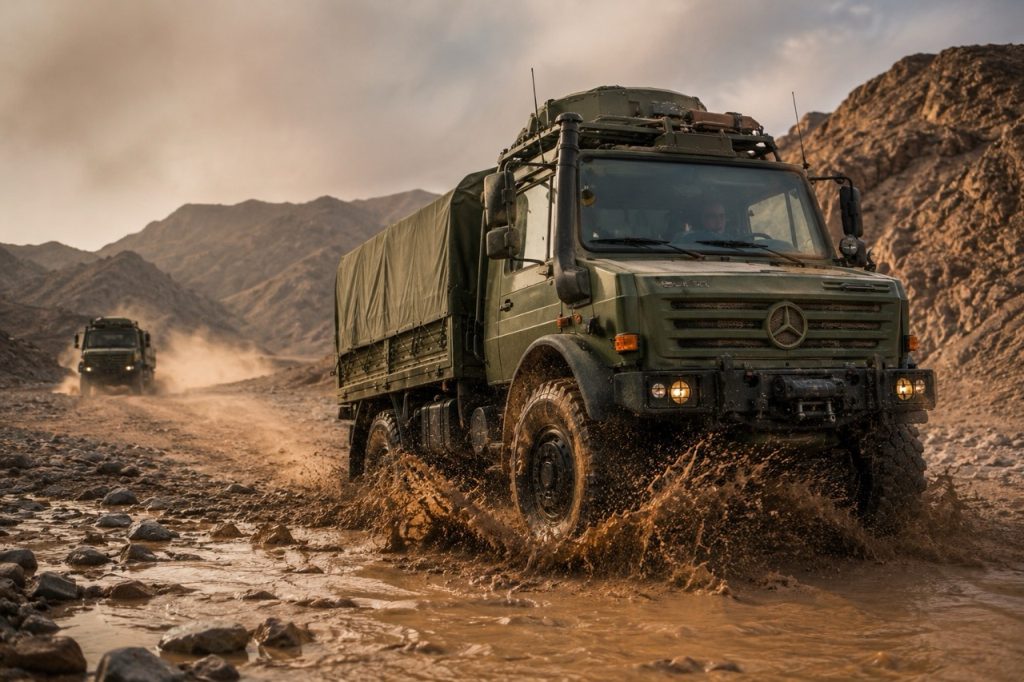
Mobility decides more battles than firepower does. A unit that cannot reach the objective, resupply a forward position, or evacuate casualties in time loses initiative regardless of how well it is armed. Terrain is rarely cooperative when it matters most: deep sand swallows tires, loose rock shifts under load, and long, exposed supply routes turn every kilometer into a test of a vehicle’s drivetrain, cooling system, and suspension. Mission readiness in these conditions is not an abstract logistics metric. It is the difference between a convoy that arrives on schedule and one that becomes a recovery job.
Few platforms have been asked to prove themselves across as wide a range of harsh environments as the Mercedes Benz Unimog. Originally conceived as an agricultural and utility vehicle in postwar Germany, the Unimog was adopted early by military users precisely because its running gear behaved differently from a conventional truck chassis. Over decades of service with NATO aligned forces and beyond, it has been driven across Saharan dune fields, Balkan mountain tracks, Nordic ice roads, and Middle Eastern gravel plains. That breadth of operational history is why the Unimog is still specified for new military contracts today, well into an era when most tactical trucks are judged primarily on payload and unit cost. This article looks at the engineering reasons behind that reputation, how the platform behaves in desert and rocky terrain specifically, where it fits into modern force structures, and what keeps a Unimog fleet operationally ready over a long service life.
Why Military Forces Continue to Deploy the Unimog
The Unimog’s military record does not begin with Germany. According to documented company and army procurement history, the Swiss Army was the first military customer for the platform anywhere in the world, receiving its first four Unimog U25 series trucks as early as 1950, only a year after series production began. Swiss Army evaluators reportedly tested the vehicle’s climbing ability and maneuverability on the construction site of a dam project in the Valais Alps, a genuinely demanding high altitude, mountain construction environment, and the results were convincing enough that Switzerland went on to order 250 vehicles. The Swiss Army procured the further developed Unimog S from 1961 onward, and Unimog family vehicles remained in Swiss service in various roles, including firefighting, for more than seventy years.
The French Army followed the Swiss lead, purchasing early production vehicles and then, according to documented production history, requesting a dedicated military variant. That request led directly to the Unimog 404, first conceived in 1953 and delivered to the French Army as prototypes from 1954 before entering full scale production. The Bundeswehr adopted the 404 shortly after its own reformation as part of NATO rearmament, and production figures on the model are well documented: total Unimog 404 production is recorded at over 64,000 units, with close to 37,000 of those delivered to German forces alone. The design was also licensed and locally produced or exported to a number of other armed forces, including Argentina, Peru, Chile, and Bolivia, extending its operational record well beyond Central Europe.
That adoption pattern continued into later generations. The Bundeswehr’s official vehicle documentation records that the service has procured roughly 18,000 units of its 2 tonne class Unimog, designated Lkw 2t gl in German military nomenclature, since 1978 alone, across configurations ranging from unarmored command vehicles to personnel and material transport. The type is used daily by logistics units across every branch of the Bundeswehr and is fitted with a raised air intake, referred to informally as a schnorchel, specifically to extend fording depth by keeping water out of the engine during river crossings. Fleet renewal has continued into the present: Daimler Truck’s own newsroom confirmed that BwFuhrparkService GmbH, the Bundeswehr’s fleet management provider, placed a new order in 2025 for a mid three digit quantity of Unimog and Zetros logistics vehicles to be delivered within a year, and a new Unimog ambulance variant, built by EMPL Fahrzeugwerk GmbH to the EN 1789 ambulance standard, was publicly presented at the Bundeswehr’s Day of the German Armed Forces event on June 28, 2025.
What has kept the Unimog in service across so many armed forces for more than seventy years is not a single standout capability but the combination of mobility, adaptability, and a long parts support horizon. A single chassis platform can be configured as a troop carrier, a cargo and logistics truck, a communications shelter carrier, a light recovery vehicle, an engineer support truck, or a base for a weapons or medical module, often with the same drivetrain and suspension underneath. For a procurement officer building a sustainment plan around a limited number of platform types, that commonality matters as much as raw off-road capability, because it reduces the number of distinct drivetrains, tools, and spare parts lines a fleet has to support.
Modern military Unimog variants remain in service with multiple NATO member states and allied forces, typically in engineer, logistics, and specialized support roles rather than as front line combat vehicles. That role placement is itself informative: these are the missions where a convoy cannot simply wait for better weather or a graded road, and where a vehicle’s ability to keep moving under load, in poor terrain, directly affects whether a unit gets fuel, water, ammunition, or medical support on time.
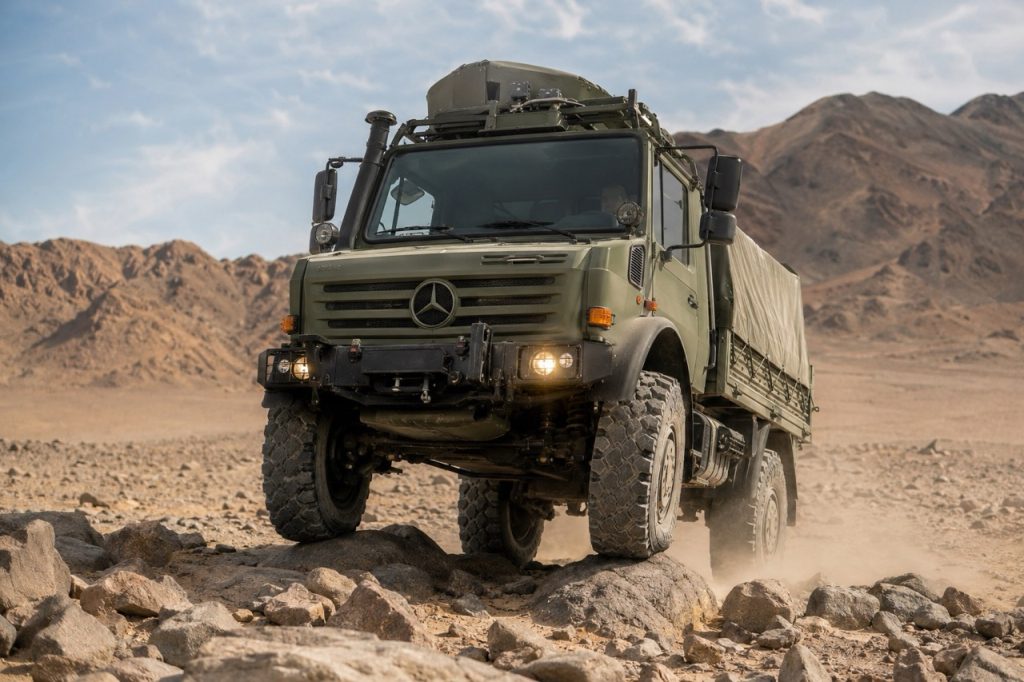
Engineering Features That Enable Exceptional Off-Road Performance
Nearly every distinctive feature of the Unimog’s off-road performance traces back to a small set of design decisions made around the drivetrain and chassis. None of them work in isolation; the value of each is really in how it interacts with the others.
Portal Axles
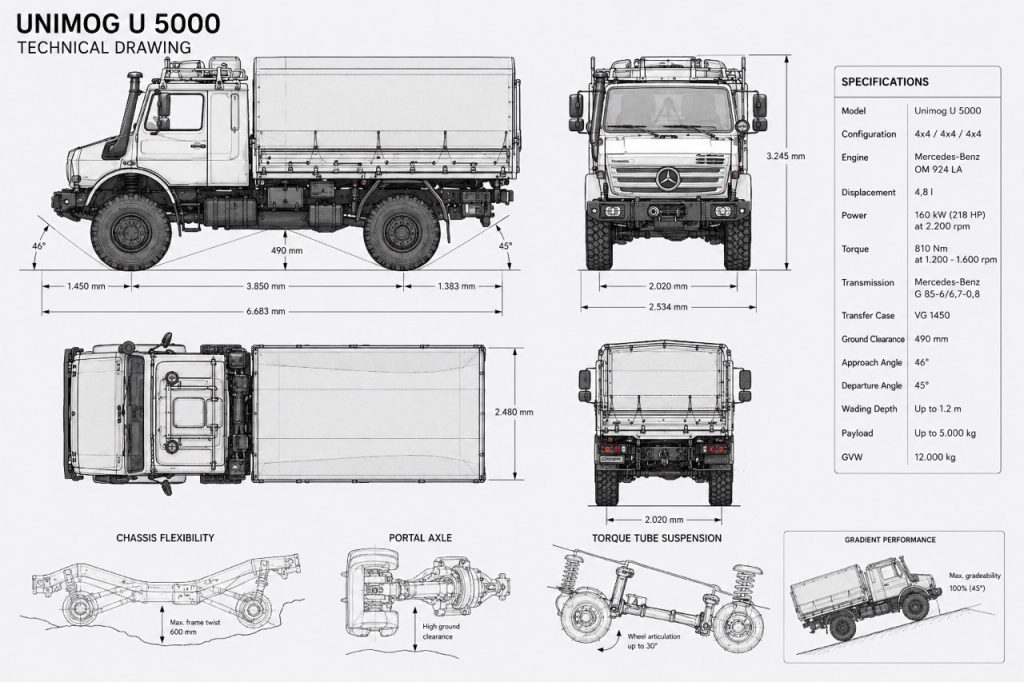
A portal axle moves the differential and axle tube above the centerline of the wheel, with a gear reduction at each wheel hub rather than at a conventional axle center. The practical effect is that the vulnerable, low-hanging components of the drivetrain sit well clear of the ground, while the wheels themselves absorb the first contact with rocks, ruts, and berms. This is what allows the Unimog to combine genuinely high ground clearance with a comparatively low overall center of gravity, since the axle housings and differentials do not need to hang low to clear obstacles. On U 4000 and U 5000 military variants, ground clearance in this range is typically in the neighborhood of 400 to 490 millimeters depending on wheelbase and configuration, a figure that would otherwise be difficult to reach without raising the vehicle’s center of gravity to the point of compromising stability.
Torque Tube Suspension, Coil Springs, and Frame Flexibility
The Unimog connects its axles to the frame through a torque tube arrangement combined with coil springs, rather than the leaf spring, live axle setups common on conventional military trucks. This allows for long spring travel and high axle articulation, on the order of 30 degrees on extreme off-road configurations, so that a wheel can drop into a rut or climb over an obstacle while keeping tire contact with the ground instead of lifting free of it. The frame itself is fully welded but engineered for torsional flexibility rather than rigidity, and the cab, engine, transmission, and any mounted body are attached at three points rather than rigidly bolted along the frame rails. Together, this lets the chassis twist under uneven loading, sometimes with diagonal articulation approaching 600 millimeters on the most off-road-focused variants, while the cab and payload structures stay level and undamaged. A rigid frame subjected to the same terrain would either lift a wheel clear of the ground, losing traction at exactly the moment it is needed, or transmit that twisting stress into the cab and body mounts.
Differential Locks, Low Range Gearing, and Weight Distribution
Permanent or selectable all wheel drive is paired with differential locks on both axles, which on current military variants can typically be engaged electro pneumatically from the cab without the driver needing to declutch. Locking the differentials forces both wheels on an axle to turn at the same speed, which matters the moment one wheel loses traction on loose sand or wet rock; without a lock, an open differential sends all of the available torque to the wheel that is already slipping, and the vehicle stalls in place. A low range gearbox with a wide spread of gear ratios then lets the driver hold engine speed in a useful power band while creeping over obstacles at walking pace, which is a very different requirement from cruising down a paved supply road. Weight distribution is managed through the axle geometry and frame layout to keep the load centered between the axles, which reduces the risk of getting either end bogged down when crossing soft or uneven ground.
Tire Pressure Adjustment and Approach, Departure, and Breakover Angles
Where fitted, a central tire inflation system lets the driver reduce tire pressure from inside the cab to increase the tire’s footprint on soft terrain such as sand or mud, then re-inflate for higher speed travel on a hard surface, without stopping to do it manually. Short frame overhangs at both ends of the vehicle, combined with the high ground clearance already discussed, give the Unimog wide approach and departure angles; published figures for the U 5000 platform, for example, put approach angle around 44 degrees and departure angle above 50 degrees, though exact numbers vary by wheelbase, body configuration, and bumper or winch fitment. A wide approach angle means the front of the vehicle can climb onto a steep bank or obstacle without the bumper or front axle striking the ground first, and the equivalent applies at the rear when descending or reversing off an obstacle.
None of these features is unique in isolation; other manufacturers have built portal axles or locking differentials into military trucks before. What distinguishes the Unimog is that all of them were designed together as one system from the outset, rather than added to a road going truck chassis as off-road options.
Traction and stability, in this context, are less a matter of any single component and more a product of how these systems interact under load. A wheel with good tire pressure but no differential lock still spins uselessly on a slick surface, and a locked differential without adequate axle articulation still lifts a wheel clear of uneven ground the moment the terrain gets rough enough. It is the combination of portal axle geometry, articulation range, locking differentials, and low range gearing acting together that lets the vehicle hold a steady line across broken ground rather than lurching or stalling, which is ultimately what a driver relies on when the terrain is unpredictable and there is no time to stop and assess the surface ahead.
Performance in Desert Operations
Desert terrain punishes vehicles in ways that are easy to underestimate from a specification sheet. Deep, dry sand offers almost no rolling resistance advantage and instead threatens to bury a wheel the moment torque is applied unevenly; soft terrain more broadly, including dry lakebeds and salt flats, can look firm from the driver’s seat and then give way under a loaded axle. Heat drives up cooling system demand at exactly the moment engines are working hardest to maintain momentum through soft ground, and fine airborne dust works its way into every filter, seal, and electrical connector on the vehicle.
The Unimog’s approach to sand is built around keeping momentum rather than fighting for traction after the vehicle has already bogged down. Reducing tire pressure through a central tire inflation system, where fitted, spreads the vehicle’s weight over a larger tire footprint before the driver reaches soft ground, rather than reacting after the wheels start to sink. Locking differentials keep torque flowing to both wheels on an axle even as one begins to slip in loose sand, and the low range gearbox lets the driver maintain a steady crawl speed rather than alternately stalling and over revving. Heat management on desert specification variants typically includes uprated cooling packages and engine air filtration designed for high dust loads, since a clogged air filter in a sandstorm is a more immediate threat to mission continuity than almost any mechanical failure. Fuel efficiency becomes a genuine operational concern on long desert supply routes where the nearest resupply point may be hundreds of kilometers away, and the diesel engines used across Unimog military variants are selected in part for the torque characteristics that keep fuel consumption manageable under sustained low-speed, high load conditions rather than for outright horsepower.
Crew fatigue and visibility are less discussed but equally real factors in sustained desert operations. Long stretches of featureless terrain, heat inside the cab, and the physical strain of low speed off-road driving over many hours all degrade a driver’s judgment over time, which is one more reason mission planners favor a platform whose controls and handling stay predictable rather than requiring constant correction for wander or instability on loose surfaces.
Long supply routes compound all of these factors at once. A convoy moving fuel or ammunition across several hundred kilometers of desert cannot treat any single vehicle’s mobility as a convenience; a truck that bogs down or overheats partway along the route becomes a liability for the entire formation, either as a target while stationary or as a drag on the schedule while other vehicles wait or attempt a recovery. This is why desert specification variants are evaluated less on peak performance figures and more on how consistently they maintain momentum, fuel economy, and cooling margin across an entire day’s driving rather than a short test section.
Performance in Rocky and Mountain Terrain
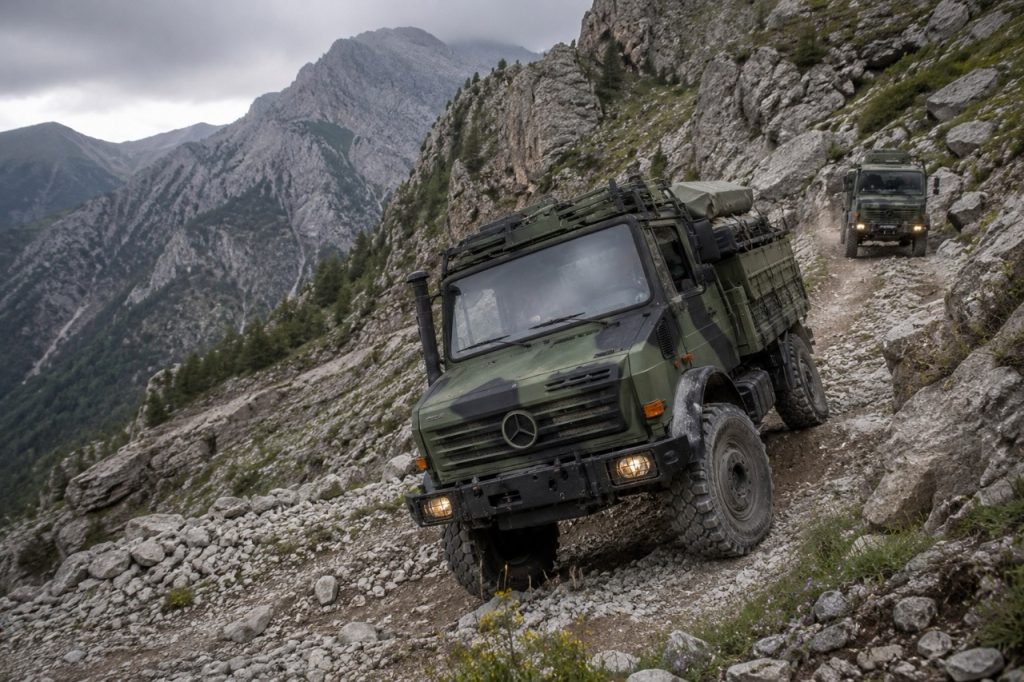
Rock and mountain terrain presents almost the opposite challenge from sand: instead of a surface that gives way too easily, the vehicle is confronted with hard, uneven, and often steep ground where a single wheel losing contact can stop forward progress entirely. Rock crawling at low speed depends on axle articulation more than raw power, since the goal is keeping all four tires in contact with an irregular surface rather than simply generating torque. The torque tube suspension and coil springs already discussed allow a wheel to drop into a gap between rocks while the opposite wheel on the same axle stays planted, and the flexible, three point mounted frame lets the chassis twist to accommodate the terrain without transmitting that stress into the cab.
Steep slopes and loose gravel raise a different concern: control at low speed without loss of traction or an unintended slide. Published gradient figures for military Unimog variants commonly reach up to a 100 percent grade, meaning a 45 degree slope, under favorable surface conditions, though actual climbing ability depends heavily on load, tire condition, and surface grip. Low range gearing again does the work here, letting the driver hold a crawl speed on a descent using engine braking rather than relying on the service brakes alone, which matters on loose gravel where brake lockup can trigger a slide. Fording capability is genuinely variant dependent: the U 4000 platform, for instance, is commonly rated for water crossings up to around 1.2 meters, while other configurations such as the U 5000 are typically rated closer to 0.8 meters, so the specific fording depth a unit can rely on has to be confirmed against the exact vehicle configuration in service rather than assumed from the platform family in general.
The safety case for this kind of chassis in mountain terrain is closely tied to the same high clearance, low center of gravity geometry that portal axles enable. A vehicle that maintains stability on a steep side slope rather than needing to slow to a crawl or divert around it keeps a convoy moving and reduces the time crews spend exposed on an unsecured route, which is itself an operational risk in contested or unstable areas.
Military Applications in Off-Road Environments
The same mobility characteristics that make the Unimog effective in desert and mountain terrain are what allow a single platform family to serve across a wide range of military and paramilitary roles rather than being built for one narrow mission set.
- Logistics and general cargo transport, moving fuel, water, ammunition, and supplies over routes unsuitable for standard trucks.
- Troop transport into forward positions where road infrastructure is limited or has been damaged.
- Engineering unit support, including mobile workshops, route clearance support, and bridging or construction equipment carriers.
- Maintenance and recovery teams, using the platform’s own off-road mobility to reach disabled vehicles in terrain a standard recovery truck cannot enter.
- Communications shelters and mobile command posts, which depend on reaching and then holding a stable forward position.
- Medical evacuation, where the suspension’s ability to smooth out rough terrain reduces further injury risk to casualties in transit.
- Border security and remote patrol operations, often over the same soft or broken terrain discussed above on a sustained, day to day basis rather than for a single mission.
- Disaster response and humanitarian logistics, where damaged infrastructure creates off-road conditions even in areas that are not naturally remote.
- Peacekeeping operations, frequently in regions with limited road maintenance and a premium on vehicles that can operate independently of paved supply routes.
This breadth of application is a direct consequence of the modular body-mounting approach discussed earlier: the same chassis, axles, and suspension underpin very different mission modules, which is part of why the platform continues to appear in force modernization programs focused on logistics and support functions rather than only in dedicated tactical vehicle competitions.
Verified Field Deployments and Operational Records
Engineering specifications describe what a vehicle is capable of; deployment records describe what it has actually done. The Unimog’s operational history includes a number of specific, documented cases that illustrate how its off-road engineering has translated into real missions rather than test-track results.
The ATF Dingo: A Unimog Based Platform in Afghanistan and Ukraine
One of the clearest examples of the Unimog chassis being trusted for demanding operational conditions is the ATF Dingo, a mine protected infantry mobility vehicle built on a reinforced Unimog U 5000 special chassis. The Dingo was fielded by the Bundeswehr during its International Security Assistance Force deployment in Afghanistan, a mission that ran from 2002 and placed German forces in and around Kabul and the country’s comparatively arid north, terrain that stressed vehicle cooling, filtration, and suspension components in ways similar to the desert conditions discussed earlier in this article. The platform’s underlying mobility has continued to be judged sufficient for demanding missions well beyond that deployment: in 2022, Germany announced it would supply 50 upgraded ATF Dingo 2 vehicles, still based on the Unimog U 5000 chassis, to Ukraine, and further Dingo 2 orders built on the same modern Unimog running gear were placed with German industry in the years that followed.
International Missions: Afghanistan, Mali, and Kosovo
Beyond the armored Dingo variant, unarmored Unimog and Zetros trucks have themselves been part of Bundeswehr international deployments for many years. Daimler Truck’s own account of the Bundeswehr fleet states plainly that these vehicles have been used on international missions, specifically naming Afghanistan, Mali, and Kosovo, where the manufacturer states they have proven their robustness and operational suitability under deployed conditions rather than only in domestic training. The Bundeswehr maintained a substantial troop presence in Mali for years under United Nations and European Union mandates, operating across the country’s Sahelian terrain, a region that combines long, exposed logistics routes with the same fine dust and heat management challenges described in the desert operations section above.
Alpine and Mountain Proving Grounds
The Unimog’s mountain and rough terrain credentials are equally well documented, and considerably older than its desert record. The Swiss Army’s original 1950 evaluation, described earlier in this article, deliberately used a Valais Alps dam construction site rather than a level test track, specifically to assess climbing ability and maneuverability on the kind of steep, broken, high-altitude terrain that a level proving ground cannot replicate. That decision to test in genuine mountain conditions before committing to a large order is itself a data point worth noting for any procurement team evaluating off-road platforms: specification sheets can describe gradient and articulation figures, but only field conditions confirm whether a chassis behaves as designed when a wheel actually loses contact with the ground on a loose alpine slope.
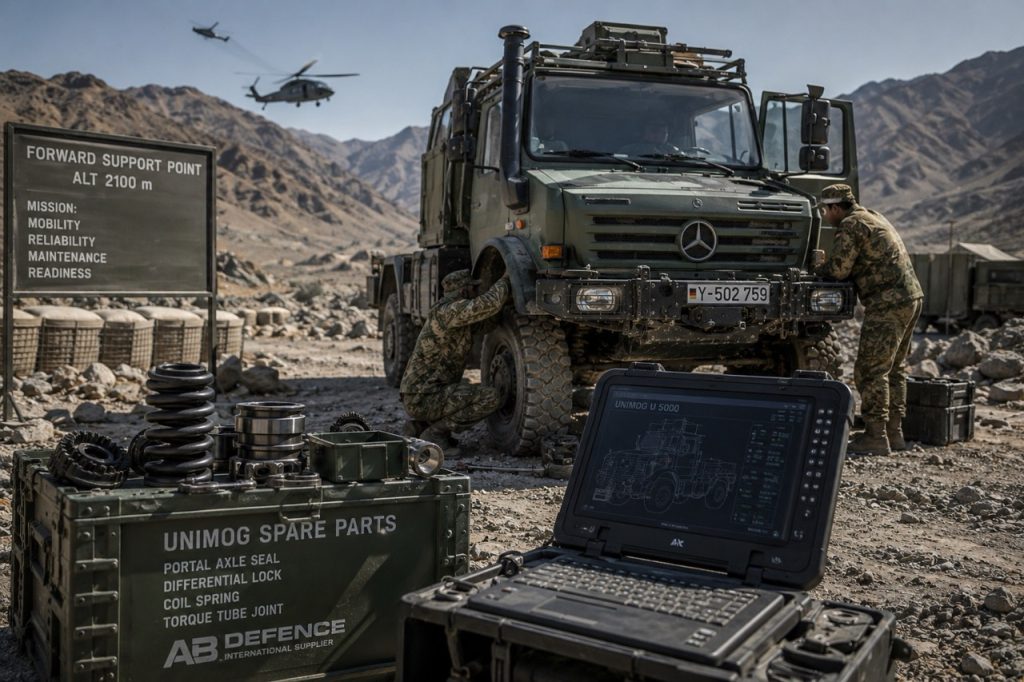
Maintenance Considerations for Harsh Environments
Off-road capability only matters if the vehicle stays serviceable after repeated exposure to the conditions described above, and the maintenance demands of a Unimog fleet operating in desert or mountain terrain are shaped directly by that terrain.
- Air filters require more frequent inspection and replacement in high-dust desert environments, where a partially clogged filter reduces engine performance well before it fails outright.
- Cooling systems need regular checks for airflow blockage from dust and debris, particularly on vehicles running sustained low speed, high load desert routes.
- Suspension components, including coil springs, shock absorbers, and torque tube joints, should be inspected on a defined schedule given the higher articulation loads of off-road use compared to on road operation.
- Portal axle gear oil and seals require monitoring, since the hub mounted reduction gearing in a portal axle depends on clean lubrication to handle the torque loads involved in low range crawling.
- Drivetrain lubrication more broadly, including differential locks and transfer case components, needs closer attention in fleets that see frequent water fording or sand exposure.
- Brake systems should be checked for contamination after water crossings and for wear patterns specific to steep, low speed descents in mountain terrain.
- Tire condition and pressure calibration matter more on a platform using variable tire pressure systems, since an underinflated tire left unmonitored on a hard surface wears very differently than one used correctly on sand.
- Dust protection for electrical connectors, seals, and cab filtration reduces the intrusion issues that are otherwise a leading cause of unscheduled desert maintenance.
None of this is unusual for a military off-road vehicle, but it does mean that preventive maintenance schedules built for on road or moderate duty use will systematically under maintain a Unimog operating in the desert and mountain conditions this article has described. Fleet readiness in this context is really a function of whether the maintenance program has been adjusted to the actual operating environment, not just the mileage or engine hours logged.
Why Spare Parts Availability Matters for Military Unimog Fleets
Every maintenance requirement described above eventually becomes a parts requirement, and the operational readiness of a Unimog fleet in demanding terrain depends as much on how quickly the right component can be sourced as it does on the underlying engineering of the vehicle. A portal axle seal, a specific differential lock component, or a coil spring rated for a particular variant is not always something a unit can substitute or fabricate locally, and a fleet with vehicles distributed across multiple bases or deployed locations needs a supply chain that can reach all of them without long lead times.
This is the practical context in which AB Defence operates as a supplier to international military and defense logistics customers. AB Defence sources and supplies spare parts for military vehicle platforms, including Unimog family components, with the kind of international logistics reach that fleet sustainment programs depend on. The value in that role is less about any single transaction and more about long term fleet support: helping a procurement or maintenance team maintain component availability across a distributed fleet, over a service life that in many cases spans decades, without the operational risk of a single point of failure in the supply chain. For fleet managers and sustainment planners, that kind of dependable sourcing relationship is what turns a well engineered vehicle into a fleet that is actually ready when it is needed.
The Unimog’s standing as one of the most capable off-road military utility platforms in service today is not the result of any single feature, but of an integrated chassis, suspension, and drivetrain design built around the requirement to keep moving in terrain that defeats conventional trucks. Portal axles, torque tube suspension, differential locks, low range gearing, and, where fitted, variable tire pressure work together to deliver the ground clearance, articulation, and traction that desert sand, rocky mountain tracks, and everything between them demand. That mobility, however, is only half of what determines operational readiness. The other half is a maintenance program matched to the actual operating environment and a spare parts supply chain capable of supporting a fleet wherever it is deployed. For military forces and defense logistics planners evaluating platforms for sustained off-road missions, the Unimog’s track record demonstrates that mobility, maintenance discipline, and reliable spare parts support are not separate considerations. They are the same readiness question, answered from three different directions.
Work With AB Defence
Partner with AB DEFENCE for Reliable Combat Support Vehicle Sustainment. AB DEFENCE is a specialist international supplier of military spare parts and fleet sustainment solutions serving NATO and allied defense organisations. With deep inventory across a wide range of combat support vehicle platforms, rigorous quality assurance processes, export compliance expertise, and a commitment to long term supply chain partnership, AB DEFENCE helps defense buyers maintain fleet availability, reduce sustainment costs, and meet their operational readiness obligations. Contact the AB DEFENCE team to discuss your spare parts requirements, strategic inventory planning, and long-term sustainment programme needs.
Contact AB Defence to discuss your procurement requirements and learn how we can support your fleet readiness objectives.
Related Military Spare Parts Categories, Vehicle Platforms & Technical Guides
Explore AB Defence’s NATO-codified (NSN) and genuine OEM spare parts catalog, platform technical specifications, and sustainment engineering guides related to this article:
Stocked Spare Parts Categories (NSN & OEM Catalog)
- Mercedes-Benz Unimog Military Spare Parts (562 stocked parts)
- Military Portal Axles, Differentials & Drive Shafts (107 stocked parts)
- Military Gearbox, Transfer Case & PTO Assemblies (108 stocked parts)
- Military Brake Calipers, Master Cylinders & Hydraulic Systems (103 stocked parts)
- Military Engine Cooling Systems, Radiators & Water Pumps (57 stocked parts)
- Full NATO NSN & OEM Spare Parts Catalog (16,760+ Parts)
Compatible Vehicle Platforms & System Hubs
- Unimog U 1300 L (1.5 Ton – 2.5 Ton)
- Unimog U 1500 L
- Unimog U 1700 L
- Unimog U 2150 L
- Unimog U 2450 L
- Request a B2B Quotation (RFQ) & Technical Support
Related Military Engineering & Sustainment Articles
- Unimog Military Spare Parts: What Every Fleet Manager Needs to Know Before Placing an Order
- Unimog Spare Parts for Military Fleets: Why AB Defence Is Your Trusted Supply Partner
- 5 Unimog Components Most Commonly Replaced in Military Operations
- What Are the Most Common Failures in Military Unimog Vehicles?