June 14, 2026
The Operational Cost of Delayed Spare Parts in Combat Support Vehicles
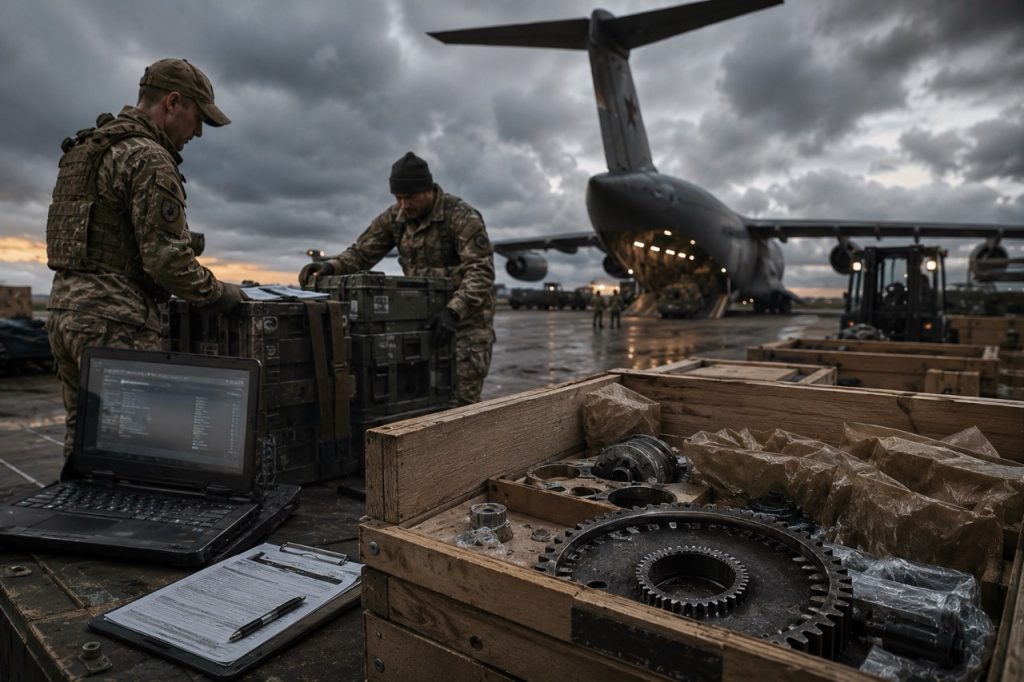
Picture a forward deployed heavy engineer company in the middle of a high tempo exercise. The bridge laying vehicle that is supposed to open the axis of advance is sitting idle. No battle damage. No engine failure. A single hydraulic control valve a part that costs a fraction of the vehicle’s total value is unavailable. The operator has been waiting eleven days. The maintenance team has cannibalized a similar valve from a recovery vehicle, which is now also degraded. Two critical assets are effectively out of action because of a supply chain gap that was entirely predictable.
This is not a hypothetical. Scenarios of this kind represent one of the most persistent and underappreciated sources of operational risk in modern military logistics. Defense organisations invest heavily in acquiring and operating combat support vehicles, yet the supply chains that keep those assets available frequently receive far less attention than the platforms themselves.
Spare parts availability is not an administrative inconvenience. It is a direct determinant of operational capability, force projection, and mission success. When the part is not there, the vehicle is not there and when the vehicle is not there, the mission is shaped by that absence. Understanding the full operational cost of spare parts delays is therefore essential for every defense procurement officer, fleet sustainment manager, and logistics planner responsible for maintaining combat support vehicle readiness.
Why Combat Support Vehicles Are Critical to Modern Military Operations
Modern military doctrine treats combat power as a system, not a collection of individual platforms. Frontline fighting vehicles tanks, infantry carriers, artillery systems attract the majority of procurement attention and public visibility. But the assets that enable those frontline systems to operate continuously, safely, and sustainably are the combat support vehicles that operate in the operational and logistical depth of the force.
Combat support vehicles encompass a wide range of specialised platforms. Recovery vehicles the ARV (Armoured Recovery Vehicle) variants operated across NATO armies, from the M88A2 Hercules to the Leopard 2 based Büffel recover disabled or battle damaged fighting vehicles from contested terrain, restoring combat mass that would otherwise be lost. Engineering vehicles clear obstacles, breach minefields, and prepare crossing points that enable manoeuvre. Bridge laying vehicles such as the M60 AVLB or the Leguan system convert impassable terrain into viable axes of advance.
Fuel transport vehicles tankers and forward area refuelling equipment translate petroleum allocations into sustained manoeuvre. Without continuous fuel resupply, the operational tempo of mechanised and armoured formations collapses within hours. Maintenance and field workshop vehicles extend the repair capacity of the force into the forward areas, keeping MTTR (Mean Time To Repair) manageable even under high intensity conditions. Medical evacuation support vehicles and mobile command platforms complete the picture of a logistically coherent fighting force.
The strategic importance of these platforms is sometimes obscured by their functional nature. A recovery vehicle does not fire a weapon. A bridge layer does not carry soldiers into contact. But remove them from the force structure and the frontline platforms quickly become immobilised, isolated, and unsustainable. NATO doctrine, articulated through frameworks such as ALP 4.2 (Allied Joint Logistic Doctrine) and STANAG compliant sustainment standards, recognises this interdependency explicitly. Combat support vehicle availability is a force multiplier and conversely, combat support vehicle unavailability is a force reducer that can cascade through the entire operational structure.
Understanding the Real Cost of Spare Parts Delays
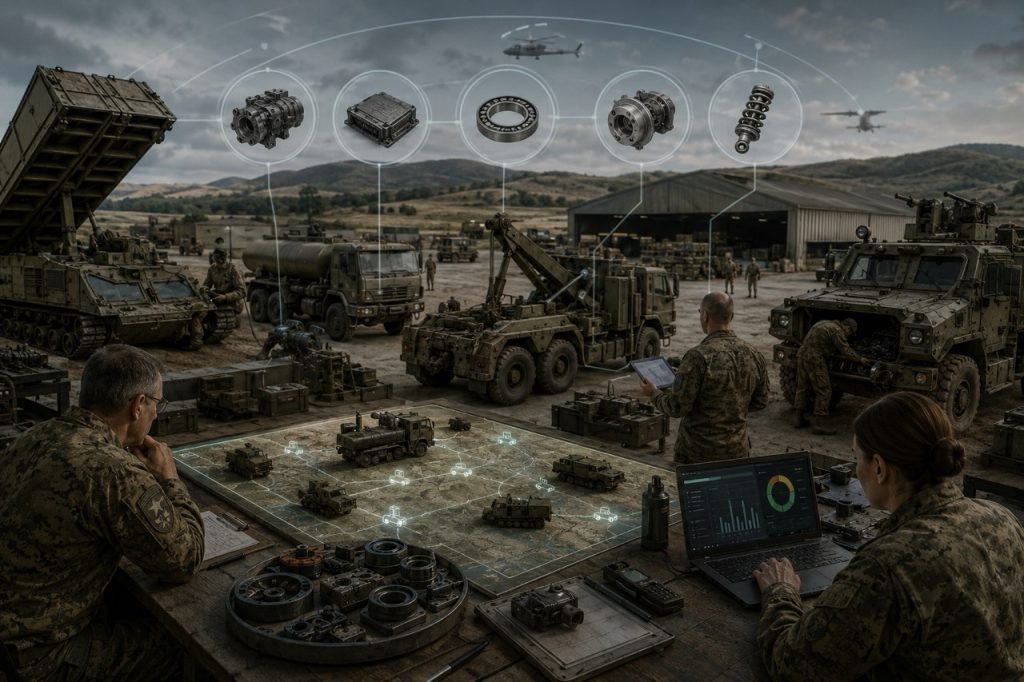
Defense organisations evaluating the cost of spare parts delays often focus on the direct procurement price differential the premium paid for emergency sourcing versus planned procurement. This is a significant cost, but it represents only a fraction of the true operational impact. The real cost of a spare parts delay is measured across a much wider set of dimensions.
Mission Interruption and Deployment Delay
When a combat support vehicle is unavailable due to a missing component, planned training events are cancelled or degraded, deployment timelines slip, and force readiness assessments decline. A delayed recovery vehicle can prevent an armoured unit from certifying for a deployment rotation. A grounded engineer vehicle can prevent a formation from completing a bridging certification. These outcomes have tangible consequences for alliance commitments, readiness reporting, and command confidence.
Vehicle Downtime and Maintenance Backlog
Every day a vehicle awaits a spare part is a day of zero productive utilisation. When multiple vehicles are awaiting parts simultaneously a common occurrence when systemic supply chain gaps exist maintenance bays become congested, technician time is wasted, and the backlog compounds. Mean Logistics Delay Time (MLDT), a standard metric in Integrated Logistics Support (ILS) frameworks, captures precisely this phenomenon: the administrative and supply chain time that inflates the total repair cycle beyond the actual hands-on repair time.
Cannibalization and Secondary Degradation
One of the most operationally damaging consequences of spare parts scarcity is cannibalization the practice of removing serviceable components from one vehicle to restore another. While cannibalization may solve an immediate problem, it creates a new one: the donor vehicle is now degraded, the removed component still needs replacement, and the paperwork burden on maintenance teams increases significantly. The U.S. Government Accountability Office has documented cannibalization rates as an indicator of supply chain stress across multiple defense sustainment programmes, noting that high rates correlate with reduced overall fleet availability.
Idle Maintenance Teams and Training Disruption
Skilled military technicians are an expensive and finite resource. When a vehicle awaits a part, the technicians assigned to it are unproductive either sitting idle or redirected to lower-priority tasks. Training scheduled around vehicle availability is cancelled or degraded. Apprentice technicians lose hands on hours. Senior technicians are pulled from mentoring roles. The human capital cost of spare parts delays is real and cumulative.
Emergency Procurement Premiums and Expedited Logistics
When planned procurement fails and urgency drives purchasing decisions, the price differential is substantial. Emergency sole source procurement, air freight costs, and expedited customs clearance can multiply the effective cost of a component by a factor of three to ten relative to planned procurement pricing. These unbudgeted expenditures consume maintenance funds that would otherwise support predictive maintenance programmes, scheduled overhauls, and strategic inventory replenishment.
Direct Costs vs Hidden Operational Costs
The direct cost of a spare parts delay is visible in procurement records. The hidden costs lost training days, cannibalization induced secondary failures, emergency freight premiums, reduced readiness ratings, contract penalties, and the compounding effect of deferred maintenance are dispersed across operational, training, and sustainment budgets and rarely aggregated into a single cost figure. When they are aggregated, the result is consistently far larger than the direct procurement cost that triggered the delay.
Operational Readiness and Fleet Availability
Operational readiness is the foundational metric of military sustainment. For combat support vehicles, readiness is typically expressed as the Mission Capable (MC) rate the percentage of the fleet that is fully or partially capable of performing its assigned mission at any given time. Fleet availability is the broader concept: the proportion of authorised vehicles that are present, operational, and deployable.
Both metrics are sensitive to spare parts availability in ways that are not always intuitive. A single missing component can render an otherwise serviceable vehicle non mission capable. Consider a few examples that illustrate the systemic vulnerability:
- A hydraulic pump failure on a bridge laying vehicle. The vehicle is mechanically complete in every other respect, but without the hydraulic system it cannot deploy or retrieve the bridge. The vehicle is NMC (Non Mission Capable) and the bridging capability of the unit is reduced or eliminated.
- An ECU (Engine Control Unit) fault on a fuel tanker. Modern military logistics vehicles increasingly rely on electronic control systems. An ECU failure can immobilise a vehicle that is otherwise in good mechanical condition. If the ECU is on a long-lead-time item or subject to export control complications, the vehicle may remain grounded for weeks or months.
- A bearing failure in the final drive assembly of a recovery vehicle. Final drive bearings in heavy recovery vehicles operate under extreme load conditions. Failure is often sudden and total. If the replacement bearing is not in stock at the depot or forward logistics element, the recovery vehicle the asset that would normally recover disabled vehicles is itself awaiting recovery.
- A brake assembly fault on a troop carrier. Safety critical components like brake systems require immediate replacement. If the correct assembly is unavailable, the vehicle is grounded under maintenance safety protocols regardless of operational urgency.
- A suspension component failure on a mobility vehicle. Off road capable combat support vehicles depend on robust suspension systems. A failed torsion bar, suspension arm, or shock absorber assembly reduces cross country mobility and may create safety hazards that ground the vehicle entirely.
Across all of these cases, the pattern is consistent: one component, one unavailable part number, one grounded vehicle. Multiply this pattern across a fleet of 20, 50, or 200 combat support vehicles operating in a high tempo environment, and the cumulative impact on fleet availability becomes severe and operationally significant.
NATO’s approach to availability management, reflected in documents such as STANAG 2454 (Codification of Material in NATO Countries) and the Allied Reliability and Maintainability Publication (ARMP) series, emphasises that maintenance planning and spare parts provisioning must be treated as integrated disciplines, not sequential administrative functions. Availability targets typically expressed as percentage MC rates in national and alliance readiness reporting require robust supply chain support to be sustained over time.
Supply Chain Bottlenecks That Create Delays
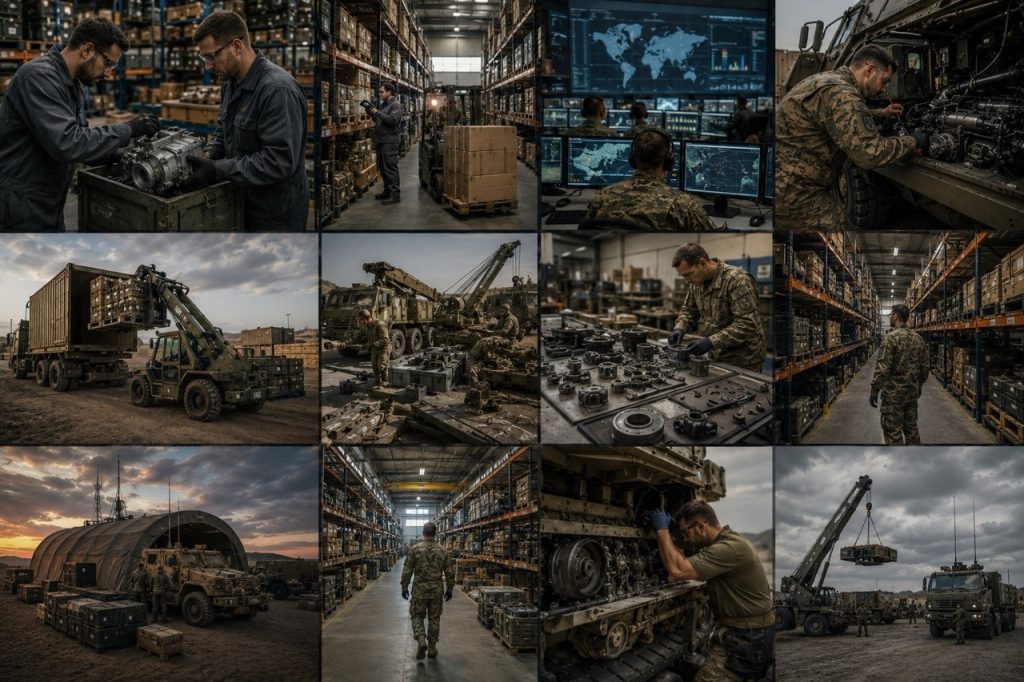
Understanding why spare parts delays occur is a prerequisite for preventing them. The sources of delay in military spare parts supply chains are numerous, often concurrent, and frequently interacting in ways that amplify individual problems into systemic failures.
OEM Discontinuation and Component Obsolescence
Combat support vehicles have long service lives often 30 to 40 years or more. Original equipment manufacturers (OEMs) that supplied components at the time of vehicle production may discontinue those components well before the vehicle reaches the end of its service life. When OEM production ends, the supply chain must either transition to alternative sources, procure Last Time Buy (LTB) quantities, or initiate engineering qualification for replacement components. Each of these paths takes time and resources, and failure to execute them in advance of actual need creates supply gaps that ground vehicles.
Single Source Dependency
Many defence grade components are produced by a single manufacturer. This single source dependency creates systemic vulnerability: any disruption to that manufacturer’s production whether from financial distress, facility damage, labour action, or capacity constraints immediately translates into a supply gap across all customers. Defense Acquisition University (DAU) guidance on supply chain risk management identifies single source dependency as one of the primary risk factors in defence materiel sustainment.
Export Control Complications
Military spare parts, particularly those with ITAR (International Traffic in Arms Regulations) or EAR (Export Administration Regulations) implications, are subject to export licensing requirements that add time and administrative complexity to international procurement. A component that can be physically shipped within 48 hours may require an export licence that takes weeks or months to approve. For allied nations procuring parts from U.S.origin programmes HMMWV variants, M113 family components, MRAP upgrades export control timelines are a significant and recurring source of supply chain delay.
Global Transportation Disruptions
The COVID-19 pandemic demonstrated, with unusual clarity, how fragile global logistics networks can be when subjected to simultaneous multi point stress. Port congestion, air freight capacity constraints, and shipping container shortages created delays measured in months rather than days across virtually every category of manufactured goods, including defence materiel. While conditions have partially normalised, the structural vulnerabilities that enabled those disruptions remain, and geopolitical risks sanctions regimes, territorial disputes, conflict adjacent supply route closures continue to create episodic disruptions in global defence supply chains.
Semiconductor Shortages and Electronics Supply Constraints
Modern combat support vehicles are increasingly electronics intensive. Vehicle management systems, diagnostic interfaces, navigation equipment, communications systems, and active safety features all depend on semiconductor components. The global semiconductor shortage that emerged in 2020 and continued through 2023 affected military programmes as well as commercial automotive production, creating shortages of ECUs, sensor assemblies, and control modules across the defence sector. As vehicles become more electronically complex, semiconductor supply chain dynamics will continue to influence military spare parts availability.
Documentation Delays and Customs Clearance
International military spare parts transactions require extensive documentation: export licences, end user certificates (EUC), Certificates of Conformance (CoC), Material Test Reports (MTR), First Article Inspection (FAI) reports, and Approved Vendor List (AVL) confirmations. In the worst cases, incomplete or incorrect documentation can hold shipments in customs for days or weeks. For time sensitive procurements, documentation management is not a bureaucratic footnote it is a critical path item.
Financial Impact on Defense Organizations
The financial consequences of spare parts delays extend well beyond the immediate procurement transaction. Defence organisations that do not adequately account for the full cost of supply chain failure tend to under invest in strategic inventory management, preventive sourcing, and supplier qualification and then absorb much larger costs when supply gaps materialise.
Emergency Procurement Premiums
Unplanned, time critical procurement is consistently more expensive than planned procurement. Emergency sole source awards, which bypass competitive procurement procedures due to urgency, typically result in prices that are substantially higher than would be achievable through a competitive process. The premium varies by component category and urgency level, but multiples of two to five times the planned procurement unit cost are not unusual in defence logistics contexts.
Air Freight and Expedited Transportation Costs
Sea freight is the most economical mode for heavy or bulky defence materiel. Air freight costs are typically five to eight times higher per kilogram than sea freight for comparable routes. When urgency drives mode selection, an organisation can pay more in freight costs for a single shipment than the component itself is worth. For high value, heavy components gearboxes, axle assemblies, large hydraulic components the air freight cost can equal or exceed the part cost.
Depot Congestion and Maintenance Throughput Reduction
When vehicles accumulate in maintenance facilities awaiting parts, depot throughput declines. Bays are occupied by vehicles in wait status, technicians are unable to progress other work, and the maintenance pipeline backs up. This congestion has a cost in terms of facility utilisation, labour efficiency, and the opportunity cost of deferred maintenance on other vehicles.
Lifecycle Cost Inflation
Deferred maintenance, secondary failures caused by cannibalization, and accelerated wear from operating degraded vehicles all inflate the total lifecycle cost of combat support vehicle programmes. Integrated Logistics Support (ILS) analyses, which model total ownership cost over the projected service life of a platform, consistently identify supply chain performance as a significant determinant of lifecycle cost outcomes. A sustainment programme that suffers recurring spare parts delays will carry a higher total ownership cost than a programme with robust supply chain management.
The Strategic Inventory Paradox
The most consistent finding across defence logistics analyses is that maintaining strategic inventory holding spare parts in stock before they are needed is almost always less expensive than procuring the same parts on an emergency basis after they are needed. The carrying cost of held inventory is real, but it is typically far smaller than the combined cost of emergency procurement premiums, expedited freight, vehicle downtime, and operational degradation. Organisations that treat inventory as a liability rather than a strategic asset consistently pay more in the long run.
How Modern Defense Organizations Reduce Spare Parts Delays
Leading defence organisations have developed a range of practices and capabilities designed to reduce spare parts delays, improve fleet availability, and manage the total cost of sustainment. These practices are not theoretical they are operational realities in NATO and allied military sustainment programmes.
Multi Sourcing and Supplier Diversification
Dependence on a single supplier for a critical component creates unacceptable supply chain risk. Multi sourcing strategies qualifying two or more suppliers for critical components distribute that risk and create competitive pressure that supports better pricing and delivery performance. For components where OEM supply is limited or unreliable, qualified aftermarket and military grade alternative manufacturers provide essential redundancy.
Strategic Supplier Qualification
Supplier qualification in the defence context is a rigorous process: factory audits, documentation verification, quality system assessment (typically against ISO 9001, AS9100, or AQAP-2110/AQAP-2310 standards), and technical validation of components against OEM specifications. Pre qualifying a network of qualified suppliers before supply gaps emerge rather than attempting emergency qualification under time pressure is a fundamental principle of resilient defence sourcing.
Demand Forecasting and Predictive Maintenance
Demand forecasting for military spare parts has historically relied on consumption-based historical data. Modern approaches add predictive analytics drawing on vehicle telematics, condition monitoring data, and failure mode modelling to anticipate demand before it becomes urgent. Condition Based Maintenance (CBM) programmes, which replace fixed interval replacement schedules with condition triggered interventions, reduce unplanned failures and generate more predictable spare parts demand profiles. This predictability directly supports inventory planning and procurement lead time management.
Digital Inventory Management and Supply Chain Visibility
Enterprise resource planning (ERP) systems, asset management platforms, and supply chain visibility tools give sustainment managers real time insight into stock levels, demand signals, supplier lead times, and inbound shipment status. When integrated across the supply chain from depot to forward logistics element these tools enable proactive interventions that prevent parts shortages from becoming vehicle groundings.
Long Term Framework Agreements and Regional Warehousing
Long term framework agreements with qualified suppliers lock in pricing, priority access, and service level commitments. They also allow suppliers to pre position inventory against anticipated demand, reducing lead times for time sensitive orders. Regional warehousing positioning strategic reserves of critical components closer to operational areas reduces the distance and time separating demand from supply, particularly in scenarios where global logistics networks are disrupted.
Performance Based Logistics (PBL)
Performance Based Logistics contracts align supplier incentives with outcome metrics rather than transaction volumes. A PBL arrangement might measure supplier performance against fleet availability rates, order fill rates, and MLDT targets. By making supplier revenue contingent on the sustainment outcomes that matter to operators, PBL creates structural incentives for proactive supply chain management. The U.S. Department of Defense and several NATO allies have implemented PBL arrangements for critical vehicle systems with measurable improvements in availability outcomes.
The Role of Reliable International Spare Parts Suppliers
As defense organisations confront the dual pressures of ageing vehicle fleets and increasingly complex supply chains, the role of specialised international spare parts suppliers has become strategically important. The evaluation of these suppliers goes well beyond price and delivery speed and rightly so.
Inventory Depth and Technical Expertise
A supplier’s inventory depth the range and volume of components held in stock determines its ability to respond to demand across a wide variety of platform types and component categories. Technical expertise the ability to interpret technical documentation, verify component specifications, and identify equivalent or replacement parts when exact OEM items are unavailable is equally important. In the military spare parts context, technical errors are not merely inconvenient. A misidentified component that reaches a maintenance bay wastes time, creates safety risks, and may damage associated systems.
Documentation, Traceability, and Quality Assurance
Defence grade spare parts require comprehensive documentation packages: Certificates of Conformance (CoC), Material Test Reports (MTR), FAI reports, country of origin documentation, and NATO stock number (NSN) cross references where applicable. Traceability the ability to document the complete supply chain history of a component from original manufacture to delivery is a quality assurance requirement in military procurement contexts and is essential for export compliance. Suppliers whose quality management systems are certified to recognised standards (ISO 9001, AS9100, AQAP-2110) provide a baseline assurance of documentation integrity.
Export Compliance and Global Logistics Capability
International spare parts procurement inherently involves export control considerations. Suppliers with established export compliance programmes ITAR registered where applicable, familiar with EAR commodity classifications, experienced with end user certificate requirements reduce the administrative friction and timeline risk associated with international procurement. Combined with global logistics capability established freight partnerships, experience with military customs procedures, and capability to manage bonded warehouse operations export compliance expertise translates directly into faster, more reliable delivery performance.
Emergency Response Capability and Long Term Partnership Potential
Defence buyers increasingly evaluate suppliers on their demonstrated ability to respond to urgent requirements not just their standard order processing performance. Suppliers with dedicated emergency response capabilities, flexible stock allocation policies, and rapid documentation turnaround provide genuine operational value in contingency situations. Beyond emergency responsiveness, the potential for long term partnership shared demand forecasting, collaborative inventory planning, priority access arrangements creates sustainable supply chain value that transactional procurement relationships cannot replicate.
Future Trends in Military Spare Parts Logistics
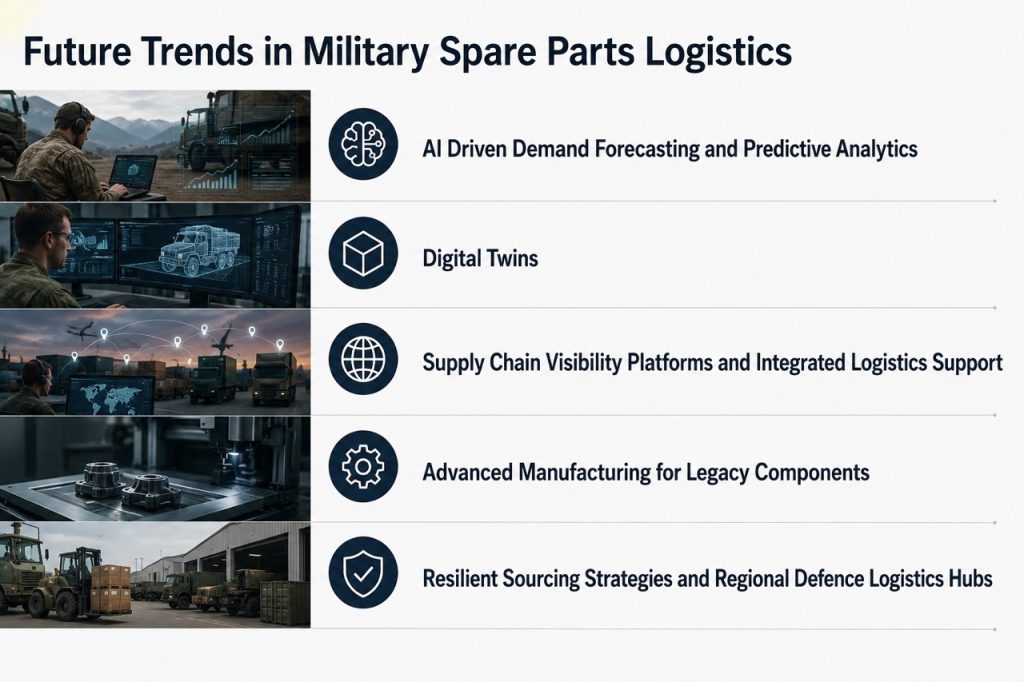
The defence spare parts supply chain of the next decade will look materially different from the one that exists today. Several converging trends are reshaping how military organisations plan, procure, and manage spare parts for combat support vehicles.
AI Driven Demand Forecasting and Predictive Analytics
Machine learning algorithms applied to vehicle telematics data, historical consumption records, and environmental operating data can generate demand forecasts with substantially greater accuracy than traditional consumption based models. By predicting component failures before they occur rather than responding after they have AI enhanced forecasting reduces unplanned demand and improves the alignment between inventory holdings and actual supply chain requirements.
Digital Twins
A digital twin is a virtual model of a physical asset, continuously updated with real-world operational and condition data. For combat support vehicles, digital twins enable maintenance planners to simulate the effects of operational tempo, environmental conditions, and component wear rates on the projected maintenance schedule. This capability supports more accurate spare parts demand forecasting and allows sustainment organisations to pre-position components ahead of predicted maintenance cycles.
Supply Chain Visibility Platforms and Integrated Logistics Support
End to end supply chain visibility real time tracking of components from supplier to depot to maintenance bay is becoming a baseline expectation in military sustainment. Platforms that integrate supplier inventory data, freight status, customs clearance progress, and maintenance demand signals into a unified operational picture enable proactive intervention at every stage of the supply chain. When integrated with Integrated Logistics Support (ILS) frameworks, this visibility supports both routine sustainment planning and contingency response.
Advanced Manufacturing for Legacy Components
Additive manufacturing (3D printing), reverse engineering, and computer numerical control (CNC) machining capabilities are increasingly being applied to produce replacement components for legacy vehicle platforms where OEM supply has been discontinued. While not a universal solution structural and safety critical components require qualification processes that limit the application of additive manufacturing these technologies extend the supportable life of ageing platforms and provide an alternative to relying on a shrinking pool of OEM suppliers.
Resilient Sourcing Strategies and Regional Defence Logistics Hubs
The geopolitical turbulence of the 2020s has driven a reassessment of supply chain concentration risk. Defence organisations and their industrial partners are increasingly pursuing regional sourcing strategies establishing qualified supplier networks within allied regions to reduce exposure to single geography supply disruptions. NATO’s focus on logistics resilience, articulated in successive summit communiques and the NATO Logistics Framework, reflects a recognition that supply chain resilience is a component of collective defence capability.
The true cost of a spare parts delay cannot be found in a single procurement record. It is distributed across lost training days, grounded assets, emergency freight invoices, degraded readiness ratings, cancelled exercises, secondary failures caused by cannibalization, and the cumulative erosion of maintenance programme effectiveness. When those costs are aggregated and measured against the investment required to prevent them strategic inventory, multi sourced supplier networks, digital demand forecasting, qualified international partners the return on investment in supply chain resilience is not marginal. It is substantial and consistently demonstrable.
The operational cost of delayed spare parts in combat support vehicles is not a niche logistics concern. It is a strategic issue that affects force readiness, operational effectiveness, and the ability of military organisations to meet their commitments to national and alliance defence objectives.
For defense procurement officers, fleet sustainment managers, and military logistics professionals, the practical implications are clear: proactive supply chain planning is less expensive than reactive emergency procurement; diversified sourcing is less risky than single source dependency; strategic inventory is more cost effective than emergency freight; and long term partnerships with qualified international suppliers deliver sustainable value that transactional procurement relationships cannot replicate.
The combat support vehicles that enable frontline operations deserve the same level of supply chain rigor as the fighting vehicles they support. Maintaining their availability requires a commitment to supply chain excellence that begins well before the maintenance order is raised and the part is found to be unavailable.
Work With AB Defence
Partner with AB DEFENCE for Reliable Combat Support Vehicle Sustainment. AB DEFENCE is a specialist international supplier of military spare parts and fleet sustainment solutions serving NATO and allied defense organisations. With deep inventory across a wide range of combat support vehicle platforms, rigorous quality assurance processes, export compliance expertise, and a commitment to long term supply chain partnership, AB DEFENCE helps defense buyers maintain fleet availability, reduce sustainment costs, and meet their operational readiness obligations. Contact the AB DEFENCE team to discuss your spare parts requirements, strategic inventory planning, and long-term sustainment programme needs.
Contact AB Defence to discuss your procurement requirements and learn how we can support your fleet readiness objectives.
Related Military Spare Parts Categories, Vehicle Platforms & Technical Guides
Explore AB Defence’s NATO-codified (NSN) and genuine OEM spare parts catalog, platform technical specifications, and sustainment engineering guides related to this article:
Stocked Spare Parts Categories (NSN & OEM Catalog)
- NATO Standard Defence Components & Military Hardware (12,993 stocked parts)
- M60 Tank Spare Parts (M60A1 / M60A3 / M60T) (497 stocked parts)
- M109 Self-Propelled Howitzer Spare Parts (585 stocked parts)
- BMC Kirpi MRAP Spare Parts (Kirpi I & Kirpi II) (597 stocked parts)
- Mercedes-Benz Unimog Military Spare Parts (562 stocked parts)
- Full NATO NSN & OEM Spare Parts Catalog (16,760+ Parts)
Compatible Vehicle Platforms & System Hubs
- Platforms
- Product Groups
- Quality
- Capabilities
- Tracked Armoured Vehicles
- Request a B2B Quotation (RFQ) & Technical Support