June 9, 2026
How Defense Contractors Source Obsolete Military Vehicle Components
Military vehicles are built to last. The HMMWV has been in U.S. service for over four decades. The M113 armored personnel carrier, first fielded in the 1960s, still operates in dozens of armed forces worldwide. The Leopard 2 main battle tank entered German service in 1979 and remains the backbone of multiple NATO armored brigades today. These platforms were engineered for longevity but the supply chains that support them were not.
Original equipment manufacturers (OEMs) typically wind down production of vehicle specific components within 10 to 20 years of a platform’s initial delivery. What happens after that? The vehicles keep rolling. The spare parts stop flowing. This is the defining tension of modern military sustainment, and it is growing more acute every year.
For defense procurement officers, fleet sustainment managers, and military logistics professionals, the question is no longer whether their fleets will encounter obsolete components. It is a question of how prepared they are when it happens. The sourcing strategies that organizations deploy in response to obsolescence directly determine whether vehicles remain mission ready or sit idle waiting for parts that no longer exist in any catalog.
This article examines how defense contractors approach the challenge of sourcing obsolete military vehicle components from strategic supplier networks and authorized surplus inventories to reverse engineering, certified aftermarket manufacturing, and the quality assurance frameworks that separate reliable solutions from dangerous shortcuts.
Understanding Component Obsolescence in Military Fleets
Component obsolescence is not a failure of planning. It is an inevitable outcome of the gap between industrial product cycles and military platform lifecycles. Manufacturers design and produce parts based on demand projections tied to active production programs. Once a vehicle platform moves past peak production volumes, OEM interest in maintaining dedicated component lines typically diminishes.
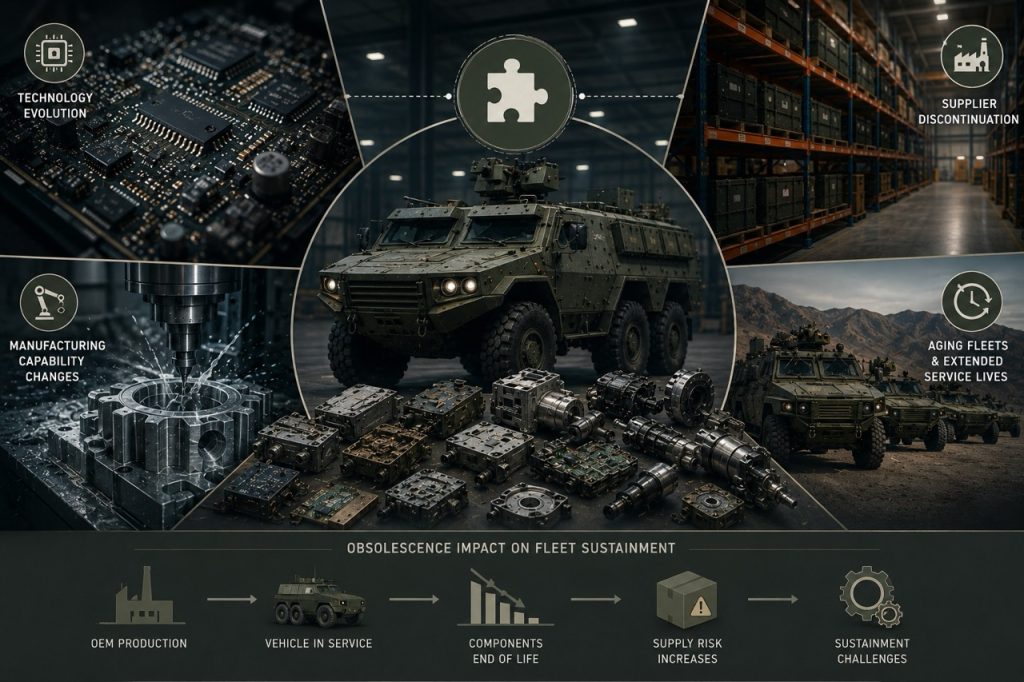
Several distinct forces drive obsolescence across military vehicle fleets:
Technology Evolution
Electronic components are the most acute example. Processors, power management ICs, sensors, and control modules designed for military vehicles in the 1990s or early 2000s are frequently no longer manufactured. The commercial electronics industry moves at a pace that military procurement cycles cannot match. When a vehicle’s engine management system relies on a microcontroller that entered end of life status a decade ago, finding a certified replacement becomes a serious logistics challenge.
Supplier Discontinuation
Many second and third tier suppliers that produced specialized mechanical components for defense OEMs have since exited the market, been absorbed through consolidation, or shifted production to other sectors. When the original tier two supplier of a suspension component for a 1980s vintage armored vehicle closes its tooling, the institutional knowledge of how to make that part can disappear with it.
Manufacturing Capability Changes
Some components were manufactured using casting, forging, or machining processes that are no longer economical at low volumes. Defense vehicles often require precision components that were produced in dedicated production runs alongside the vehicle assembly line. Once that line closes, rebuilding the manufacturing capability from scratch requires significant investment that few commercial suppliers are willing to make without guaranteed demand.
Aging Fleets and Extended Service Lives
Budget pressures have extended the service lives of many military platforms well beyond their original design parameters. A vehicle projected to serve for 20 years may now be tasked to serve for 35 or 40. Every additional year in service multiplies the probability of encountering components for which no active commercial supply exists.
Why Obsolete Parts Are a Growing Defense Challenge
The convergence of several macro level trends has made component obsolescence one of the most pressing issues in defense sustainment and it is getting harder, not easier, to manage.
Global supply chain disruptions exposed vulnerabilities that had been building for years. When events force manufacturers to prioritize their highest volume commercial products, defense specific low volume components are often the first to be deprioritized or discontinued entirely. The defense industry, which depends on stable industrial partners, has had to confront how fragile some of those relationships actually are.
Simultaneously, modernization budgets are consuming resources that might otherwise fund fleet replacements. Many nations are upgrading specific capabilities adding active protection systems, improved communications, or enhanced engine management without retiring the underlying legacy platforms. This creates a situation where the vehicle is being enhanced but the base platform and its legacy components still need to be supported for another decade.
The consequence of all of this is straightforward: a growing number of vehicles in active service depend on components that no longer appear in any OEM parts catalog. Defense contractors, government sustainment organizations, and military MRO providers must find those parts elsewhere or create them.
How Defense Contractors Source Obsolete Military Vehicle Components
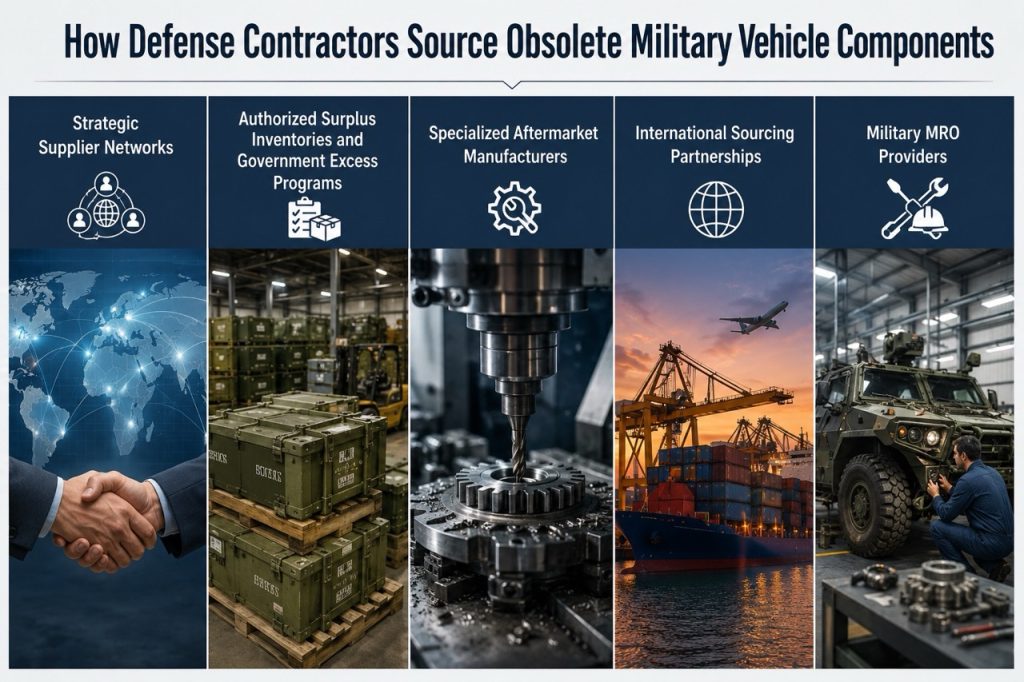
Successful sourcing of obsolete military components is not a single transaction. It is an ecosystem of relationships, strategies, and capabilities that experienced defense suppliers build and maintain over years. The following approaches represent the core of how professional defense logistics organizations address this challenge.
Strategic Supplier Networks
The most capable defense spare parts suppliers have built global networks of qualified sub-tier manufacturers, surplus dealers, and independent maintenance organizations over years of operation. These networks are not directories. They are managed relationships with vetted partners who can be called upon when a specific component need emerges. A supplier with strong network depth can locate inventory that does not appear in any public database, simply because they have established the right contacts in the right places.
Authorized Surplus Inventories and Government Excess Programs
When military organizations retire vehicles or reduce fleet sizes, the associated spare parts often enter government surplus channels. Programs that manage and distribute excess defense material provide one legitimate source of certified, original components. Defense contractors with experience in these channels can identify relevant surplus stocks, verify component condition and provenance, and acquire parts that would otherwise be unavailable through commercial channels.
The key distinction here is traceability. Surplus components obtained through authorized channels come with documentation that can be verified. They are not anonymous parts from unknown origins. This matters enormously for quality assurance and counterfeit prevention.
Specialized Aftermarket Manufacturers
A significant segment of the defense supply chain consists of manufacturers who specialize in producing low volume, high complexity components for legacy military platforms. These companies invest in tooling, certifications, and engineering expertise specifically to serve sustainment markets that OEMs have abandoned. For mechanical components such as drive shafts, hull fittings, suspension arms, or transmission housings, specialized aftermarket manufacturers can often reproduce parts to original specifications using modern precision manufacturing methods.
The critical differentiator between a reliable aftermarket supplier and an unreliable one comes down to documentation, engineering rigor, and quality system maturity areas that professional defense logistics providers evaluate carefully before placing any order.
International Sourcing Partnerships
Many military platforms are operated by multiple nations, and the component supply chain for widely fielded vehicles often extends across multiple countries. A component that is discontinued in one national market may still be in active production or held in inventory somewhere else. Defense contractors with established international partnerships particularly in NATO logistics circles can leverage these connections to identify sources that domestically focused organizations might never find.
Long term agreements with international partners also create supply continuity for critical components. Rather than sourcing reactively when a need arises, experienced defense logistics providers establish framework arrangements that guarantee access to specific components across a defined period.
Military MRO Providers
Organizations providing maintenance, repair, and overhaul services for military vehicles accumulate component inventory and technical expertise as a byproduct of their operations. MRO providers who have serviced specific platforms for years often hold stocks of serviceable removed components, overhauled assemblies, and exchange units that represent a secondary supply channel for hard to find parts. Building relationships with established MRO organizations is a standard element of a mature obsolescence management strategy.
Reverse Engineering and Approved Reproduction
When no original component can be located through surplus, aftermarket channels, or international sourcing reverse engineering offers a path to producing a functionally and dimensionally equivalent replacement. This is not a shortcut. When done properly, it is a rigorous engineering process that requires significant expertise.
When Reverse Engineering Is Appropriate
Reverse engineering becomes a viable option when original technical documentation such as engineering drawings, material specifications, or manufacturing process records is unavailable. It is also used when existing documentation is incomplete or when a component design needs to be adapted for manufacture using currently available materials or processes.
The decision to pursue reverse engineering should always be made with careful consideration of the regulatory and intellectual property landscape. For components that were originally developed using government funding, the IP situation may be more straightforward. For proprietary OEM designs, more complex legal and contractual considerations apply.
The Engineering Validation Process
A credible reverse engineering program begins with thorough dimensional verification of original parts using precision measurement equipment. Material analysis including spectrographic analysis, hardness testing, and metallurgical examination establishes the correct material grade and heat treatment requirements. Where surface coatings, plating, or sealing treatments are present, they are identified and specified.
Once a reproduction design has been established, first article inspection (FAI) procedures verify that manufactured samples conform to all specified dimensions and material properties. Functional testing under simulated operating conditions validates that the reproduced component performs equivalently to the original in service.
Quality Assurance and Documentation Requirements
Reproduced components require the same documentation standards as any other defense component: material certificates, inspection records, test results, and certificates of conformity (CoC). The complete manufacturing record must be traceable from raw material through to finished component. Any supplier claiming to offer reverse engineered military components without this documentation chain should be treated with significant caution.
Aftermarket Manufacturing for Legacy Military Vehicles
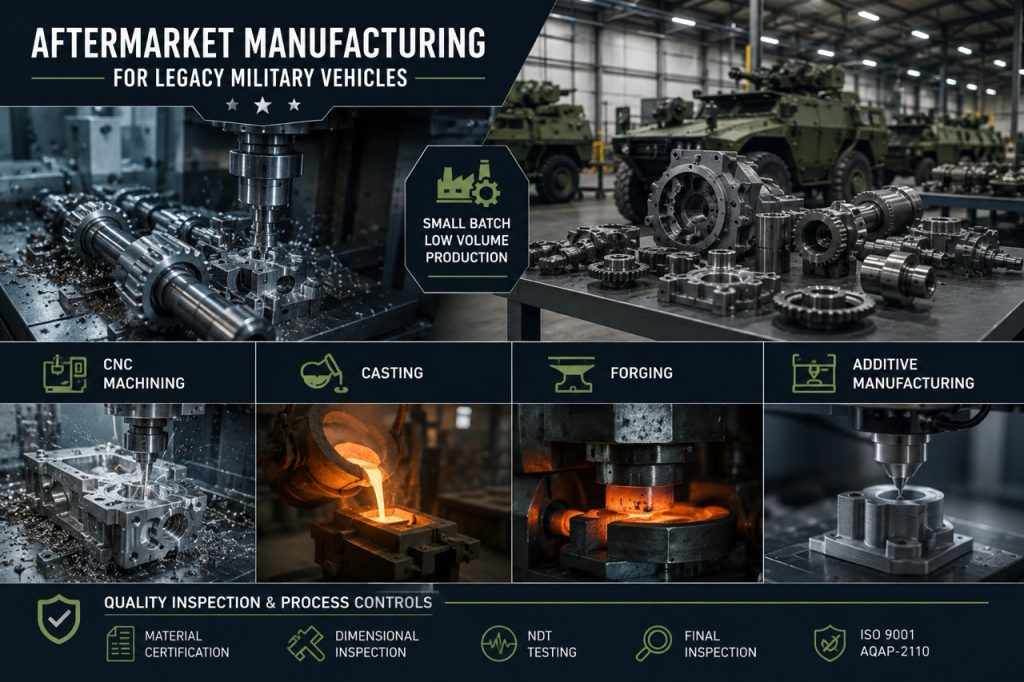
For mechanical components where design documentation exists or can be reconstructed, direct manufacturing offers a reliable path to component supply. Modern manufacturing capabilities have expanded the range of components that can be economically produced in small batches.
Small Batch and Low Volume Production
Defense sustainment volumes rarely justify long production runs. A requirement for 50 or 200 units of a specific casting or machined component is not commercially attractive to most manufacturers. Specialized defense suppliers have built business models specifically around this reality, investing in flexible manufacturing capabilities and accepting the economics of low-volume, high complexity work.
Manufacturing Capabilities Relevant to Defense Components
CNC machining covers the majority of precision mechanical components: shafts, housings, brackets, flanges, and structural fittings. Investment casting and sand casting are used for complex geometry components where machining from solid would be prohibitively expensive. Forging is appropriate for high strength structural components that must withstand significant impact or fatigue loads. Additive manufacturing is beginning to find application in the production of prototype components, non structural parts, and tooling though its use in load bearing military applications remains subject to rigorous qualification requirements.
Quality Inspection and Process Controls
Defense grade aftermarket manufacturing requires documented quality control procedures at every stage. Incoming material certification, in process dimensional checks, non destructive testing where applicable, and final inspection with full dimensional reporting are minimum expectations. Suppliers operating under ISO 9001 quality management systems provide a baseline of procedural discipline. Those operating under AQAP-2110 or equivalent NATO quality assurance standards provide a higher level of assurance specifically tailored to defense production requirements.
The Importance of Traceability and Quality Assurance
Counterfeit components represent one of the most serious risks in the military spare parts market. A counterfeit or substandard component installed in a tactical vehicle does not simply cause a maintenance problem it can cause mission failure, equipment damage, or loss of life. The defense supply chain has historically been targeted by counterfeit parts suppliers precisely because the demand for hard to find components creates pressure to accept alternative sources without adequate scrutiny.
Professional defense suppliers counter this risk through disciplined traceability and quality assurance practices.
Documentation Standards
Every component supplied for military vehicle sustainment should be accompanied by a complete documentation package. This includes the material test report (MTR) confirming raw material composition and mechanical properties, dimensional inspection records, applicable test results, and a certificate of conformity signed by an authorized quality representative. For components produced under an approved quality system, the CoC links back to the specific quality plan and inspection records applicable to that production lot.
Lot Tracking and Supply Chain Transparency
Traceability extends beyond the component itself to encompass the full supply chain from raw material to delivery. Lot numbers and heat numbers allow any quality issue identified in service to be traced back to its origin. This is not administrative overhead it is the mechanism that allows a fleet manager to isolate a potential quality problem before it propagates across multiple vehicles.
Supplier Qualification and Audit Programs
Defense buyers should require that their spare parts suppliers operate formal supplier qualification programs covering their own sub tier supply chain. A quality system that only addresses what happens inside a supplier’s own facility does not adequately manage the risk introduced by external manufacturing partners. Approved vendor lists (AVL) and periodic supplier audits are standard tools for maintaining supply chain integrity.
Inventory Strategies That Prevent Fleet Downtime
The most effective responses to component obsolescence are proactive rather than reactive. Fleets that wait until a component is needed to begin sourcing will inevitably face extended downtime while suppliers locate or manufacture replacements. Organizations that implement strategic inventory management significantly reduce this exposure.
Critical Component Identification
Fleet managers should maintain a continuously updated register of components that have entered or are approaching end of life status. For each critical component, the register should include current stock levels, estimated consumption rates, identified supply sources, and lead times. Components with long lead times and high mission criticality warrant the most aggressive inventory building.
Safety Stock and Demand Forecasting
Statistical demand forecasting based on historical consumption data, fleet size, and operational intensity provides the foundation for safety stock calculations. For obsolete components where consumption data may be limited, subject matter expert judgment and conservative safety factors are appropriate supplements. The cost of holding excess inventory for a critical component is almost always lower than the cost of fleet downtime while waiting for emergency sourcing.
Long Term Procurement Agreements
Where a reliable supply source for a critical component exists, long-term procurement agreements lock in supply and often reduce unit costs through volume commitments. These agreements should include provisions for minimum delivery quantities, quality standards, documentation requirements, and escalation mechanisms. Multi year frameworks with trusted suppliers provide the supply continuity that reactive, spot-market procurement cannot.
Multi Source Procurement and Supply Chain Resilience
Dependence on a single source for any critical component introduces unacceptable risk. Developing qualified secondary sources for high priority parts takes time and investment, but it is essential insurance against supply disruption. Organizations that have diversified their sourcing for critical components are significantly better positioned to maintain operational readiness when a primary source experiences production problems, business disruptions, or quality issues.

Best Practices for Defense Procurement Teams
Evaluating a spare parts supplier for military vehicle sustainment requires more than price comparison. The following criteria represent the considerations that experienced procurement teams apply when building their supplier base.
- Engineering capability: Can the supplier provide technical analysis, reverse engineering services, and first article documentation or do they simply resell what is already in the market?
- Quality system maturity: Does the supplier operate under ISO 9001, AQAP, or equivalent standards? What does their internal quality process look like in practice?
- Documentation completeness: Are certificates of conformity, material test reports, and inspection records provided as standard? What does a sample documentation package look like?
- Supply chain transparency: Can the supplier identify and qualify their sub tier manufacturing partners? Do they conduct supplier audits?
- Logistics and delivery capability: Can the supplier meet required delivery timelines? What are their typical lead times for aftermarket manufactured components versus stock items?
- Lifecycle support experience: Has the supplier worked with the specific vehicle platforms in the customer’s fleet? Do they understand the technical requirements and operational context?
- Long term partnership potential: Is the supplier oriented toward building ongoing relationships, or toward transactional spot sales?
Reducing single source dependency and building a diversified network of qualified suppliers across different categories mechanical, electronic, hydraulic, structural is the foundation of a resilient fleet sustainment program.
Future Trends in Military Component Obsolescence Management
The defense sustainment landscape continues to evolve, and several emerging capabilities are beginning to reshape how obsolescence is managed.
Digital Supply Chains and Predictive Analytics
Defense organizations are increasingly investing in digital sustainment platforms that integrate vehicle maintenance data, component consumption records, and supply chain status into unified management tools. Predictive analytics applied to maintenance records can identify components approaching failure before they are removed, allowing proactive procurement rather than emergency sourcing. This shift from reactive to predictive supply chain management has the potential to significantly reduce the disruption caused by obsolescence events.
Additive Manufacturing at Point of Need
While additive manufacturing has not yet reached the maturity required for most structural military applications, its role in sustainment is expanding. For non-structural components, jigs, tooling aids, and prototype development, 3D printing is already in use across several defense maintenance organizations. As material certifications and qualification processes for additively manufactured defense parts mature, this technology will increasingly complement traditional manufacturing methods for legacy component supply.
Digital Twins and Lifecycle Modeling
The concept of the digital twin a continuously updated virtual model of a physical system offers defense fleet managers a powerful tool for obsolescence forecasting. By modeling the expected service life and failure modes of every major component across a fleet, digital twin systems can generate forward looking demand signals for obsolescence prone parts years before actual failures occur. Several advanced defense programs are integrating digital twin capabilities into their sustainment architectures.
Collaborative Sustainment and Regional Logistics Hubs
Among NATO allies and allied nations operating common platforms, there is growing recognition that collaborative sustainment offers efficiencies that individual national programs cannot achieve alone. Shared inventory management, coordinated long-term procurement, and regional logistics hubs serving groups of allied users can spread the cost of maintaining supply for legacy components across a wider user base. The NATO Support and Procurement Agency (NSPA) model represents one established framework for this kind of collaborative approach.
Sustainment is a Strategic Capability
Acquiring a military vehicle is a procurement event. Sustaining it across 30 or 40 years of operational service is an ongoing strategic commitment that requires planning, expertise, and relationships that most organizations underestimate at the outset.
Component obsolescence is not a problem that can be solved once and filed away. It evolves continuously as technologies age, suppliers exit the market, and platforms remain in service long past anyone’s original projections. The organizations that manage this challenge successfully keeping their fleets operational, their readiness rates high, and their maintenance budgets predictable share a common characteristic: they treat spare parts sourcing as a strategic function, not an administrative one.
Successful defense sustainment depends on maintaining continuous access to reliable obsolete components through qualified sourcing partners, strategic inventory management, engineering expertise, and resilient global defense supply chains. Whether that means investing in aftermarket manufacturing relationships, building strategic inventory for critical components, or developing reverse engineering capabilities for truly orphaned parts, the underlying principle is the same: operational readiness is built not just on the platforms themselves, but on the infrastructure that keeps them running.
For defense procurement officers, fleet managers, and government acquisition agencies evaluating their sustainment approach, the question is not whether obsolescence will affect their fleets. It will. The question is whether they will meet that challenge with a plan or manage it as a crisis.
Work With AB Defence
AB Defence operates as a specialized international supplier of military spare parts and fleet sustainment solutions, serving defense procurement organizations, military logistics managers, and armed forces across NATO and allied nations. With a rigorous approach to quality assurance, full documentation traceability, and deep technical expertise across a broad range of military vehicle and equipment platforms, AB Defence is structured to meet the demanding standards that defense procurement officers rightly require.
Whether you are managing aging fleet sustainment, sourcing critical components against compressed timelines, or seeking a long-term supply chain partner with genuine defense industry expertise, AB Defence offers the technical capability, compliance framework, and operational reliability that defense supply chains depend on.
Contact AB Defence today to discuss your procurement requirements and learn how we can support your fleet readiness objectives.
Related Military Spare Parts Categories, Vehicle Platforms & Technical Guides
Explore AB Defence’s NATO-codified (NSN) and genuine OEM spare parts catalog, platform technical specifications, and sustainment engineering guides related to this article:
Stocked Spare Parts Categories (NSN & OEM Catalog)
- NATO Standard Defence Components & Military Hardware (12,993 stocked parts)
- M60 Tank Spare Parts (M60A1 / M60A3 / M60T) (497 stocked parts)
- M109 Self-Propelled Howitzer Spare Parts (585 stocked parts)
- BMC Kirpi MRAP Spare Parts (Kirpi I & Kirpi II) (597 stocked parts)
- Mercedes-Benz Unimog Military Spare Parts (562 stocked parts)
- Full NATO NSN & OEM Spare Parts Catalog (16,760+ Parts)
Compatible Vehicle Platforms & System Hubs
- Platforms
- Product Groups
- Quality
- Capabilities
- Tracked Armoured Vehicles
- Request a B2B Quotation (RFQ) & Technical Support