June 1, 2026
The Hidden Risks of Unverified Military Spare Parts in Defense Operations
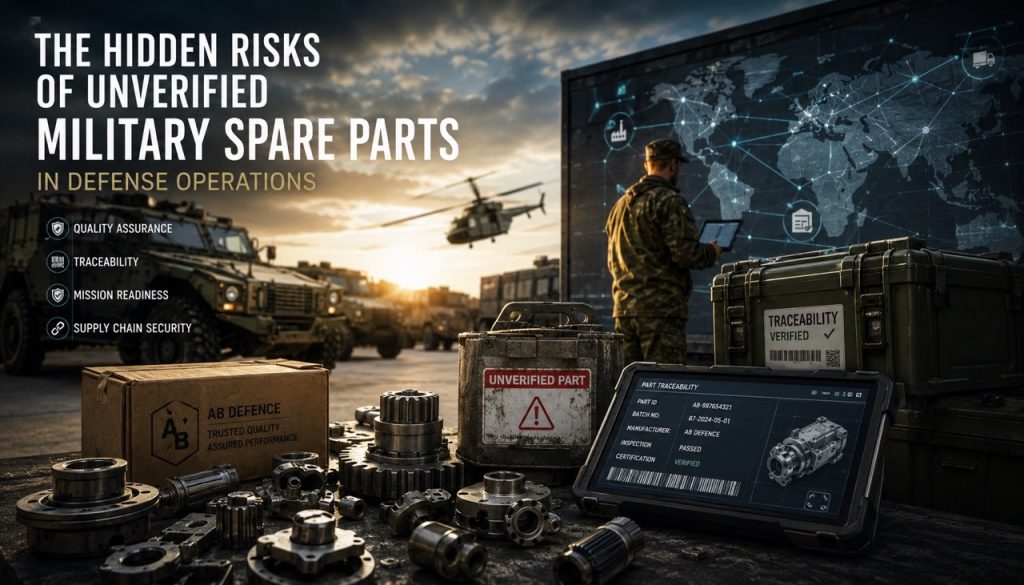
Modern armed forces operate some of the most demanding and high-stakes machinery ever engineered. From main battle tanks and mine-resistant ambush protected (MRAP) vehicles to tactical trucks and military aviation ground support platforms, every system depends on thousands of individual components performing reliably across extreme environmental conditions, variable maintenance cycles, and unpredictable operational demands.
The increasing globalization of manufacturing, the fragmentation of defense supply chains, and growing pressure on defense budgets have opened pathways for unverified, non-traceable, and counterfeit components to enter military inventories. The consequences can range from increased maintenance costs and reduced fleet availability to mission failure and risk to personnel safety.
This article examines the full spectrum of risks associated with unverified military spare parts, explains why verification and traceability are operational necessities, and provides practical guidance for defense procurement officers, fleet sustainment managers, and military logistics professionals working to protect the readiness and integrity of their fleets.
What Are Unverified Military Spare Parts?
The term “unverified military spare parts” encompasses a broader category of components than is sometimes appreciated within procurement environments. Understanding the distinctions between different types of parts is the first step toward building effective risk management strategies.
Definitions
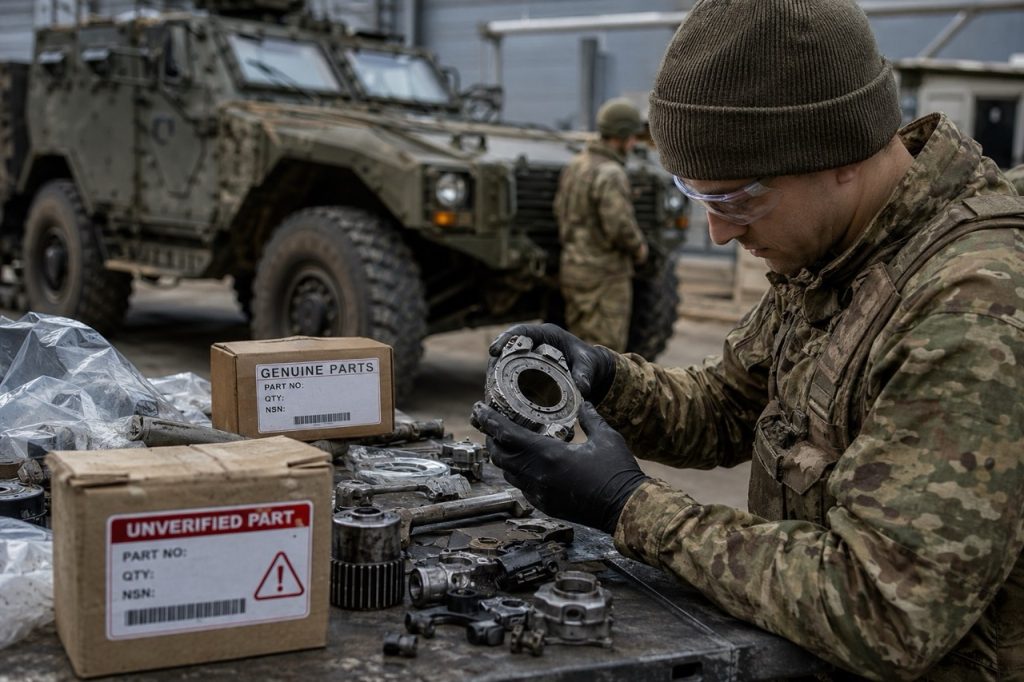
Unverified parts are components that have not been confirmed as meeting the technical, material, or quality requirements specified for a given military system or platform. The lack of verification may relate to the manufacturing process, the materials used, dimensional tolerances, surface treatments, or heat treatment specifications any of which can critically affect component performance under operational loads.
Non-traceable parts are components that cannot be tracked back to their point of manufacture, the batch from which they came, the raw materials used, or the quality inspection records generated during production. Traceability is not simply a documentation requirement; it is the mechanism by which quality issues can be identified, contained, and investigated.
Counterfeit components are parts that have been fraudulently represented as genuine, certified, or OEM-compliant products. Counterfeiting in defense supply chains is a well-documented global problem. The U.S. Government Accountability Office (GAO) and NATO logistics bodies have flagged counterfeit components as a persistent risk across both military vehicle and aviation supply chains. Counterfeit parts may be physically indistinguishable from genuine components but may be manufactured from inferior materials or to incorrect tolerances.
Unauthorized aftermarket parts are components manufactured outside the original equipment manufacturer’s (OEM) authorized supply base without proper licensing, approval, or validation against the original specification. While some aftermarket production is legitimate and certified, unauthorized aftermarket production lacks the engineering validation and quality oversight required for safety-critical military applications.
Parts with incomplete documentation are components that may have been manufactured correctly but for which the supporting documentation certificates of conformity, material test reports, inspection records, batch numbers is absent, incomplete, or cannot be independently verified.
Key Distinctions in Procurement Environments
OEM (Original Equipment Manufacturer) parts are produced by or under license from the original designer of a given platform or component. They are manufactured to validated specifications, supported by full documentation, and backed by the manufacturer’s quality management system. For defense applications, OEM parts typically carry the highest level of assurance.
Authorized aftermarket parts are produced by third-party manufacturers operating under formal agreements with the OEM or the relevant defense authority. They are validated against the original specification and produced under a quality management system that has been audited and approved. For many legacy platforms where OEM supply has become constrained or unavailable, authorized aftermarket production represents a legitimate and valuable source of supply.
Reverse-engineered parts are produced by copying the physical dimensions and apparent material composition of an existing component without access to the original design documentation, material specifications, or manufacturing process data. Reverse engineering in a defense context is highly regulated. Parts produced through reverse engineering without formal design authority approval and independent validation cannot be considered equivalent to OEM or authorized aftermarket components, regardless of how closely they may physically resemble the original.
The confusion between these categories is a recurring challenge in defense procurement, particularly for legacy platforms where OEM support has declined and procurement officers are under pressure to locate and qualify alternative supply sources. This pressure, while understandable, creates conditions in which unverified components can enter the supply chain.
Why Verification Matters in Defense Operations
Military systems are engineered to perform under conditions that far exceed the demands placed on civilian equivalents. A military utility vehicle may be required to operate continuously across extreme temperature ranges, over heavily degraded terrain, under combat loads, and without access to depot level maintenance facilities for extended periods. The components within that vehicle must deliver reliable performance across those conditions not nominal performance under ideal conditions.
Reliability in this context is not an abstract quality standard. It is the operational foundation on which mission planning, logistics calculations, and force deployment depend. A fleet whose components have an uncertain or unverified quality status introduces variability into readiness calculations that commanders and logistics planners cannot effectively manage.
Interoperability across NATO and allied defense organizations adds a further dimension. When components must meet defined NATO STANAGs (Standardization Agreements) or national defense specifications, the use of non-verified parts that may not conform to those standards creates interoperability risks that extend beyond the individual platform to the broader alliance logistics framework.
Critical Documentation Requirements
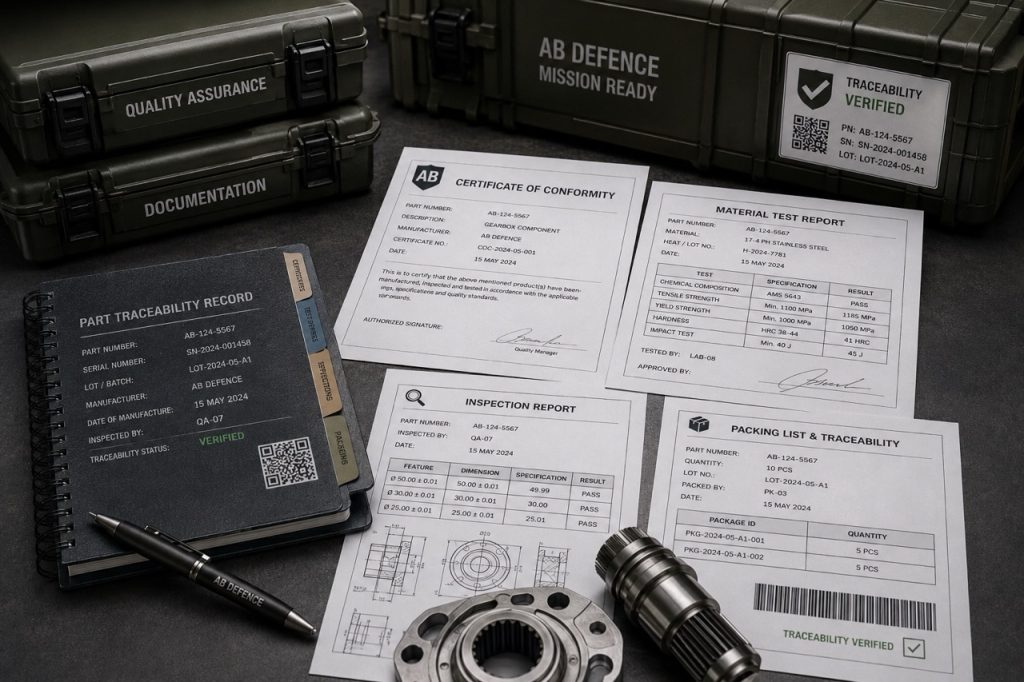
For a spare part to be considered verified for defense use, it must typically be supported by a defined set of documentation, the most important of which include:
- Certificate of Conformity (CoC): A formal declaration by the manufacturer that the supplied components conform to the applicable specification, drawing, or contract requirement. A CoC should identify the specific contract, part number, revision status, quantity, batch or lot number, and the quality standard under which the products were manufactured and inspected.
- Material Test Reports (MTR): Certificates provided by the material manufacturer confirming the chemical and mechanical properties of the raw material used in component production. MTRs are particularly critical for structural components, fasteners, and any part subject to cyclic or impact loading.
- Batch and Lot Traceability Records: Documentation that enables a specific component to be traced back to the production batch from which it originated, enabling targeted withdrawal or inspection if a quality issue is identified post-delivery.
- Manufacturing and Process Records: Documentation of the production processes, heat treatments, surface finishes, and dimensional inspections applied to a component during manufacture.
- First Article Inspection (FAI) Reports: For new sources of supply, FAI documentation demonstrates that the initial production lot meets the dimensional, material, and functional requirements of the specification before series production commences.
- Inspection and Test Records: Evidence of the quality control inspections and functional tests applied to the specific batch of components being supplied.
Applicable Quality Frameworks
The defense industry operates within a well defined quality framework that sets requirements for both suppliers and their supply chains. The most relevant standards and frameworks include:
NATO AQAP Standards: The Allied Quality Assurance Publications (AQAP) series particularly AQAP-2110 (quality assurance requirements for design, development, and production), AQAP-2120 (production quality), and AQAP-2130 (inspection and test) define quality management requirements for NATO defense contracts. Compliance with the applicable AQAP standard is a contractual requirement for suppliers to NATO member nation defense organizations in most cases.
ISO 9001: The international standard for quality management systems provides the foundational framework within which AQAP requirements are built. ISO 9001 certification is typically a minimum requirement for military spare parts suppliers, though AQAP compliance imposes additional defense specific requirements beyond ISO 9001.
National Defense Procurement Frameworks: Individual NATO member nations maintain their own defense quality assurance frameworks, such as the UK’s Defence Standard 05-061 and equivalent national standards, which define additional requirements for suppliers to national defense programs.
Learn More About the Platforms
The Hidden Risks of Unverified Military Spare Parts
The risks introduced by unverified military spare parts are rarely immediately apparent. Unlike an incorrect part that is obviously the wrong size or clearly incompatible, an unverified component will often fit correctly, function acceptably under initial conditions, and pass a basic visual inspection. The failure mode, when it occurs, is typically delayed appearing under stress, over time, or in the specific conditions that reveal material or manufacturing deficiencies. The following sections examine each category of risk in detail.
1. Mission Failure and Reduced Operational Readiness
Fleet readiness the percentage of vehicles or platforms available and fully mission-capable at any given time is a primary performance metric for military logistics and fleet management organizations. The introduction of unverified parts creates a hidden variable in readiness calculations that can manifest as unexpected component failures, unplanned maintenance events, and reduced availability at precisely the moments when full readiness is most critical.
A single failed component can ground a vehicle or platform entirely. In tactical environments, vehicle recovery may not be immediately available, and the cascading effects of one immobilized vehicle on convoy security, route management, and mission timelines can be significant. In a fleet context, if unverified parts from a common procurement event have been installed across multiple vehicles, the failure of one component may indicate that an entire cohort of vehicles requires immediate inspection and potentially preventive replacement a major unplanned maintenance event that can significantly degrade fleet availability.
Defense organizations operating under formal readiness reporting frameworks such as the U.S. Department of Defense’s Defense Readiness Reporting System (DRRS) or equivalent NATO national systems will see the direct impact of unverified part failures in their readiness metrics, affecting resource allocation, deployment planning, and operational commitments.
The U.S. Government Accountability Office has repeatedly highlighted spare parts quality and traceability as factors affecting military vehicle fleet readiness in published reports, underscoring the systemic nature of this risk across major defense organizations.
2. Safety Risks for Military Personnel
The most serious risk associated with unverified military spare parts is the direct threat to the safety of the personnel who operate, crew, and maintain the platforms on which those parts are installed. Unlike commercial vehicle applications where a component failure may result in a roadside breakdown, military platform failures can occur in hostile environments, under combat loads, or in situations where the ability to stop, evacuate, or recover is severely constrained.
Safety critical systems are particularly vulnerable:
- Brake Systems: Military vehicles operating in mountainous terrain, conducting convoy operations on steep gradients, or performing emergency stop maneuvers depend on brake components that perform consistently and predictably. Brake components manufactured from substandard materials or to incorrect tolerances may perform adequately during normal operations but fail under high temperature, high load conditions precisely when reliable braking performance is most critical.
- Suspension Components: The suspension systems of military vehicles are engineered to manage the combination of high vehicle weight, rough terrain, and dynamic loading conditions. Unverified suspension components particularly springs, control arms, and suspension pivot pins may be manufactured from materials with inadequate fatigue life, leading to premature failure and loss of vehicle control.
- Electrical and Electronic Systems: Modern military vehicles incorporate sophisticated electrical architectures. Counterfeit or substandard electrical components can cause unpredictable failures in power distribution, communications, fire suppression, or active protection systems.
- Fuel and Hydraulic Systems: Seals, hoses, and fittings that do not meet the material specifications for the fluid types, pressures, and temperature ranges they must handle can fail in ways that create fire risks or sudden loss of hydraulic function in critical systems.
- Powertrain Components: Unverified engine, transmission, and driveline components can fail suddenly and without warning, particularly under the sustained high-load conditions that characterize military vehicle operations in demanding terrain.
The consequences of safety critical component failures in military contexts from vehicle rollovers due to suspension failure to brake failures on steep mountain routes represent an unacceptable risk that verified, traceable, and properly documented supply chains are specifically designed to prevent.
3. Increased Lifecycle Costs
The economic argument for procuring unverified military spare parts is almost always based on a comparison of unit purchase price. An unverified component may appear to offer a 20%, 30%, or even 50% cost saving compared to an OEM or authorized aftermarket equivalent. However, this comparison captures only the acquisition cost and ignores the significant additional costs that unverified components introduce across the platform lifecycle.
Repeat repairs represent one of the most direct additional cost items. Components that fail prematurely require additional labor for removal and replacement, additional parts to perform the re repair, and additional vehicle downtime. If a brake component that should have a service life of 40,000 kilometers fails at 15,000 kilometers due to substandard material, the total cost of the replacement cycle including labor, parts, and downtime may significantly exceed the cost of having used the correct component initially.
Unplanned downtime generates costs that extend beyond the direct maintenance expense. Vehicle downtime in a military context may require mission replanning, the reallocation of other vehicles to cover operational commitments, and the engagement of recovery and field maintenance teams. These indirect costs are rarely captured in basic parts procurement cost comparisons.
Additional inspections triggered by a suspected quality issue across a fleet cohort can consume significant maintenance labor resources. If an investigation determines that a batch of unverified parts has been installed across 50 vehicles, the cost of inspecting, testing, and potentially replacing those components across the entire cohort can be substantial.
Inventory inefficiencies arise when unverified parts that fail prematurely create irregular consumption patterns that disrupt inventory planning. Defense logistics systems depend on accurate mean time between failure (MTBF) data to plan stock levels and procurement cycles. Parts that fail outside predicted parameters distort these calculations and can lead to stockouts, excess inventory, or emergency procurement requirements all of which carry additional cost.
Premature platform retirement or major overhaul can result in extreme cases where unverified components cause damage to surrounding systems or structures. A failed unverified bearing that seizes and damages a transmission housing, or a substandard hydraulic hose that fails and degrades a hydraulic actuator, can generate repair costs orders of magnitude greater than the value of the original component.
4. Supply Chain Traceability Failures
Traceability the ability to trace a component back through the supply chain to its source is not simply a quality administration requirement. It is a fundamental risk management tool that enables defense organizations to identify, contain, and respond to quality issues in a systematic and timely manner.
When a quality issue is identified with a specific batch of components whether through in service failure, inspection findings, or a supplier notification traceability data enables defense logistics organizations to quickly identify which vehicles in which units received components from the affected batch, prioritize inspections based on operational criticality, coordinate targeted withdrawals and replacements, and conduct failure analysis to determine root cause and prevent recurrence.
Without adequate traceability documentation, none of these steps can be executed efficiently. An organization that has installed unverified parts lacking batch traceability cannot determine which vehicles are at risk. It must either accept the risk of continued operation or conduct a fleet wide inspection a costly and disruptive undertaking that could have been avoided with proper documentation.
Traceability is also essential for warranty claims, incident investigations, and legal proceedings arising from equipment failures. The absence of verifiable documentation linking a failed component to its manufacturer, batch, and inspection records creates significant challenges in determining liability and securing compensation for defective supply.
5. Regulatory and Compliance Exposure
Defense procurement is conducted within a framework of contractual, regulatory, and standards-based obligations that exist to protect both operational effectiveness and the integrity of the public procurement process. The introduction of unverified spare parts into a defense supply chain can create compliance exposure at multiple levels.
At the contract level, defense supply contracts typically specify the quality standards to which supplied components must conform, the documentation that must accompany deliveries, and the supplier qualification requirements that must be met. The supply of components that do not meet these requirements constitutes a contract breach, with potential financial and legal consequences.
At the regulatory level, defense procurement organizations in NATO member nations are subject to national defense acquisition regulations and oversight frameworks. Non compliant parts can trigger audit findings, procurement holds, and reporting obligations to national defense authorities.
At the NATO standardization level, equipment destined for joint operations or NATO assigned force structures may be required to meet specific STANAG requirements. The use of unverified or non-compliant components can create interoperability and certification challenges that affect a nation’s ability to contribute equipment to NATO operations.
Export control regulations add a further dimension. Many defense components are subject to export control regulations including the International Traffic in Arms Regulations (ITAR) in the United States and equivalent national frameworks that impose strict requirements on the traceability and authorization of component movements across international borders. Unverified components with unclear supply chain histories can create export control compliance risks.
6. Counterfeit Component Infiltration
Counterfeit components represent the most insidious category of unverified military spare parts because they are specifically designed to deceive. Unlike a part that is simply non conforming due to manufacturing limitations or inadequate quality control, a counterfeit component is produced and presented with the deliberate intent to misrepresent its origin, specification compliance, and quality status.
The global market for counterfeit industrial and defense components is significant and well-documented. Reports from defense procurement oversight bodies in multiple NATO member nations have identified counterfeit components entering military supply chains through both direct procurement from fraudulent suppliers and through multi tier supply chains where the counterfeit introduction occurs several levels removed from the defense customer.
The increasing complexity of defense supply chains with OEM production distributed across multiple countries, authorized distributors operating in global markets, and procurement officers often unable to conduct direct supplier audits creates conditions in which counterfeit component infiltration is a persistent and evolving risk.
The identification of counterfeit components is technically challenging. Surface markings, packaging, and physical dimensions may closely match genuine components. Detection typically requires material analysis, dimensional inspection against original specifications, and documentation verification checks that are rarely applied to every incoming component in a high-volume supply operation.
The aerospace industry, which faces similar challenges, has developed the AS9120 standard specifically for distributors of aerospace components, addressing traceability and counterfeit prevention. Defense organizations can draw on the principles embedded in these aerospace standards when developing counterfeit prevention programs for military vehicle and equipment supply chains.
The Impact on Military Vehicle Sustainment
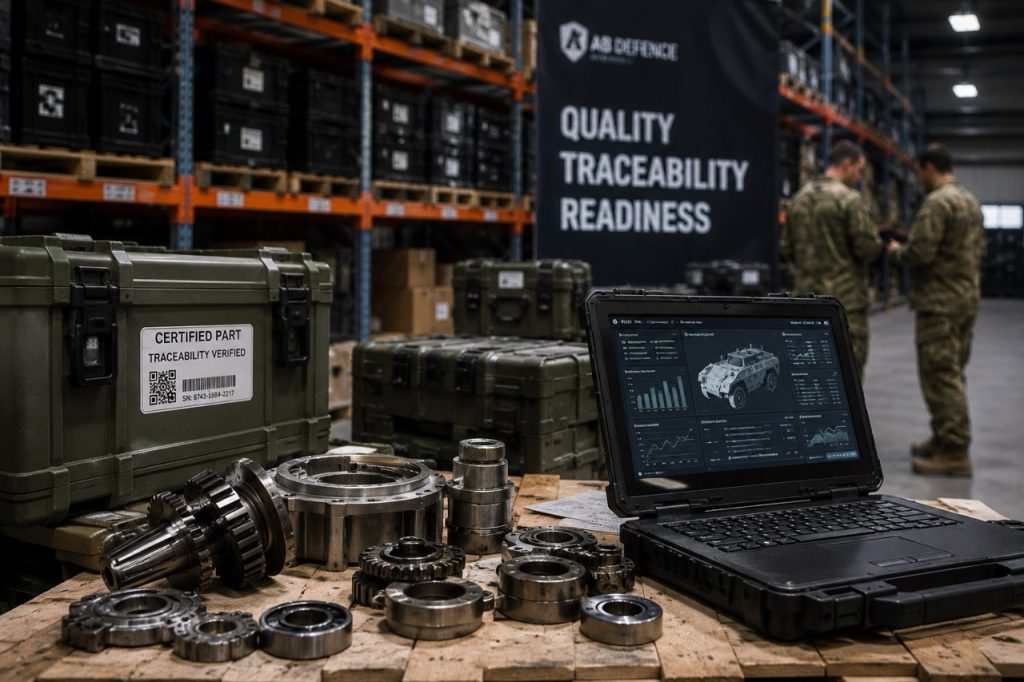
Military vehicle fleets represent some of the most demanding sustainment challenges in defense logistics. The diversity of platforms from main battle tanks and infantry fighting vehicles to tactical trucks, MRAPs, armored personnel carriers (APCs), and wheeled logistics vehicles combined with extended operational lifecycles and increasingly constrained OEM support for legacy platforms, creates an environment where the risks associated with unverified spare parts are particularly acute.
Armored vehicles and infantry fighting vehicles operate under some of the most demanding conditions of any ground vehicle. Their drive systems, suspension components, and power packs are subject to sustained high load operation in harsh terrain. The use of unverified components in these systems particularly in running gear, transmission, and suspension directly affects both operational availability and crew safety.
MRAP (Mine Resistant Ambush Protected) vehicle fleets, procured in large quantities by multiple NATO nations over the past two decades, present specific sustainment challenges. Many MRAP platforms are now approaching the end of their originally planned service lives but are being retained in service through life extension programs. For legacy MRAP platforms, OEM parts supply is often constrained or discontinued, creating strong incentives to source components from alternative suppliers. The risk of unverified components entering MRAP fleets through alternative sourcing is consequently elevated, and the safety implications — given the vehicle’s primary function of protecting occupants from blast and ballistic threats are significant.
Tactical trucks and wheeled logistics vehicles form the backbone of military mobility and supply chain operations. Their high operational tempo and large fleet sizes mean that maintenance volumes are significant, creating both a higher volume of spare parts procurement and a correspondingly larger surface area for potential quality risks.
Legacy platform sustainment the maintenance of platforms that have been in service for 20, 30, or even 40 years represents the greatest challenge in managing unverified spare parts risk. For legacy platforms, original technical documentation may be incomplete, OEM production may have ceased, and the supply base may consist entirely of reverse-engineered or aftermarket components of varying quality and traceability status. Effective lifecycle management for legacy platforms requires investment in design authority review, re-qualification of alternative sources, and rigorous incoming inspection not simply acceptance of whatever parts are available at the lowest unit price.
How Leading Defense Organizations Reduce Spare Parts Risk
Leading defense organizations and their prime contractors have developed systematic approaches to managing spare parts quality risk. These approaches operate across the full procurement lifecycle, from initial supplier qualification through receipt inspection and in service monitoring.
Supplier Qualification Programs
Formal supplier qualification programs establish the criteria that a supplier must meet before being approved to supply components for a specific program or category of components. Qualification typically involves assessment of the supplier’s quality management system (including ISO 9001 and applicable AQAP compliance), manufacturing capabilities and process controls, documentation and traceability systems, inspection and test capabilities, and past performance on comparable programs.
Qualification is not a one-time event. Leading programs require periodic re-assessment typically on an annual or biennial basis to confirm that suppliers maintain the standards on which their qualification was based, and to identify any changes in ownership, manufacturing capability, or quality system status that might affect supply quality.
Approved Vendor Lists (AVL)
An Approved Vendor List is the practical output of a supplier qualification program: a controlled register of suppliers whose qualifications have been assessed, documented, and approved for specific component categories. Procurement of components outside the AVL requires a defined waiver or new qualification process, preventing opportunistic sourcing from unqualified suppliers.
Maintaining an effective AVL requires active management including regular review of supplier performance data, periodic re qualification audits, and a clear process for suspending or removing suppliers whose performance falls below acceptable standards.
Documentation Verification
Every delivery of defense spare parts should be accompanied by a defined documentation package, and that package should be verified before components are accepted into inventory. Verification checks should confirm that the Certificate of Conformity references the correct contract, part number, and revision status; that Material Test Reports are provided for material-critical components; that batch and lot numbers are consistent across all documentation; and that the documentation is authentic and has not been altered.
Defense organizations with high spare parts volumes may implement risk-based documentation review procedures, with enhanced scrutiny for safety critical components, new suppliers, or parts categories with a history of quality issues.
Incoming Inspection Procedures
Physical inspection of incoming spare parts provides an additional layer of protection against non-conforming and counterfeit components. Incoming inspection programs for defense spare parts typically include dimensional verification against drawing requirements for critical features; visual inspection for surface finish, marking, and packaging consistency; material verification testing such as portable XRF (X-ray fluorescence) analysis for components where material certification cannot be independently verified; and functional testing for components where operational performance can be verified at incoming inspection.
Multi-Source Procurement Approaches
For critical spare parts categories, maintaining two or more qualified sources of supply reduces both supply continuity risk and the commercial pressure that can arise from single source dependence. Dual or multi source procurement requires investment in qualification of additional suppliers but provides resilience against supply disruption and reduces the risk of cost escalation or quality deterioration from a single dominant supplier.
Strategic Inventory Planning
Adequate safety stock of critical and long lead spare parts reduces the urgency pressure that can lead to acceptance of unverified components during supply emergencies. Strategic inventory planning based on accurate mean time between failure data, deployment schedules, and supply lead times enables defense organizations to manage their spare parts requirements systematically rather than reactively.
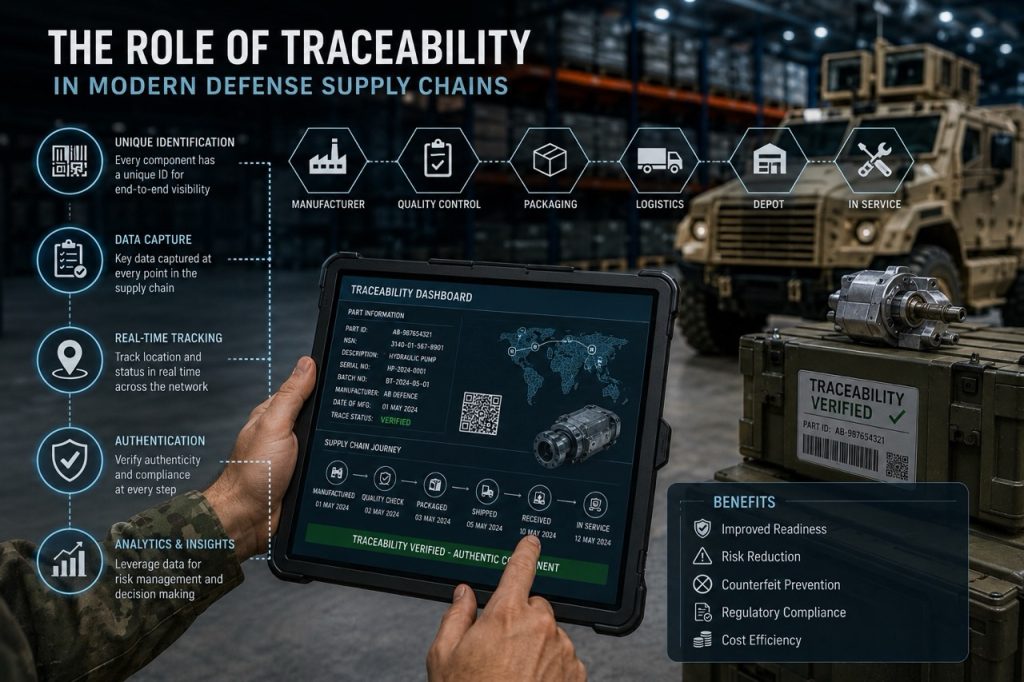
The Role of Traceability in Modern Defense Supply Chains
Traceability has evolved from a documentation formality to a core enabler of modern defense supply chain management. As defense supply chains have grown in complexity spanning multiple tiers of suppliers across multiple countries the ability to track the provenance, quality status, and location of individual components has become a strategic capability rather than an administrative function.
Digital supply chain systems are increasingly being adopted across defense programs to capture, store, and share traceability data across the supply chain in real time. These systems enable end to end tracking of components from raw material through manufacturing, inspection, distribution, and installation, creating a complete and auditable history for every component in the fleet.
Serialization the assignment of unique identifiers to individual components enables component level traceability that extends beyond batch level records. Serialized components can be tracked throughout their operational life, enabling condition based maintenance approaches, accurate remaining life calculations, and targeted recalls if quality issues are identified.
Batch control systems provide the practical foundation for most defense spare parts traceability programs. By maintaining batch level records of production, inspection, and distribution, defense logistics organizations can quickly identify the scope of exposure when a quality issue is identified and take targeted corrective action rather than conducting costly fleet wide investigations.
Blockchain technology is being explored in a number of defense and aerospace supply chain programs as a mechanism for creating immutable, distributed traceability records that cannot be altered after the fact. While blockchain based supply chain applications are still in relatively early stages of adoption in defense contexts, the potential for creating tamper-proof provenance records for critical components has attracted attention from defense procurement organizations in several NATO nations.
Predictive logistics capabilities, enabled by the integration of component performance data with supply chain and maintenance management systems, are emerging as a further evolution of traceability based supply chain management. By correlating component performance data with supply chain provenance information, predictive logistics systems can identify quality trends in specific supply batches before they result in field failures, enabling proactive rather than reactive quality management.
Checklist: How Defense Buyers Can Verify Military Spare Parts Suppliers
The following checklist provides practical guidance for defense procurement officers, fleet sustainment managers, and logistics professionals evaluating spare parts suppliers. Each item represents a key verification criterion that should be assessed before approving a supplier for defense spare parts supply.
Documentation and Traceability
- Does the supplier provide full Certificates of Conformity (CoC) referencing the applicable specification, part number, revision status, and batch/lot number with every delivery?
- Are Material Test Reports (MTR) provided for material-critical components, traceable to the specific heat or batch of raw material used?
- Does the supplier maintain batch and lot traceability records that enable individual components to be traced back to their manufacturing batch, material source, and inspection records?
- Is the supplier’s documentation system independently audited and verified as part of their quality management system certification?
Quality Certifications and Standards
- Does the supplier hold current ISO 9001 certification from an accredited certification body?
- Where required by contract, does the supplier comply with the applicable NATO AQAP standard (AQAP-2110, AQAP-2120, or AQAP-2130)?
- Does the supplier have quality certifications specific to the component types being procured (e.g., AS9120 for aerospace standard distribution, EN/AS quality standards for specific component categories)?
- Are the supplier’s quality certifications current and verified directly with the issuing certification body?
Manufacturing and Process Capability
- Has the supplier demonstrated manufacturing capability through a First Article Inspection (FAI) process against the applicable drawing or specification?
- Does the supplier maintain documented and controlled manufacturing process records, including heat treatment, surface treatment, and dimensional inspection records?
- Has the supplier’s manufacturing capability been assessed through an on-site audit or survey by the defense customer or an authorized representative?
Past Performance
- Does the supplier have verifiable past performance supplying components of the same or similar category to defense or regulated industrial customers?
- Is reference information available from previous defense customers regarding supply quality, delivery performance, and responsiveness to quality issues?
- Has the supplier had any significant quality notifications, delivery holds, or contract terminations on previous defense programs?
Supply Continuity and Emergency Response
- Does the supplier maintain adequate inventory or production capacity to fulfill forecast defense requirements on standard lead times?
- Does the supplier have demonstrated capability to fulfill emergency or expedited requirements when operationally necessary?
- Does the supplier have contingency plans for supply disruption events, including alternative material sources and manufacturing redundancy?
Export Compliance and Technical Support
- Does the supplier have established export compliance procedures, including familiarity with ITAR, EAR, and applicable national export control frameworks?
- Can the supplier provide technical support for specification queries, application questions, and failure investigation support?
- Does the supplier maintain a clear escalation pathway for quality and delivery issues, with named points of contact for defense customers?
Future Trends in Defense Spare Parts Verification
The field of defense spare parts verification is evolving rapidly, driven by advances in digital technology, increasing recognition of supply chain risk at the policy level, and growing investment by NATO and allied nations in defense supply chain resilience.
Digital Traceability Systems
The transition from paper based to fully digital traceability systems is accelerating across the defense sector. Digital platforms that capture component provenance data at the point of manufacture and maintain that data through distribution, receipt inspection, and installation enable real time traceability visibility that paper-based systems cannot provide. Defense programs increasingly specify digital traceability requirements in procurement contracts, creating commercial incentives for suppliers to invest in compatible systems.
AI Assisted Supply Chain Monitoring
Artificial intelligence and machine learning applications are being developed to analyze supply chain data for anomalies that may indicate quality risks or counterfeit component infiltration. AI assisted monitoring can identify unusual patterns in documentation, pricing, or supply routes that may warrant enhanced inspection or investigation, providing a scalable tool for supply chain risk management in high volume procurement environments.
Increased NATO Standardization
NATO’s logistics community, through the NATO Support and Procurement Agency (NSPA) and the Conference of National Armaments Directors (CNAD), continues to develop and strengthen standardization frameworks for defense supply chain quality and traceability. Increased NATO standardization reduces interoperability risks and creates common quality frameworks that facilitate the sharing of supplier qualification data and best practices across alliance member nations.
Growing Emphasis on Supply Chain Resilience
The experience of defense supply chain disruptions accelerated by global events of the past decade has elevated supply chain resilience to a policy priority across multiple NATO nations. Defense industrial base strategies published by the United States, United Kingdom, France, Germany, and other NATO members identify supply chain diversification, domestic production capacity, and strategic stockpiling as priorities. This policy shift creates both commercial and regulatory incentives for defense organizations to invest in robust supplier qualification and spare parts traceability programs.
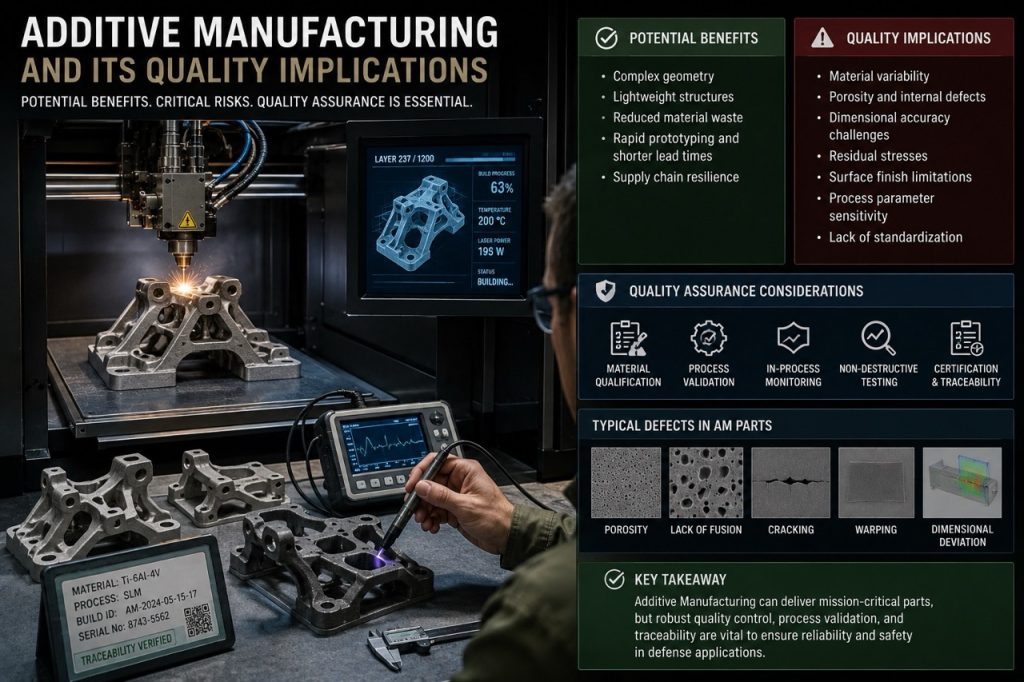
Additive Manufacturing and Its Quality Implications
Additive manufacturing (3D printing) is increasingly being explored as a solution for legacy spare parts supply, particularly for components where OEM production has ceased. While additive manufacturing offers real potential for solving legacy parts supply challenges, it also introduces new verification requirements. Components produced through additive manufacturing must be validated against the original design intent a process that requires access to original design data, material specifications, and qualified additive manufacturing processes. The procurement of additively manufactured spare parts without adequate verification of the manufacturing process and material properties represents a form of unverified supply that carries similar risks to other categories of non verified components.
In modern defense operations, the true cost of an unverified military spare part is rarely the purchase price. The real cost appears when readiness declines, missions are delayed, equipment fails unexpectedly, or personnel safety is compromised. Effective verification, traceability, and supplier qualification are no longer administrative requirements they are operational necessities that directly support military readiness and long-term fleet sustainment.
The risks examined in this article from mission failure and personnel safety threats to increased lifecycle costs, traceability failures, regulatory exposure, and counterfeit infiltration are well documented and avoidable. They are avoidable not through greater spending on spare parts per se, but through greater investment in the quality and traceability frameworks that ensure the parts procured are what they purport to be.
Defense procurement officers, fleet sustainment managers, and military logistics professionals who build robust supplier qualification programs, maintain rigorous documentation verification practices, and invest in digital traceability capabilities are not adding bureaucratic overhead to their operations they are protecting the operational effectiveness, equipment integrity, and personnel safety that their organizations depend upon.
As defense supply chains continue to grow in complexity, and as the consequences of supply chain failure become increasingly visible at the operational level, the organizations that treat spare parts verification as a strategic priority rather than a procurement formality will be best positioned to maintain the fleet readiness, operational sustainability, and mission capability their forces require.
You could contact us for defence spare parts
Related Military Spare Parts Categories, Vehicle Platforms & Technical Guides
Explore AB Defence’s NATO-codified (NSN) and genuine OEM spare parts catalog, platform technical specifications, and sustainment engineering guides related to this article:
Stocked Spare Parts Categories (NSN & OEM Catalog)
- NATO Standard Defence Components & Military Hardware (12,993 stocked parts)
- M60 Tank Spare Parts (M60A1 / M60A3 / M60T) (497 stocked parts)
- M109 Self-Propelled Howitzer Spare Parts (585 stocked parts)
- BMC Kirpi MRAP Spare Parts (Kirpi I & Kirpi II) (597 stocked parts)
- Mercedes-Benz Unimog Military Spare Parts (562 stocked parts)
- Full NATO NSN & OEM Spare Parts Catalog (16,760+ Parts)
Compatible Vehicle Platforms & System Hubs
- Platforms
- Product Groups
- Quality
- Capabilities
- Tracked Armoured Vehicles
- Request a B2B Quotation (RFQ) & Technical Support