April 29, 2026
Why Unimog Platforms Remain Essential in Modern Military Logistics
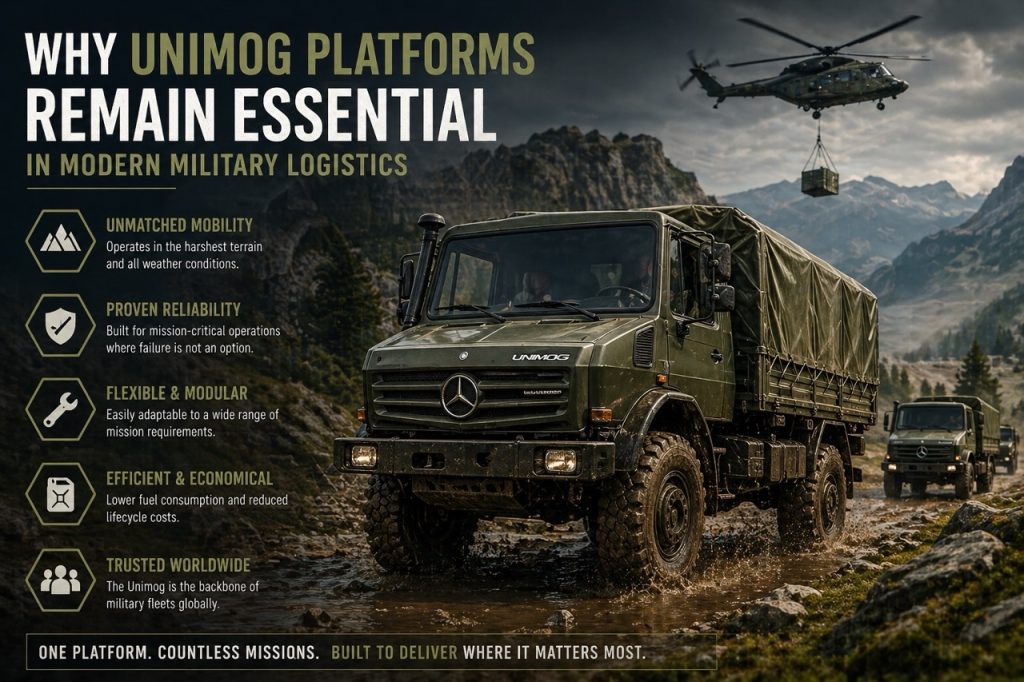
From Agricultural Roots to the Battlefield
The story of the Unimog begins not in a defence ministry but in the ruins of post-war Germany. The first model was designed by Albert Friedrich and Heinrich Rößler shortly after World War II, originally intended to be used in agriculture as a self-propelled machine providing a power take-off to operate saws in forests or harvesting machines on fields. The abbreviation itself reveals this universal ambition: the name Unimog is an acronym for the German “UNIversal-MOtor-Gerät”, Gerät being the German word for machine or device.
Military interest came quickly. Officers of the French Army, then occupying forces in Germany, noted the Unimog during testing in the early 1950s and considered it useful for patrolling purposes. The Unimog proved so successful that Daimler-Benz was ordered to develop an entirely new variant purely for military purposes. That early validation set the tone for seven decades of continuous service across dozens of armed forces.
Engineering That Defined Off-Road Mobility
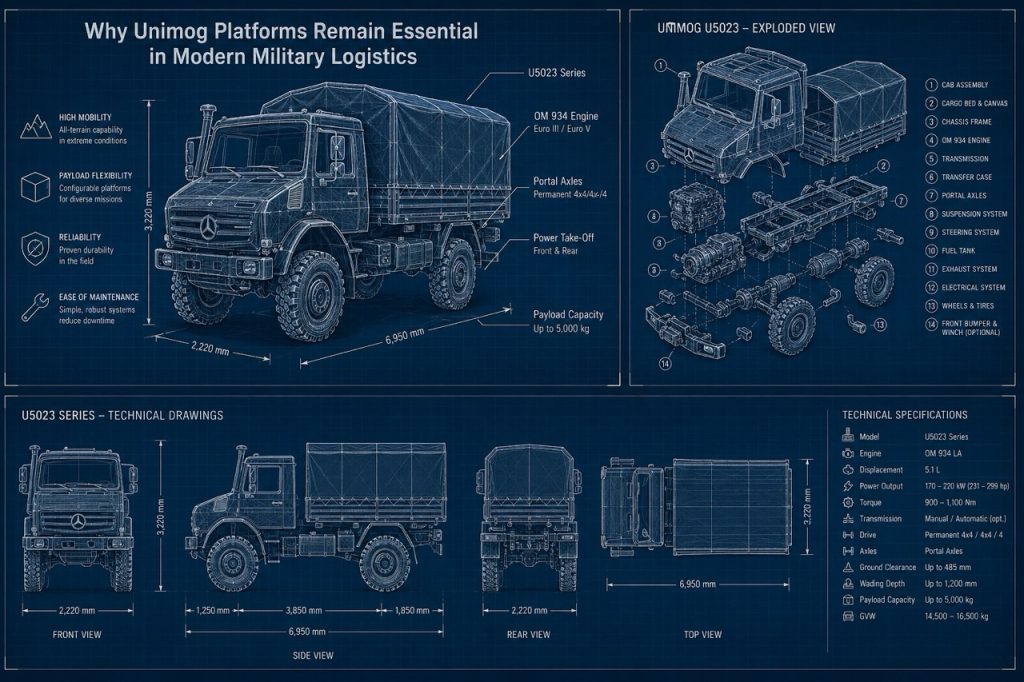
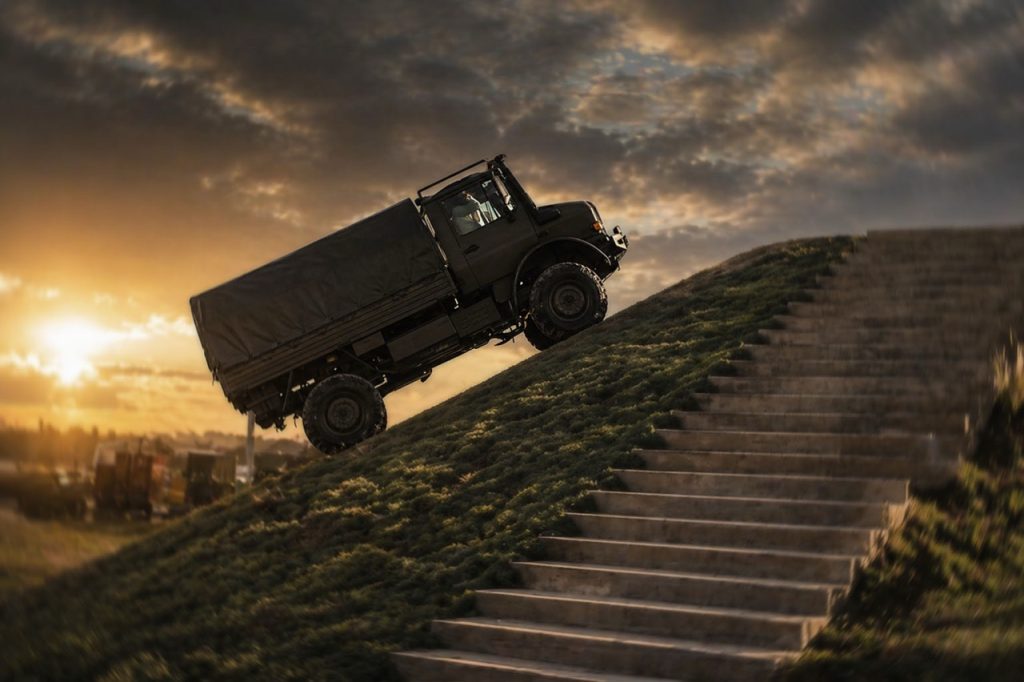
The reason the Unimog has outlasted countless rivals is rooted in a chassis architecture that remains genuinely distinctive. The Unimog’s characteristic design element is its chassis: a flexible ladder frame with short overhangs, and coil-sprung beam portal axles with a central torque tube and transverse links. Having portal axles, the wheels’ centres are below the axle centre, which gives the Unimog a high ground clearance without the need for large tyres.
This is not a trivial advantage in military operations. The coil-sprung axles with torque tubes allow an axle angle offset of up to 30°, giving the wheels a wide range of vertical movement to allow the truck to drive over extremely uneven terrain, even boulders of one metre in height.
The platform also features all-wheel drive, portal axles, and differential locks at both front and rear, combined with provisions for mounting a wide variety of working implements. This combination — off-road capability plus implement-mounting versatility — is precisely what makes the Unimog irreplaceable in forward logistics, where a single vehicle is often expected to perform multiple roles under field conditions.
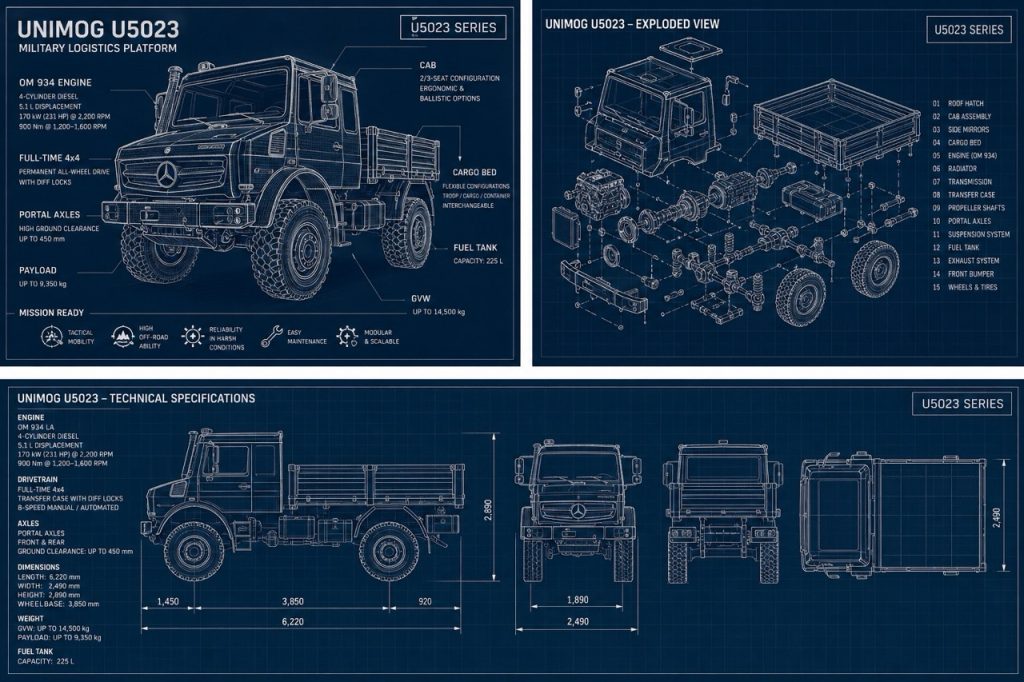
The current heavy military variant, the U5000, reflects how far the platform has evolved technically. The Unimog U5000 is a 4×4 high-mobility tactical military truck with a gross vehicle weight of up to 12,500 kg, a payload capacity between 5,500 and 7,500 kg, and is powered by a water-cooled OM 924 LA turbocharged direct injection diesel engine producing 160 kW, with a top speed of 105 km/h on road. Critically for rapid deployment scenarios, the U5000 can be airlifted inside the cargo compartment of fixed-wing tactical transport aircraft.
A Proven Record Across NATO’s Flanks
The clearest evidence of the Unimog’s continued relevance is found in the procurement decisions of NATO member states, particularly those operating along the Alliance’s more exposed eastern and northern flanks.
Lithuania provides the most comprehensive case study. Lithuania’s military truck expansion in cooperation with NATO was initiated in 2015 as part of the country’s effort to update its fleet, with an initial procurement of 88 Unimog U5000s. Follow-on contracts delivered a total of 110 systems in 2019 and another 142 in 2020, with approximately 70 more platforms accepted between 2021 and 2023.
This process has continued without interruption. In September 2024, the Defence Materiel Agency under Lithuania’s Ministry of National Defence signed a contract for an additional 51 Unimog U5000 trucks through the NATO Support and Procurement Agency (NSPA), with the contract valued at EUR 47 million. In total, over 170 Mercedes-Benz Unimog U5000 trucks have been purchased under the supplemented contract since 2021.
Lithuanian commanders have been explicit about why the platform earns this sustained investment. As the Lithuanian Armed Forces Depot Storage Service Commander explained, the trucks demonstrate strong cross-country capacity on both paved and unpaved roads and can ford water obstacles up to 1,200 mm deep — qualities that are genuinely useful during exercises and logistical resupply to hard-to-access sites.
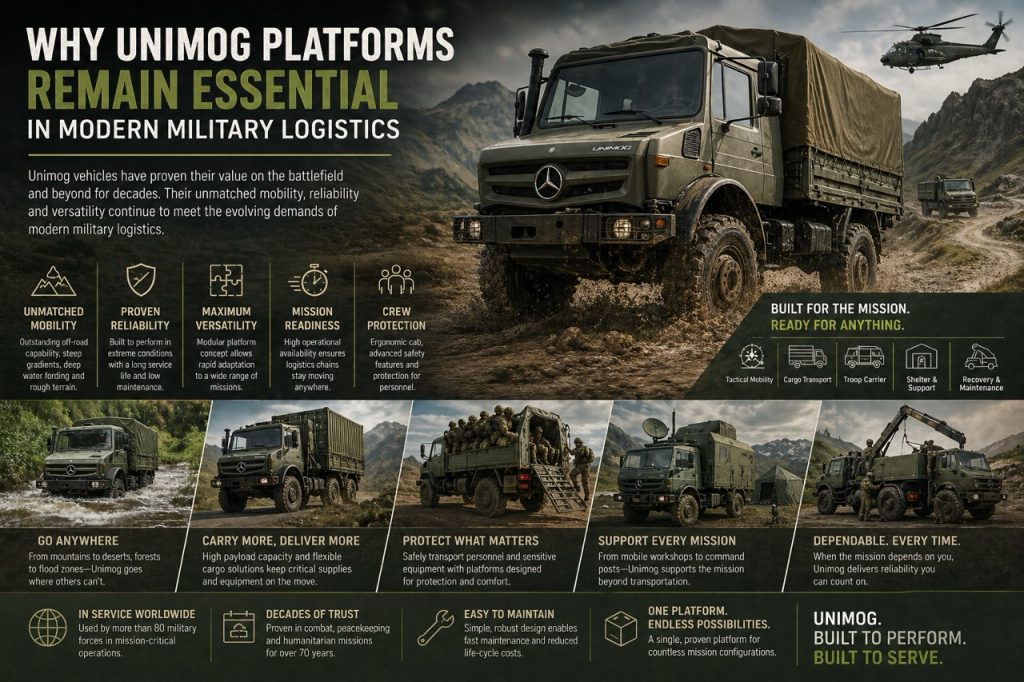
The vehicles serve a wider range of functions than simple cargo transport. The U5000 trucks in Lithuanian service are used for logistical provision, personnel transportation, medical evacuation, and special personnel tasks. That breadth of application — from resupply runs to frontline medical evacuation — reflects how the platform functions as a force multiplier rather than a single-purpose asset.
The Armoured Vehicle Connection
Beyond direct logistics duties, the Unimog chassis has formed the foundation of several armoured vehicle programmes that remain in operational service today. Armoured vehicles developed in Germany using Unimog chassis include the ATF Dingo used by the Bundeswehr in Afghanistan, while the French Aravis mine-protected vehicle is based on the Special Chassis FGA 12.5, itself a military application of the U5000. The Buffel, RG-19, and Mamba armoured personnel carriers from South Africa are also based on the Unimog driveline.
This derivative ecosystem is significant. It demonstrates that the Unimog’s value to military planners extends beyond the vehicle itself; the chassis serves as a trusted engineering foundation for protected mobility solutions, effectively multiplying its strategic relevance across multiple programme categories.
France’s Multi-Billion-Euro Vote of Confidence
Perhaps the most significant recent signal of the Unimog’s durability as a platform came from France. The French defence procurement agency Direction générale de l’armement is reported to have selected Arquus, in partnership with Daimler Truck, as the preferred bidder for the “Flotte tactique et logistique terrestre” programme — a long-term initiative worth approximately 5 billion euros covering up to 7,000 logistics and tactical vehicles.
The scale of that requirement reflects a broader recognition within European armies that logistics depth is a genuine operational vulnerability. Both France’s 2019–2025 and 2024–2030 defence programming laws identify the renewal of up to 7,000 trucks by 2030 as a central objective for the Army’s transformation towards high-intensity operations.
The selection logic is also instructive for understanding the platform’s competitive position. A militarised commercial chassis such as the Unimog already benefits from economies of scale, making it difficult for bespoke designs to match on price, while the combined industrial footprint of Arquus factories in France and Daimler’s major production facilities gives the consortium unmatched production depth. In other words, the Unimog wins not only on technical merit but on industrial reliability and cost efficiency — qualities that matter as much to defence planners as raw performance.
Logistics Support That Spans 160 Countries
Operational readiness in a deployed environment depends not only on what a vehicle can do, but on whether it can be repaired when it fails. This is an area where the Unimog carries a structural advantage that few competitors can match. Daimler Truck operates approximately 5,000 authorised workshops in over 160 countries, providing integrated logistics support whether vehicles are deployed on active missions or in standard use.
For NATO forces conducting multinational operations across unfamiliar territory, that network substantially reduces the risk of vehicles becoming deadlined due to parts or expertise shortages. The same platform that can be procured through the NSPA, assembled in Germany or Turkey, and supported by a global dealer network provides a level of supply chain resilience that bespoke military designs rarely achieve.
Related Military Spare Parts Categories, Vehicle Platforms & Technical Guides
Explore AB Defence’s NATO-codified (NSN) and genuine OEM spare parts catalog, platform technical specifications, and sustainment engineering guides related to this article:
Stocked Spare Parts Categories (NSN & OEM Catalog)
- Mercedes-Benz Unimog Military Spare Parts (562 stocked parts)
- Military Portal Axles, Differentials & Drive Shafts (107 stocked parts)
- Military Gearbox, Transfer Case & PTO Assemblies (108 stocked parts)
- Military Brake Calipers, Master Cylinders & Hydraulic Systems (103 stocked parts)
- Military Engine Cooling Systems, Radiators & Water Pumps (57 stocked parts)
- Full NATO NSN & OEM Spare Parts Catalog (16,760+ Parts)
Compatible Vehicle Platforms & System Hubs
- Unimog U 1300 L (1.5 Ton – 2.5 Ton)
- Unimog U 1500 L
- Unimog U 1700 L
- Unimog U 2150 L
- Unimog U 2450 L
- Request a B2B Quotation (RFQ) & Technical Support
Related Military Engineering & Sustainment Articles
- Unimog Military Spare Parts: What Every Fleet Manager Needs to Know Before Placing an Order
- Unimog Spare Parts for Military Fleets: Why AB Defence Is Your Trusted Supply Partner
- 5 Unimog Components Most Commonly Replaced in Military Operations
- What Are the Most Common Failures in Military Unimog Vehicles?