April 27, 2026
M113 Modernization vs Replacement: What Defense Buyers Need to Consider
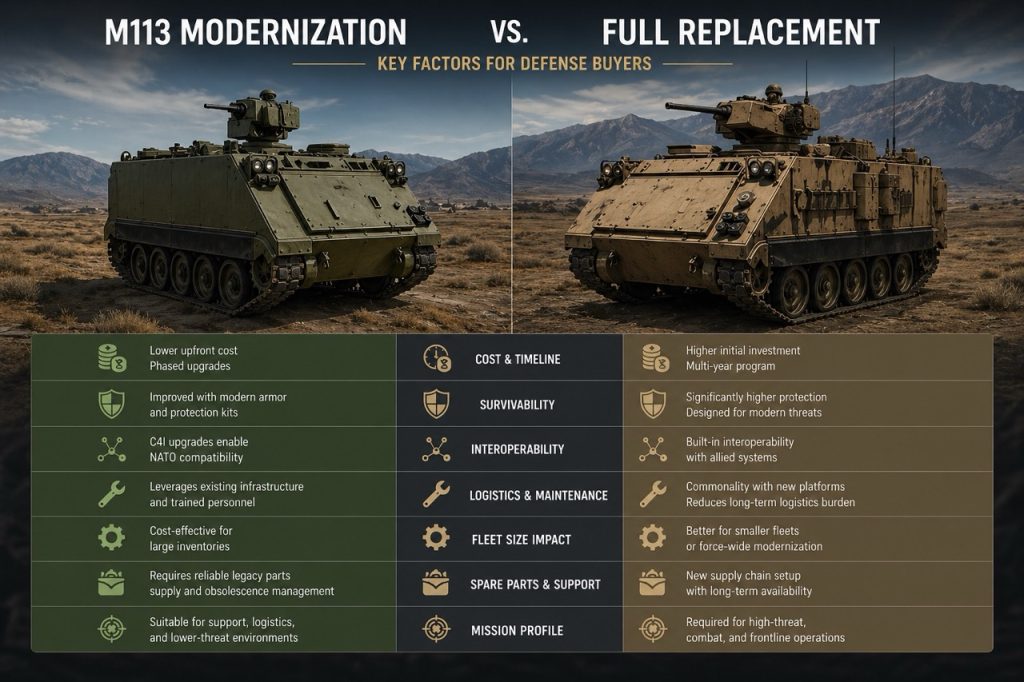
The M113 armored personnel carrier has served military forces across the globe for more than six decades. With over 80,000 units produced and used by more than 50 countries, it became a symbol of mechanized infantry forces for decades. Today, defense procurement officers and logistics managers face a critical fork in the road: invest in modernizing existing M113 fleets or commit to full platform replacement? The answer is rarely straightforward, and the stakes, both financial and operational, are high.
This article examines the key factors defense buyers must evaluate when making this decision, drawing on real-world programs, verified data, and the latest developments in the global defense market.
The M113’s Legacy and Its Current Limitations
The M113 entered service in the early 1960s and quickly became one of the most versatile tracked platforms ever fielded. However, its original design was built for a different era of warfare. In the 1980s, the M2 Bradley replaced the M113 in the front-line transport role, moving it to rear-area roles. In the Iraq War, urban warfare tactics still defeated the M113, leading it to be almost entirely replaced in active service by Mine-Resistant Ambush Protected Vehicles (MRAP).
The armor protection gap is particularly significant. Aluminum alloy is lighter than steel but requires around three times the thickness for an equivalent level of ballistic protection, meaning the armor of the M113 was only designed for 7.62 mm and shell splinter protection. In comparison, modern platforms like the Stryker offer substantially greater ballistic protection on all sides. This fundamental structural limitation is one of the most important factors driving replacement discussions today.
Recent combat experience has reinforced these concerns. The Israel Defense Forces still operates large numbers of the M113, maintaining a fleet of 6,000 of the vehicles. On numerous occasions, the IDF’s M113s have proven vulnerable to modern anti-tank missiles, IEDs, and RPGs. In May 2025, Israel’s Ministry of Defense announced a call for tender to sell 5,000 M-113s in “as is” condition, a clear signal of the platform’s diminishing role in frontline operations.
The Case for Modernization
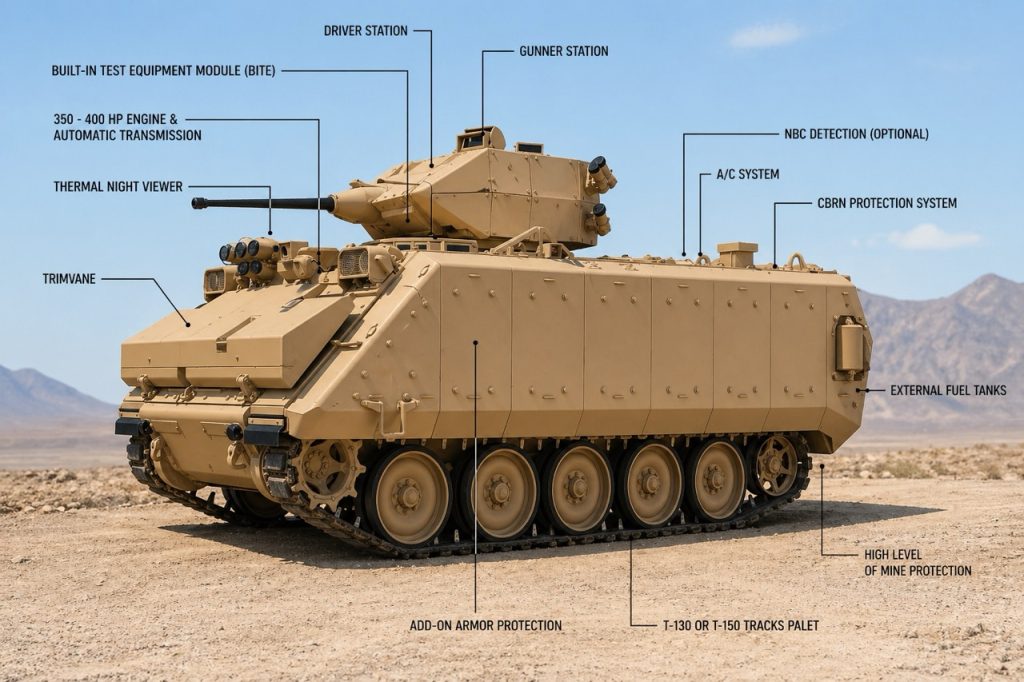
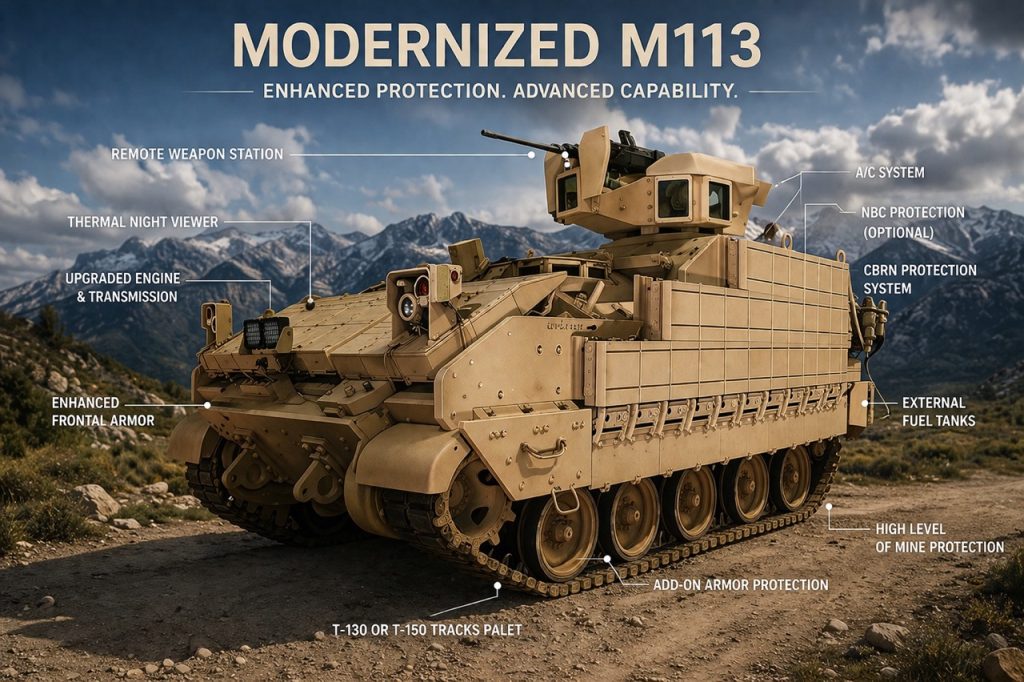
Despite its limitations, the M113 remains operationally relevant for many armed forces, and modernization packages have advanced significantly. At the DEFEA 2025 international defense exhibition in Athens, Israeli defense company Rafael Advanced Defense Systems unveiled a comprehensive modernization package for the globally recognized M113, turning the time-tested platform into a cutting-edge Infantry Fighting Vehicle (IFV).
Crucially, the modernized vehicle has also been upgraded with next-generation C4I (Command, Control, Communications, Computers, and Intelligence) capabilities, enabling real-time battlefield networking and coordination with allied units. This NATO-compatible upgrade ensures interoperability with modern military forces, offering a scalable solution for defense forces across different regions.
From a financial perspective, modernization carries a compelling argument. By leveraging the existing M113 platform, of which thousands remain in global service, armies can achieve significant improvements in lethality, survivability, and operational relevance without committing to the high costs associated with acquiring new-generation IFVs. This cost-effective transformation makes it particularly appealing for nations seeking to enhance their armored capabilities under constrained defense budgets.
For countries operating large M113 fleets, the modernization route also avoids the severe disruption that comes with re-training entire maintenance crews, restructuring supply chains, and procuring all-new logistics infrastructure. The sunk cost of existing parts inventories, tooling, and institutional knowledge is considerable and should factor into any total cost of ownership analysis.
Additionally, improved modernized M113s can receive higher-output engines, new steering systems, and upgraded torsion bars that add to the weight-carrying capability of the vehicle Defense-Update, while enhanced protection suites can provide defense against IEDs, RPGs, and heavy automatic weapons fire.
The Case for Replacement
The U.S. Army’s decision to retire the M113 family is the most documented and closely watched platform transition in modern defense procurement. The AMPV Family of Vehicles is being introduced to replace the older M113 series in the U.S. Army’s Armored Brigade Combat Teams, offering modernized capabilities in survivability, mobility, and interoperability.
The Army originally planned to acquire a total of 2,907 AMPVs. The 3rd Infantry Division is the first of its type to have a fully modernized armored brigade combat team with Abrams SepV3 tanks, M2A4 Bradley infantry combat vehicles, M109A7 Paladin Integrated Management howitzers and AMPVs.
The operational advantages of the AMPV over the M113 are measurable. The AMPV offers a 78% increase in interior volume compared to the M113, as well as improved armor and speed capabilities. The vehicle is equipped with an NBC (nuclear, biological, chemical) protection system, air conditioning, night vision, and a fire suppression system.
From a logistics standpoint, the replacement approach also delivers long-term savings through parts commonality. The AMPV shares common components with the M109A7 Paladin howitzers and Bradley vehicles, including tracks, engines and transmissions, which will reduce the logistical burden on the unit. This kind of fleet standardization reduces the number of unique spare parts that must be stocked, simplifies training, and lowers depot-level maintenance costs over time.
The Spare Parts Equation: A Factor That Shapes Both Paths
Regardless of whether a defense buyer chooses modernization or replacement, the spare parts supply chain is one of the most operationally critical factors in the decision. Unlike most commercial products, military systems remain in service for decades. Over the lifespan of a system, sustainment costs can dwarf the initial procurement, with over 70% of a weapon system’s lifecycle cost incurred in sustainment.
For M113 operators choosing to modernize, access to verified, NATO-standard components is non-negotiable. Engine parts, transmission components, suspension systems, filtration units, and hull structural elements must meet traceability requirements and be available within operationally acceptable lead times. Supply chain disruption is not an abstract risk: aging platforms often face component obsolescence, and sourcing delays can ground entire formations.
Mission criticality means that spare parts must be immediately available, and that means investing in technologies and processes that modernize equipment sustainment. Wichita State University’s National Institute for Aviation Research has successfully created digital twins for critical U.S. Department of Defense assets like the M113 armored personnel carrier, enabling evaluation for additive manufacturing to determine whether parts can be 3D printed. This development signals that the spare parts ecosystem for the M113 is actively evolving, even as some nations move toward replacement.
For buyers on the replacement path, early spare parts planning is equally critical. Supply chain risks and component obsolescence create a severe bottleneck for the global military vehicle sustainment market, directly hampering the ability to maintain aging fleets. Transitioning to a new platform requires building an entirely new parts inventory, qualifying suppliers, and establishing depot-level support structures, all of which take time and capital.
Key Decision Factors for Defense Buyers
When evaluating M113 modernization versus replacement, procurement officers should weigh the following dimensions carefully.
Budget envelope and timeline are the starting point. Full platform replacement is a multi-year, capital-intensive program. FY 2026 procurement for 86 AMPVs alone totals $554.678 million, covering government furnished material, government furnished equipment, kits, field modification hardware, engineering, logistics, and program management. ArmyModernization packages, by contrast, can be phased and scaled to annual budget cycles.
Mission profile determines the survivability threshold. Forces operating in high-threat environments with modern ATGM threats, heavy IED exposure, or urban combat requirements face fundamentally different risk calculations than those using the M113 in support, logistics, or training roles. The modernization ceiling has genuine limits when it comes to protection against peer-adversary weapons systems.
Fleet size affects the economics significantly. Operators with large M113 inventories, say, hundreds or thousands of hulls, can spread modernization costs across a broader base, making per-unit upgrade investments more favorable. Smaller fleets may find that the administrative overhead of managing a legacy platform outweighs the cost of transitioning to a newer system.
Interoperability requirements are increasingly non-negotiable in coalition environments. NATO partners operating alongside U.S. forces, for example, must account for digital battlefield integration, communications compatibility, and shared logistics. Modernization kits that include C4I upgrades address this directly, but buyers should verify compatibility with allied systems before committing.
Parts availability and supplier qualification directly affect operational readiness. Defense buyers should conduct a thorough assessment of their current spare parts pipeline for M113-specific components: engines, transmissions, filtration systems, suspension components, and electronics. If key components are approaching obsolescence or are sourced from a single supplier, this creates strategic risk whether the fleet is being modernized or maintained as-is pending replacement.
What the Ukraine Conflict Has Revealed
The ongoing conflict in Ukraine has generated real-world data on M113 performance under modern warfare conditions. The U.S. Department of Defense announced at the beginning of January 2025 that 900 M-113 armored personnel carriers and 300 armored medical treatment vehicles will be transferred to Ukraine. These transfers have accelerated U.S. Army replacement timelines, as Army Chief of Staff Gen. James McConville stated that the service would not replace equipment sent to Ukraine with “new-old stuff,” but would instead procure next-generation platforms.
The conflict has also highlighted that M113s, while providing basic protection and mobility, struggle against modern anti-armor threats. This combat data is shaping procurement decisions across multiple NATO and partner nations, reinforcing the urgency of both modernization investment and longer-term replacement planning.
The Role of Verified Spare Parts Suppliers in Both Scenarios
Whether a defense force is extending the service life of its M113 fleet or managing a transition period toward a replacement platform, the quality and traceability of spare parts is a constant operational requirement. OEM-standard components, full NSN compatibility, and documented supply chain traceability are baseline expectations in any serious procurement program.
Defense buyers evaluating suppliers should confirm that components meet applicable military specifications, that traceability documentation is complete and auditable, and that the supplier has a demonstrated track record with both wheeled and tracked armored platforms. The ability to support cross-platform requirements, from legacy M113 parts to components for newer tracked systems, is increasingly valuable as many forces manage mixed fleets during transition periods.
Conclusion
The M113 modernization versus replacement decision is not one-size-fits-all. For forces with large fleets, constrained budgets, and missions that do not place vehicles in the highest-threat environments, a well-executed modernization program with modern protection, C4I integration, and a reliable spare parts supply chain can extend operational life significantly and deliver genuine capability gains. For forces operating in high-threat environments, seeking deep interoperability with allied next-generation platforms, or managing force-wide modernization priorities, full replacement is the more strategically sound path, even if the timeline and capital commitment are substantial.
In both cases, the spare parts supply chain is not a secondary concern. It is a mission-critical variable that shapes readiness, cost, and operational continuity from day one. Defense buyers who treat parts procurement as an afterthought to the platform decision consistently face avoidable readiness gaps down the line. Those who integrate verified, NATO-standard parts sourcing into their modernization or transition strategy from the outset are the ones who maintain operational effectiveness through the full program lifecycle.
Related Military Spare Parts Categories, Vehicle Platforms & Technical Guides
Explore AB Defence’s NATO-codified (NSN) and genuine OEM spare parts catalog, platform technical specifications, and sustainment engineering guides related to this article:
Stocked Spare Parts Categories (NSN & OEM Catalog)
- M113 Armored Personnel Carrier (APC) Spare Parts (29 stocked parts)
- M113 Engine & Powerpack Spare Parts (Detroit Diesel 6V53) (20 stocked parts)
- Electrical, Electronic & Vision Systems for Military Vehicles (250 stocked parts)
- Military Engine Cooling Systems, Radiators & Water Pumps (57 stocked parts)
- NATO Standard Defence Components & Military Hardware (12,993 stocked parts)
- Full NATO NSN & OEM Spare Parts Catalog (16,760+ Parts)
Compatible Vehicle Platforms & System Hubs
- M113 Series
- M113 Modernization Program
- YPR-765 Infantry Fighting Vehicle Series
- ACV-300 / ACV-350 Tracked Armoured Vehicle Series
- Tracked Armoured Vehicles
- Request a B2B Quotation (RFQ) & Technical Support