October 12, 2026
Military Vehicle Hydraulic System Failures: Causes, Maintenance and Critical Spare Parts
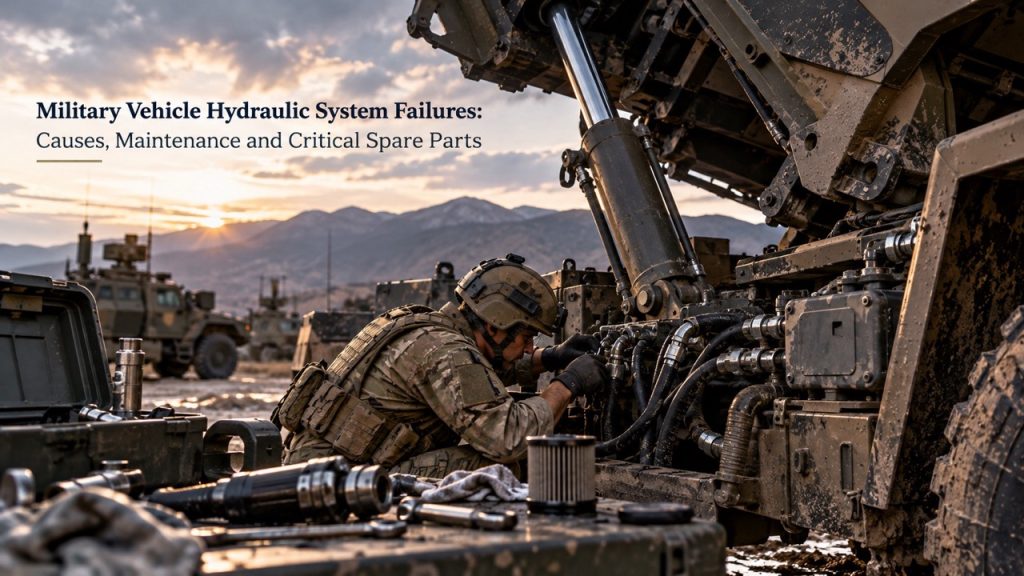
Hydraulic systems
This article covers how military vehicle hydraulic systems fail, how faults are diagnosed, the maintenance practices that reduce failures, and the spare parts questions that matter to procurement and sustainment teams. It is general guidance: hydraulic architecture differs widely between platforms, and the vehicle’s own technical documentation is the authority for fluids, test pressures, intervals and procedures.
How to Read This Guidance
Hydraulic advice mixes four kinds of statement, and they carry different weight.
| Level | Example | How to treat it |
| General engineering principle | Particulate contamination accelerates wear in precision components. | Broadly applicable. Explains why failures happen. |
| Common maintenance practice | Keep the circuit clean whenever hoses are disconnected. | Good practice, but subordinate to the approved procedure. |
| Manufacturer-specific requirement | A fluid or cleanliness target set by a component maker. | Applies only to that component or product line. |
| Vehicle-specific requirement | Test pressure, fluid type or service interval for a given vehicle. | Found only in the vehicle documentation. Always takes priority. |
Vehicle documentation takes priority. Where this article differs from the vehicle technical manual, OEM maintenance documentation or an approved maintenance procedure, the vehicle documentation prevails. For that reason the article gives no test pressures, flow rates, fluid grades, filtration ratings, torque values or service intervals: the required value must be confirmed in the vehicle or component technical manual.
Where Hydraulic Systems Are Used in Military Vehicles
The hydraulic functions on a military vehicle depend on its role. Common applications include steering assistance, braking functions, winches and recovery equipment, lifting and loading equipment and, on armoured platforms, turret movement. AB Defence’s Hydraulics & Mechanical Components range covers pumps, valve blocks, actuators, cylinders, hoses and seals for wheeled and tracked platforms.
Architecture varies with mission, platform configuration and installed equipment. A light tactical truck, a recovery vehicle and a tracked armoured vehicle may share little beyond the physics, so any description of a “typical” system is a prompt to check the specific vehicle’s manual.
Why Military Vehicle Hydraulic Systems Fail
Hydraulic failures usually involve a handful of mechanisms that feed one another. Contaminated fluid wears a pump, the worn pump sheds more debris, and a leaking seal lets in air or dirt. The chain matters because replacing the last component to fail rarely removes the first cause.
Fluid Contamination
Contamination is the best documented problem in military hydraulic fluid. In a 1996 U.S. Army TARDEC field demonstration on M1A1 tanks, fluid drained from vehicles at one site held so much particulate that particle counts could not be determined, with water content around 0.4 percent. The vehicles were still performing normally, yet the authors warned that the contamination left them vulnerable to corrosion and excessive wear that might not yet have appeared as a hydraulic malfunction. The same report found that the main reason used fluid was being discarded was water and particulate contamination, not loss of fluid performance. These findings come from tracked vehicles and one fluid specification: they show that contamination can build unnoticed, not what limits apply elsewhere.
Contamination enters through dust and moisture ingress, wear debris, degraded fluid and maintenance practices that introduce dirt when a circuit is opened. Particles close in size to internal clearances are the ones most likely to score surfaces and jam moving parts.
Incorrect or Degraded Fluid
The wrong viscosity, an incompatible fluid, oxidation, additive depletion and temperature exposure all degrade performance. The TARDEC work adds a nuance: used fluid kept most of its additive performance but lost anti foaming capability, so foaming can signal fluid condition. Fluid contaminated with engine oil, brake fluid or gear oil could not be recovered, mixing two military hydraulic fluids made the result unfit for recycling, and residual detergent in a triple rinsed drum made one batch unusable. The correct fluid for any vehicle is the one named in its technical manual; this article does not recommend one.
Hydraulic Leakage
External leakage is visible and is usually traced to damaged seals, worn hoses, loose or damaged fittings and worn actuator seals. Internal leakage is harder to see: worn pump elements, valves or actuator seals allow fluid to bypass its intended path, so the system loses efficiency without leaving a mark on the ground. Typical consequences are slow or weak actuator movement, drift under load and rising fluid temperature, so internal leakage should be suspected when performance falls but the circuit is dry.
Hose and Fitting Failure
Hoses and fittings fail through abrasion against adjacent parts, ageing, incorrect routing, excessive bending, vibration, heat exposure, damaged reinforcement, improper assembly, incorrect fittings and repeated pressure cycling. Hose standards describe construction and performance classes: SAE J517 covers common hoses for mobile and stationary equipment, and ISO 18752 classifies hoses by pressure class and impulse cycle grade. Adoption of the SAE standards is voluntary, and neither standard defines what a given military vehicle uses; that is set in the vehicle’s parts documentation.
Seal Failure
Seals fail from temperature extremes, pressure, wear, contamination, incorrect installation, surface damage on the mating component and chemical incompatibility with the fluid. Material compatibility is not interchangeable: Parker’s O ring compatibility tables rate nitrile satisfactory in petroleum base hydraulic oil but unsatisfactory in certain phosphate ester fluids, with EPDM showing the opposite pattern. Parker also notes that its published temperature ranges are approximate and that seals should be tested under actual service conditions.
Hydraulic Pump Wear or Failure
Pumps wear through contamination, loss of lubrication, cavitation, inlet restrictions and ordinary service. Symptoms include abnormal noise and reduced flow or pressure, but no single symptom proves a pump has failed. A restricted inlet, low fluid level, air ingress or a clogged breather can produce the same noise and performance loss in a healthy pump.
Cavitation and Aeration
The two are often confused but are not the same. Cavitation is the formation and collapse of vapour cavities when local absolute pressure falls below the fluid’s vapour pressure, typically because a pump demands more fluid than reaches it. The collapse erodes metal surfaces and can contaminate the fluid with metal particles. Aeration is air entering or mixing with the fluid, commonly through leaking suction side fittings or pump shaft seals, and it brings foaming, loss of lubrication, overheating and seal damage. Both can cause noise and erratic movement, but the remedies differ: cavitation points to supply restriction, low level, pump speed, viscosity or cold fluid, while aeration points to an air leak that must be found and sealed.
Valve and Control Component Problems
Directional, pressure control and flow control valves, including solenoid operated types, are sensitive to contamination. Spools can stick, seats can wear and internal leakage can develop, producing slow, erratic or delayed actuator response. On electro hydraulic systems, electrical faults such as supply voltage problems, connector faults or control signal errors can imitate a hydraulic fault, so the electrical side should be checked in sequence before a valve is condemned.
Cylinder and Actuator Failures
Cylinders fail through rod damage, corrosion and scoring that cut through seals, contamination, worn seals that allow internal bypass, external leakage and misalignment that loads the rod and seals unevenly. Internal bypass often appears as drift under load rather than as a visible leak.
Temperature Related Problems
Temperature changes fluid viscosity, seal behaviour, start up conditions and component efficiency. The TARDEC demonstration deliberately used a cold site, a dry dusty site and a hot, humid site, because climate shapes the problems a fleet sees, and cold fluid can contribute to cavitation and aeration. No universal operating range exists; limits come from the fluid, seal and vehicle documentation. Heat problems can also overlap with wider cooling system faults, which AB Defence covers in its guide to military vehicle cooling systems.
Common Symptoms of Hydraulic System Problems
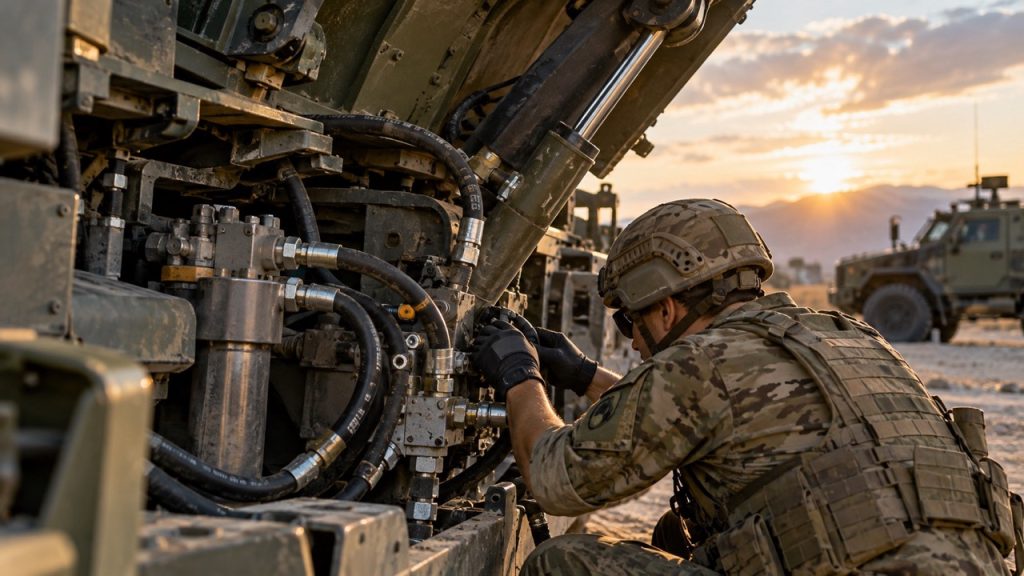
Technicians typically encounter slow or inconsistent actuator movement, reduced steering assistance, abnormal noise, overheating, visible leakage, unstable pressure, actuator drift, foaming, vibration and delayed response. Each has several possible causes. A symptom tells you where to start testing, not which part to replace.
How Hydraulic Faults Should Be Diagnosed
A systematic sequence avoids replacing parts that were never faulty. The order below is general; measurement points, test pressures and test procedures must come from the applicable maintenance manual.
- Review the maintenance history and any recent repairs.
- Identify the exact system and circuit affected.
- Inspect fluid level and condition. Appearance alone is unreliable: in the Army study, fluid looked clear while still holding roughly double the permitted water content.
- Check for visible leakage.
- Inspect hoses and fittings.
- Examine filters and contamination indicators.
- Verify pressure where the manual specifies a test procedure.
- Test flow where required.
- Check fluid temperature.
- Inspect pump operation, including inlet conditions and drive.
- Inspect valves.
- Check cylinders and actuators.
- On electro hydraulic systems, check the electrical controls.
Do not replace components solely on symptoms without confirming the root cause. Follow the manual’s depressurisation and safety procedures before opening any circuit.
Maintenance Practices That Reduce Hydraulic Failures
Fluid Management
Use only the approved fluid, keep it in controlled storage, prevent contamination during filling and avoid undocumented mixing. The Army report’s most important lesson was the need for clean containers: even rinsed drums carried residue that spoiled fluid.
Filtration
Pressure filters, return line filters, suction strainers where fitted, breathers and contamination indicators each protect a different part of the circuit, and each has its own service requirement in the manual. A restricted strainer or clogged breather can itself contribute to cavitation or aeration, so filtration is a maintenance item, not a fit and forget one. No universal micron rating applies; the required filtration is platform specific.
Clean Maintenance Practice
Cleanliness matters whenever a circuit is opened for hose, pump, valve or cylinder work, or when a reservoir is opened. Clean around ports before disconnecting, protect open ports and hose ends with caps or plugs, and keep replacement parts sealed until installation. These are widely accepted practices, not requirements from a specific manual, so the approved procedure governs.
Hose, Seal and Cylinder Inspection
Inspect hoses for abrasion, cracking, blistering, exposed reinforcement, leaks, damaged fittings and improper routing. Inspect cylinder rods for corrosion and scoring, and check seals for leakage and contamination. No universal hose replacement interval exists; criteria and intervals belong to the vehicle’s maintenance schedule.
Scheduled and Condition Based Maintenance
Scheduled inspection and condition based maintenance can both apply, depending on the fleet maintenance programme and the manual. The Army report points to the value of condition data: because fluid cannot be judged by eye, measuring water and particle content is what shows whether fluid is fit for service.
Critical Hydraulic Spare Parts for Military Vehicle Fleets
The exact spare parts list is platform specific, but the categories that matter are consistent, and each is critical for a different reason.
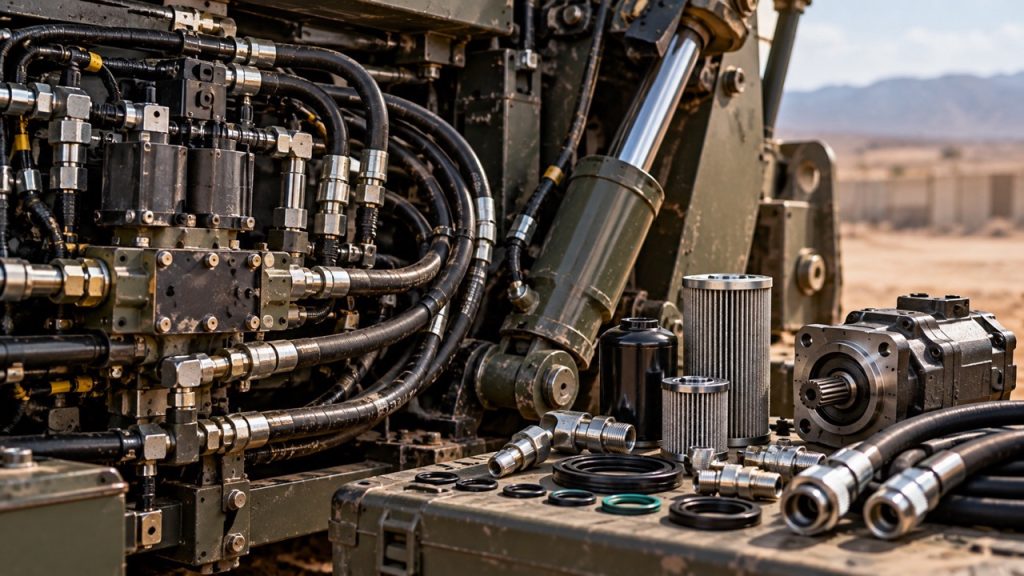
Hoses, assemblies, fittings and adapters are exposed to abrasion, vibration, heat and pressure cycling in service. Seals, O rings and seal kits restore sealing at cylinders, pumps and joints, and a wrong seal can undo an otherwise correct repair. Filter elements are consumables that protect every downstream component; see AB Defence’s Filtration & Fluid Systems range. Pumps, control valves, solenoids and pressure control valves are the functional core of the circuit and include precision components that are sensitive to contamination. Cylinders and their rod and piston seals convert fluid power into motion. Accumulators, reservoir components, pressure and temperature sensors and the approved fluid complete the list where the platform uses them.
Hydraulic Hoses: Why Visual Similarity Is Not Enough
Two hoses that look alike can differ in internal diameter, pressure rating, reinforcement, fitting type, thread, length, temperature rating, bend radius, fluid compatibility and construction. Standards illustrate why: ISO 18752 distinguishes standard and compact hose types with different outside diameters and bend radii, and a hose assembly’s maximum working pressure is governed by its lowest-rated component, including the end fittings. A replacement must therefore be identified from the correct technical documentation and verified against the application, never selected by appearance alone.
Seals and O-Rings: Small Components, Major Consequences
A seal must match dimensions, material, pressure capability, temperature capability and fluid compatibility. An O ring of the correct size is not automatically acceptable: as the compatibility ratings above show, material choice can decide whether a seal lasts or degrades. Seal kits should be matched to the specific component and fluid, using the parts catalogue or component documentation.
Pump Replacement: Diagnose Before Ordering
Reduced hydraulic performance is not always a pump problem. Clogged filters, inlet restrictions, air ingress, a faulty pressure control valve, internal actuator leakage, incorrect fluid and mechanical drive issues can all reduce flow or pressure. Replacing a pump without addressing these causes risks a repeat failure, and accurate diagnosis avoids unnecessary procurement of one of the more expensive assemblies in the circuit.
What to Verify Before Ordering a Hydraulic Spare Part
Part identification should start from the exact vehicle configuration, not a photograph. Before ordering, verify the following where applicable.
| Check group | What to confirm |
| Vehicle | Manufacturer, model, variant, serial number, and VIN or chassis number where relevant. |
| Documentation | Technical manual, illustrated parts catalogue, OEM part number, NSN where officially documented, and any superseded part numbers. |
| Component | Component manufacturer and model, pressure rating, flow requirement, port configuration, thread type and mounting dimensions. |
| Hoses and seals | Hose size, length and connector orientation; seal material. |
| Solenoid-operated valves | Coil voltage and connector type. |
These checks matter because a wrong hydraulic part can fit physically and still fail to perform. Differences in pressure capability, port configuration, seal material, flow characteristics, solenoid electrical specification, dimensions or hose construction may not be visible on inspection, and the consequences range from leakage to poor performance to early failure. Technical documentation should override visual matching. AB Defence’s guide on how to identify the correct military vehicle spare part before ordering covers the identification process in more detail.
Spare Parts Stocking for Fleet Readiness
Inventory should reflect how parts are consumed and how critical they are. Three broad groups are useful. High consumption maintenance items include filters, seals, O rings, selected hoses and common fittings. Repair components include seal kits, solenoids, valves and sensors. Higher value assemblies include pumps, hydraulic cylinders and valve blocks. Stock levels should be set from vehicle population, historical consumption, failure data, mission requirements, supplier lead time, repair capability and platform criticality. Because these inputs differ for every fleet, this article gives no recommended quantities.
Field Repairs and Workshop Repairs
Temporary fault isolation, field level replacement, workshop overhaul and component rebuilding differ in tooling, cleanliness control and authorisation. Field work isolates the fault and replaces authorised items; workshops can test, clean and rebuild components under controlled conditions. All of it must follow authorised maintenance procedures, and improvised repairs are not covered here.
The Role of Contamination Control in Hydraulic Reliability
Contamination control is central because hydraulic components rely on very small clearances. Abrasive particles wear pumps and cylinders, stick valve spools and damage seals, and worn components shed more particles. Cleanliness is commonly expressed with ISO 4406, which codes the level of solid particle contamination using three scale numbers. Required targets are system specific: component manufacturers set their own, and military documents may use different schemes. The Army report, for example, specified fluid cleanliness with SAE AS4059 classes and a separate water limit. A cleanliness figure is therefore only meaningful against the target set for that system.
Procurement Mistakes That Commonly Lead to Wrong Hydraulic Parts
Common procurement errors include ordering by visual appearance, ignoring the vehicle variant, working from incomplete part numbers, overlooking superseded numbers, confusing similar hose fittings, assuming matching dimensions guarantee compatibility, ignoring pressure rating or seal material, and buying for a generic vehicle model instead of the exact configuration. They share one cause: a gap between what a part looks like and what the documentation says it is.
Hydraulic System Reliability and Military Fleet Availability
Contamination control and preventive inspection reduce avoidable failures; correct diagnosis avoids needless component swaps; accurate part identification avoids the delay of receiving a wrong part; and authoritative documentation keeps all of it consistent. Component availability then determines how quickly a confirmed fault is closed out. No readiness figure is claimed here, but each link removes a source of avoidable downtime.
Hydraulic reliability in military vehicles rests on a few disciplines applied consistently: diagnose the root cause before replacing parts, keep the circuit clean, use the correct fluid, maintain filtration, inspect hoses and seals, and identify spare parts from authoritative documentation rather than appearance. For maintenance teams that means treating fluid condition as measurable data. For procurement teams it means a correct hydraulic order begins with the exact vehicle configuration and the technical manual, and ends with verification of every parameter that distinguishes one part from a look-alike.
Work With AB Defence
Partner with AB DEFENCE for Reliable Combat Support Vehicle Sustainment. AB DEFENCE is a specialist international supplier of military spare parts and fleet sustainment solutions serving NATO and allied defense organisations. With deep inventory across a wide range of combat support vehicle platforms, rigorous quality assurance processes, export compliance expertise, and a commitment to long term supply chain partnership, AB DEFENCE helps defense buyers maintain fleet availability, reduce sustainment costs, and meet their operational readiness obligations. Contact the AB DEFENCE team to discuss your spare parts requirements, strategic inventory planning, and long-term sustainment programme needs.
Contact AB Defence to discuss your procurement requirements and learn how we can support your fleet readiness objectives.
Related Military Spare Parts Categories, Vehicle Platforms & Technical Guides
Explore AB Defence’s NATO-codified (NSN) and genuine OEM spare parts catalog, platform technical specifications, and sustainment engineering guides related to this article:
Stocked Spare Parts Categories (NSN & OEM Catalog)
- Military Brake Calipers, Master Cylinders & Hydraulic Systems (103 stocked parts)
- Electrical, Electronic & Vision Systems for Military Vehicles (250 stocked parts)
- Military Pneumatic Air Fittings, Brake Valves & Compressors (115 stocked parts)
- Military Portal Axles, Differentials & Drive Shafts (107 stocked parts)
- Military Cab, Armor Body Panels, Mirrors & Structural Hardware (130 stocked parts)
- Full NATO NSN & OEM Spare Parts Catalog (16,760+ Parts)
Compatible Vehicle Platforms & System Hubs
- Brake & Suspension Systems
- Hydraulics & Mechanical Components
- Electrical, Electronic & Vision Systems
- Body, Panel & Gasket Solutions
- Tactical Wheeled Vehicles
- Request a B2B Quotation (RFQ) & Technical Support
Related Military Engineering & Sustainment Articles
- Military Brake System Failures: Causes, Risks and Maintenance Priorities
- Armored Vehicle Suspension Failures: 6 Warning Signs Maintenance Teams Should Never Ignore
- Why Military Vehicle Electrical Systems Fail: Common Problems and Spare Parts
- 8 Components Most Frequently Replaced in Armored Military Vehicles