October 8, 2026
How to Identify the Correct Military Vehicle Spare Part Before Ordering
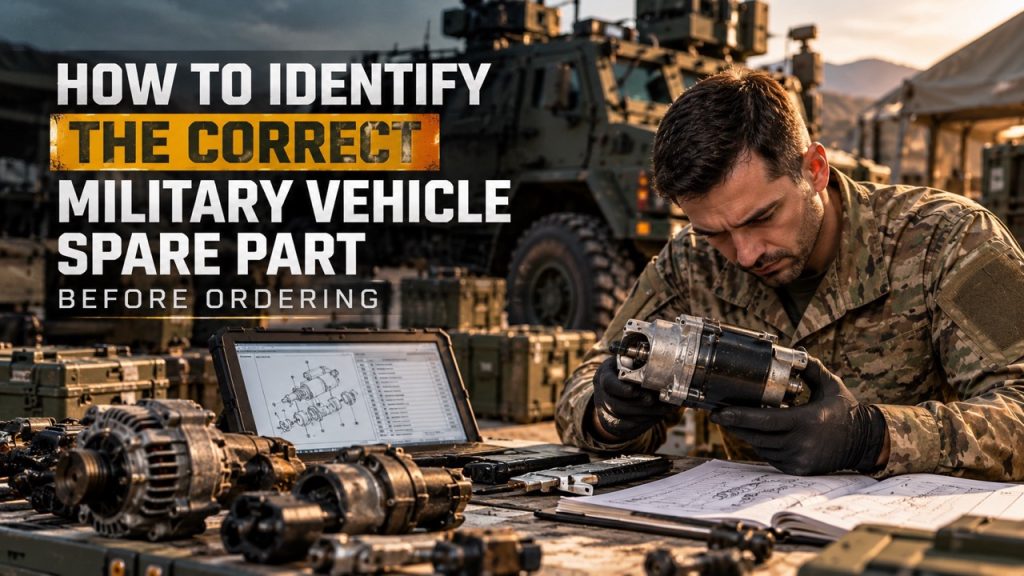
A starter motor that looks identical to the one on the workbench can still be wrong for the vehicle in the bay. It may be wound for a different voltage, carry a different mounting flange, or belong to a production run that ended before the vehicle left the factory. In military fleets, where one platform can exist in several national, contractual and upgrade configurations, a part that merely resembles the original is a risk, not a solution.
This guide explains how procurement teams, maintenance departments and fleet managers can identify a military vehicle spare part before an order is placed. The central point is simple: visual resemblance and an incomplete description are not sufficient. Reliable identification depends on configuration specific verification against authoritative identifiers and technical publications.
The principles below are general. Wherever a specific vehicle, OEM or contract is involved, the applicable OEM parts catalogue, technical manual, maintenance publication and the vehicle’s recorded configuration take priority over any general guidance, including this article.
Why Accurate Spare Part Identification Matters in Military Fleets
An incorrectly identified part rarely fails in a dramatic way at the point of ordering. The cost appears later. The component arrives, and it does not fit: the dimensions differ, the mounting arrangement is different, the connector does not match the harness, the voltage is wrong, or a left hand part has been supplied where a right hand part was needed. Pressure or flow ratings may differ from the original, a gear ratio may not match the axle it is meant to serve, or a seal may be made from a material that was never specified for the fluid it will contact.
Each of these outcomes has downstream effects. The vehicle stays out of service while a replacement is sourced again, which delays maintenance and reduces availability. Return freight, re shipment and handling add to logistics costs, and for cross border orders a rejected consignment can also mean further customs and export paperwork. Procurement lead time already spent on the wrong item is lost. Where the component is safety related, such as a brake, steering or suspension part, an unnoticed mismatch can create a hazard rather than just a delay.
Start With the Exact Vehicle Configuration
Component identification begins with the vehicle, not the component. Record the manufacturer, vehicle family, exact model and variant, production year, and the serial or chassis number. Many military vehicles do not follow a conventional civilian VIN format, so use whatever identification the vehicle actually carries: a manufacturer serial number, a chassis number, a military registration or a data plate designation.
Then record the major assemblies: engine model and serial number, transmission model, transfer case, axle models, brake system and steering system, plus any installed equipment packages. Two vehicles that look the same from outside can differ in all of these. Differences arise from production batches, customer contracts, country specific configurations and later modifications, upgrades or retrofits. A retrofit may have replaced the very assembly that the original catalogue lists.
The Most Important Part Identifiers
OEM Part Number
The OEM part number is often the most valuable single identifier because it ties the item to the manufacturer’s own drawing and catalogue. It must be recorded exactly as written. Prefixes, suffixes, revision letters and dash numbers are all part of the number, and a missing digit or suffix can point to a different component. Manufacturers use their own numbering schemes, so a number from one OEM cannot be interpreted using the logic of another. Numbers also change over time: an old number may have been superseded, so the number stamped on a worn part and the number currently used by the manufacturer are not always the same.
NSN and NIIN
A NATO Stock Number (NSN) is a 13-digit code used within the NATO Codification System to identify standardized items of supply. It has two parts. The first four digits form the NATO Supply Classification (NSC), which places the item in a general group and class. The remaining nine digits are the National Item Identification Number (NIIN): two digits identifying the National Codification Bureau (NCB) that assigned the number, followed by seven sequentially assigned digits with no inherent meaning. The United States, for example, uses NCB codes 00 and 01.
Two points need care. First, an NSN identifies an item of supply, not simply one manufacturer’s commercial part number. Within the codification record, more than one manufacturer reference number may be associated with an item, subject to the approved identification data. That does not mean any similar part from any source can be substituted; it means the item’s identity is defined by its codification data. Second, not every item used on a military vehicle has an NSN. Many components, particularly in older, export or commercially derived configurations, may never have been codified.
CAGE and NCAGE Codes
A Commercial and Government Entity (CAGE) code is a five character code that identifies an organization, typically a manufacturer or supplier, at a particular location. For entities outside the United States, the equivalent in the NATO Codification System is the NCAGE code, assigned through national codification bureaus and the NATO Support and Procurement Agency (NSPA). A CAGE or NCAGE code identifies who made or supplied something, not what the part is. Its value in identification is as a second key: when two parts carry similar numbers, the manufacturer code helps establish whose number it is and whether the reference belongs to the right source.
Serial Numbers and Vehicle Applicability
Manufacturers change designs during production. Parts catalogues record this through applicability notes, often expressed in concept as “used up to vehicle serial number XXXXX” and “used from vehicle serial number XXXXX”. These are illustrative placeholders, not real numbers. A later vehicle may need a different pump, seal, sensor, starter, alternator, brake component, steering component or transmission part from an earlier vehicle of the same model. Without the vehicle serial number, the catalogue’s applicability notes cannot be applied and the buyer is left guessing which side of the break the vehicle falls on.
Use Technical Manuals and Illustrated Parts Catalogues
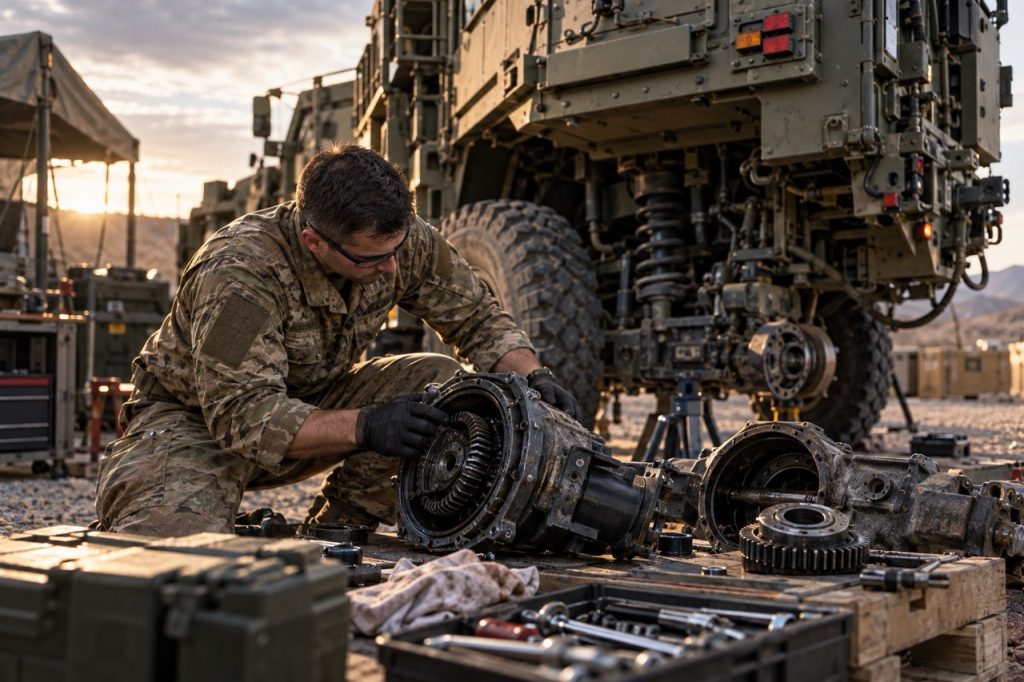
Technical publications are the reference against which every other identifier should be checked. Depending on the nation, service and manufacturer, they may be called illustrated parts catalogues, illustrated parts breakdowns, repair parts and special tools lists, maintenance manuals, technical manuals, electronic technical manuals or OEM electronic parts catalogues. These names and formats are not universal; the publication system used by one army or manufacturer cannot be assumed for another.
Whatever the format, confirm the figure number, the item number, the part number, the quantity per assembly, the installation position and any applicability notes or serial number ranges. U.S. Army repair parts and special tools lists, for example, cross reference figure and item numbers to part numbers and NSNs and use a usable on code to show which configurations an entry applies to. Read the notes; a part number appearing in the right figure may still be listed for a different configuration.
Check for Part Number Supersessions
A superseded number is one that has been replaced by another; the replacement may be called the service replacement or the current number, and the old number is then regarded as obsolete. Supersession is a statement by the controlling authority, usually the OEM, about a relationship between two numbers. It does not automatically mean that every installation condition is identical. A replacement may require a modified mounting, a different connector, an additional adapter or a companion part, or it may be valid only from a given serial number. Confirm the relationship in OEM bulletins, updated catalogues or official cross reference documentation rather than assuming it from a search result.
Never Assume Interchangeability
Several terms are often used loosely and should be kept apart. A part may have a similar appearance without being functionally equivalent. It may have equivalent function without being a direct replacement in a particular installation. A direct replacement may fit without being formally interchangeable under the applicable technical documentation. An approved substitute is one that the responsible authority has accepted for a defined use, and a modified replacement is a part that needs rework or additional components to work.
Dimensions and photographs cannot establish any of these relationships. Interchangeability is a documented engineering and configuration control decision. Where a military customer applies its own interchangeability or substitution rules, those rules, not the supplier’s judgement, define what is acceptable.
Verify the Major Assembly
The same vehicle platform may be built with different engines, transmissions, transfer cases, axles, steering systems, brake systems, cooling systems and electrical systems. A component that belongs to one of these assemblies must be identified against that assembly. Major assemblies carry their own data plates with their own model and serial information, and that information, where it exists, is often more reliable than the vehicle’s overall designation. Check the assembly that is actually installed, not the one the platform is expected to have.
Use Data Plates, Markings and Photographs
A clear photograph of a data plate often settles a question that a description cannot. Depending on the component, a plate or tag may show the manufacturer, model, part number, serial number, voltage, power rating, gear ratio, pressure rating, production code or date code. Not every plate carries all of these, and some components carry none. Stamped numbers, casting marks and labels on the body of the part may supply what the plate does not.
Useful photographs include the complete component from several sides, the identification plate, any stamped or cast numbers, connectors, mounting points, the part beside a measuring scale and the part in its installed location. These images should support documentary verification, not replace it. A photograph can show that two parts look alike. It cannot show that they are the same.
Confirm Dimensions and Technical Specifications
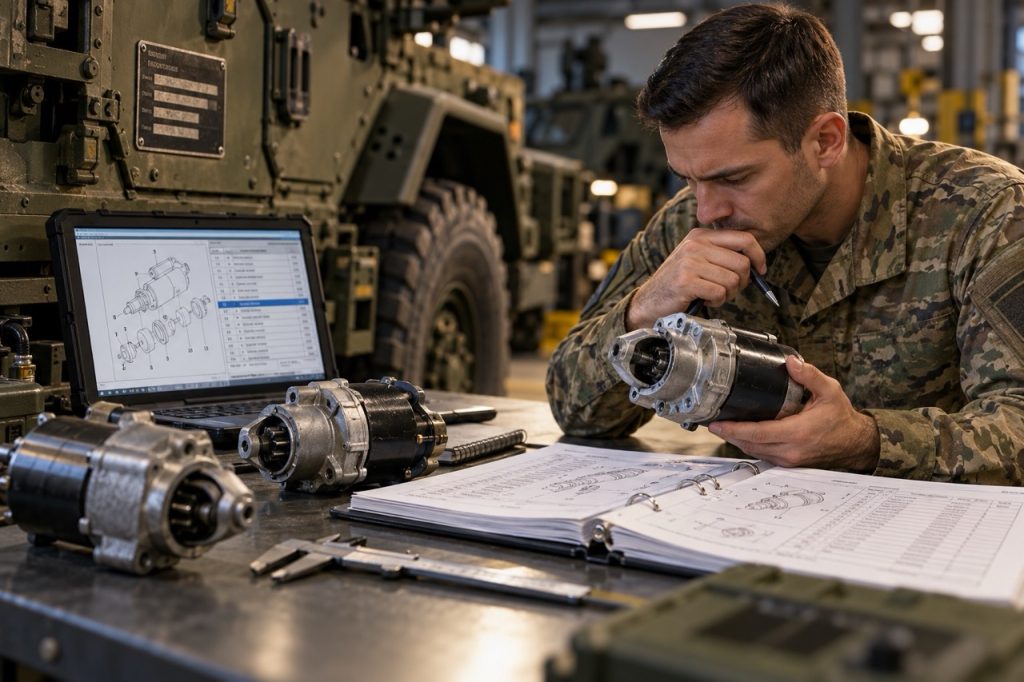
Measurements become important when identifiers are missing, illegible or in doubt. Typical checks include overall length, shaft and bore diameters, hole spacing and bolt pattern, thread size, spline count and dimensions, flange configuration, connector dimensions and seal diameter. Use calibrated instruments and record the units. Dimensional agreement is a necessary check but never a sufficient one: two parts can share every outer dimension and still differ in internal clearances, materials, ratings or tolerances.
Left-hand and right-hand variants deserve a separate check. Steering parts, suspension components, brake components, hub assemblies, body panels and lighting equipment are commonly handed. Terms such as left and right should be read according to the OEM’s or the publication’s own convention, which may be defined from the driver’s seat, from the front of the vehicle or by reference to a figure.
Casting Number vs Orderable Part Number
Cast or forged housings often carry a number moulded or stamped into the metal. That number commonly identifies the raw casting or forging, not the finished service assembly that was machined, fitted with bearings or seals, and tested. As a general principle, a casting number, forging number or housing number should not be treated as an orderable service part number unless the manufacturer’s documentation says so. Machining variants, internal components and finishing can all differ under one casting. Check the number against the parts catalogue before it goes into a request.
Assembly, Subassembly or Repair Kit?
Procurement errors often arise from the level of the requirement rather than the identity of the part. A buyer who needs a complete assembly may order a housing; a buyer who needs a seal kit may receive a complete pump. Be explicit about whether the requirement is a complete assembly, a subassembly, a housing, an internal component, a repair kit, a seal kit or a service kit.
Terms such as repair kit, overhaul kit and seal kit do not guarantee identical contents across manufacturers or across revisions of the same kit. Where possible, obtain the official bill of materials or kit content listing and compare it with the items the repair actually needs.
Special Considerations for Electrical, Hydraulic and Mechanical Components
Electrical Components
For starter motors, alternators, relays, solenoids, sensors, control units, wiring harnesses and motors, verify the voltage, connector type, pin configuration, current or power rating, mounting arrangement and OEM number. Communication protocols matter only where they are documented for the application. Do not infer electrical specifications from a similar looking vehicle; take them from the documentation for the specific configuration.
Hydraulic and Pneumatic Components
For pumps, valves, cylinders, hoses, brake components and air-system parts, verify the documented connection and thread type, hose size, pressure rating, flow requirement where applicable, seal type and material where specified, port configuration and installation orientation. Take ratings from the documentation, not from general assumptions.
Seals, Bearings and Standard Components
Items that appear to be standard can still differ in dimensions, tolerance, load rating, speed rating, material, seal design, temperature capability, lubrication arrangement and internal clearance. A military or OEM component should not be replaced on dimensional similarity alone.
Obsolete Military Vehicle Parts and DMSMS
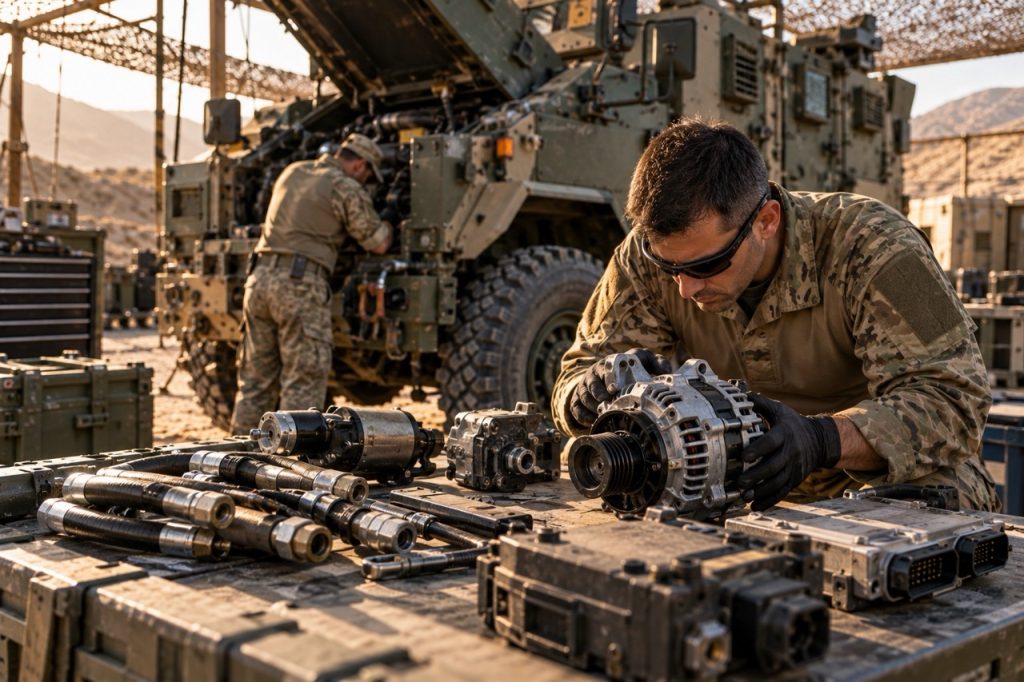
Older platforms outlive the supply chains that built them. The U.S. Department of Defense defines Diminishing Manufacturing Sources and Material Shortages (DMSMS) as the loss or impending loss of the last known manufacturer or supplier of raw material, production parts or repair parts. Legacy military vehicles may therefore depend on approved replacements, alternative manufacturers, reverse engineering, controlled substitution or remanufacture.
Terminology matters here as well. New production, OEM, original equipment (OE), new old stock (NOS), aftermarket, remanufactured and reconditioned parts are not equivalent categories, and they are not equally suitable for every application. The end user’s specifications, contract terms and technical acceptance criteria determine what is acceptable. Where engineering approval is required for a substitute, a part must not be fitted until that approval exists.
Supplier Traceability and Counterfeit Risk
Identification does not end with the number. The buyer also needs evidence that the part is what it is claimed to be. Useful evidence includes manufacturer traceability, certificates, packaging labels, lot or batch information and supplier documentation. U.S. defense acquisition rules illustrate the principle: DFARS clause 252.246-7007, which covers electronic parts, requires contractors to maintain traceability processes, including certification documentation, identification of supply chain intermediaries and, where available, manufacturer batch identification such as date codes, lot codes or serial numbers. The clause is specific to electronic parts, but the discipline applies more widely.
Packaging and preservation can also depend on correct identification. Military parts may carry preservation, packaging and marking requirements set by the contract or by applicable standards, and those requirements should be confirmed against the contract rather than assumed.
What Information Should Be Sent With an RFQ?
A complete request lets the supplier verify, not guess. Send as much of the following as is available; not every field will exist for every part:
- Vehicle manufacturer, model, variant, production year and chassis, VIN or serial information
- Engine model, transmission model and, where relevant, axle and transfer case models
- OEM part number, NSN, NIIN and manufacturer CAGE or NCAGE code if known
- Part description, quantity required and installation location
- Technical manual or catalogue reference, with figure and item number
- Photographs, including the data plate, and measured dimensions
- Markings on the old component, including previous supplier or manufacturer numbers
- Whether the requirement is OEM, equivalent or an approved alternative
A Step by Step Military Spare Part Identification Checklist
The following sequence moves from the vehicle to the purchase order. Adapt it to the publications and contract rules that apply to the fleet.
- Identify the exact vehicle configuration, including serial number and any modifications.
- Identify the relevant major assembly and read its own data plate.
- Record every number and marking on the existing component before it is cleaned or discarded.
- Check the technical manual or OEM catalogue for the figure, item and quantity.
- Verify the OEM part number exactly, including prefixes, suffixes and revision letters.
- Verify the NSN or NIIN where one exists, against the codification record.
- Check manufacturer and CAGE or NCAGE information to confirm whose number it is.
- Check serial number applicability against the catalogue notes.
- Check supersession history and confirm the installation conditions of any replacement.
- Confirm dimensions, connectors and configuration, including handing and orientation.
- Confirm the level of the requirement: assembly, component or repair kit, with the kit contents listed.
- Confirm the acceptance basis: OEM, equivalent or approved alternative, and who must approve it.
- Verify supplier traceability and documentation, then issue the purchase order only after identification is confirmed.
Illustrative Examples
The following scenarios are hypothetical and do not refer to real parts, numbers or vehicles.
- Alternators. Two alternators look identical and have the same mounting. One is rated for a different system voltage. Only the data plate or the catalogue entry shows the difference.
- Steering component. A steering arm is ordered from a photograph. The vehicle needs the opposite hand. The part fits the wrong side and cannot be used.
- Seal kit. A seal kit is ordered by pump model. The pump design changed at a serial number break, and the kit supplied belongs to the earlier design.
- Supersession. An old number is replaced by a new service number. The new part needs a different connector, which the buyer discovers only on installation.
- Casting number. A casting number stamped on a housing is quoted as the part number. The supplier ships a bare housing when a complete assembly was required.
Common Mistakes to Avoid
Several warning signs should halt an order until they are resolved: only a photograph is available; the supplier identifies the part by description alone; the part number is incomplete; the vehicle serial number is unknown; several OEM numbers appear in search results; an old number may have been superseded; voltage or connector configuration is unknown; left or right orientation is unclear; repair kit content has not been confirmed; or no traceability documentation is available. Any one of these is a reason to go back to the manual.
Correct identification is a verification process, not a lookup. Each identifier, whether an OEM number, an NSN, a CAGE code or a serial number range, answers a different question, and none of them is reliable in isolation. The publication for the specific vehicle and configuration is the arbiter.
AB Defence supplies spare parts for military land platforms, and its website describes a supply model built on documentation, traceability and Certificates of Conformance. Buyers who send a complete identification package, as outlined above, give any supplier the best chance of confirming the right part before it ships. Enquiries can be directed through the AB Defence contact page.
Work With AB Defence
Partner with AB DEFENCE for Reliable Combat Support Vehicle Sustainment. AB DEFENCE is a specialist international supplier of military spare parts and fleet sustainment solutions serving NATO and allied defense organisations. With deep inventory across a wide range of combat support vehicle platforms, rigorous quality assurance processes, export compliance expertise, and a commitment to long term supply chain partnership, AB DEFENCE helps defense buyers maintain fleet availability, reduce sustainment costs, and meet their operational readiness obligations. Contact the AB DEFENCE team to discuss your spare parts requirements, strategic inventory planning, and long-term sustainment programme needs.
Contact AB Defence to discuss your procurement requirements and learn how we can support your fleet readiness objectives.
Related Military Spare Parts Categories, Vehicle Platforms & Technical Guides
Explore AB Defence’s NATO-codified (NSN) and genuine OEM spare parts catalog, platform technical specifications, and sustainment engineering guides related to this article:
Stocked Spare Parts Categories (NSN & OEM Catalog)
- NATO Standard Defence Components & Military Hardware (12,993 stocked parts)
- M60 Tank Spare Parts (M60A1 / M60A3 / M60T) (497 stocked parts)
- M109 Self-Propelled Howitzer Spare Parts (585 stocked parts)
- BMC Kirpi MRAP Spare Parts (Kirpi I & Kirpi II) (597 stocked parts)
- Mercedes-Benz Unimog Military Spare Parts (562 stocked parts)
- Full NATO NSN & OEM Spare Parts Catalog (16,760+ Parts)
Compatible Vehicle Platforms & System Hubs
- Platforms
- Product Groups
- Quality
- Capabilities
- Tracked Armoured Vehicles
- Request a B2B Quotation (RFQ) & Technical Support