October 5, 2026
Military Vehicle Cooling Systems: Common Failures, Maintenance and Spare Parts
1. Why Cooling System Reliability Matters
A diesel engine converts only part of its fuel energy into useful work. The rest must be removed as heat, and the cooling system is the main way that happens. When it cannot keep up, the consequences escalate from reduced engine output to damage to the cylinder head, gaskets and other components that are expensive to repair and slow to replace.
For a military fleet, that translates directly into availability. A vehicle that overheats is not available until the cause is diagnosed and corrected, and some cooling system conditions are serious enough to be written into maintenance tables as grounds for classing a vehicle as not fully mission capable. The HMMWV unit level maintenance table, for example, lists a coolant leak of a stated severity class among the conditions that leave the vehicle not fully mission capable.
Cooling faults also tend to compound. A weeping hose, a partly blocked radiator or a tired fan drive may each be tolerable on its own; together, on a hot day under load, they can push an engine past its limits. That is why cooling system maintenance is a readiness issue as much as a mechanical one, and why choosing the right replacement part matters: a component that physically fits but does not match the original’s flow, pressure, temperature or material requirements can introduce a new fault rather than remove one.
Scope note. This article covers general principles and commonly encountered failure modes. Coolant specifications, test limits, component layouts and service intervals differ between vehicles and engines. Where an example is taken from a specific manual, it is identified as such and should not be read as a universal rule. The applicable OEM technical manual or military maintenance manual always takes precedence.
2. How a Military Vehicle Cooling System Works
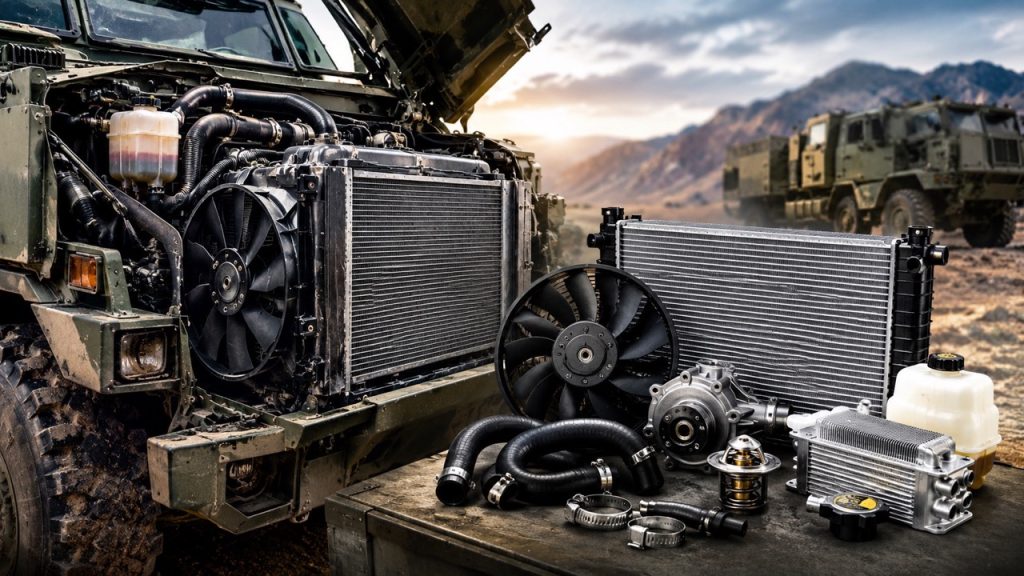
In a liquid cooled engine, a water pump circulates coolant through passages in the block and cylinder head, where it absorbs heat. The hot coolant flows to the radiator, which transfers that heat to the air passing through its core. A thermostat regulates flow so the engine reaches and holds its intended operating temperature. A fan increases airflow when vehicle motion alone does not provide enough, such as at idle or low speed under load.
The system is pressurised. The pressure cap sets the pressure limit and allows coolant to move to and from an expansion or surge tank as it expands and contracts. Higher system pressure raises the coolant’s boiling point, so a cap that fails to hold pressure reduces the margin against boiling. This is why military manuals repeatedly warn against opening the cap on a hot engine.
| Component | Role | Design dependent points |
| Radiator and core | Transfers heat from coolant to air | Core type, size and mounting differ by platform |
| Coolant | Carries heat; protects against freezing, boiling and corrosion | Type and additive chemistry are engine and service specific |
| Water pump | Circulates coolant | Belt, gear or other drive; integrated or separate |
| Thermostat | Regulates flow to control temperature | Opening temperature is engine specific |
| Fan, fan drive, shroud | Moves air through the radiator; shroud directs it | Mechanical, hydraulic or electric drive; clutch or control logic varies |
| Hoses, pipes, clamps | Connect the circuit | Moulded or fabricated; clamp type varies |
| Expansion/surge/degas tank, pressure cap | Manage expansion, venting and system pressure | Cap rating is system-specific |
| Sensors and controls | Report temperature; command the fan | Gauge, sender, switches, modules or ECU logic |
| Oil coolers; charge air coolers, heat exchangers | Remove heat from other fluids or intake air | Fitted where the engine or driveline requires; may share the radiator package |
The exact configuration depends on the vehicle and engine design. On the HMMWV, for instance, the engine and transmission oil coolers are mounted on the radiator, so cleaning or removing one affects the other. Other platforms use different packaging, so always work from the manual for the vehicle in front of you.
3. Common Cooling System Failures
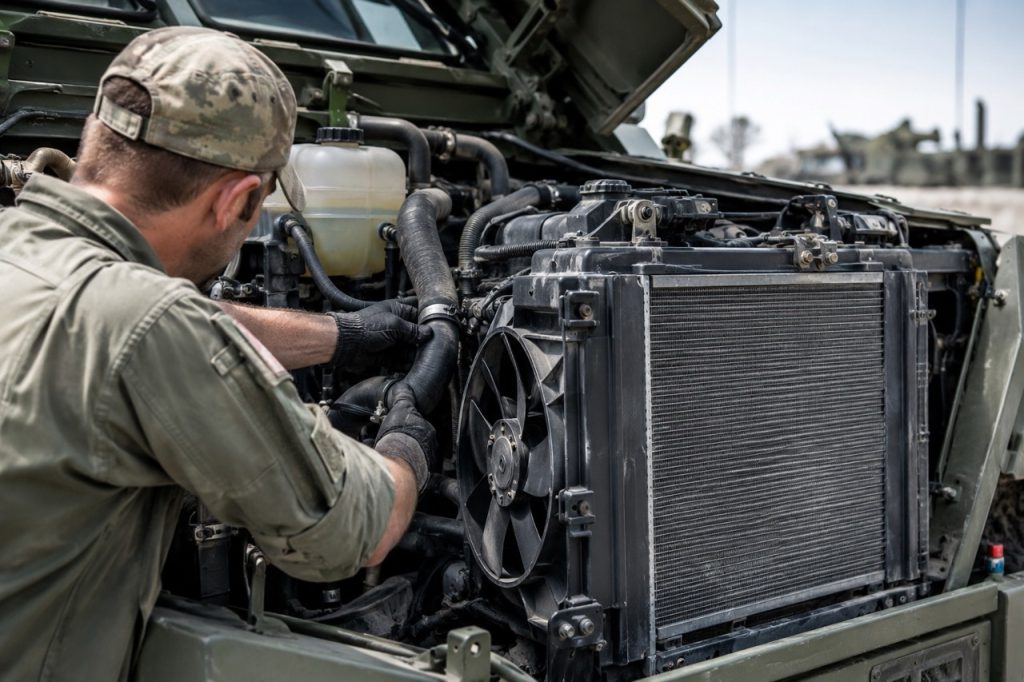
The failure modes below are widely encountered in heavy duty liquid cooled engines. How often each occurs, and how it presents, varies by platform, climate and use.
Coolant leakage and deteriorated hoses
Causes: age, heat cycling, vibration, chafing, chemical attack, loose or damaged clamps, and cracked fittings. Symptoms: residue or drips, a falling level in the coolant tank, hoses that feel soft, swollen, hardened or cracked. Implications: hoses and clamps belong in every scheduled inspection. If ignored: a small leak becomes coolant loss, and a hose that fails under pressure can empty the system quickly and release hot coolant and steam.
Radiator blockage, fouling and damage
Causes: external dust, mud, debris and bent fins restrict airflow; internal scale and corrosion products restrict coolant flow; impact can crush or crack the core. Symptoms: temperature that climbs under load or in high ambient heat, or uneven heat across the core. Implications: cleaning must be done carefully. The HMMWV maintenance manual describes removing debris from radiator and oil cooler fins with water and compressed air, and cautions that high pressure water can damage the cooler and radiator. If ignored: progressive loss of cooling margin, and in some cases repair at a higher maintenance level, as the same manual’s diagnostic text directs for radiator repair.
Fan and fan drive failure
Causes: clutch or hydraulic drive faults, failed control switches or solenoids, broken blades, damaged shrouds, slipping drive belts. Symptoms: overheating at idle or low speed, a fan that does not engage at its set temperature, abnormal noise. Implications: diagnose the control, the drive and the mechanical parts separately. The M1083 series manual’s cooling flowchart, for example, treats the temperature gauge and sender, the belt and the fan clutch or timer as separate checks. If ignored: cooling capacity is lost exactly when load and ambient heat are highest.
Water pump wear or failure
Causes: bearing wear, seal failure, impeller erosion or corrosion, drive belt problems. Symptoms: leakage at the pump, bearing noise, poor circulation despite a sound radiator. Implications: inspect the pump area for leaks and play at every scheduled check. If ignored: circulation loss can lead to rapid overheating.
Thermostat malfunction
A thermostat stuck closed restricts circulation and causes overheating; one stuck open can cause slow warm up and an engine that runs cooler than intended. Opening temperature is engine specific, so a replacement must match the specification.
Pressure cap failure
A worn seal or weak spring lets pressure escape, lowering the boiling margin and leading to boil over and coolant loss. A cap with the wrong rating can also overstress hoses and the radiator. Military manuals include cap checks in their diagnostic procedures; the HMMWV manual’s cooling reference, for example, directs a check of the seal and spring on the pressure cap.
Coolant contamination, incorrect coolant, corrosion and deposits
Causes: the wrong coolant type, incompatible mixing, wrong concentration, depleted inhibitors, poor quality water, or oil and other fluids entering the system. Symptoms: rusty, dirty or oily coolant, scale, and failed coolant tests. Implications: coolant requirements are engine and service specific. Cummins, for example, specifies coolant standards by engine family, and its maintenance sheet for at least one engine (the ISX) states that supplemental coolant additives are required. The US Army’s TB 750-651 sets its own testing and mixing rules for Army coolants, including nitrite testing for corrosion protection. If ignored: corrosion and scale reduce heat transfer and damage components.
Sensor and control problems
A faulty sender, gauge or wiring fault can show a false reading or fail to command the fan. Verify real coolant temperature before replacing hardware: the M1083 flowchart starts by confirming the gauge and sender.
Overheating from multiple or secondary faults
Overheating is a symptom, and it often has more than one cause. Repeated overheating after a repair suggests the root cause has not been found. A fault outside the cooling circuit, such as combustion gases entering the coolant, can also present as overheating or unusual system pressure.
4. Maintenance Practices
Good cooling system maintenance is mostly disciplined inspection. Military manuals structure it by who performs the check and when. For the HMMWV, operator level checks include confirming coolant level in the coolant tank before operation and not opening the radiator cap on a recently operated engine. Unit level checks include testing coolant condition against TB 750-651, inspecting the surge tank, radiator shroud and coolers, and cleaning radiator and oil cooler cores as needed.
- Visual and leak inspection: hoses, clamps, joints, pump area, radiator seams, tank, and the ground beneath the vehicle.
- Coolant level and condition: check level with the system cold, and test condition. Never open the cap on a hot, pressurised system.
- Correct coolant: use the specified type and concentration. The Army’s TB 750-651 says not to add 100% antifreeze directly to a radiator, and describes a separate arctic type coolant used at full strength.
- Radiator and airflow: inspect fins, shroud and surrounding structure for blockage or damage; clean using the method the manual allows.
- Fan, fan drive and belts: check engagement, mounting, condition and drive.
- Water pump and thermostat: inspect for leakage, noise and play; test or replace per the manual.
- Pressure cap and pressure testing: inspect the seal and spring and test the system where the manual specifies.
- Records: log coolant tests, top ups, replacements and recurring faults, so repeat problems are visible.
Intervals are platform specific. Cummins’ own maintenance sheets give different coolant test and service recommendations for different engine families, and refer users to a separate service bulletin for extended intervals. No universal interval can be stated. Follow the OEM or military manual for the vehicle.
5. The Military Operating Environment
Demanding conditions do not change how a cooling system works, but they change how fast margins are used up. The following are general engineering principles, not claims about specific platforms or operating procedures.
- Dust, sand, mud and debris coat radiator fins and restrict airflow, reducing heat rejection.
- High ambient temperature reduces the temperature difference between coolant and air, so the radiator has less margin to reject heat.
- Heavy loads and sustained operation raise heat output and keep the system near its limits for longer.
- Vibration fatigues hoses, brackets, clamps and radiator mountings.
- Corrosive environments accelerate corrosion of fins, fittings and fasteners.
- Long storage can age coolant, harden hoses and dry out seals. Inspect and test before returning a vehicle to service.
- Field maintenance raises the risk of using the wrong coolant, topping up with unsuitable fluid or contaminating the system.
- Cold climates call for different coolant protection. TB 750-651 describes one approach for arctic conditions, which is service specific.
6. Cooling System Spare Parts
Commonly replaced or serviceable parts include radiators and cores, water pumps, thermostats, coolant hoses and clamps, fan assemblies and fan drives, belts, expansion or degas tanks, pressure caps, temperature sensors, seals and gaskets, oil coolers and heat exchangers. They look simple, but correct identification is where many sourcing errors begin.
Identify a part using as many of these references as the documentation allows:
- OEM part number and the applicable manual’s parts listing.
- Engine model and engine serial number; vehicle model and configuration.
- NSN where one exists (see below).
- Dimensions, connection type and material.
- Pressure rating, where applicable.
- Voltage and electrical or control characteristics for sensors, switches and electric fans.
An NSN is a 13 digit NATO Stock Number: a four digit NATO Supply Class and a nine digit item identification number whose first two digits identify the codifying country. Codification is carried out under the NATO Codification System. An NSN identifies an item of supply, but it should still be checked against the vehicle’s parts documentation. Configuration differences within one platform can change which item applies.
7. Troubleshooting
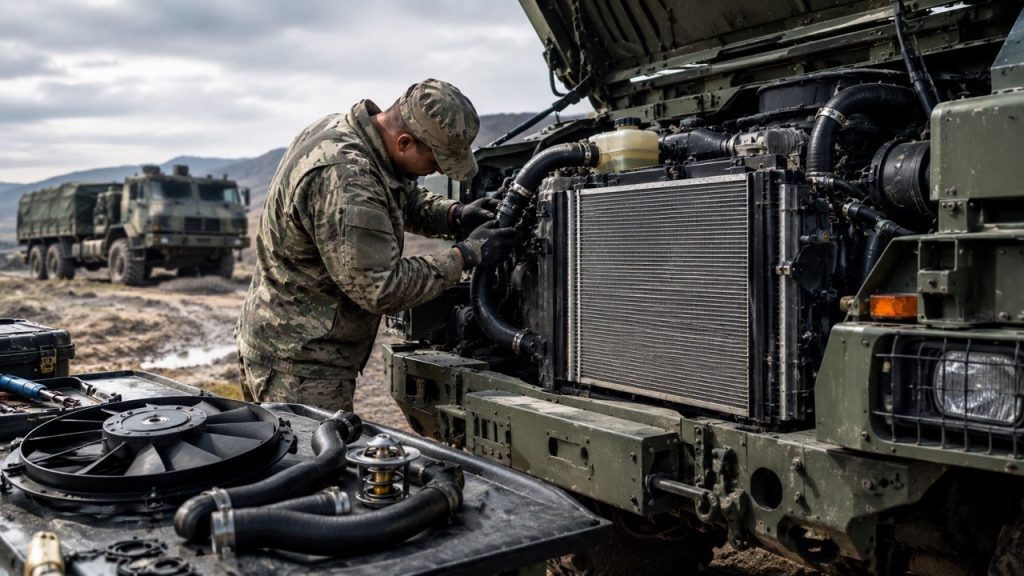
Troubleshooting must follow the applicable technical manual and safety procedures, including depressurising the system before opening it. The table gives general orientation only.
| Symptom | Possible cause | Inspection / action |
| Engine overheating | Low coolant, blocked radiator, fan fault, stuck thermostat, pump failure, cap fault | Check level and leaks; inspect airflow and fan; follow the manual’s diagnostic flowchart |
| Coolant loss | External leak, cap not holding pressure, boil over, internal leak | Inspect hoses, clamps, pump, radiator and cap; pressure test where specified |
| Temperature fluctuations | Thermostat sticking, air in system, sender or gauge fault, intermittent fan control | Verify actual temperature; check thermostat, bleeding and the sensor circuit |
| Poor coolant circulation | Pump wear, internal blockage, thermostat closed, air lock | Check pump and drive; inspect for blockage; confirm filling and bleeding procedure |
| Restricted radiator airflow | Debris on fins, bent fins, damaged shroud, obstruction | Inspect and clean as the manual allows; avoid high pressure water on the core |
| Cooling fan problems | Drive or clutch fault, control switch or module fault, belt slip, damaged blades | Check engagement, controls, belt and mounting separately |
| Water pump noise | Bearing wear, loose or worn drive belt, misalignment | Inspect pump, belt and tensioner; replace per manual |
| Excessive coolant pressure | Over rated cap, blocked vent or overflow path, combustion gas entering coolant | Check cap rating and vent lines; investigate engine side causes |
| Repeated overheating | Root cause not found; more than one fault | Re inspect the full system; check coolant condition and records |
8. Preventive Maintenance Checklist
- Coolant: level correct (system cold), correct type, condition tested, no contamination.
- Hoses and clamps: no cracks, swelling, softness, chafing or seepage; clamps secure.
- Radiator: no leaks, damage or blockage; fins straight and clean.
- Fan and fan drive: secure, undamaged, engaging correctly; belts in good condition.
- Water pump: no leakage, noise or play.
- Thermostat: operating per specification.
- Expansion/degas tank and pressure cap: no cracks or leaks; cap seal and spring in good condition.
- Sensors: readings plausible; wiring and connectors sound.
- Leaks, airflow, corrosion, contamination: all checked and recorded.
- Maintenance records: updated, with test results and any repeat faults.
9. Spare Parts Procurement Considerations
Buyers sourcing cooling system parts for military vehicles should work from a verified part identification, not from appearance alone.
- Identification and OEM reference: confirm the OEM part number against the vehicle’s parts documentation.
- Cross reference and NSN verification: verify cross references to the original item and check that any NSN applies to the exact configuration.
- Compatibility: confirm vehicle and engine compatibility, including variants.
- Material and dimensions: check material quality and dimensional accuracy, especially for hoses, caps and core connections.
- Pressure and temperature: confirm pressure and temperature ratings match the original requirement.
- Traceability and documentation: ask for supplier traceability and supporting documentation, so the part’s origin can be shown.
- Quality control: ask what inspection and quality checks apply before shipment.
- Packaging and storage: rubber and elastomer parts need suitable packaging and storage to avoid deterioration before use.
Where a part has no NSN or verified OEM number, procurement should rely on drawings, dimensions and specifications rather than assumptions.
10. Conclusion
Cooling system reliability underpins engine reliability, and engine reliability underpins vehicle availability. Preventive maintenance catches the slow faults, such as leaks, fouling and coolant degradation, before they become failures. Correct diagnosis matters because overheating usually has more than one contributing cause, and replacing the wrong part wastes time. Correct part identification, backed by traceable and technically compatible spares, is what keeps a repaired cooling system reliable. In every case, the vehicle’s own technical manual is the final authority.
Work With AB Defence
Partner with AB DEFENCE for Reliable Combat Support Vehicle Sustainment. AB DEFENCE is a specialist international supplier of military spare parts and fleet sustainment solutions serving NATO and allied defense organisations. With deep inventory across a wide range of combat support vehicle platforms, rigorous quality assurance processes, export compliance expertise, and a commitment to long term supply chain partnership, AB DEFENCE helps defense buyers maintain fleet availability, reduce sustainment costs, and meet their operational readiness obligations. Contact the AB DEFENCE team to discuss your spare parts requirements, strategic inventory planning, and long-term sustainment programme needs.
Contact AB Defence to discuss your procurement requirements and learn how we can support your fleet readiness objectives.
Related Military Spare Parts Categories, Vehicle Platforms & Technical Guides
Explore AB Defence’s NATO-codified (NSN) and genuine OEM spare parts catalog, platform technical specifications, and sustainment engineering guides related to this article:
Stocked Spare Parts Categories (NSN & OEM Catalog)
- Military Engine Cooling Systems, Radiators & Water Pumps (57 stocked parts)
- Military Vehicle Engines & Complete Power Assemblies (154 stocked parts)
- Military Engine Internal Components & Overhaul Parts (104 stocked parts)
- Military Air, Oil, Fuel & Hydraulic Filters (34 stocked parts)
- Military Fuel Injection Pumps, Injectors & Fuel Control (64 stocked parts)
- Full NATO NSN & OEM Spare Parts Catalog (16,760+ Parts)
Compatible Vehicle Platforms & System Hubs
- Engine & Powertrain Systems
- Filtration & Fluid Systems
- MTU Engine Series
- ALCO Diesel Engines
- Railway & Industrial Engines
- Request a B2B Quotation (RFQ) & Technical Support